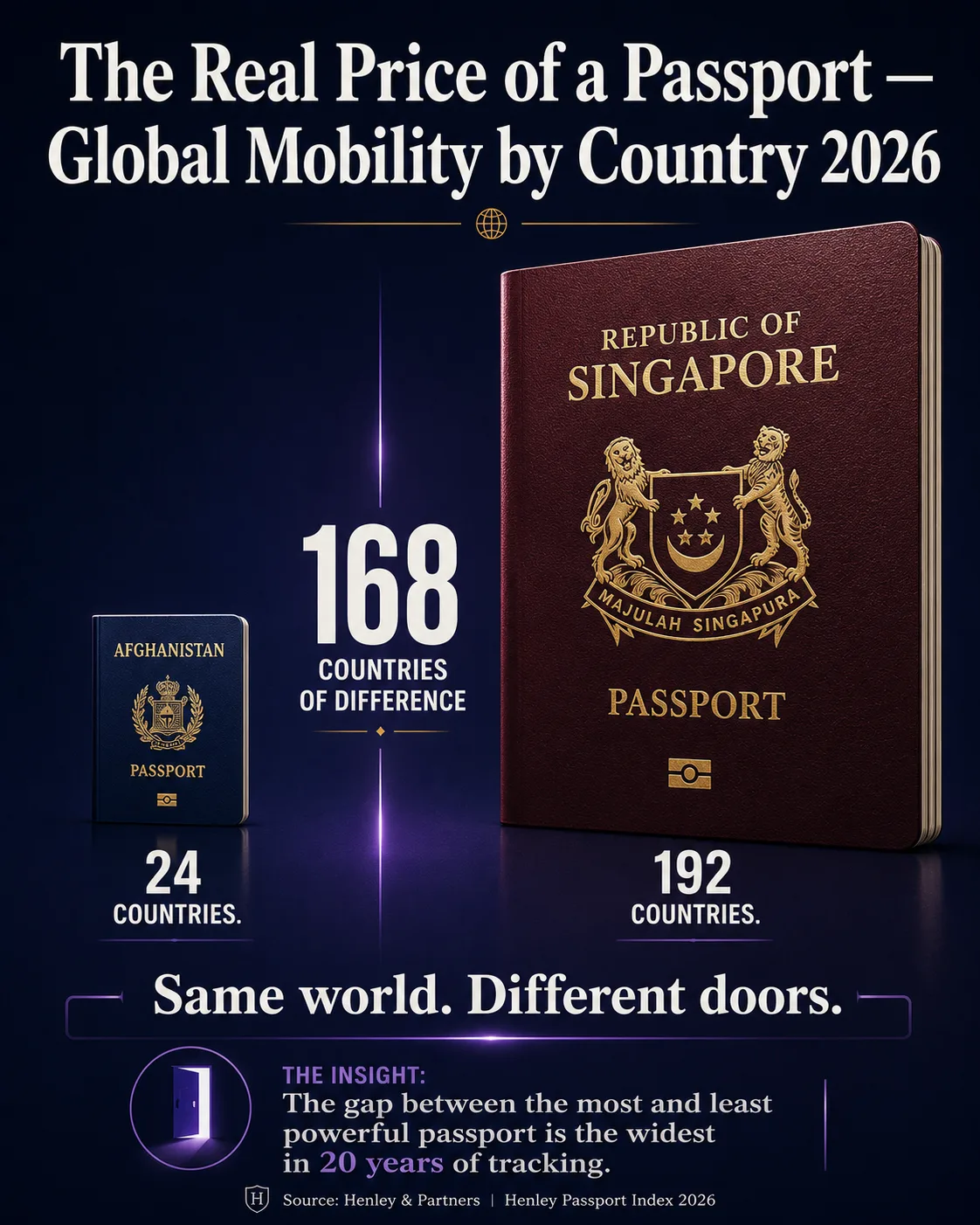
The Real Price of a Passport —
Global Mobility by Country 2026
Singapore’s passport opens 192 countries without a visa. Afghanistan’s opens 24. The gap between them — 168 destinations — is the widest in 20 years of tracking, and it has been growing every year. The United States, which held the world’s most powerful passport as recently as 2014, has fallen to 10th place, with 37 countries now outranking it. The UAE has added 149 destinations since 2006 — the most dramatic rise in the index’s history. And for those unhappy with the passport they were born with, a second one is available from $90,000. What your passport lets you do — and what it costs to upgrade — is one of the defining inequalities of the modern world.
- The gap between the world’s strongest and weakest passports is the widest ever recorded. In 2026, Singapore’s passport opens 192 countries. Afghanistan’s opens 24. The 168-destination gap is the largest in the 20-year history of the Henley Passport Index (primary, January 2026). In 2006, when the index began, the gap between the then-top-ranked US passport and Afghanistan was 118 destinations. In two decades, the divide has grown by 50 destinations — meaning the world’s most and least mobile citizens are further apart than ever, even as global travel has expanded overall.
- The United States has experienced one of the sharpest passport power declines in modern history. In 2014, the US held the most powerful passport in the world jointly with the UK. By January 2026, it ranked 10th — with 37 countries outranking it despite its top-10 position. It lost 7 visa-free destinations in the past 12 months alone, and briefly fell out of the top 10 for the first time in the index’s history in late 2025. The Henley report identifies it as the third-largest ranking decline in the index’s 20-year history, after Venezuela and Vanuatu. The primary driver is reciprocity: as the US imposes stricter entry requirements on foreign nationals, other countries remove visa-free access for Americans in return.
- The UAE has achieved the most dramatic passport rise in the index’s 20-year history. From a ranking of approximately 65th in 2006, the UAE has risen to become the first Arab-majority country to break into the global top tier, adding 149 visa-free destinations since 2006 — the largest gain in the index’s history — and climbing 57 places in the rankings, according to CNN’s reporting of the January 2026 Henley data. The mechanism was deliberate and systematic: sustained diplomatic engagement and bilateral visa-liberalisation agreements across Africa, Asia, and Latin America over two decades.
- Passport inequality is structurally embedded in how the global visa system was built. The Global Citizen Solutions Global Passport Report 2026 finds that all 20 of the most privileged passports (those that receive the most visa-free access) belong to OECD members or high-income economies, while all 20 of the most generous countries (those that grant the most visa-free access to others) are lower-income states. There is a nine-fold gap between the access that African passport holders receive in Europe and the access that European passport holders receive in Africa. As the report notes: this is not a coincidence but “a structural feature of how the modern visa system was constructed.”
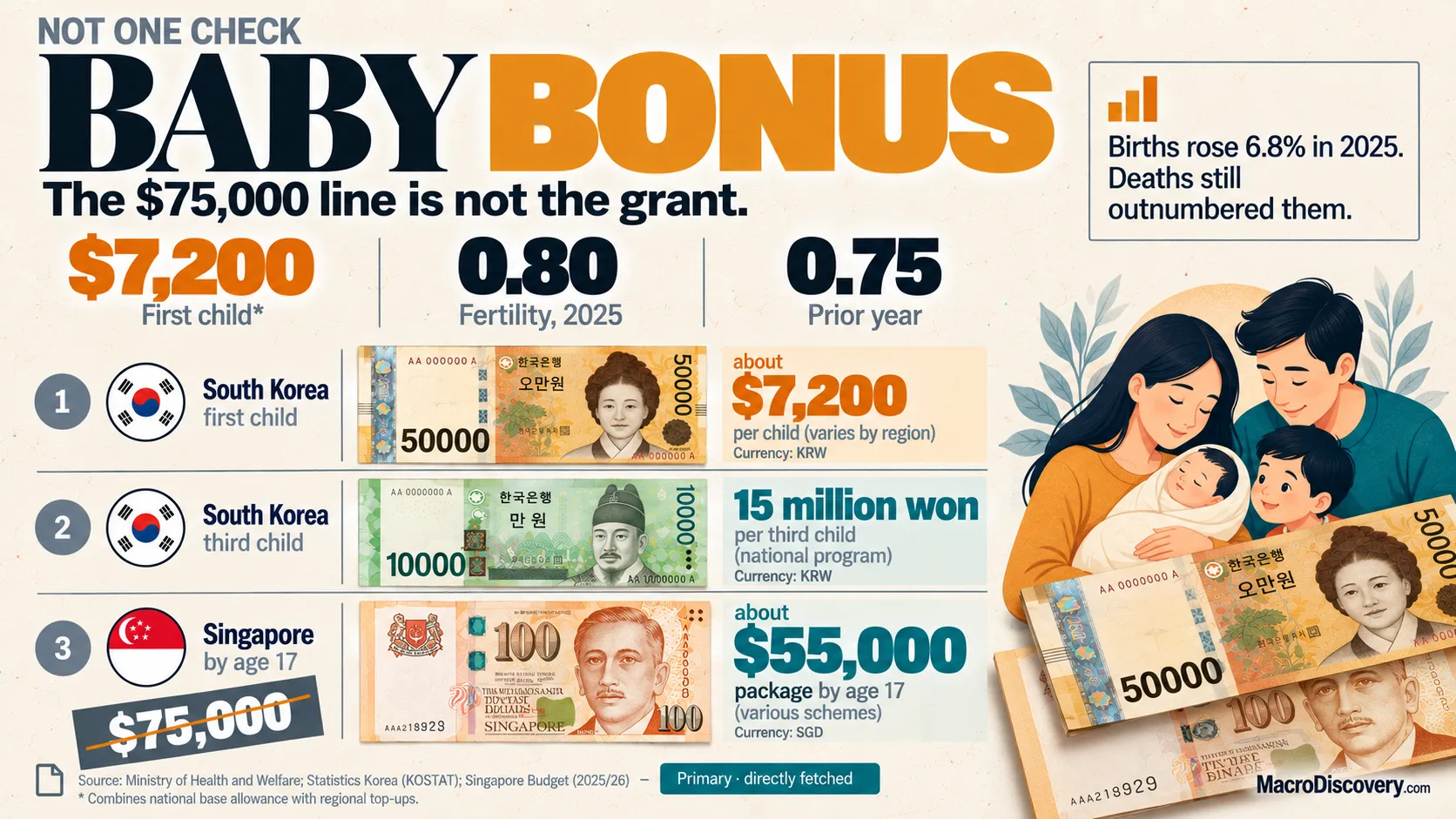
- A second passport is now a mainstream wealth-management tool — starting at $90,000. Citizenship by investment (CBI) programmes in São Tomé & Príncipe and Nauru currently offer the lowest entry point at $90,000 per passport. Caribbean programmes (the established global standard) range from $200,000 (Dominica) to $250,000 (St Kitts & Nevis). Turkey requires a $400,000 real estate investment. EU citizenship via Malta requires €690,000 or more plus eight months of residency. US nationals now represent the single largest nationality group applying for alternative citizenship — 30% of Henley & Partners’ entire CBI client base — with applications 67% higher in Q3 2025 than the full year 2024.
Source: Henley & Partners — Henley Global Mobility Report (primary · directly fetched · January 13, 2026 · henleyglobal.com/newsroom/press-releases/henley-global-mobility-report-january-2026). Data from IATA Timatic (exclusive). Directly confirmed from primary: Singapore 192 · Japan & South Korea 188 · Denmark, Luxembourg, Spain, Sweden, Switzerland 186 (3rd) · “unprecedented group of 10 European countries tied 4th” · UK 182 (7th, steepest YoY loss) · Canada, Iceland, Lithuania 181 (8th) · Malaysia 180 (9th) · US 179 (10th) · Afghanistan 24 (last) · Syria 26 · Iraq 29. UAE position (top 10 area, first Arab-majority country in elite tier) confirmed via CNN Jan 2026 primary. India 56 destinations from MonkeyTravel 2026. Bar lengths proportional to destination count, anchored at Singapore 192.
| Country | 2006 rank (approx) | 2026 rank | Destinations gained/lost | Direction | Key driver |
|---|---|---|---|---|---|
🇦🇪 UAEUnited Arab Emirates |
~65th (approx) | Top 10 | +149 | ▲▲▲ Greatest rise in history | “Sustained diplomatic engagement and visa liberalization” (CNN/Henley). First Arab-majority country in elite global tier. +57 places. |
🇺🇸 United StatesUS passport |
#1 (2006–2014) | 10th | −7 (YoY) | ▼ 3rd-largest decline in history | Fell from joint #1 (2014) to #10. “Third-largest ranking decline over 20 years after Venezuela and Vanuatu.” Fell 6 places from 4th to 10th. Reciprocity: US visa tightening triggers counter-restrictions. |
🇬🇧 United KingdomPost-Brexit |
#1 (2015) | 7th | −8 (YoY) | ▼ Steepest year-on-year losses | UK fell from #1 in 2015 to #7 in 2026. Brexit removed EU free movement — the right to live and work across 27 countries — a major real-world mobility reduction not fully captured in Henley score. −8 destinations in 12 months: “steepest YoY losses” (CNN/Henley 2026). |
🇰🇷 South KoreaAsia rise |
Lower tier | #2 (joint) | +significant | ▲▲ Major rise | Decades of bilateral agreements, particularly with Latin American and African nations. Now joint 2nd at 188 destinations with Japan. |
🇯🇵 JapanAsia leadership |
Mid-tier 2006 | #2 (joint) | +major | ▲▲ Asia dominance | Held #1 multiple times in 2010s. In 2025, Japan regained visa-free access to China for the first time since the pandemic — a significant diplomatic development. Now tied 2nd at 188. |
🇷🇺 RussiaSanctions impact |
Mid-upper tier | Lower tier | Declined | ▼ Geopolitical decline | Russia and Belarus declined due to geopolitical tensions and war-related sanctions following 2022 Ukraine invasion. Multiple countries imposed visa requirements on Russian citizens in response. |
🇦🇫 AfghanistanPerennial bottom |
Very bottom | #101 (last) | 24 | ▼ Perennially last | Has ranked last for multiple consecutive years. 24 visa-free destinations. Taliban governance since 2021 has deepened international isolation. Gap to Singapore: 168 destinations (record). |
Sources: Henley Global Mobility Report (primary · directly fetched · January 13, 2026) · CNN World Report (January 13, 2026) · IAS Services 2026 analysis · immigrationworld.com 2026 (MonkeyTravel 2026 analysis). UAE “+149 destinations since 2006 · climbing 57 places” confirmed from CNN primary citing Henley. US “third-largest ranking decline after Venezuela and Vanuatu” from CNN Jan 2026 primary. UK “steepest year-on-year losses” and “−8 destinations in 12 months” confirmed from CNN and Henley primary. Click column headers to sort.
| Country / Programme | Min. investment 2026 | Processing time | Visa-free destinations | Key notes |
|---|---|---|---|---|
🇸🇹 São Tomé & PríncipeGulf of Guinea · cheapest globally |
$90,000 | 3–5 months | ~85–90 | Non-refundable donation to National Transformation Fund. Cheapest CBI globally. CPLP membership = pathway to eventual Portuguese/Brazilian citizenship. Limited track record (newer programme). |
🇳🇷 NauruPacific · promotional rate |
$90,000* | 3–5 months | 85+ | *Promotional rate until June 30, 2026 (normally $115,000–150,000). Includes UK visa-free access — unusual at this price point. Launched 2024; limited track record. Nauru is famously also the world’s most obese country (61%). |
🇻🇺 VanuatuPacific · fastest timeline |
$130,000 | 30–60 days | 90+ | Fastest CBI programme globally — passport in 30 days. Visa-free to Singapore and Hong Kong. Lost Schengen visa-free access. Requires in-person biometrics since Nov 2025. Zero income tax jurisdiction. |
🇩🇲 DominicaCaribbean · cheapest Caribbean |
$200,000 | 3–4 months | 140+ | Lowest-cost Caribbean CBI. Schengen + EU visa-free. Does NOT include UK visa-free. Minimum raised from lower threshold in July 2024 Caribbean MoA (all 5 nations aligned). Solid track record. |
🇦🇬 Antigua & BarbudaCaribbean |
$230,000 | 4–6 months | 150+ | Family-friendly: $230,000 covers a family of four. 5-day visit required within first 5 years. Schengen + UK visa-free. Strong institutional track record. |
🇬🇩 GrenadaCaribbean · unique US access |
$235,000 | 4–6 months | 140+ | Only Caribbean CBI with US E-2 Investor Visa Treaty — allows citizens to live and run a business in the US legally. Visa-free to Schengen, UK, China, India, Russia simultaneously. Unique combination. |
🇰🇳 St Kitts & NevisWorld’s oldest CBI · 1984 |
$250,000 | 45–60 days* | 157 | World’s oldest running CBI programme (since 1984). *Accelerated Application Process (AAP): 45 days. Strongest passport of Caribbean programmes. Requires in-person biometrics. Highest bankability among Caribbean programmes. |
🇹🇷 TurkeyReal estate route |
$400,000 | 3–6 months | ~110 | $400,000 real estate investment (genuine property market). US E-2 eligible. No EU access but strong regional reach. No ongoing residency requirement. Geopolitically significant straddling Europe and Asia. |
🇲🇹 MaltaEU citizenship · by Merit only |
€690,000+ | 12–36 months | 185 | EU Court ruling (April 2025) ended Malta’s standard CBI programme. Now “Citizenship by Merit” only — reserved for exceptional contributions to Malta or humanity. Not available to ordinary investors. EU + Schengen access. |
🇦🇹 AustriaExceptional merit · most powerful EU |
€2M+ | Highly discretionary | 185 | Not a standard investment programme — requires “extraordinary achievements benefiting Austria.” Perfect mobility score: 185 destinations (EU + Schengen). Most powerful EU passport available but almost never granted. EU passport: highest global mobility. |
Sources: immigrantinvest.com (June 2026 · CBI pricing data · confirmed across multiple 2026 sources) · immigrationworld.com (2026) · Henley & Partners CBI page (2026 confirmed programmes) · wheretoemigrate.io (March 2026 · programme comparison) · astons.com (March 2026) · globalresidenceindex.com (2026) · nzgoldenvisa.com (May 2026). Caribbean July 2024 Memorandum of Agreement (5-country alignment to $200,000+ minimum) confirmed from multiple sources. Malta CBI ended April 2025 after EU Court of Justice ruling; now “Citizenship by Merit” only (confirmed). Spain closed 2025 · Ireland 2023 · UK 2022 · Netherlands 2024. Prices are minimum investment only and exclude legal fees, due-diligence charges, and family member costs. Click column headers to sort.
Why Has the Passport Power Gap Grown to Its Widest Point in History?
The 168-destination gap between Singapore and Afghanistan in 2026 is not simply the result of one country improving and another declining. It reflects two simultaneous trends that are pulling in opposite directions: a clustering of strong passports at the top of the Henley index as wealthy nations have negotiated visa liberalisation with each other, and a deepening isolation of the weakest passports at the bottom as those same nations have tightened entry requirements for citizens of politically unstable or economically weak states.
In 2006, when the Henley Passport Index began systematic tracking, the gap between the then-top-ranked US passport and Afghanistan was 118 destinations. In 20 years, that gap has grown by 50 destinations — despite the fact that global travel has expanded dramatically over the same period. Dr. Christian H. Kaelin, chairman of Henley & Partners and creator of the index, frames it precisely: “Rising average access masking a reality in which mobility advantages are increasingly concentrated among the world’s most economically powerful and politically stable nations.” The average passport is getting stronger — but the gap between the strongest and weakest is getting wider simultaneously.
The structural mechanism is well-established: visa liberalisation agreements are negotiated bilaterally, and they tend to happen between countries with comparable economic power, diplomatic credibility, and security trust. The EU’s Schengen zone and the US Visa Waiver Program both grant broad reciprocal access among high-income, politically stable nations while maintaining strict requirements for citizens of lower-income or politically unstable ones. The Global Citizen Solutions Global Passport Report 2026 identifies this as structural rather than coincidental: all 20 of the world’s most privileged passports belong to OECD members or high-income economies, and the hierarchy it reflects is one that was designed — not accidentally produced — by the modern international visa system.
Why Has the US Passport Fallen So Far — and Is the UK the Biggest Loser?
The decline of the US passport from joint first place in 2014 to tenth place in 2026 is among the most significant geopolitical mobility stories of the past decade. It is not principally a story about the US becoming less diplomatically powerful in an absolute sense. It is a story about reciprocity: the mechanism by which countries that impose strict entry requirements on foreign nationals find that other countries impose equivalent requirements on their own citizens in return.
As the United States has tightened its visa and entry requirements for citizens of numerous countries — a trend accelerating through 2024 and 2025 — those countries have responded by removing or restricting visa-free access for American passport holders. The US also faces a structural challenge: the Visa Waiver Program, which allows citizens of 42 allied nations to enter the US without a prior visa, is under pressure from proposals that would require extensive biometric and personal data submission as a condition of maintaining the programme. The Henley report cites an Atlantic Council assessment warning these proposals risk enabling “real-time ideological screening.” If implemented, the likely response from partner countries would be further erosion of US visa-free access globally.
The United Kingdom’s decline is of a different character. The UK recorded the steepest year-on-year losses of any country in the 2026 Henley index, losing 8 visa-free destinations in 12 months — taking it from 5th to 7th place, having held the top position as recently as 2015. Brexit removed a benefit not fully visible in the Henley score: the right of UK citizens to live, work, and retire freely across all 27 EU member states. That right — effectively an additional 27 countries of unrestricted access — disappeared with EU membership. The Henley score counts visa-free entry for tourism, not the right of residency; the full mobility loss from Brexit is therefore larger than the ranking decline suggests.
US: 1st (2014) → 10th (2026)
— 37 countries now outrank the US despite its 10th-place listing
— Lost 7 visa-free destinations in the past 12 months
— Briefly dropped out of the top 10 in late 2025 (first time in index history)
— “Third-largest ranking decline over 20 years, after Venezuela and Vanuatu” (Henley/CNN)
— US nationals are now Henley’s largest single CBI client group (30%)
— CBI applications from US nationals 67% higher in Q3 2025 vs full year 2024
UK: 1st (2015) → 7th (2026)
— “Steepest year-on-year losses” of any country in 2026 (−8 destinations in 12 months)
— Brexit removed free movement across 27 EU countries — not fully reflected in Henley score
The primary driver for both is reciprocity: tightening entry requirements for others leads to tightening requirements for your own citizens. Sources: Henley primary (Jan 13, 2026) · CNN Jan 2026.
How Did the UAE Gain 149 Destinations in 20 Years — and What Can Others Learn?
The United Arab Emirates holds the record for the greatest improvement in passport power in the 20-year history of the Henley Passport Index. Starting from approximately 65th place in 2006, the UAE has risen to become the first Arab-majority country to break into the global elite tier, adding 149 visa-free destinations and climbing approximately 57 places in the rankings, according to CNN’s reporting of the January 2026 data. In practical terms, UAE passport holders can now access roughly 83% of the world’s countries without obtaining a visa in advance — a level of freedom unimaginable for an Arab-majority nation two decades ago.
The mechanism was not accidental. The UAE pursued what Henley describes as “sustained diplomatic engagement and visa liberalisation” — systematically negotiating bilateral agreements with countries across Africa, Asia, and Latin America, often in conjunction with economic investment relationships, development aid, and diplomatic relationship-building. The UAE invested heavily in being a trusted diplomatic partner to governments across the developing world, and the visa agreements followed. This is the opposite of how most wealthy countries approach passport power: they wait for visa liberalisation as a consequence of status rather than actively engineering it as a diplomatic objective.
The UAE’s rise demonstrates that passport power is not a fixed function of national wealth or historical status — it is a diplomatic achievement that can be deliberately pursued. South Korea’s rise to joint second in 2026 reflects the same principle: decades of expanded trade relationships and bilateral agreements with countries that previously had limited engagement with Korea. Japan’s regaining of visa-free access to China in 2025, for the first time since the pandemic, illustrates how a single diplomatic development can add a country of 1.4 billion people to one’s visa-free portfolio. Passport power, in the modern era, is a measure of how many countries trust you — and trust, unlike wealth, can be actively cultivated.
Who Is Buying Second Passports — and How Much Does It Cost?
Citizenship by investment (CBI) has transformed from an obscure legal mechanism used by a handful of ultra-wealthy families into a mainstream financial planning and mobility tool, with more than 55,000 individuals acquiring second passports through economic citizenship pathways in the past decade, generating over $5.2 billion in foreign direct investment for host countries. In 2026, approximately 25 countries operate CBI or residency-by-investment programmes of some kind, though fewer than 15 are widely used and fully open. Several high-profile programmes have closed: Spain in 2025, Ireland in 2023, the UK in 2022, and the Netherlands in 2024. Malta’s standard CBI programme was terminated by an EU Court of Justice ruling in April 2025 and replaced with a discretionary “Citizenship by Merit” pathway available only to those demonstrating exceptional contributions to Malta or humanity.
The cheapest entry point is currently São Tomé & Príncipe and Nauru, both at $90,000 via non-refundable government donation. Vanuatu offers the fastest timeline at 30–60 days for $130,000, though it lost Schengen visa-free access and requires in-person biometrics since November 2025. Caribbean programmes — historically the global standard for CBI — now start at $200,000 following a July 2024 Memorandum of Agreement among the five Caribbean CBI nations (Dominica, Grenada, Antigua & Barbuda, St Lucia, St Kitts & Nevis) to align their minimum thresholds. Turkey requires a $400,000 real estate investment. EU citizenship, the most powerful outcome, now effectively requires the Malta merit pathway (highly discretionary, €690,000+) or the Austrian merit route (essentially never granted to non-exceptional cases).
The most significant trend in the CBI market is the shift in who is buying. US nationals are now the single largest nationality group applying for alternative citizenship globally — 30% of Henley & Partners’ entire CBI client base, with applications 67% higher in Q3 2025 compared to the full year 2024. The motivations are a mixture of passport power anxiety (as the US ranking declines and reciprocity restrictions increase), tax planning, and what the industry calls “Plan B” security — a physical and legal backup option for political or economic instability. The Global Citizen Solutions Global Citizenship Programs Index 2026 identifies a new phenomenon: high-net-worth families are no longer purchasing a single second passport but constructing “citizenship portfolios” of multiple jurisdictions calibrated for mobility, tax residence, and geopolitical risk.
Entry level ($90,000–$130,000): São Tomé, Nauru, Vanuatu. These programmes open 85–90 destinations — useful for Asia-Pacific travel but no Schengen access (Vanuatu lost it). Faster and cheaper but with limited track records and lower bankability among international banks.
Caribbean standard ($200,000–$250,000): The established global benchmark. 140–157 visa-free destinations including Schengen. Dominica is cheapest; St Kitts is oldest and most trusted; Grenada uniquely adds US E-2 Investor Visa Treaty access. Family inclusion typically adds $25,000–$50,000 per dependent.
Turkey ($400,000 real estate): Genuine property market, US E-2 eligible, no EU access. Strong regional position between Europe and Asia.
EU citizenship (€690,000+): Most powerful outcome (185 destinations, full EU residency rights) but now only via Malta’s merit pathway or Austria’s exceptional merit route — neither is available to ordinary investors.
Hidden costs: All programmes charge separate legal fees, due-diligence fees ($5,000–$20,000), and government processing fees on top of the investment minimum. Total cost is typically 15–25% higher than the headline investment figure. Sources: Multiple 2026 CBI programme sources confirmed (see sources section).
What Does Passport Inequality Mean for Billions of People Who Cannot Buy Their Way Out?
The citizenship-by-investment industry, whatever its merits for individual buyers, addresses the passport inequality problem for a small and already-privileged group. The Henley index’s January 2026 data shows that the 168-destination gap between Singapore and Afghanistan is the result of a system in which your birthplace determines your mobility for life — and that gap is growing wider in every edition of the index. For the billions of people holding passports in the lower half of the global rankings, the option of purchasing an alternative citizenship is not available. A $90,000 minimum investment is out of reach for the vast majority of Afghan, Syrian, Iraqi, Pakistani, or Yemeni citizens whose passports grant the least access.
The structural analysis from the Global Citizen Solutions Global Passport Report 2026 is unsparing: all 20 of the world’s most privileged passports belong to OECD members or high-income economies. All 20 of the most generous countries — those granting the most visa-free access to foreign visitors — are lower-income states. There is a nine-fold gap between the openness that African passport holders receive in Europe and the openness that European passport holders receive in Africa. As the report states: “The instruments are newer; the hierarchy is older.” The expansion of visa-free zones, electronic travel authorisations, and digital nomad visas has created new vocabulary of liberalisation while changing the underlying distribution of mobility privilege very little.
IATA Director General Willie Walsh, quoted in the Henley primary press release, identifies the core tension of the current moment: “A record number of people are expected to travel in 2026. The unequivocal economic and social benefits generated by this travel grow as it becomes more accessible. But while more people have the economic freedom to travel, many nationalities are seeing that a passport alone is no longer sufficient to cross borders.” The paradox of 2026 is that travel has never been more physically accessible —5.2 billion airline passengers expected this year — while the document that determines who can travel freely has never been more stratified. The world is more connected than ever. Access to that connection is more unequal than ever.
This framing is more precise than “passport power reflects wealth.” Wealth matters, but what visa-free agreements actually measure is trust — the bilateral belief that citizens of Country A arriving in Country B will comply with the terms of their visit and return home. Countries whose citizens are perceived as likely to overstay, work illegally, or apply for asylum tend to face stricter requirements. Countries whose citizens are perceived as trustworthy, low-risk tourists with strong reasons to return home face fewer.
This trust is shaped by GDP (wealthy citizens have more reason to return) but also by governance, rule of law, political stability, and diplomatic relationships. The UAE’s dramatic rise shows trust can be built through deliberate diplomacy. The US decline shows it can be eroded through policy choices that reduce that trust asymmetrically — making it harder for others to enter, which causes them to reciprocate. Passport power is not a fixed attribute of nations. It is a dynamic measure of their standing in the international system.
Sources: Henley Global Mobility Report 2026 (primary · directly fetched) · Global Citizen Solutions Global Passport Report 2026.
- Henley & Partners — “A Growing Passport Divide Reshapes Global Mobility in 2026” (primary · directly fetched · January 13, 2026 · Singapore 192 · Japan + South Korea 188 · DK/LU/ES/SE/CH 186 · 10 European tie 4th · Afghanistan 24 · 168-destination gap · 118 in 2006 · Kaelin quote · IATA Walsh quote · 5.2B passengers 2026)
- CNN — “The world’s most powerful passports for 2026” (January 13, 2026 · UK 182 steepest YoY loss −8 · US 179 rank 10 back in top 10 · 37 countries outrank US · UAE +149 destinations since 2006 +57 places · “first Arab-majority country to break into global top 10” · US nationals 30% Henley CBI business · Misha Glenny quote · US lost 7 destinations YoY · US “third-largest decline after Venezuela and Vanuatu”)
- Global Citizen Solutions — Global Passport Report 2026 (July 2026 · “nine-fold gap” Africa↔Europe · all 20 most privileged = OECD/high-income · all 20 most generous = lower-income states · “structural feature of how modern visa system was constructed” · “instruments are newer; hierarchy is older”)
- AFAR — “The 2026 World’s Most Powerful Passport Rankings” (updated July 2026 · Henley basis · Afghanistan 24 last · Syria 26 · Iraq 29 · US 179 rank 10 · 37 countries outrank US · US “third-largest decline” · Canada/Iceland/Lithuania 181 8th · UK 182 7th)
- Immigration World — “Passport Rankings 2026: Most Powerful & Weakest Passports” (May 2026 · Henley basis · 168-destination gap record · UAE +149 since 2006 · US decline analysis · UK steepest losses · US nationals 21% investment migration applications · Q3 2025 +67%)
- IAS Services — “Most Powerful Passport in the World: 2026 Rankings” (March 2026 · Henley basis · Singapore 192 · Japan + SK + UAE second · Sweden 3rd 186 · Belgium/DK/FI/FR/DE/IE/IT/LU/NL/NO/ES/CH 4th 185 · UK 6th 182 · Afghanistan last 24 · Syria 26 · Iraq 29)
- Immigrant Invest — “Cheapest Citizenship by Investment Options in 2026” (June 2026 · São Tomé $90,000 · Nauru $90,000 promo · Vanuatu $130,000 · Dominica $200,000 · Antigua $230,000 · Grenada $235,000 · St Lucia $240,000 · St Kitts $250,000 · Caribbean MoA July 2024)
- WhereToEmigrate — “Citizenship by Investment 2026: Complete CBI Guide” (March 2026 · $5.2B FDI total · 55,000+ passports past decade · 11 programmes compared · Malta EU Court ruling April 2025 · Turkey $400,000 · St Kitts AAP 45 days · processing times)
- Henley & Partners — Citizenship by Investment Programmes (2026 · active programme list · due-diligence requirements · “cheapest options: São Tomé and Nauru from ~$90,000–130,000” · dual citizenship guidance · 11 programmes with Henley due-diligence clearance)
- Wikipedia — Henley Passport Index (June 2026 · comprehensive index history · US 2014 top rank · UK 2015 top rank · UAE rise confirmed · Singapore #1 2024–2026 · methodology confirmed IATA Timatic)