How Wars End —
Every Major Conflict Since 1900
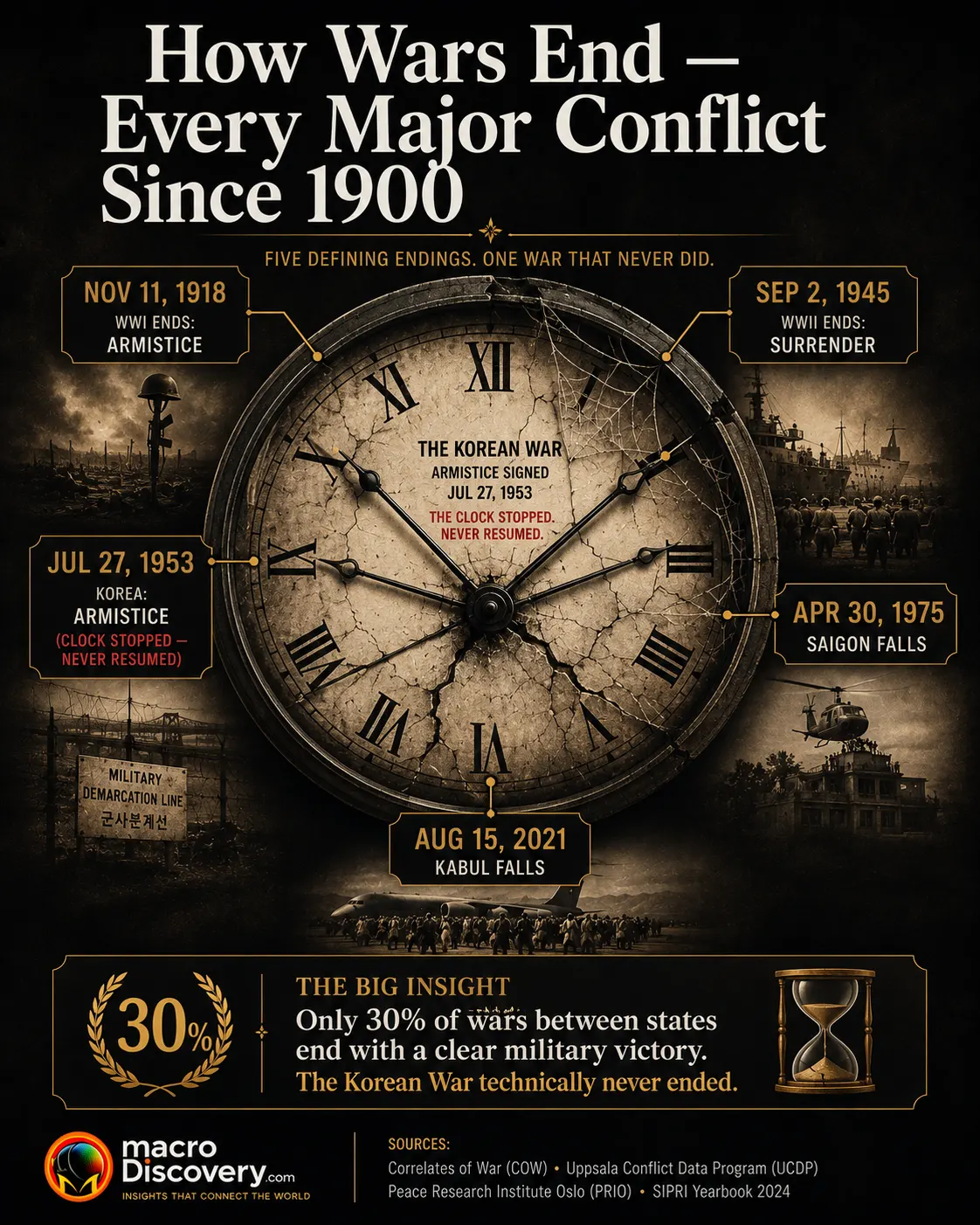
Only 30% of wars between states end with a clear military victory by either side. Forty percent end without any formal agreement at all. The Korean War is technically still happening — its 1953 armistice was never followed by a peace treaty. Afghanistan lasted 20 years and ended with the Taliban winning anyway. World War II’s decisive unconditional surrender, the image most people carry in their heads, is the exception so rare it has not been repeated in 80 years. Here is the data on how every major conflict since 1900 actually ended — and what it means for the wars still ongoing today.
- World War II’s decisive unconditional surrender is not the template for how wars end — it is the historic exception. Data from the Uppsala Conflict Data Program shows only 30% of interstate wars end with a clear military victory by either side. Sixty-six percent end in some form of compromise. The image of V-J Day — total defeat, formal surrender, unambiguous outcome — has not been replicated in any major war in the eight decades since 1945.
- Forty percent of all wars end without any formal agreement. They simply stop — through mutual exhaustion, declining violence, or de facto disengagement. No treaty, no armistice, no formal declaration. The conflict often does not end so much as decline to lower levels of violence. This is not a failure of diplomacy; it is the most common outcome in the historical record.
- The Korean War is the defining modern example of a “frozen conflict.” The armistice of July 27, 1953 halted the fighting — but no peace treaty has ever followed in 73 years. North and South Korea remain technically at war. The 38th parallel became one of the most militarised borders on earth. The Korean case established the template for frozen conflicts that would follow: Cyprus (1974), Kashmir (ongoing), and the unresolved territorial disputes seeded by almost every ceasefire agreement that stops fighting without resolving the underlying political question.
- Superpower withdrawal from asymmetric wars has consistently produced reversal of military gains. The United States spent 20 years in Afghanistan, lost approximately 2,400 military personnel, and spent over $2 trillion. The Taliban retook Kabul within weeks of withdrawal. The US spent 20 years in Vietnam, withdrew under a 1973 peace agreement, and the North captured Saigon in 1975. The pattern is consistent: military occupation can suppress an insurgency for years or decades, but withdrawal transfers control back to the force that has deeper local legitimacy and staying power.
- The factors that determine how wars end have been consistent across a century. Dan Reiter’s research at Emory University (Princeton University Press, 2009) identifies two central variables: information about the balance of military power — what each side learns from battlefield outcomes — and credibility of commitment — whether either side believes the other will honour a peace settlement. When both sides have accurate information and credible commitment mechanisms, negotiations succeed. When one or both are missing, wars continue or produce ceasefires that last only until conditions change.
Sources: CSIS — “Peace, Ceasefire or Stalemate? How Wars End and the Road Ahead for Ukraine” (November 8, 2024 · primary · directly fetched · Benjamin Jensen + Jose M. Macias III · CSIS Futures Lab). Data source: Uppsala Conflict Data Program (UCDP). SIPRI Yearbook 2001 (primary) — “When major armed conflicts have subsided or ended in recent years, this has been the result of negotiation, not victory.” Note: percentages address different subsets of conflicts and do not sum to 100% — 40% “no formal agreement” and 66% “some compromise” overlap with victory cases depending on classification. All figures are from UCDP-based analysis.
| # | Termination Type | How it works | Historical examples | Durability |
|---|---|---|---|---|
| 1 | Military VictoryDecisive |
One side defeats the other militarily — by capturing territory, destroying forces, or occupying the capital — and the loser accepts defeat. | WWII (Allied victory over Germany + Japan) · Falklands (UK over Argentina) · Gulf War (coalition over Iraq for Kuwait) | High durability when total. Lower when partial (Gulf War left Saddam in place → Iraq War 2003). |
| 2 | Negotiated SettlementPolitical |
Both sides reach a political agreement that resolves (or defers) the underlying dispute, usually with international mediation. | Dayton Accords (Bosnia 1995) · Good Friday Agreement (Northern Ireland 1998) · Mozambique (1992) | Variable. Requires both sides to accept terms as better than continued fighting. Often fragile in early years. |
| 3 | Armistice / Frozen ConflictUnresolved |
Fighting stops under a ceasefire or armistice but no political resolution occurs. The conflict is “frozen” — active violence ends, underlying dispute remains. | Korean War (1953 armistice · still frozen) · Cyprus (1974) · Nagorno-Karabakh (multiple ceasefires) · Iran-Iraq War (1988) | Fragile. Can reignite when conditions change. Korea has lasted 73 years; most frozen conflicts eventually thaw. |
| 4 | One Side Abandons the WarWithdrawal |
One belligerent unilaterally withdraws or disengages — often due to war weariness, domestic political pressure, or resource exhaustion — without achieving stated goals. | Vietnam (US withdrawal 1973 → North Vietnam wins 1975) · Afghanistan (US/NATO withdrawal 2021 → Taliban wins) · Soviet-Afghan War (USSR withdrew 1989) | Often produces reversal of military gains. The remaining side achieves de facto victory. Withdrawal rarely ends the underlying conflict. |
| 5 | Internal CollapseImplosion |
A belligerent’s government, military, or society collapses from internal pressure — revolution, economic failure, military mutiny — rather than direct battlefield defeat. | WWI Germany (November Revolution 1918 forced armistice) · Soviet withdrawal from WWI (1917 revolution) · Austro-Hungarian Empire (1918 collapse) | Rapid but often produces political instability and future conflicts. Germany’s 1918 collapse seeded the “stab in the back” myth that contributed to WWII. |
Framework: Fred Iklé — “Every War Must End” (Columbia University Press, 1971; revised 2005). Updated by Small Wars Journal (April 2026) applying Iklé’s taxonomy to 21st-century conflicts. Dan Reiter — “How Wars End” (Princeton University Press, 2009/2010) provides the academic bargaining framework: war termination depends on (1) information about the balance of power and resolve, and (2) credibility of commitment to abide by a peace settlement. Click column headers to sort.
| War | Years | Duration | Est. Deaths | How it ended | Outcome type |
|---|---|---|---|---|---|
World War IAllied Powers vs Central Powers |
1914–1918 | 4 yrs | ~20M+ | German internal revolution (Nov 1918) forced armistice Nov 11, 1918. Treaty of Versailles June 1919 followed. Germany did not formally surrender militarily — it collapsed internally. | Allied Victory + Collapse |
Russian Civil WarBolsheviks vs White Army + Allies |
1917–1922 | 5 yrs | ~5-9M | Red Army achieved complete military victory. White Army forces collapsed, foreign intervention withdrew. Bolshevik government consolidated control. Rare civil war total victory. | Military Victory |
World War IIAllies vs Axis Powers |
1939–1945 | 6 yrs | ~70-85M | Germany: unconditional surrender May 8, 1945 (V-E Day). Japan: unconditional surrender Sep 2, 1945 (V-J Day) after atomic bombings of Hiroshima and Nagasaki. Total military and political destruction of both Axis states. The template never repeated. | Total Allied Victory |
Chinese Civil WarCommunists vs Nationalists |
1927–1949 | 22 yrs | ~1-2M | Communist (PLA) military victory. Nationalist government fled to Taiwan. PRC founded Oct 1, 1949. Taiwan remains unrecognised by PRC — the conflict’s legal status is still disputed. | Communist Victory Unresolved Taiwan |
Korean WarUN/South Korea vs North Korea/China |
1950–1953 | 3 yrs | ~3-5M | Armistice signed July 27, 1953. No peace treaty has ever been signed in 73 years. DMZ created at 38th parallel. US deaths: ~36,500 in-theater (54,246 worldwide including non-combat). Technically still at war. | Frozen Conflict |
Vietnam WarUS/South Vietnam vs North Vietnam/Viet Cong |
1955–1975 | 20 yrs | ~3.5M+ | Paris Peace Accords Jan 1973: US withdrew. North Vietnam continued fighting. Saigon fell April 30, 1975. North Vietnam unified the country. US deaths: 58,281 (VA data). Classic superpower withdrawal → reversal outcome. | N. Vietnam Victory US Withdrawal |
Soviet-Afghan WarUSSR vs Afghan Mujahideen |
1979–1989 | 10 yrs | ~1-2M | USSR withdrew February 15, 1989 after 10 years of fighting and approximately 15,000 Soviet deaths. The Afghan government it supported collapsed in 1992. Mujahideen victory — followed by Taliban rise. | Soviet Withdrawal |
Falklands WarUK vs Argentina |
1982 | 74 days | ~900 | Argentine forces surrendered June 14, 1982. UK retook the islands. Clear, rapid, decisive military victory. No ongoing dispute about sovereignty outcome — Argentina never formally renounced its claim, but the military conflict ended conclusively. | UK Military Victory |
Iran-Iraq WarIran vs Iraq |
1980–1988 | 8 yrs | ~500K-1M | UN Security Council Resolution 598 led to ceasefire August 20, 1988. Essentially no territorial change from pre-war borders. Neither side achieved stated objectives. Iraq declared victory; Iran accepted “poisoned chalice” of ceasefire (Khomeini’s words). | Stalemate / Ceasefire |
Gulf WarUS-led coalition vs Iraq |
1990–1991 | 7 months | ~25-35K+ | Coalition launched Operation Desert Storm January 1991. Ground war lasted 100 hours. Ceasefire Feb 28, 1991. Kuwait liberated. Saddam Hussein remained in power — the limited objective left the root cause unresolved, requiring the Iraq War in 2003. US deaths: 258. | Limited Victory |
Bosnian WarBosnia vs Serb/Croat forces |
1992–1995 | 3.5 yrs | ~100-200K | Dayton Accords signed November 1995 in Dayton, Ohio. NATO air campaign (Operation Deliberate Force) tipped the military balance. International mediation forced negotiated settlement. Bosnia divided between two entities. Classic internationally-mediated negotiation. | Negotiated Settlement |
Iraq WarUS-led coalition vs Iraq / insurgency |
2003–2011 | ~8 yrs | ~200K-1M+ | Initial invasion achieved rapid regime change (Saddam captured December 2003). Subsequent insurgency lasted years. US combat operations ended September 1, 2010. US withdrawal December 2011. ISIS emerged from the power vacuum in 2013-2014. US deaths: ~4,500. | US Withdrawal |
War in AfghanistanUS/NATO vs Taliban/Al-Qaeda |
2001–2021 | 20 yrs | ~176K+ | US/NATO withdrawal completed August 30, 2021. Kabul fell to Taliban August 15, 2021 — two weeks before US forces left. Taliban restored full control within weeks. Longest US war in history. US deaths: approximately 2,400. $2+ trillion spent. Pre-war government restored. | US Withdrawal Taliban Victory |
Russo-Ukrainian WarRussia vs Ukraine |
2022– | 3+ yrs | 100Ks est. | Russia invaded February 24, 2022. Neither side has achieved stated objectives. Russia controls approximately 20% of Ukraine’s territory but failed to capture Kyiv, Kharkiv, or Odesa. Historical pattern: stalemate/ceasefire is most likely outcome. Status: ONGOING. | Ongoing |
Israel-Gaza WarIsrael vs Hamas |
2023– | 2+ yrs | 50K+ Gaza | Hamas attack October 7, 2023. Israeli military campaign ongoing. Complex asymmetric conflict involving hostages, humanitarian crisis, regional escalation. Political end-state undefined. Status: ONGOING. | Ongoing |
Sources: Imperial War Museum Timeline (187M deaths 1900-present) · Our World in Data “War and Peace” (citing UCDP — WWI 7M+ military / WWII 21M+ combatant deaths / 75% of all war deaths since 1800 = WWI+WWII) · US Department of Veterans Affairs “America’s Wars” (US casualty data confirmed) · Congress.gov CRS Report RL32492 (Korean War 36,500 in-theater / 54,246 worldwide · Vietnam 58,281 · Gulf War 258) · Costs of War Project (Afghanistan ~176K+ deaths · ~$2 trillion+) · UCDP (ongoing conflict data). Death estimates are ranges from multiple sources and should be treated as approximations — historical casualty counts are contested. Click column headers to sort.
Why Is the WWII Template So Misleading About How Wars Actually End?
The image most people carry of how a war ends comes from September 2, 1945: General Douglas MacArthur standing on the deck of the USS Missouri as Japanese officials signed the instrument of surrender. Or from the celebrations of V-E Day on May 8, 1945, when Germany’s unconditional capitulation was announced. Total war, total victory, formal surrender, clear outcome. The problem is that this template has not been replicated in any major conflict in the 80 years since. It was the exception, not the rule — even historically. The circumstances that produced WWII’s decisive outcomes were unusual and have not since been reproduced.
Those circumstances included: complete military encirclement and collapse of the losing states, with no territory from which to continue fighting; the explicit Allied policy of demanding unconditional surrender, which removed any incentive to negotiate; the political delegitimisation of the losing governments through their association with genocide and total war; and the atomic bomb, which confronted Japan with the prospect of unlimited destruction without requiring an invasion. Remove any one of these factors and the outcome would likely have been a negotiated armistice — as WWI produced in 1918 despite Germany’s military defeat.
The data from the Uppsala Conflict Data Program, analysed by CSIS researchers in November 2024, confirms how unusual the WWII outcome was: only 30% of interstate wars end with a clear military victory by either side. The vast majority end in some form of compromise — stalemate, frozen ceasefire, or negotiated settlement that reflects the balance of military power at the time of stopping rather than the complete defeat of one side. Wars, in the historical record, tend to end when both sides calculate that the costs of continuing outweigh the benefits of the best available settlement — not when one side is destroyed.
What Is a “Frozen Conflict” — and Why Does Korea Matter 73 Years Later?
On July 27, 1953, representatives of the United Nations Command, the Korean People’s Army, and the Chinese People’s Volunteer Army signed an armistice agreement at Panmunjom. The guns fell silent. But no peace treaty followed. North and South Korea remained — and remain today — technically in a state of war, separated by a 4-kilometre-wide demilitarised zone that runs close to the 38th parallel, heavily fortified on both sides. The armistice has held for 73 years. The underlying political question — which Korea should govern the peninsula — has not been answered.
This is the defining modern example of what political scientists call a “frozen conflict”: a situation in which military violence has ceased under a ceasefire or armistice, but the political dispute that caused the war remains unresolved. The parties cannot agree on political terms, cannot fight to a decisive conclusion, and so remain suspended in a neither-war-nor-peace state that can persist for decades. Other frozen conflicts produced by the same dynamic include Cyprus (divided since 1974), Kashmir (disputed since 1947), and multiple post-Soviet territorial disputes. In each case, a ceasefire stopped the killing without answering the question the war was about.
Dan Reiter’s research at Emory University identifies why frozen conflicts arise: when neither side has accurate information about whether it could win militarily, and when neither side trusts the other to abide by a peace settlement, the incentive to negotiate a final political resolution is low. A ceasefire is acceptable because it stops the immediate costs of fighting. A peace treaty is unacceptable because it would require one side to formally concede what military force has not resolved. Korea’s armistice became permanent not because both sides were satisfied but because neither believed it could do better without unacceptable risk.
Why Do Superpowers Consistently Lose Long Wars Against Irregular Forces?
The pattern is consistent enough to constitute a principle. The United States spent 20 years in Vietnam, beginning with military advisers in 1955 and ending with the fall of Saigon in 1975. The United States spent 20 years in Afghanistan, beginning with the post-9/11 invasion in 2001 and ending with the Taliban’s rapid retaking of Kabul in August 2021. The Soviet Union spent 10 years in Afghanistan from 1979 to 1989, lost approximately 15,000 soldiers, and watched the government it had installed collapse in 1992. In all three cases, a superpower with vastly superior technology, firepower, and resources was ultimately defeated by an irregular force with inferior equipment but superior staying power.
The explanation, captured in Reiter’s war termination framework, lies in the asymmetry of political commitment. For the superpower, the war is a strategic choice — one among many commitments, balanced against other priorities, subject to domestic political pressure, and eventually exhausting public support. For the irregular force defending its home territory or pursuing political objectives rooted in local identity, the war is existential — the stakes are high enough to sustain fighting through losses that would be politically intolerable for a democratic government sending citizens to die in a distant conflict. The side that can outlast the other’s political will, not the side with superior military capability, tends to win long asymmetric conflicts.
The CSIS analysis of UCDP data confirms this: “war weariness, domestic politics, and intelligence estimates play a critical role in shaping how each side develops a strategy for the end game.” When the RAND Corporation evaluated US counterinsurgency outcomes across history, it found that political legitimacy — the degree to which the local population accepts the political framework being imposed — was the single most important determinant of success. Military force could suppress an insurgency indefinitely. It could not create legitimacy where it did not exist.
Vietnam: 20 years of US involvement · 58,281 US military deaths (VA) · Paris Peace Accords Jan 1973 → US withdrawal · Saigon fell April 30, 1975 · North Vietnam unified country under communist rule.
Afghanistan: 20 years of US/NATO involvement · approximately 2,400 US military deaths · Doha Agreement Feb 2020 → withdrawal completed Aug 30, 2021 · Kabul fell to Taliban August 15, 2021 · Taliban restored pre-war governance within weeks.
In both cases: military occupation suppressed the insurgency for years; withdrawal transferred control back to the force with deeper local legitimacy and indefinite staying power. The lesson — that US military force could not substitute for political legitimacy or create a self-sustaining government — was learned and then unlearned in the two decades between these wars. Sources: US VA · Congress.gov · Costs of War Project · CSIS (Nov 2024).
What Does the Historical Record Tell Us About How Ukraine and Gaza Will End?
The CSIS analysis of UCDP data, published November 2024 specifically to address this question, is direct: based on how wars have ended in the 21st century, the most likely outcome for any ongoing high-intensity conflict is not military victory but some form of ceasefire or negotiated settlement that reflects the balance of military power at the time of stopping. Only 30% of interstate wars end with a clear military victory by either side. Fifty-four percent of high-intensity conflicts end in lower activity, ceasefire, or peace agreement rather than decisive military outcome.
For the Russo-Ukrainian War, specifically, the historical pattern suggests that the most probable outcome is a frozen ceasefire: fighting stops along current lines of control (which approximate Russia’s gains in eastern Ukraine and Crimea), a formal armistice or ceasefire is negotiated, but no peace treaty resolves the underlying political questions of sovereignty, territorial integrity, and security guarantees. This would produce a “new Korea” — an armed border, a permanently mobilised Ukraine, Russian forces positioned for potential future action, and a frozen dispute that could reignite when conditions change. The Geopolitical Futures assessment of April 2025 reached the same conclusion: wars end in “victory, compromise, or mutual exhaustion,” and with neither side achieving stated goals after three years, exhaustion and compromise are the realistic options.
The CSIS researchers note a crucial insight that applies to any negotiation to end an ongoing war: “ending any war requires a change in the domestic governing coalition, with new elites injecting ideas about strategies for ending a war.” Wars rarely end when the same leadership that started them negotiates a settlement they previously refused. They end when internal political change — elections, leadership succession, revolution, or exhaustion of ruling elites — creates space for a settlement that the previous government could not accept politically. The Korean War ended when Eisenhower replaced Truman. The Vietnam War accelerated toward its end under Nixon. Internal political dynamics, not just military outcomes, drive war termination.
Has War Become Less Common Since 1945 — and What Does the Long-Run Data Show?
The evidence on this question is more nuanced than either the optimistic or pessimistic reading suggests. Our World in Data’s analysis of UCDP conflict data finds that the sheer death toll from wars has declined dramatically since the peak of the mid-20th century. The World Wars were catastrophic outliers: three-quarters of all war deaths since 1800 occurred in WWI and WWII alone. The post-1945 period, while containing numerous major conflicts in Korea, Vietnam, the Middle East, and elsewhere, has been substantially less deadly in aggregate than the two world wars’ combined toll of approximately 90-100 million deaths.
But the frequency of conflicts has not declined as clearly. Our World in Data notes that at least 150 ongoing armed conflicts have been recorded each year in recent data — up from previous decades, though the number rarely fell below 100 even in quieter periods. The nature of conflict has changed: major interstate wars (state vs state) have become rarer since 1945, partially due to nuclear deterrence preventing great-power military confrontation. Civil wars, proxy conflicts, and asymmetric conflicts have become more common, more durable, and harder to resolve. The “Long Peace” — the absence of direct military confrontation between major powers since 1945 — is the defining geopolitical achievement of the nuclear age, and it has held even as smaller conflicts proliferated.
The Imperial War Museum estimates approximately 187 million deaths from war between 1900 and the present, noting that the actual figure is “likely far higher.” This encompasses two world wars, multiple major civil wars, the Korean and Vietnam wars, Cold War proxy conflicts, post-Cold War ethnic and territorial conflicts, and the ongoing conflicts of the 2020s. It is the largest concentration of war-related mortality in recorded history. And yet the statistical trend since 1945 is, on the measure of deaths per capita, downward — the world is far larger and far less likely to die in war than it was in 1914 or 1939. The challenge for the current era is whether the structural factors that produced the Long Peace — mutual nuclear deterrence, international institutions, economic interdependence — remain adequate to prevent a return to the patterns of the first half of the 20th century.
- CSIS — “Peace, Ceasefire or Stalemate? How Wars End and the Road Ahead for Ukraine” (November 8, 2024 · primary · directly fetched · Benjamin Jensen + Jose M. Macias III · 40% no agreement · 66% compromise · 30% interstate victory · 31% frozen ceasefire · 54% high-intensity outcome · data: UCDP)
- SIPRI Yearbook 2001 — “Major Armed Conflicts” (primary · “No conflicts in 1999-2000 ended through outright victory” · “Most conflicts have lasted seven years or more” · “result of negotiation, not victory”)
- Dan Reiter — “How Wars End” (Princeton University Press · 2009/2010 · primary academic source · two factors: balance of power information + credibility of commitment · bargaining model of war termination)
- Small Wars Journal — “From Bargain to Breakdown” (April 6, 2026 · Iklé’s 5 types applied to 21st-century conflicts · “interstate wars rarely [30%] end with clear military victory” · UCDP cited)
- Imperial War Museum — “Timeline of 20th and 21st Century Wars” (primary · “187 million people died as a result of war from 1900 to present” · “actual number likely far higher”)
- Our World in Data — “War and Peace” (UCDP basis · “three-quarters of all war deaths since 1800 = WWI+WWII” · WWI 7M+ military · WWII 21M+ combatants · 150+ active conflicts annually)
- US Department of Veterans Affairs — “America’s Wars” (primary · Vietnam 58,281 US deaths · Gulf War 258 · confirmed casualty data)
- Congress.gov CRS Report RL32492 — “American War and Military Operations Casualties” (primary · Korean War 36,516 in-theater / 54,246 worldwide · Vietnam 1955-1975 dates · Gulf War · Afghanistan data)
- Geopolitical Futures — “How Wars End” (April 28, 2025 · “victory, compromise, or mutual exhaustion” · Russia-Ukraine analysis)
- Parley Policy — “How Wars End” (August 2022 · Iklé taxonomy · types of ceasefire/armistice/peace treaty · “peace treaties becoming increasingly rare”)