The Countries With
the Highest Quality of Life
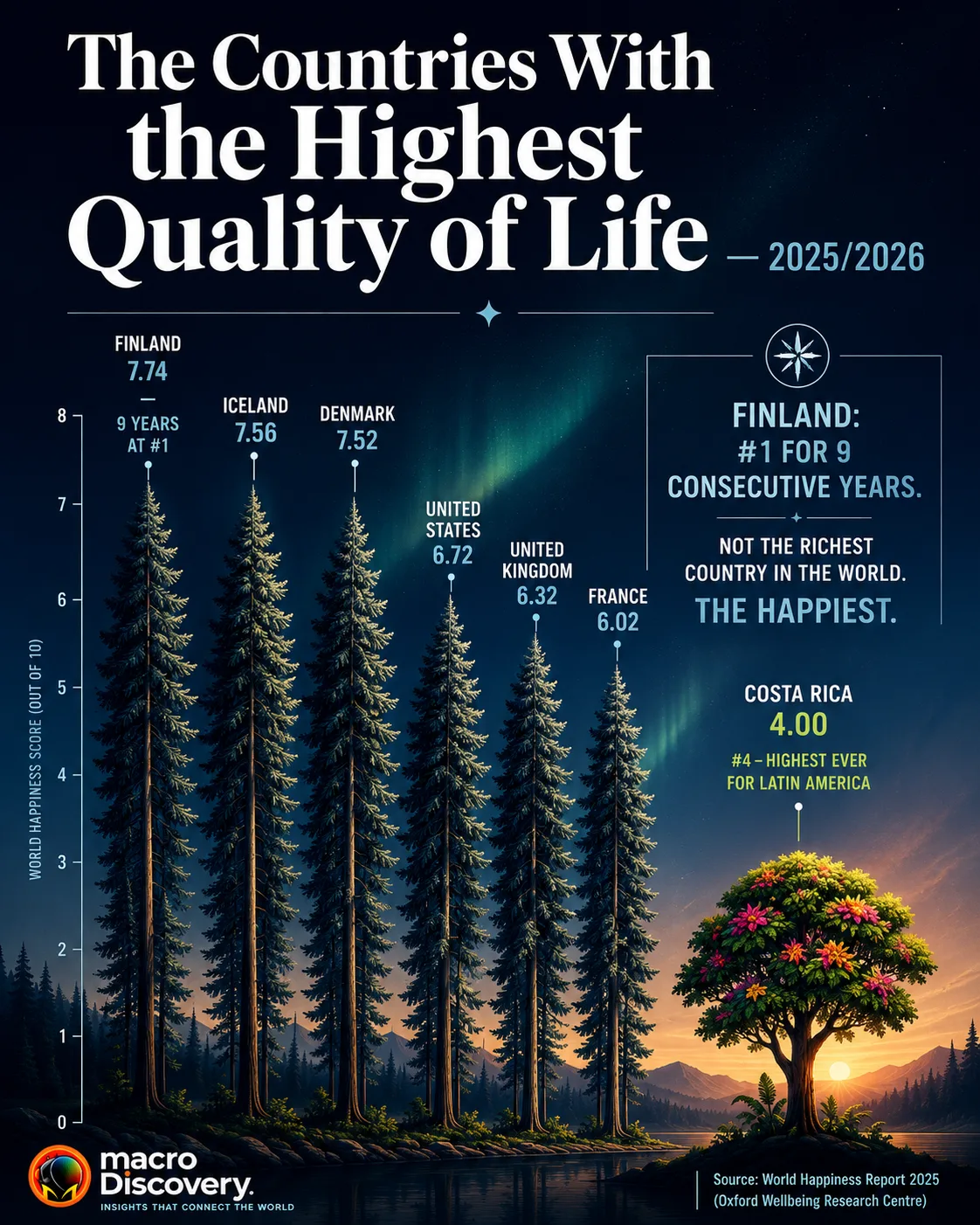
Finland has been the world’s happiest country for nine consecutive years. Iceland leads the UN’s Human Development Index. Costa Rica, with a fraction of Europe’s wealth, entered the global happiness top five for the first time. The US fell to #23 — its lowest position in the report’s history. The data from 2025 and 2026’s most authoritative global wellbeing surveys tells a story not just about who leads, but about why wealth alone never quite explains it.
- Nordic countries dominate global quality of life by every major measure. Five of the top six countries in the World Happiness Report 2026 are Nordic. Four of the top five in the UN Human Development Index are Nordic or Scandinavian. The common thread is not raw wealth — it is the combination of universal public services, high social trust, low corruption, compressed inequality, and strong community life.
- Finland is the world’s happiest country for the ninth consecutive year — the longest unbroken run in the WHR’s 14-year history. Yet Finland is not the world’s wealthiest country. Over 25 nations exceed Finland’s GDP per capita. The Finnish model demonstrates that social infrastructure — healthcare, education, safety nets, trust in institutions — generates more life satisfaction than income alone.
- Costa Rica’s rise to #4 is the most striking result of the 2026 report — the highest ranking ever achieved by a Latin American country. Costa Rica outperforms nations with two to three times its per-capita income. The research attributes this to strong social bonds, high life expectancy, perceived freedom, and a culture of community. It is powerful evidence that wellbeing and wealth are related but not the same thing.
- The United States fell to #23 in the WHR 2026 — its lowest position in the report’s history. Canada fell from 6th to 25th. Both declines are concentrated among young people: in the US, Canada, Australia, and New Zealand, happiness among those under 25 has fallen by an average of 0.86 points on a 10-point scale over the past 20 years — a sustained decline with no counterpart in most of the rest of the world.
- Iceland leads the UN Human Development Index at 0.972 — the highest composite score ever recorded for life expectancy, education, and income combined. But when Iceland’s score is adjusted for its ecological footprint (planetary pressures), it falls 40 places. Sweden is the only top-5 HDI country whose score improves when sustainability is factored in — a distinction that matters increasingly as the HDI evolves to measure development’s long-term viability.
WHR 2026 scores marked ★ are from WHR 2025 edition (2022-2024 data) — exact 2026 scores not released in the primary Gallup article but rankings confirmed. WHR 2026 (14th edition) published March 18, 2026 by Oxford Wellbeing Research Centre/Gallup/UN SDSN · primary directly confirmed. HDR 2025 (UNDP) published May 6, 2025 · statistical annex directly confirmed · data year 2023. Costa Rica (WHR #4) ranks approximately #62 on HDI — illustrating how subjective wellbeing and objective human development diverge.
| Country | WHR 2026 Rank | HDI 2025 Rank | Life Expectancy | WHR Category | Key strength | HDI |
|---|---|---|---|---|---|---|
| 🇫🇮Finland | #1 (9th yr) | #12 | 81.9 yrs | Nordic Leader | Social trust, low corruption, safety nets. Not the richest — 25+ countries beat its GDP per capita yet it leads happiness. | |
| 🇮🇸Iceland | #2 | #1 (0.972) | 82.7 yrs | Nordic Leader | Highest HDI ever recorded. Small, equal society. Free healthcare + education. Loses 40 ranks on planetary-pressure-adjusted HDI. | |
| 🇩🇰Denmark | #3 | #4 (0.962) | 81.9 yrs | Nordic Leader | Smallest wealth gap in top 10 (Netherlands has smallest happiness gap). Work-life balance. One of world’s lowest income inequalities. | |
| 🇨🇷Costa Rica | #4 🆕 | ~#62 | ~80 yrs | Latin Am. Breakthrough | Highest-ever WHR rank for a Latin American country. Outperforms nations with 2-3× its income. Strong social bonds, perceived freedom, community. | |
| 🇸🇪Sweden | #5 | #5 (0.959) | 83.3 yrs | Nordic Leader | Legal minimum 25 days vacation (up to 40+). 480 days parental leave at 80% pay. Only top-5 HDI country whose score improves on sustainability-adjusted HDI. | |
| 🇳🇴Norway | #6 | #2 (0.970) | 83.3 yrs | Nordic Leader | Highest GNI per capita in top 10 ($112,710 PPP). Strong oil sovereign wealth fund funds exceptional public services. Loses 49 ranks on planetary-adjusted HDI. | |
| 🇨🇭Switzerland | #10 | #2 (0.970) | 84.0 yrs | Consistent Top 10 | 3rd-highest life expectancy globally (84.0 yrs). Top 5 in both happiness and HDI consistently. Direct democracy, multilingual, exceptional institutions. | |
| 🇭🇰Hong Kong SAR | Not top 30 | #8 (0.955) | 85.5 yrs | HDI standout | Highest life expectancy in the world (85.5 yrs) — yet absent from happiness top 30. The divergence between objective longevity and subjective wellbeing is most extreme here. | |
| 🇩🇪Germany | ~#22 | #5 (0.959) | 81.4 yrs | HDI top 5 | Strong on objective capabilities (HDI #5) but lower on subjective happiness. Gap reflects economic anxiety, political fragmentation, and aging population stress. | |
| 🇺🇸United States | #23 (lowest) | #18 (0.938) | — | Both declining | Lowest WHR rank in 14-yr history. IHDI falls to #29 (−11.3% inequality discount — largest in top 20). 1 in 4 Americans ate all meals alone in a day (BLS 2023). |
Sources: WHR 2026 (14th edition · March 18, 2026 · Gallup primary, directly confirmed · data 2023-2025) · UNDP Human Development Report 2025 statistical annex (May 6, 2025 · directly confirmed · data year 2023). Life expectancy from UNDP HDR 2025 statistical annex. Costa Rica HDI rank is approximate — exact rank is approximately 62nd. US WHR rank of #23 is the lowest in the World Happiness Report’s 14-year history. Click column headers to sort.
Why Does Finland Keep Winning the Happiness Rankings — and What Is the Nordic Secret?
Finland has ranked as the world’s happiest country in every World Happiness Report since 2018 — nine editions in a row, spanning an era of global pandemics, inflation shocks, and geopolitical upheaval that destabilised happiness scores across most of the world. The streak is unprecedented in the WHR’s 14-year history.
What makes the result remarkable is what Finland is not. It is not the world’s wealthiest country. More than 25 nations exceed Finland’s GDP per capita. It does not have the world’s highest life expectancy — that distinction belongs to Hong Kong. It is not the largest country, the most ethnically diverse, or the most internationally influential. What Finland has is a social model that converts income into wellbeing with exceptional efficiency. High social trust — the belief that most people in your society can be relied upon — is the single variable most strongly correlated with Finland’s top ranking, according to WHR researchers. Low corruption, strong universal healthcare and education, and a deeply embedded culture of community participation complete the picture.
The Nordic model that underpins Finland’s score is shared across Denmark, Sweden, Norway, and Iceland — all five feature in the WHR 2026 top six. Common features include universal healthcare with no financial barrier at point of use; free higher education with no tuition fees; parental leave systems that encourage both parents to take time off (Sweden’s 480-day leave at 80% pay is the most generous major example); compressed income distributions with among the world’s lowest Gini coefficients; and active labour market policies that help workers transition between jobs without falling into poverty. These are not unique to any one Nordic country — they are the shared institutional design that the WHR’s 15 years of data consistently identifies as the foundation of sustained high wellbeing.
What Does Iceland’s HDI Lead Tell Us That Happiness Rankings Don’t?
Iceland sits at #1 in the UN Human Development Index with a score of 0.972 — the highest composite score of health, education, and income ever recorded in the HDR’s 35-year history. It ranks #2 in the WHR. The difference in positions between the two measures illustrates exactly what they each capture differently.
The HDI is an objective measurement of capabilities: how long do people actually live, how many years of education do they actually receive, and what income do they actually earn? Iceland scores at the frontier of all three. Its life expectancy is 82.7 years. Its expected years of schooling is 18.9 — meaning the average Icelandic child can expect nearly 19 years of formal education. Its GNI per capita is $69,117 in purchasing power parity terms. These are not survey responses — they are measured outcomes. Iceland’s #1 HDI position reflects a society that has built functioning institutions across all three pillars of human development to a degree unmatched globally.
The WHR’s Cantril ladder, by contrast, captures how people subjectively feel about their lives in aggregate. Iceland’s #2 position reflects very high life satisfaction — but Finland’s social trust and community infrastructure edges it at the margin. This divergence is useful: a country that scores highly on both measures has both good outcomes AND high subjective satisfaction. A country that scores well on one but not both has something to learn from the gap. Hong Kong is the most dramatic illustration of this divergence: it ranks #8 on HDI — its life expectancy of 85.5 years is the highest in the world — yet it sits well outside the WHR top 30. High longevity and income do not automatically translate into high subjective wellbeing, particularly when housing costs make daily life severely stressful for most residents.
Why Did Costa Rica Reach the Top 5 in Happiness — Despite Having a Fraction of Europe’s Wealth?
Costa Rica’s rise to fourth place in the WHR 2026 — the highest ranking any Latin American country has ever achieved — is the most discussed result of this year’s report and arguably its most important finding. Costa Rica’s GDP per capita is approximately $25,000, roughly a quarter of Norway’s or Switzerland’s. It has a fraction of the healthcare spending of the European top 10. It faces significant inequality and infrastructure challenges. And yet its population rates their lives higher than the citizens of Germany, Australia, the UK, France, the US, or Canada.
The WHR researchers attribute Costa Rica’s performance to a specific combination of factors. Social support — the belief that you have someone to count on in times of trouble — is exceptionally high. Life expectancy, at approximately 80 years, is competitive with much wealthier nations. Perceptions of freedom to make life choices are high. And critically, Costa Rica abolished its military in 1948, redirecting defence spending into education and healthcare — a policy that has compounded over 75 years into strong public services and a culture that prioritises social investment over military capability.
The broader message is that the relationship between income and happiness is real but not linear. Beyond a threshold of basic material security, additional income produces diminishing returns in life satisfaction. What matters increasingly is the quality of relationships, the trust people have in each other and in institutions, perceived freedom, and community. Costa Rica — and the similarly positioned Mexico at #12 — demonstrate that a society can achieve very high subjective wellbeing by investing in social bonds and public services rather than simply maximising GDP. This is not a romantic notion — it is one of the most replicated findings in the 14-year history of the World Happiness Report.
Why Is the United States Falling in Global Happiness Rankings?
The United States ranked #23 in the World Happiness Report 2026 — the lowest position in the report’s 14-year history. Canada fell from 6th place to 25th. Australia fell from 10th to 15th. These declines are concentrated in a specific demographic and a specific geography: young people in English-speaking countries.
In the US, Canada, Australia, and New Zealand, happiness among people under 25 has fallen by an average of 0.86 points on the 0-10 Cantril scale over the past 20 years. This is a sustained, multi-decade decline with no equivalent in most of the rest of the world — in 85 of 136 countries, young people report being happier now than 20 years ago, and in eight of the ten global regions, youth wellbeing has improved. The decline appears to be structural, not temporary.
The WHR 2026 report focused on social media, trust, social connection, and digital environments as key themes. Several independent data points converge on social isolation as a central driver. The US Bureau of Labor Statistics found that in 2023, 1 in 4 Americans ate all their meals alone in a single day — a figure that has risen 53% since 2003. WHR research found that across 47 countries, young students who use social media for more than seven hours a day report much lower wellbeing than those who use it for under one hour. The US ranks 10th for happiness among adults over 60 — the problem is concentrated entirely among the young. An older American is about as happy as someone in a top-10 country. A younger American is substantially less happy than a peer in Finland, Denmark, or even Costa Rica.
Does a High Human Development Index Mean a High Quality of Life?
Not necessarily — and the divergence between HDI and WHR scores is one of the most intellectually interesting features of global wellbeing data. The HDI measures objective achievements: how long people live, how educated they are, how much they earn. It says nothing directly about how satisfied people are with those lives. The WHR measures subjective satisfaction: how people rate their own lives on a ladder from worst to best. The two measures overlap substantially but diverge in important ways.
Germany is a striking example. It ranks #5 on the HDI (0.959) — its citizens live long, are highly educated, and earn well. Yet Germany ranks approximately 22nd on the WHR — outside the top 20 of subjective wellbeing. The gap likely reflects a combination of factors: economic anxiety driven by industrial restructuring and energy transition costs, political fragmentation, and an aging population creating intergenerational stress on social systems. High objective achievement does not automatically produce high subjective satisfaction.
The reverse case is Costa Rica: #4 in the WHR, approximately #62 in the HDI. Its citizens are not the longest-lived, best-educated, or highest-earning in the world — but they report among the highest life satisfaction on earth. The philosophical implication is significant: the goal of national development policy should arguably be to maximise wellbeing outcomes, not objective capability scores. Capability is a means to the end of a good life. A country can build exceptional objective capabilities and still fail to translate them into satisfied citizens — and a country with more modest capabilities can achieve very high satisfaction through social investment, community, and trust. The data from 2025 and 2026’s most authoritative global surveys is consistent on this point: money and longevity matter, but they are not sufficient.
- Gallup — “Happiness Rankings Show Stability and Change” (March 18, 2026 · WHR 2026 14th edition primary · directly fetched · Finland #1 for 9th yr · complete top-10 · Costa Rica #4 · US #23 · Canada #25 · generational data · social media theme)
- UNDP — HDR 2025 Statistical Annex: HDI Table (primary PDF · directly confirmed · Iceland 0.972 #1 · Norway/Switzerland 0.970 · Denmark 0.962 · Germany/Sweden 0.959 · Australia 0.958 · HK 0.955 · US 0.938 #18 · life expectancy data)
- UNDP — HDR 2025 Statistical Annex: Planetary Pressures-Adjusted HDI Table (Sweden +2 ranks · Iceland −40 · Norway −49 · Australia −59 · sustainability adjustments)
- UNDP — Human Development Reports Country Insights (HDR 2025 · released May 6, 2025 · covers 193 countries · data year 2023)
- US News — “Finland Is No. 1, U.S. Falls in World Happiness Report Rankings” (March 20, 2025 · WHR 2025 13th edition · Finland 7.74 · Denmark/Iceland 7.52 · Sweden 7.35 · US #24 · all Nordic top 10)
- Forbes — “The 20 Happiest Countries In The World For 2025” (March 20, 2025 · WHR 2025 edition · full top 20 · Costa Rica #6 in 2025 · Mexico #10 · youth decline · dining alone data)
- StatRanker — “Top 100 Happiest Countries: WHR 2025” (Gallup World Poll basis · 2022-2024 data · methodology note · Latin American paradox context)
- StatRanker — “Top 100 Countries by HDI: Latest UNDP Ranking” (UNDP HDR 2025 basis · Iceland #1 · Norway/Switzerland #2 · Denmark #4 · IHDI adjustments · methodology)
- DataPandas — “HDI by Country” (UNDP 2025 basis · China trajectory 0.484→0.797 · US IHDI −11.3% to #29 · Hong Kong life expectancy 85.5 · inequality-adjusted analysis)
- Wikipedia — World Happiness Report (historical editions · methodology · Cantril ladder · six factor framework · Finland nine years #1 confirmed · March 2026 reference)