The Countries Winning the Global Talent Race
The Countries Winning
the Global Talent Race
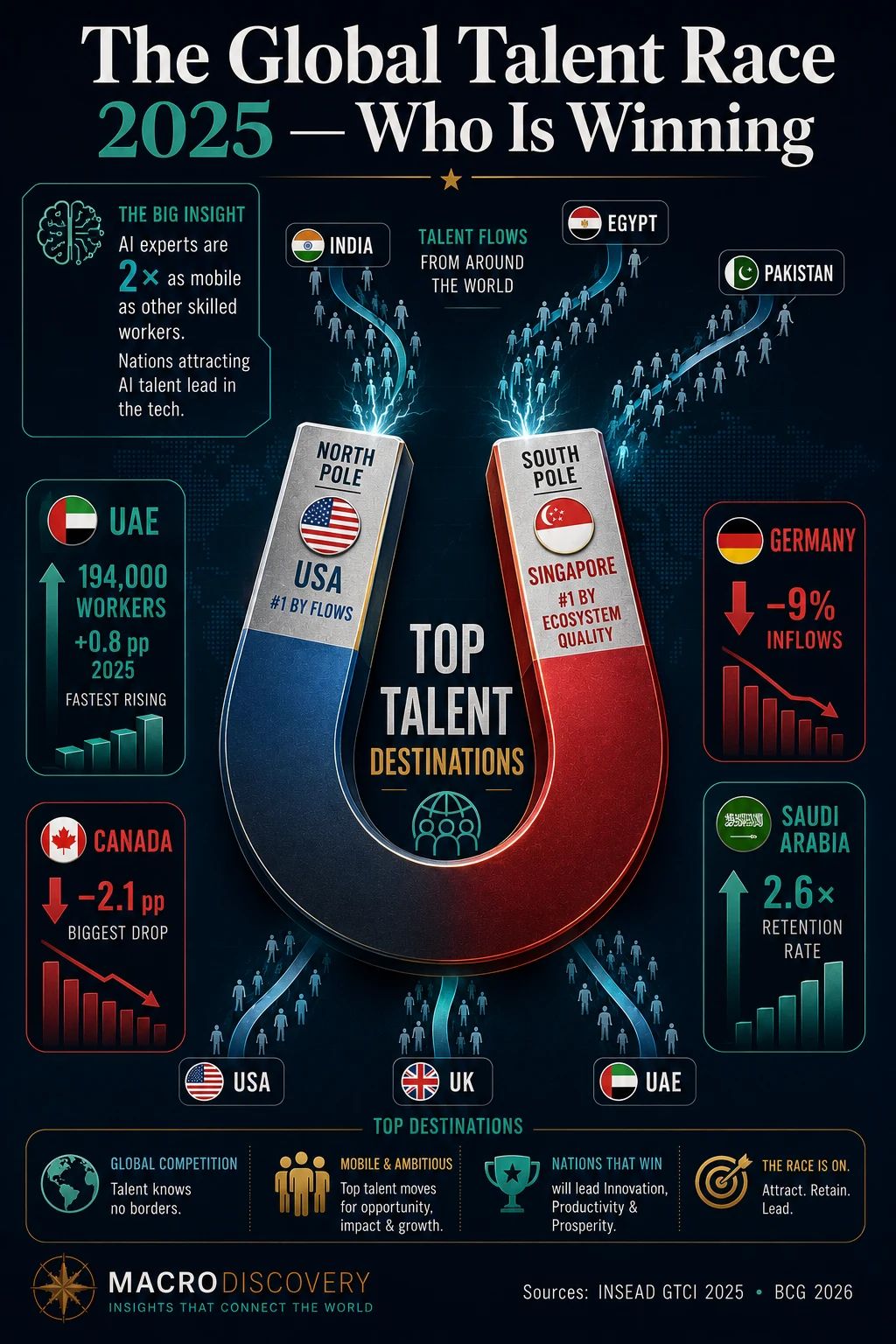
Singapore topped the global talent rankings for the first time in 11 years, displacing Switzerland. The US dropped to its lowest position since 2013. The UAE attracted 194,000 skilled workers in a single year. Canada lost more talent market share than any other major destination. The race for the world’s best and brightest is accelerating — and the map of who is winning is being redrawn.
- Singapore tops the Global Talent Competitiveness Index for the first time in 11 editions, displacing Switzerland which had led every edition since the index launched in 2013. Singapore ranked first in Formal Education, Regulatory Landscape, and Generalist Adaptive Skills — the capacity for soft skills, digital literacy, and innovation-oriented thinking that has emerged as the strongest single predictor of talent competitiveness.
- The United States dropped to #9 — its lowest GTCI position since 2013, falling from #3 in 2023. The decline was driven by weaker performance in Generalist Adaptive Skills (from #5 to #13) and drops in openness and lifelong learning indicators. Paradoxically, the US still attracts more internationally mobile talent than any other country — capturing 39% of all cross-border highly skilled worker flows in 2024.
- The UAE has become the world’s fastest-growing talent destination, attracting approximately 194,000 highly skilled workers in 2025 — now a top-3 destination globally for highly skilled, STEM, and AI talent, rapidly closing on the UK. Its advantages: no income tax, digital visa processing, a young cosmopolitan population, and Gulf proximity to fast-growing source markets including India, Egypt, Pakistan, and Nigeria.
- Canada dropped from a top-3 talent destination to #7 in a single year — the largest single-year market share loss of any major destination in the BCG dataset (−2.1 percentage points). Tighter immigration policies implemented from 2024 onward directly reversed a decade of talent attraction gains.
- AI talent is the most strategically contested category — and the only one where the US is losing ground. AI experts are nearly twice as mobile as other highly skilled workers. Nations that lead in attracting AI talent in a specific technology field are 17 times more likely to lead in that technology overall. The race for AI researchers is, in effect, the race for economic leadership in the next decade.
| # | Country | Region | Movement | Status | Standout strength | Score |
|---|---|---|---|---|---|---|
| 1 | 🇸🇬Singapore |
Southeast Asia | ↑ from #2 | ★ New #1 | #1 Formal Education · #1 Regulatory Landscape · #1 Generalist Adaptive Skills. First time at top in 11 editions. | |
| 2 | 🇨🇭Switzerland |
Western Europe | ↓ from #1 | 10-yr leader | Held #1 for every edition 2013–2024. Strong across all pillars. Still #2 globally by narrow margin. | |
| 3 | 🇩🇰Denmark |
Northern Europe | ↑ from #4 | Rising | Active labour market practices. Nordic model: learning from adversity, organisational agility. | |
| 4 | 🇫🇮Finland |
Northern Europe | Stable | Consistent | World-class education system. Strong lifelong learning culture. Workforce resilience a key metric. | |
| 5 | 🇸🇪Sweden |
Northern Europe | Stable | Consistent | Innovation ecosystem. Strong R&D investment. STEM talent pipeline highly developed. | |
| 6 | 🇳🇱Netherlands |
Western Europe | Stable | Consistent | Highly internationalised workforce. English language proficiency. Strong enabling environment. | |
| 7 | 🇳🇴Norway |
Northern Europe | Stable | Consistent | High quality of life. Strong enabling environment. Active labour market support. | |
| 8 | 🇱🇺Luxembourg |
Western Europe | Stable | Consistent | Highly internationalised. Multilingual workforce. Financial sector talent hub. Small but elite. | |
| 9 | 🇺🇸United States |
North America | ↓ from #3 (2023) | Lowest since 2013 | Still strong: vocational skills, enabling/growing talent. Fell on: Generalist Adaptive Skills (#5→#13), openness, lifelong learning. | |
| 10 | 🇦🇺Australia |
Oceania | Stable | Top 10 | Highest-ranking Oceania country. Scores higher than Singapore on retaining talent, but lower on adaptive skills overall. | |
| 14 | 🇨🇦Canada |
North America | Stable | Surpasses US on attract | Surpasses US specifically in the “attract talent” pillar. But mobility data shows actual inflows declining fast (see BCG table below). | |
| 23 | 🇮🇱Israel |
Middle East | Stable | MENA #1 | Regional leader. Strong in retaining talent, mid-level and high-level skills, professional and managerial workforce. | |
| 25 | 🇦🇪UAE |
Middle East | ↑ Rising fast | Top 25 · Fast rising | Both GTCI top-25 AND BCG top-3 for actual inflows (194K workers in 2025). Rare dual leadership position. | |
| 53 | 🇨🇳China |
East Asia | ↓ from #40 (2023) | Declining | Sharp decline from 47→40→53 across three editions. Fell despite large economy; talent ecosystem not keeping pace with income growth. |
Source: Global Talent Competitiveness Index 2025 (GTCI 2025), INSEAD in partnership with Portulans Institute. Published November 26, 2025. 135 countries · 77 indicators · 6-pillar framework (Enable, Attract, Grow, Retain, Vocational Skills, Global Knowledge Skills). Independently audited by the Joint Research Centre (JRC) of the European Commission. Movement column compares 2025 rank to 2024 rank unless stated otherwise. Click column headers to sort.
| Destination | Overall rank | STEM rank | AI rank | 2025 Inflow trend | Key insight |
|---|---|---|---|---|---|
| 🇺🇸 United States | #1 | #1 | #1 | ↑ Gaining in 3/4 | +4.0 pp highly skilled · +2.6 pp STEM · +1.2 pp research. But LOSING AI share — the only category where US is not extending its lead. |
| 🇬🇧 United Kingdom | #2–3 | #3 | #2–3 | ↓ Declining all cats | Losing share in all categories. UAE quickly gaining on UK in highly skilled and AI. Still top-3 but position weakening. |
| 🇦🇪 UAE | #3 | #2 | #3 | ↑ +0.8 pp · 194K | ~194,000 highly skilled attracted in 2025. Overtook Canada and UK in STEM. No income tax, fast visa, Gulf diaspora networks. |
| 🇮🇳 India | Varies | #3 | #3 | ↑ Rising | Largely NRIs (non-resident Indians) returning, not new foreign talent. Key source country globally — BCG calls India “single most important external labour market.” |
| 🇨🇦 Canada | #7 (was #3) | Falling | Falling | ↓ −2.1 pp · Biggest drop | Largest single-year market share loss of any major destination (−2.1 pp). Tighter immigration policy reversed a decade of talent gains in one year. |
| 🇩🇪 Germany | Mid-tier | Research ↑ | Falling | ↓ −9% inflows | Inflows −9%, outflows +3%. Manufacturing slowdown reducing demand. Still #3 for research talent specifically. Net talent exporter turning negative. |
| 🇸🇦 Saudi Arabia | Rising | Rising | Rising | ↑ 2.6× retention | Highest retention ratio (2.6×) of any major destination — workers who go to Saudi Arabia tend to stay. Indian professionals a primary inflow source. |
Source: BCG Top Talent Tracker Q2 2026 (released June 16, 2026 · BCG in partnership with Revelio Labs · 221 million highly skilled professionals tracked across 200+ destinations through end-2025). BCG defines “highly skilled” as holding at least a bachelor’s degree. Data is derived from LinkedIn-sourced professional profile data (Revelio Labs), not official government migration statistics. Percentage-point changes are year-on-year comparisons within the Q2 2026 methodology base. Overall mobility fell 11.6% in 2025 vs 2024 (−430,000 movers). STEM fell −13%, AI fell −12%, research fell −19%.
Why Did Singapore Overtake Switzerland After Ten Consecutive Years at the Top?
For every one of the first ten editions of the Global Talent Competitiveness Index — from 2013 through 2024 — Switzerland ranked first. In 2025, Singapore displaced it. The shift was not sudden: Singapore had been narrowing the gap steadily, and the 2025 edition introduced new indicators around AI adoption, workforce resilience, and employee wellbeing that reflected Singapore’s specific strengths.
Singapore ranked first globally in three pillars: Formal Education, Regulatory Landscape, and Generalist Adaptive Skills. The last of these — measuring broad-based capabilities including soft skills, digital literacy, and innovation-oriented thinking — has emerged as the strongest single determinant of talent competitiveness in the 2025 model. Singapore’s workforce, according to GTCI, has more high-level knowledge worker skills required for professional, managerial, and leadership roles than any other country in the world.
Switzerland remains number two and is not declining — Singapore simply caught up. Both countries represent the pinnacle of talent ecosystem design: high quality of life, stable governance, world-class education, low bureaucratic friction, and genuine openness to global workers. The gap between them is narrow enough that one or two indicator movements could swap positions again in the next edition. What the shift signals more broadly is that the old assumption of European permanent dominance is no longer guaranteed — and that Asian economies with the right institutional foundations can compete at the very top.
Why Did the US Drop to Its Lowest Talent Ranking Since 2013?
The United States fell from #3 in the 2023 GTCI to #9 in 2025 — the first time it has not appeared in the top five since the index launched. The GTCI analysis identifies two specific drivers: a drop in Generalist Adaptive Skills (from #5 to #13 globally) and declines in the “openness” and “lifelong learning” pillars. GTCI’s openness measure reflects how welcoming a country’s environment is to foreign talent — and in 2024 and 2025, US immigration policy became notably more restrictive under the second Trump administration.
The paradox is striking. The GTCI measures the quality of the talent ecosystem — and the US is declining. The BCG tracker measures where workers actually move — and the US is still dominant, capturing a growing share of international talent flows. In 2025, despite tighter immigration policy, the US gained 4.0 percentage points of market share in highly skilled workers, 2.6 points in STEM, and 1.2 points in research talent. The US ecosystem’s gravitational pull — concentrated in Silicon Valley, Boston, New York, and other major innovation hubs — remains powerful enough to overcome policy headwinds for the subset of workers who do choose to move.
The one exception is AI. This is the only talent category where the US is not extending its lead. BCG’s June 2026 report described this as “potentially the defining question of the next decade of the global technology race.” AI talent is nearly twice as mobile as other skilled workers. It is also the category most directly correlated with technological leadership. A nation that leads in attracting AI researchers is 17 times more likely to lead in the underlying technology. Whether the US’s AI share decline is a temporary fluctuation or a structural trend will be one of the most consequential empirical questions of the coming years.
How Did the UAE Become One of the World’s Top Talent Destinations So Quickly?
Ten years ago, the UAE barely registered in global talent competition data. In 2025, it attracted approximately 194,000 highly skilled workers — making it a top-3 global destination for highly skilled, STEM, and AI talent, and rapidly closing on the UK across all categories. The speed of the UAE’s rise is the most remarkable story in global talent geography of the last decade.
The structural advantages are clear. The UAE charges no personal income tax — a significant draw for high-earning professionals from countries with 40-50% marginal rates. It has reformed its visa system, making residency digital and significantly faster than previously. It sits geographically and culturally close to the largest talent source markets — India, Egypt, Pakistan, and Nigeria — giving it diaspora networks that lower the friction of relocation. Dubai and Abu Dhabi have invested heavily in quality-of-life infrastructure: healthcare, international schooling, safety. BCG identifies Saudi Arabia and the UAE as “pockets of high and rising mobility” beginning to challenge traditional European destinations.
Saudi Arabia is on a similar trajectory, attracting talent with Vision 2030-funded investment in technology, entertainment, and public sector modernisation. BCG data shows Saudi Arabia now has the highest retention ratio — 2.6 times — of any major talent destination: workers who relocate there tend to stay. Indian professionals are a primary inflow source for both Gulf nations, drawn by strong salaries, improving lifestyle, and proximity to home. Over time, the Gulf’s willingness to invest in talent attraction as a national policy lever may create a genuine third tier of global talent hubs alongside North America and Europe.
Why Did Canada Lose More Talent Market Share Than Any Other Country in 2025?
Canada was, for most of the 2010s, the textbook example of talent attraction done right. Its points-based immigration system, welcoming cultural reputation, strong universities, and high quality of life made it the preferred destination for skilled workers who could not immediately secure US visas — particularly Indian and Chinese professionals navigating long H-1B queues in the US. In the BCG tracker, Canada consistently ranked in the top three for internationally mobile talent.
In 2025, it dropped to seventh — losing 2.1 percentage points of market share, the largest single-year decline among major destinations in the dataset. The cause was direct: the Canadian government implemented significant tightening of immigration pathways from 2024 onward, reducing the intake of skilled workers following political pressure over housing costs and public services. The result was a near-immediate reversal in talent flows. What took a decade to build — a reputation as the most accessible major English-speaking destination for skilled immigrants — began to unwind in a single policy cycle.
The Canadian case is instructive for any country considering talent policy. Talent attraction reputations are built slowly and destroyed quickly. Workers planning international relocation assess years of policy track record, not just today’s rules. Once Canada signaled that it was tightening, workers and their employers began redirecting — to the US, to the UAE, to Australia — before the restrictions were even fully implemented. The BCG data suggests that Germany is experiencing a similar dynamic, with talent inflows falling 9% and outflows rising 3% in 2025, driven by its manufacturing-sector slowdown and a perception of reduced economic opportunity.
Is Brain Drain Actually Harmful — or Can Emigration Build Talent at Home?
The conventional story of brain drain holds that when skilled workers leave developing countries for richer ones, the origin country loses irreplaceable human capital. A landmark peer-reviewed study published in Science in 2025 — synthesising decades of empirical research using natural experiments, visa policy changes, and international lotteries — found the reality is considerably more nuanced.
High-skilled emigration can actually increase the stock of educated workers at home — a process the researchers call “brain gain.” The mechanism: when a country’s workers are known to be in demand internationally, this raises the expected returns to education domestically, causing more people to invest in training. A US visa programme for Filipino nurses led to large increases in nursing school enrolment in the Philippines — such that the number of domestic nurses ultimately increased. A relaxation of US H-1B caps led to a surge in computer science training in India: more people gained IT skills than emigrated, producing a net increase in India’s skilled workforce.
Whether emigration causes brain drain or brain gain depends primarily on whether the origin country has the training infrastructure to produce new graduates in response to foreign demand. Countries with strong universities and vocational systems can turn emigration into a positive-sum dynamic. Countries without that infrastructure cannot. China’s former rapid rise in the GTCI rankings — from #47 to #40 between 2022 and 2023 — and its subsequent fall to #53 in 2025 partly reflects the tension between its large external talent diaspora and an internal talent ecosystem that has not kept pace with the country’s income growth. A country can produce many talented people and lose too many of them at the same time.
Which Regions Are Rising — and Which Are Falling Behind?
Europe’s dominance of the GTCI top 25 is extraordinary: 18 of the top 25 positions belong to European economies. The Nordic countries — Denmark, Finland, Sweden, Norway — occupy four of the top seven slots. Their talent ecosystems share common features: active labour market policies that help workers bounce back from job loss, educational systems that emphasise learning from adversity, and strong institutional trust. These are the elements that the 2025 GTCI, themed “Resilience in the Age of Disruption,” identifies as most important for the current era.
Sub-Saharan Africa and Latin America remain largely absent from the upper tiers. Neither region produced a single country among the “dynamic movers” in the 2025 GTCI analysis — countries that are improving most rapidly relative to their income level. Mauritius (#49) leads Sub-Saharan Africa; Chile (#39) leads Latin America. GTCI analysis attributes the Latin American absence from dynamic movers partly to a “talent plateau” — as countries move from middle- to high-income status, institutional and educational reforms often lag behind income growth, creating a gap between economic advancement and talent-system quality.
The fastest-rising story in talent geography is the Gulf. The UAE (#25) and Saudi Arabia are building talent ecosystems and migration infrastructure simultaneously — a combination that few regions have managed to do at speed. If the Gulf sustains its current trajectory, the 2030 GTCI editions may show it competing genuinely with Europe for the top tier of talent ecosystem quality, rather than merely for migrant inflows.
- GTCI 2025 — Global Talent Competitiveness Index Countries page (INSEAD/Portulans Institute · primary · directly fetched · full ranking table · 135 countries · all regional leaders confirmed)
- INSEAD — Global Talent Competitiveness Index 2025 (primary · published Nov 26, 2025 · “Talent & Resilience: Navigating an era of Disruption” · 77 indicators · JRC audit)
- INSEAD Knowledge — “The World’s Most Talent Competitive Countries, 2025” (full top-10 analysis · Singapore #1 reasons · US #9 reasons · Nordic resilience model)
- BCG — Top Talent Tracker Q2 2026 press release (June 16, 2026 · primary · 221M tracked · mobility −11.6% · US gains in 3/4 categories · UAE 194K · Canada #7 · Saudi 2.6× retention)
- BCG — “Global Talent Mobility Is Slowing and Shifting” (December 2025 · UAE 178K 2025 · Canada/UK decline · Middle East rising · methodology note)
- BCG — “Who’s Winning the Global Race for STEM and AI Talent?” (Q4 2024 · 200M tracked · US 39% · UAE 8% STEM · AI experts 2× mobility · 17× technology leadership finding)
- ScienceDaily citing Science — “Brain drain or brain gain?” (Batista, Mobarak et al. · Science 2025 · DOI: 10.1126/science.adr8861 · brain gain mechanisms · Philippines nurses · India IT training)
- Poets&Quants — “A First: Singapore Is No. 1 In INSEAD’s 2025 Global Talent Ranking” (November 2025 · Singapore’s 3× first rankings · Switzerland displacement · GTCI director quotes)
- Center for Global Development — “Global Talent Mobility in 2025: Slowing and Shifting” (BCG analysis · US widens lead · UAE gains 3pp AI · national talent agencies emerging)