What $1 Million
Actually Buys
in 20 Countries
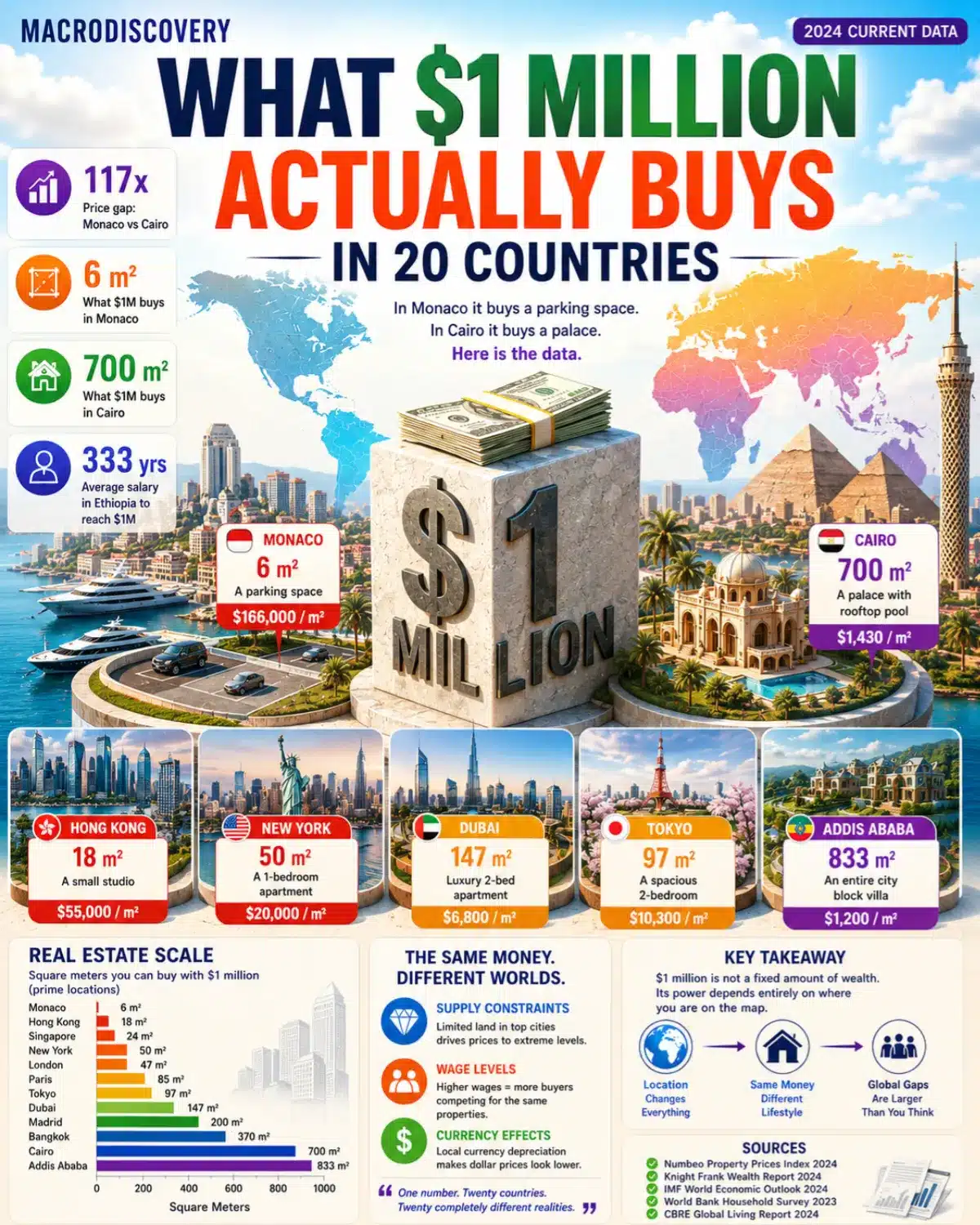
In Monaco, $1 million buys a parking space. In Cairo, it buys a palace with a rooftop pool. The same number means something completely different depending on where you stand on Earth — and the gap is larger than most people realize.
Prime city-center real estate area, salary equivalence, and lifestyle benchmarks. All figures in 2024 USD.
Prime city-center property area purchasable for $1 million USD. Ranked from least to most.
One million dollars is the most culturally loaded number in the English language. It is shorthand for wealth, for success, for life-changing money. It appears in game shows, in rap lyrics, in financial planning conversations. It is the first large number most people can actually visualize.
But $1 million is not a fixed quantity of purchasing power. It is a number that passes through the exchange rate of geography — and that exchange rate varies by a factor of more than 100 depending on where you are standing.
“In Monaco, $1 million does not buy an apartment. It buys 6 square meters — roughly the size of a prison cell, in the most expensive principality on earth. In Addis Ababa, the same $1 million buys 833 square meters of prime property. The gap between those two numbers is the gap between two entirely different worlds.”
The Real Estate Gap
Why the Same Number Means Different Things
Three forces drive the purchasing power gap. The first is supply constraints. Monaco has 2.1 square kilometers. Hong Kong’s buildable land is geographically limited. Manhattan is an island. When land is finite and demand from global wealth is infinite, prices converge toward infinity.
The second is wage levels. In countries with high average wages, more people can bid for the same properties, pushing prices up. In countries with low average wages, very few people can compete for prime real estate — keeping prices low even in major cities, because the buyer pool is thin.
The third is currency. A significant portion of the apparent cheapness in many emerging markets is currency depreciation. Properties in Lagos, Cairo, and Addis Ababa priced in local currency have often risen substantially — but dollar-denominated buyers see value because the naira, pound, and birr have all depreciated significantly against the US dollar over the past decade.
The $1 million benchmark reveals something important about how geography mediates wealth. The number itself is neutral — it carries no intrinsic purchasing power. Its meaning is entirely constructed by the local context in which it is spent.
For investors, the data suggests two very different strategies. The first is conventional: Monaco, Hong Kong, and Singapore are expensive because global demand for limited prime locations is structurally high. The second is value-oriented: Tokyo offers world-city quality at mid-tier prices, and cities like Dubai, Bangkok, and Medellín offer premium lifestyle at a fraction of the cost of their Western equivalents — with the tax structures to match.
What the data also reveals is the scale of global inequality embedded in a single number. One million dollars is simultaneously too small to buy a functional home in Monaco, and more money than a typical Ethiopian family will see across fifteen generations. The number has not changed. The world around it has.