Every Active Border Dispute
on Earth Right Now
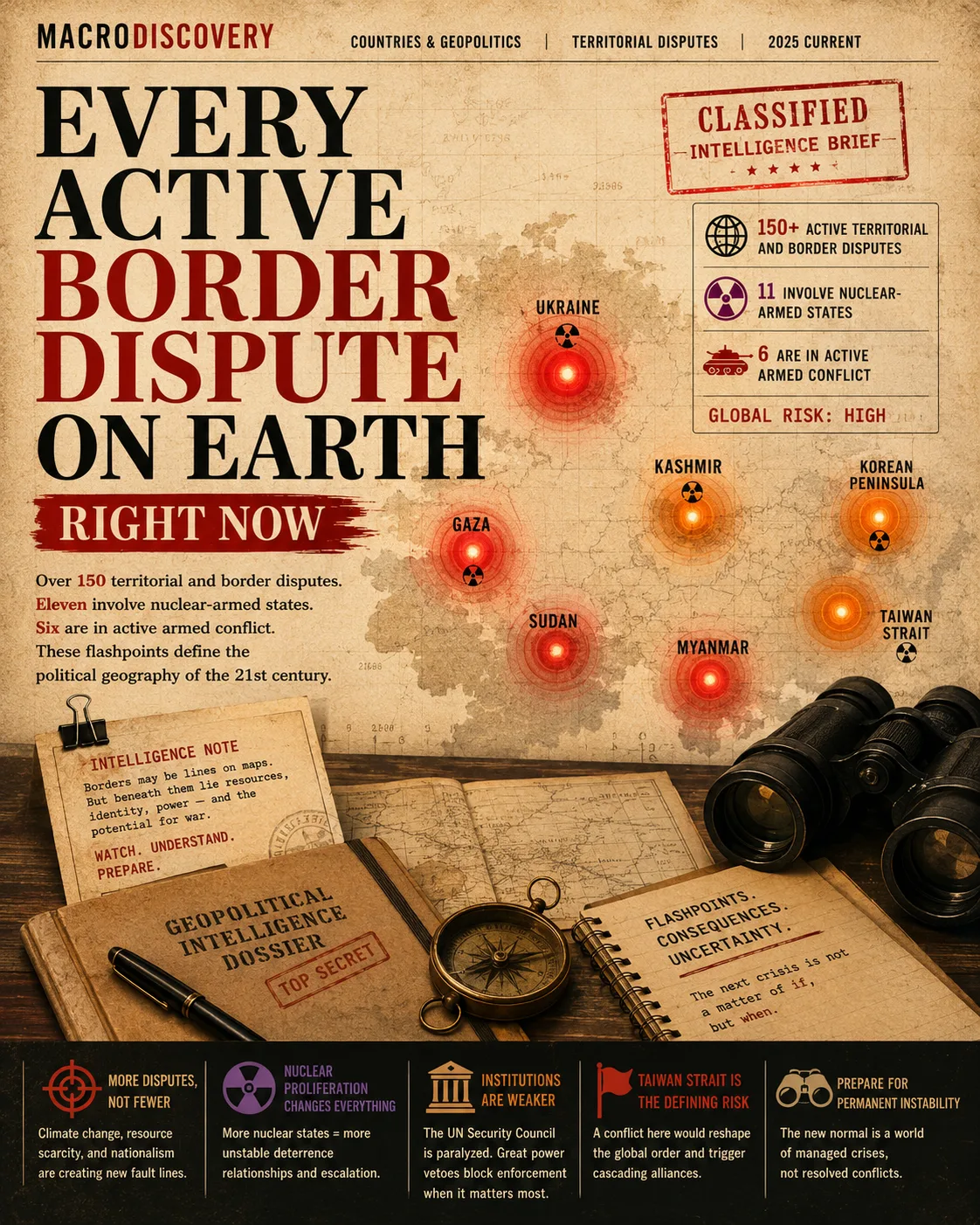
There are over 150 active territorial and border disputes on Earth today. Eleven involve nuclear-armed states directly or by proxy. Six are in active armed conflict. Most will never appear in a single news cycle — but together they define the political geography of the 21st century.
Each marker represents an active dispute. Color = severity level. ☢ = nuclear-armed state involved. Sources: ICJ, IISS Military Balance 2025, CFR Global Conflict Tracker.
Ranked by current risk level. Status assessed as of Q1 2025. ☢ = nuclear-armed state directly involved or adjacent. Sources: IISS, CFR, ICJ 2025.
Number of active territorial or border disputes per region. Severity weighted — one armed conflict counts more than ten latent claims.
The five disputes most likely to escalate significantly in the next 3–5 years, based on military posturing, political signaling, and structural drivers.
The geography of conflict has a structural logic that rarely changes between generations. Most of the disputes on the map above are not new — they are old disputes that were managed, suppressed, or ignored until the conditions that made them manageable changed. What is new is the convergence of three accelerants that are simultaneously destabilizing frozen conflicts, intensifying active ones, and creating new territorial claims where none previously existed: resource scarcity, nuclear proliferation, and the declining capacity of international institutions to enforce legal rulings.
The nuclear dimension is the least-discussed structural shift. In 1990 there were five confirmed nuclear states. Today there are nine, with Iran widely assessed to be within weeks of breakout capacity. Every new nuclear state adds a new set of deterrence relationships that did not previously exist — and each relationship introduces its own escalation ladder and red lines. The Kashmir dispute is the clearest example: the 2019 Balakot strikes established that two nuclear-armed states can conduct airstrikes against each other without triggering nuclear use, but only because both sides chose restraint. That restraint is not guaranteed the next time.
“Most border disputes are not about where the line is drawn. They are about what lies underneath it — oil, water, rare earths, shipping lanes — and which generation of leadership decides the prize is worth the risk.”
The Venezuela–Guyana escalation is the clearest current example of resource discovery as a conflict trigger. The pattern is consistent across history: the discovery of extractable value beneath disputed territory reliably converts latent claims into active ones. The same dynamic is now playing out in the Arctic, where melting ice is revealing seabed resources and opening shipping routes that were theoretical for most of the 20th century, and in the South China Sea, where seabed hydrocarbon estimates drove China’s nine-dash line from diplomatic position to physical infrastructure.
The structural trend over the next decade is toward more disputes, not fewer. Three forces are driving this. First, climate change is redrawing resource maps — exposing Arctic seabed, changing river flows that define borders, and creating water scarcity disputes in regions where borders were drawn assuming current hydrology. Second, the post-Cold War institutional order — the ICJ, UNCLOS, UN Security Council — has been rendered partly inoperative by great-power veto and selective compliance. When China can reject a binding Permanent Court of Arbitration ruling without consequence, and Russia can invade a neighbor that signed a sovereignty guarantee, the deterrent value of international law collapses for every other state watching.
Third, and most consequentially, the Taiwan Strait remains the single highest-consequence unresolved dispute on the planet. A military conflict there would not be a regional crisis — it would be the first direct military confrontation between the world’s two largest economies, involving the most advanced semiconductor manufacturing capacity on Earth, triggering alliance obligations that would draw in Japan, Australia, the Philippines, and the US simultaneously. Every other dispute on this map would be secondary. The question that defines the 2020s and 2030s is whether that confrontation can be indefinitely deterred, or whether the window Xi Jinping has publicly signaled for resolution will eventually produce a decision to test it.