Home AI Technology Gaming Future Economy Geography Automobile Science Web Stories

Timeline: How Countries Go Bankrupt

Macro Discovery
On: September 8, 2026 6:41 AM
Follow Us:
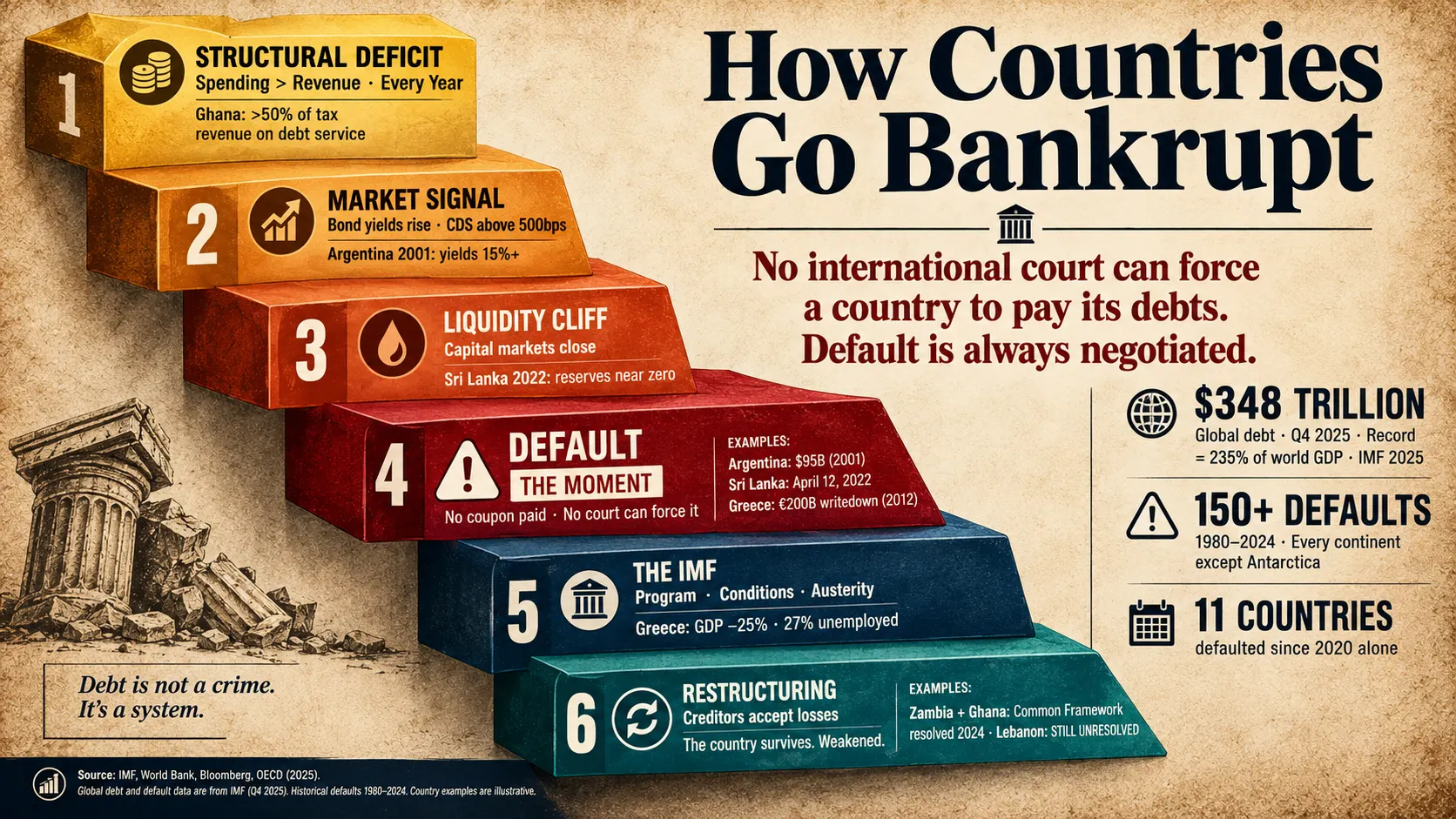
Editorial infographic showing a six-step staircase explaining how countries move from structural deficits and rising bond yields to a liquidity crisis, sovereign default, IMF intervention, and debt restructuring. How Countries Go Bankrupt.
Timeline: How Countries Go Bankrupt — MacroDiscovery
MacroDiscovery
Sovereign Debt · Finance · History · 6 min read · IMF Sept 2025 · IIF Q4 2025 · Primary
IMF — “Global Debt Remains Above 235% of World GDP” (PRIMARY · imf.org · directly fetched · September 17, 2025 · Authors: Gaspar, Goncalves, Poplawski-Ribeiro) · IMF — “Debt is Higher and Rising Faster in 80 Percent of Global Economy” (PRIMARY · imf.org · May 29, 2025) · IIF — Global Debt Monitor Q4 2025 (PRIMARY · iif.com · $348 trillion record) · IMF Fiscal Monitor April 2026 (PRIMARY)
Sovereign Debt · Economic History · Crisis Mechanics

Timeline: How
Countries Go Bankrupt

Between 1980 and 2024, more than 150 sovereign defaults or restructurings occurred — affecting every continent except Antarctica. Unlike a corporate bankruptcy, no international court can force a country to pay its debts. The resolution is always negotiated. Russia. Argentina. Greece. Sri Lanka. Lebanon. The world now carries $348 trillion in total debt — a record. More than half of low-income countries are already in or at high risk of debt distress.

By MacroDiscovery
Source: IMF (primary · imf.org · directly fetched) · IIF Global Debt Monitor Q4 2025
Key stat: 150+ sovereign defaults 1980-2024 · $348T global debt · 11 defaults since 2020
150+
sovereign defaults or restructurings 1980-2024 · every continent except Antarctica · Argentina defaulted four times
$348T
global debt · Q4 2025 · record all-time · +$29T added in 2025 alone · IIF Global Debt Monitor · “above 235% of world GDP” IMF
11
countries defaulted since 2020 alone · worst run in decades · including Zambia, Ghana, Sri Lanka, Ethiopia, Lebanon, Argentina, Russia
>50%
of low-income countries in or at high risk of debt distress · June 2025 · citing IMF/World Bank · “debt is higher and rising faster” · IMF May 2025
Visualization 01 — The Process · How a Country Goes Bankrupt
The Six Stages from Fiscal Stress to Sovereign Default

A country cannot go bankrupt the way a company can — there is no international bankruptcy court, no automatic liquidation, no creditor-enforced restructuring. Instead, sovereign default is a process: a cascade of fiscal, market, and political failures that typically unfolds over months to years. Here are the six stages. Sources: IMF — Policy Paper PP/25/002 “Debt Vulnerabilities and Financing” (PRIMARY · imf.org · January 31, 2025) · IMF Fiscal Monitor April 2026 (PRIMARY) · established sovereign debt economics literature.

1
Stage 1 · The Structural Problem
The Government Spends More Than It Earns — Every Year
Most sovereign crises begin with a structural primary deficit — government spending persistently exceeds tax revenues. The gap is funded by borrowing. In good times, lenders are willing. As long as economic growth exceeds the cost of borrowing, the debt can be managed. The problem begins when growth slows, commodity prices fall, or interest rates rise — and the arithmetic of debt starts working against the country. The warning signs: a rising debt-to-GDP ratio, increasing reliance on short-term borrowing, and debt service consuming an ever-larger share of government revenues. Ghana’s warning: it was spending over 50% of its tax revenues on debt interest payments before it defaulted in 2022.
Ghana 2022: >50% of tax revenue on debt service
2
Stage 2 · The Market Signal
Bond Markets Price In the Risk — Yields Rise, Spreads Blow Out
As debt levels rise and fiscal credibility erodes, investors demand higher yields to compensate for default risk. Credit default swap (CDS) spreads — which measure the market-implied probability of default — begin to widen. Spreads above 500 basis points signal significant market concern. Spreads above 1,000 basis points indicate imminent stress. At this stage, the country can still borrow — but at increasingly punishing rates that make the fiscal problem worse. Argentina in early 2001 was paying bond yields above 15%. Greece in 2011 was paying above 25%. Sri Lanka’s spreads crossed 2,000 basis points in early 2022, months before it declared default.
Warning: >500 bps = concern · >1,000 bps = imminent crisis
3
Stage 3 · The Liquidity Cliff
The Country Can No Longer Roll Over Its Debt. Markets Close. The Clock Starts.
Governments need to continuously refinance maturing debt by issuing new bonds. When market confidence collapses, investors refuse to buy new issuance at any yield — effectively shutting the country out of capital markets entirely. The country now has a fixed supply of foreign exchange reserves and a calendar of debt payments it cannot meet. Foreign currency reserves begin to drain as the government services existing debt and defends its currency. In Sri Lanka’s case, foreign reserves fell to near zero — the country could not import petrol, medicines, or cooking gas. The queue at petrol stations became the visible face of a sovereign debt crisis.
Sri Lanka 2022: reserves fell near zero · couldn’t import fuel or medicine
4
Stage 4 · The Default
The Government Misses a Payment — or Declares It Cannot Pay. This Is the Moment of Formal Default.
A sovereign default occurs when a government fails to make a scheduled interest or principal payment on its debt. This can happen as a formal declaration — as Sri Lanka announced on April 12, 2022, becoming the first Sri Lankan government in history to default on external debt — or as a prolonged standstill, as Argentina did in December 2001 when it declared a payment moratorium on roughly $95 billion of debt, the largest sovereign default in history at that point. Unlike a corporate default, no automatic insolvency proceedings begin. No court seizes state assets. The country continues to exist, to govern, and to negotiate. But the damage is immediate: credit rating downgrade to default, capital flight, currency collapse, and political crisis typically follow in rapid succession.
Argentina 2001: $95B default · government toppled · 5 presidents in 2 weeks
5
Stage 5 · The IMF
The IMF Arrives. So Do the Conditions. The Country Must Agree to Structural Reforms in Exchange for a Bailout.
In almost every sovereign debt crisis, the International Monetary Fund becomes involved. The IMF provides emergency financing — but always with conditions: fiscal austerity, structural reforms, exchange rate adjustment, and a credible path to debt sustainability. The conditions are economically painful and politically combustible. Greece’s population faced years of wage cuts, pension reductions, and austerity that drove unemployment to 27% and contracted GDP by 25% — one of the deepest economic contractions in the developed world in peacetime. IMF programs stabilise the crisis but do not resolve the debt. The debt must still be restructured through negotiation with creditors.
Greece 2010-15: GDP −25% · unemployment 27% · austerity for 5 years
6
Stage 6 · The Restructuring
Creditors Accept Losses. Debt Is Extended, Reduced, or Both. The Country Emerges — Weakened but Still Sovereign.
A sovereign debt restructuring negotiates new terms with creditors: lower interest rates, extended maturities, or outright haircuts on principal — the amount creditors agree to lose. Greece’s 2012 restructuring involved the largest sovereign debt writedown in history at the time: private sector creditors accepted a haircut of more than 50% on €200 billion of bonds. Zambia and Ghana completed restructurings under the G20 Common Framework in 2024, after years of negotiations complicated by the involvement of China as a major bilateral creditor. Sri Lanka completed its restructuring in 2024 outside the Common Framework. Lebanon defaulted in 2020 and as of 2025 has still not completed restructuring — the longest current unresolved sovereign default. Recovery is slow: Argentina defaulted in 2001 and returned to growth by 2003, but has defaulted again twice since.
Zambia + Ghana: Common Framework resolved 2024 · Lebanon: still unresolved 2025
Visualization 02 — The Historical Record · Key Sovereign Defaults Since 1998
The Defaults That Shaped the Modern Sovereign Debt Architecture

Between 1980 and 2024, more than 150 sovereign defaults and restructurings occurred. These are the landmark cases — the ones that redefined the rules, exposed the gaps in the international system, and left lasting marks on their populations. Tap any card to expand. Sources: IMF Policy Paper PP/25/002 (PRIMARY · January 31, 2025) · OECD Global Debt Report 2025 (PRIMARY) · established sovereign debt crisis records.

🇷🇺 Russia 1998 Resolved · IMF rescue
Defaulted on rouble-denominated GKO government bonds. First post-Cold War EM shock. Triggered LTCM collapse and global contagion.
~$40B
▾
What happened
Rouble devaluation + GKO bond default
Russia’s fiscal deficit, fuelled by low oil prices and the aftermath of rapid privatisation, combined with a speculative attack on the rouble. In August 1998, Russia simultaneously devalued the rouble, declared a 90-day moratorium on foreign debt payments, and defaulted on its rouble-denominated GKO treasury bills. The ruble lost around two-thirds of its value in weeks. The default triggered the collapse of Long-Term Capital Management (LTCM), a US hedge fund so large the Federal Reserve organized a Wall Street rescue to prevent systemic contagion.
Outcome
Recovery within 2 years; Russia growth resumed
A sharp devaluation made Russian exports more competitive. Rising oil prices from 1999 refilled government coffers. Russia repaid the IMF ahead of schedule. The 1998 default was a shock — but Russia’s commodity wealth made recovery faster than expected. The episode redefined how markets priced emerging market risk and directly led to the creation of better IMF lending facilities.
🇦🇷 Argentina 2001 Chaotic collapse Largest at the time
$95 billion default — the largest sovereign default in history at the time. GDP fell 11%. Five presidents in two weeks. Argentina’s fourth default in memory.
$95B
▾
What happened
Currency peg collapsed · $95B default · GDP −11%
Argentina had pegged the peso to the US dollar at 1:1 since 1991 — a commitment that made imports cheap and inflation low, but destroyed export competitiveness. When Brazil devalued in 1999, Argentina became uncompetitive overnight. Unemployment reached 21%. The IMF provided $40B in support, then withdrew when Argentina could not meet fiscal targets. In December 2001, the government froze bank accounts (the “corralito”). Riots broke out. President de la Rúa resigned, fleeing the Casa Rosada by helicopter. Argentina then defaulted on approximately $95 billion of debt — the largest sovereign default in history at that time.
Outcome
4 defaults total · fastest recovery then relapse
Argentina devalued the peso, which fell 70%, then grew rapidly from 2003. But the 2001 default was Argentina’s third in living memory — and it has defaulted again twice since, in 2014 (technical default over holdout creditors) and in 2020 ($65B external restructuring). Argentina has now defaulted four times since 1988. Each recovery has been followed by a new crisis, driven by unresolved structural fiscal imbalances, inflation, and capital flight.
🇬🇷 Greece 2010–2012 Resolved · EU/IMF/ECB troika Largest in history (at the time)
Debt-to-GDP exceeded 180%. GDP fell 25%. Unemployment hit 27%. Bond yields above 35%. The largest sovereign debt restructuring in history at the time — a €105B+ private sector haircut.
€200B+
▾
What happened
Debt/GDP 180% · yields 35%+ · GDP −25%
Greece joined the euro in 2001, gaining access to cheap German-rate borrowing. Fiscal deficits — partly masked in government statistics — built up through the 2000s. The 2008 global financial crisis triggered a reappraisal of all sovereign risk. When Greece’s true deficit size was revealed in 2009, markets panicked. Bond yields spiked above 35%. The EU, IMF and ECB (“Troika”) provided €240B in bailout funding over two rounds, in exchange for severe austerity measures. GDP fell 25% over five years — one of the deepest peacetime contractions in any developed economy.
The restructuring
Largest write-down in history (at the time)
In 2012, private sector creditors accepted a “haircut” of more than 50% on approximately €200 billion of Greek government bonds — the Private Sector Involvement (PSI). This reduced Greece’s debt-to-GDP from 180% to around 160% — still dangerously high. The restructuring was the largest sovereign debt write-down in history at the time. Greece required a third bailout in 2015, exited its last program in 2018, and has since achieved a remarkable fiscal recovery — running primary surpluses and receiving credit rating upgrades by 2025.
🇱🇧 Lebanon 2020 Still unresolved · 2025
$32B foreign debt default. Banking system collapsed. Over 75% of population fell into poverty. As of 2025, Lebanon remains the longest-running unresolved sovereign default.
$32B
▾
What happened
$32B default · banking collapse · poverty 75%+
Lebanon’s financial system was built on a Ponzi-like structure: the central bank (Banque du Liban) paid banks high interest rates to deposit dollars, which funded a fiscal deficit and a currency peg to the dollar. When capital inflows slowed in 2019, the structure collapsed. Banks froze deposits. The currency lost more than 90% of its value. In March 2020, Lebanon defaulted on $32B in foreign currency bonds — its first ever. A massive explosion at Beirut’s port in August 2020 compounded the devastation.
Current status (2025)
Still unresolved · no IMF program agreed
Five years after its default, Lebanon has still not agreed an IMF program or completed a debt restructuring — making it the longest-running unresolved sovereign default in the current wave. Political deadlock, sectarian governance, and lack of agreement on bank-loss allocation have prevented the reforms needed for IMF engagement. The World Bank estimates more than 75% of Lebanon’s population now lives in poverty, up from 28% before the crisis.
🇱🇰 Sri Lanka 2022 Restructuring finalised 2024
“First sovereign default in Sri Lanka’s history” — April 12, 2022. Foreign reserves near zero. No fuel, no medicine. Government toppled. Fastest resolution of the post-2020 wave.
$54B
▾
What happened
Reserves near zero · fuel/food/medicine crisis
Sri Lanka declared it was suspending payment on most foreign debt on April 12, 2022 — the country’s first sovereign default in its history. The crisis combined multiple failures: years of fiscal mismanagement including large tax cuts in 2019, a COVID-era collapse in tourism that wiped out the country’s primary foreign exchange earner, and a government-imposed ban on chemical fertilizers that devastated agriculture and caused a domestic food crisis. Foreign reserves fell to near zero. Sri Lanka could not pay for fuel imports; petrol queues stretched for kilometres. The government of President Gotabaya Rajapaksa collapsed after mass protests; Rajapaksa fled the country.
Resolution
IMF program + restructuring completed 2024
Sri Lanka agreed an IMF Extended Fund Facility program in 2023. It completed a restructuring of its external bonds in 2024 — outside the Common Framework but achieving comparable terms. The restructuring was seen as a relative success, completing faster than Zambia or Ghana. Sri Lanka’s GDP contracted sharply in 2022-23 but stabilised in 2024. The episode became a case study in how quickly a seemingly stable middle-income country can collapse when multiple shocks arrive simultaneously.
🇬🇭 Ghana · 🇿🇲 Zambia 2020–2024 Common Framework · Resolved 2024
Both restructured under the G20 Common Framework — the first real tests of the post-COVID debt architecture. Zambia: first African COVID default (2020). Ghana: cedi −60%, debt/GDP 85% (2022). Both completed restructuring 2024.
CF 2024
▾
Zambia — first COVID African default
Default Nov 2020 · CF resolved 2024
Zambia defaulted on its eurobonds in November 2020 — the first African country to default during the COVID-19 pandemic, after years of borrowing to fund infrastructure. Zambia’s debt had grown substantially partly through Chinese bilateral loans for infrastructure projects. The presence of Chinese state-owned bank creditors, who negotiate outside the Paris Club framework, significantly slowed the Common Framework process. Zambia ultimately agreed restructuring terms with all creditor groups and completed the process in 2024, becoming the first Common Framework graduation.
Ghana — cedi crisis
Dec 2022 default · cedi −60% · CF 2024
Ghana entered debt distress in 2022 as the cedi lost nearly 60% of its value, inflation rose above 50%, and the country was spending over half of its tax revenues on debt service — leaving almost nothing for basic public services. Ghana undertook both a domestic debt exchange (affecting local banks and pension funds) and an external restructuring under the Common Framework, finalised in 2024. The domestic debt exchange caused significant losses for Ghanaian banks, tightening credit and prolonging the economic contraction.
🇷🇺 Russia 2022 Sanctions-driven · First since 1918
First Russian foreign currency default since 1918 — driven not by insolvency but by Western sanctions blocking payments. A new precedent: a country defaulting because creditors are legally barred from receiving payment.
~$40B
▾
What happened
Sanctions blocked payments · unique precedent
Russia’s 2022 default was unlike any other in this period: Russia had the money to pay — its oil revenues were surging — but Western sanctions following the invasion of Ukraine blocked the payment mechanisms. When Russia’s deadline for a $100M coupon payment passed in May 2022, international rating agencies declared it in default on its foreign currency sovereign debt. This was Russia’s first foreign currency default since 1918. The episode exposed a new category of sovereign default: the geopolitical freeze-out, in which creditworthiness is irrelevant and politics determines payment.
Significance
New precedent for sanctions-as-default mechanism
Russia’s 2022 default set a precedent that legal and financial infrastructure can be weaponised as geopolitical tools. The ~$40B in affected eurobonds remain in legal limbo — Russia insists it is trying to pay, creditors cannot legally receive payment. The episode raised fundamental questions about sovereign debt law, jurisdiction, and the political limits of financial globalisation. Unlike every other default in this list, Russia’s arose from a political decision by Western governments rather than from a fiscal failure.

Most people think “bankruptcy” is the same for countries as it is for companies. It is not. When a company cannot pay its debts, a court takes over. Assets are seized. Creditors are paid in order of priority. The process has rules. Sovereign debt has none of these things. When a country cannot pay, what follows is negotiation — chaotic, political, and often very slow. Understanding why requires understanding the fundamental architecture of global finance.

“Global Debt Remains Above 235% of World GDP.”

— IMF Blog, “Global Debt Remains Above 235% of World GDP” (PRIMARY · directly fetched · imf.org · September 17, 2025 · Authors: Vitor Gaspar, Carlos Eduardo Goncalves, Marcos Poplawski-Ribeiro · © 2026 International Monetary Fund)

Why There Is No International Bankruptcy Court — and Why That Matters

The most important fact about sovereign default is structural: there is no international court with the authority to seize state assets, impose a restructuring, or force payment. A country that refuses to pay cannot be compelled. Its government continues to operate. Its army remains intact. This is why sovereign default resolution typically takes years rather than weeks. Greece’s restructuring took from 2010 to 2012. Zambia’s took from 2020 to 2024. Lebanon defaulted in 2020 and remained unresolved in 2025 — five years of legal and political limbo. The negotiation is complicated by the modern creditor mix: the days when a handful of Western commercial banks and the Paris Club of official creditors could be gathered in a room have passed. Today’s sovereign borrowers owe money to international bondholders, bilateral lenders (including China), multilateral institutions, and domestic banks. Each creditor class has different legal claims, different incentives, and different willingness to accept losses.

Why it matters: the absence of a legal framework means that every sovereign default is resolved by power and politics, not by law. Creditors who bought bonds under New York or English law have rights in those courts — but cannot enforce against a foreign government’s assets easily. The gap between what creditors are legally owed and what they will actually collect is where sovereign debt negotiations happen.
Multiple primary sources · IMF PP/25/002 (January 2025) · ODI · Lazard 2020-2025 analysis
11
Eleven countries defaulted on sovereign debt between 2020 and 2025 — the worst wave of sovereign defaults since the 1980s. The cases include Zambia, Ghana, Sri Lanka, Ethiopia, Argentina, Lebanon, Russia, and Suriname. The G20 Common Framework was tested — and found to be slow.
The 2020-2025 sovereign debt wave was triggered by the simultaneous impact of COVID-19 (which destroyed tourism and commodity revenues), the subsequent global inflation shock (which raised import costs and tightened fiscal space), and the 2022-2023 interest rate surge in advanced economies (which raised refinancing costs and caused capital outflows from emerging markets). Zambia and Ghana became the first real tests of the G20’s Common Framework for debt restructuring — a mechanism designed to coordinate creditor groups including China, which had become the world’s largest bilateral sovereign creditor. China’s projected $22 billion in debt repayments from developing countries in 2025 illustrates the scale of its new creditor role. The Common Framework achieved results in Zambia (2024) and Ghana (2024), but both took significantly longer than hoped. Ethiopia’s negotiations remain ongoing. Lebanon never engaged the framework at all.
Source: “Since 2020, 11 countries have already defaulted on their debt obligations, including Zambia, Ghana, Sri Lanka, and Ethiopia” (Global Governance Reimagined, June 2025, citing IMF and World Bank data) · ODI — “Common framework, uncommon challenges: lessons from the post-COVID debt restructuring architecture” (odi.org · “Three landmark bondholder restructurings were concluded by the end of 2024: two, in Ghana and Zambia, were finalised under the Common Framework, and one, Sri Lanka, outside of the CF”) · Lazard — “The 2020-2025 Sovereign Debt Crisis: What have we learnt and what lies ahead?” (lazard.com · acted as sole financial advisor to Argentina, Ecuador, Lebanon, Suriname, Zambia, Ethiopia, Ghana and Sri Lanka) · China $22B: Lowy Institute projection for 2025 repayments

Who Is Next — and Why $348 Trillion of Debt Makes the Question Urgent

The scale of global debt creates systemic fragility. More than half of low-income countries were already in or at high risk of debt distress as of June 2025, according to IMF and World Bank assessments. African government debt stocks more than doubled from $283 billion to $655 billion between 2012 and 2022. Egypt carries a debt-to-GDP ratio near 95% and has a near-term calendar of large bond maturities. Pakistan has stabilised under an IMF program but remains vulnerable. Ethiopia’s Common Framework restructuring has not concluded. The countries that are most at risk share common features: high debt-to-revenue ratios (not just debt-to-GDP), significant foreign currency debt exposure, reliance on commodity exports for foreign exchange, and limited access to domestic capital markets at sustainable rates. History suggests that the catalyst for the next wave will not be predictable in advance — it will be a combination of an external shock (rising rates, commodity crash, regional conflict) and a domestic vulnerability that reaches the breaking point.

Why it matters: the $348 trillion global debt figure is relevant not because high debt always causes crisis, but because it reduces the margin for error. Countries with manageable debt can absorb shocks. Countries that are already over-extended cannot. The question is not if the next sovereign debt crisis will occur. It is when, and where.
IMF / World Bank Assessment (citing June 2025) · IMF Policy Paper PP/25/002 (PRIMARY · January 2025) · IMF Fiscal Monitor April 2026 (PRIMARY)
>50%
More than half of low-income countries are in, or at high risk of, debt distress as of June 2025. African debt stocks more than doubled from $283 billion to $655 billion between 2012 and 2022. The IMF’s April 2026 Fiscal Monitor is titled: “High Debt, Rising Risks.”
The IMF’s own assessment of countries at high risk or in debt distress puts their median debt-to-GDP at 57% — lower than the peak before the Heavily Indebted Poor Countries (HIPC) Initiative of the late 1990s, which itself resolved a major wave of debt crises. But the comparison is imperfect: today’s debt includes far more market debt (eurobonds held by international investors) and Chinese bilateral loans, both of which are harder to restructure quickly than the Paris Club debt that dominated the HIPC era. The IMF’s Global Debt Database and the Common Framework were designed to address these new complexities — but five years of post-COVID restructuring have exposed significant limits. The slowness of the Common Framework, the complexity of China’s creditor role, and Lebanon’s complete inability to progress a restructuring suggest the international architecture for sovereign debt crises needs substantial reform. The world does not lack the mechanisms to identify the next crisis. It lacks the mechanisms to resolve it quickly.
Source: “As of June 2025, more than half of low-income countries are in, or at high risk of, debt distress” (Global Governance Reimagined, June 25, 2025, citing IMF/World Bank) · IMF Policy Paper PP/25/002 “Debt Vulnerabilities and Financing” (PRIMARY · imf.org · January 31, 2025 · “countries assessed at high risk or in debt distress: median debt to GDP ratio of 57 percent”) · IMF Fiscal Monitor April 2026 “Fiscal Policy under Pressure: High Debt, Rising Risks” (PRIMARY · imf.org · title confirmed) · African debt: “African debt stocks more than doubling from USD 283 billion to USD 655 billion between 2012 and 2022” (Global Governance Reimagined citing World Bank data) · OECD Global Debt Report 2025: “G20 Common Framework…four countries have applied: Chad, Ethiopia, Ghana and Zambia. As of December 2024…”)

Key Numbers at a Glance
Historical Record · 1980-2024
150+
Sovereign defaults or restructurings since 1980. Every continent except Antarctica. Argentina: 4 times. Russia: twice. Greece: the largest restructuring in history (2012) at the time.
IMF PP/25/002 + historical record
2020-2025 Wave · Worst in Decades
11
Countries defaulted since 2020. Includes Zambia, Ghana, Sri Lanka, Ethiopia, Lebanon, Argentina, Russia. Common Framework tested. Lebanon: still unresolved in 2025.
IMF / World Bank assessment
Current Risk · June 2025
>50%
Of low-income countries in or at high risk of debt distress. Africa: debt doubled in a decade. Egypt near 95% GDP. IMF April 2026: “High Debt, Rising Risks.”
IMF / World Bank June 2025
Frequently Asked Questions
How do countries go bankrupt — what is a sovereign default?
A sovereign default occurs when a government fails to make a scheduled interest or principal payment on its debt. Unlike a corporate bankruptcy, there is no international court that can force payment, seize assets, or impose restructuring. Resolution is always negotiated — between the government, its creditors (bondholders, bilateral lenders, multilateral institutions), and often the IMF. Between 1980 and 2024, more than 150 sovereign defaults or restructurings occurred globally, affecting every continent except Antarctica. The process typically unfolds in six stages: structural deficit → market loss of confidence → liquidity crisis → default → IMF program → debt restructuring.
Which countries have defaulted on their debt most recently?
Since 2020, 11 countries have defaulted on sovereign debt — the worst wave since the 1980s. The most notable cases: Zambia (November 2020 — first African COVID default, restructured under Common Framework 2024), Lebanon (March 2020 — $32B, still unresolved in 2025), Sri Lanka (April 12, 2022 — first in its history, restructured 2024), Ghana (December 2022 — cedi crisis, Common Framework 2024), Russia (2022 — sanctions-driven, first FX default since 1918), and Ethiopia (2023 — Common Framework negotiations ongoing). Argentina defaults four times since 1988 — in 1988, 2001, 2014, and 2020.
What was the largest sovereign debt default in history?
Greece’s 2012 restructuring was the largest sovereign debt restructuring in history at the time — involving private sector creditors accepting a haircut of more than 50% on approximately €200 billion of Greek government bonds. Before that, Argentina’s 2001 default on approximately $95 billion of debt held the record for the largest sovereign default at the time. Greece’s entire crisis involved over €240 billion in EU/IMF/ECB bailout funding, a GDP contraction of 25% over five years, and peak unemployment of 27%. The crisis also triggered fundamental changes to how the eurozone handles fiscal crises, including the creation of the European Stability Mechanism.
What happens to a country after it defaults on its debt?
The country continues to function — it does not cease to exist or lose its government. But the immediate consequences are severe: the currency typically depreciates sharply, inflation rises, borrowing costs spike, and foreign investment flees. The IMF usually becomes involved, providing emergency financing in exchange for fiscal adjustment conditions. A debt restructuring negotiation then begins with creditors — which can take years. Sri Lanka’s restructuring was completed in two years (2022-2024); Lebanon’s has dragged on for five years with no end in sight. Recovery depends on the depth of the underlying economic problem: Russia bounced back within two years in 1998; Argentina has defaulted four times despite numerous recoveries.
Which countries are at risk of defaulting on their debt in 2025 and 2026?
As of June 2025, more than half of low-income countries are in or at high risk of debt distress, according to IMF and World Bank assessments. Key countries to watch include Ethiopia (Common Framework restructuring not yet concluded), Egypt (debt-to-GDP near 95%, large near-term maturities), and several smaller Sub-Saharan African states. Lebanon remains in default with no resolution path. The IMF’s April 2026 Fiscal Monitor is titled “Fiscal Policy under Pressure: High Debt, Rising Risks.” Total global debt reached $348 trillion in Q4 2025 (IIF) — nearly $29 trillion more than at end-2024. IMF note: countries at high risk currently carry a median debt-to-GDP of 57%.
Sources
  • IMF Blog — “Global Debt Remains Above 235% of World GDP” (PRIMARY · directly fetched · imf.org/en/blogs/articles/2025/09/17/global-debt-remains-above-235-of-world-gdp · September 17, 2025 · © 2026 International Monetary Fund · Authors: Vitor Gaspar, Carlos Eduardo Goncalves, Marcos Poplawski-Ribeiro · KEY: “In the US, general government debt last year rose to 121 percent of GDP (from 119 percent)” · “China saw an increase to 88 percent (from 82 percent)” · “Japan: 230% of GDP” · “Excluding the US, public debt in advanced economies fell by more than 2.5 points to 110 percent of GDP” · Subtitle: “Decline in private lending offsets increase in public borrowing; notable differences persist across countries and income groups”)
  • IMF Blog — “Debt is Higher and Rising Faster in 80 Percent of Global Economy” (PRIMARY · imf.org/en/blogs/articles/2025/05/29/debt-is-higher-and-rising-faster-in-80-percent-of-global-economy · May 29, 2025 · visible in fetched page related articles · “Fiscal Policy under mounting uncertainty means government budgets need resilience—particularly in countries whose economic weight makes them influence global trends”)
  • IIF — Global Debt Monitor Q4 2025 (PRIMARY · iif.com · December 2025 · “Global debt hit a record $348 trillion in Q4 2025” · “Nearly $29 trillion was added to global debt stockpiles in 2025” · “The rise in global debt continues to be concentrated in the government sector, with China and the U.S. once again recording the largest increases”)
  • IIF — Global Debt Monitor Q3 2025 (PRIMARY · iif.com · “Chart 1: Global debt hit a record $346 trillion in Q3 2025—up $5.5 trillion since end-2024”)
  • IMF — “Debt Vulnerabilities and Financing in Emerging Market and Developing Economies” Policy Paper PP/25/002 (PRIMARY · imf.org · January 31, 2025 · “countries assessed at high risk or in debt distress: median debt to GDP ratio of 57 percent” · Common Framework: Chad, Ethiopia, Ghana, Zambia applicants · CDS thresholds: >500bps concern, >1000bps imminent · LIC financing challenge data)
  • IMF — Fiscal Monitor April 2026 “Fiscal Policy under Pressure: High Debt, Rising Risks” (PRIMARY · imf.org · April 2026 · Title confirmed from search results: “Global debt-at-risk three…GDP in only four years. Financing costs continue to adjust upward as governments refinance maturing” · “April 2025 Fiscal Monitor”)
  • OECD — Global Debt Report 2025, Chapter: Sovereign Debt Markets in Emerging Market and Developing Economies (PRIMARY · oecd.org · “G20 Common Framework for Debt Treatments beyond the Debt Service Suspension Initiative (Common Framework) was set up in 2020…four countries have applied: Chad, Ethiopia, Ghana and Zambia. As of December 2024…” · “The Global Sovereign Debt Roundtable (GSDR) was established in 2022 by the IMF, the World Bank and the G20”)
  • OECD — Global Debt Report 2026, Chapter: Sovereign Borrowing Outlook (PRIMARY · oecd.org · “Gross borrowing by central governments in EMDEs…crossed USD 4 trillion in 2025, a significant increase from around USD 3 trillion in 2024” · top 5 EMDE borrowers: China, India, Brazil, Egypt, Argentina = 78% of total)
  • ODI — “Common framework, uncommon challenges: lessons from the post-COVID debt restructuring architecture” (odi.org · 2024-2025 · “Three landmark bondholder restructurings were concluded by the end of 2024: two, in Ghana and Zambia, were finalised under the Common Framework, and one, Sri Lanka, outside of the CF. A further Common Framework participant, Ethiopia, is yet to finalise negotiations.”)
  • Global Governance Reimagined — “Drowning in Debt” (globalgovernancereimagined.com · June 25, 2025 · citing IMF/World Bank · “As of June 2025, more than half of low-income countries are in, or at high risk of, debt distress” · “Since 2020, 11 countries have already defaulted on their debt obligations, including Zambia, Ghana, Sri Lanka, and Ethiopia” · “African debt stocks more than doubling from USD 283 billion to USD 655 billion between 2012 and 2022” · China: “$22 billion in repayments in 2025” projected record, citing Lowy Institute)
  • Gridoasis.com — “What Happens When Countries Can’t Pay Their Debt” (April 26, 2026 · “Between 1980 and 2024, more than 150 sovereign defaults or restructurings occurred, affecting countries across every continent except Antarctica. Argentina defaulted four times. Russia defaulted in 1998. Greece restructured its debt in 2012 in the largest sovereign default in history at that time. Sri Lanka defaulted in 2022 as foreign reserves were exhausted.” · “Argentina defaulted on ~$95 billion in debt, the largest sovereign default at the time” · “Debt-to-GDP exceeded 180%. GDP fell 25%. Unemployment surpassed 27%. Bond yields peaked above 35%.” · “Sri Lanka declared the country was suspending payment on most foreign debt from April 12, 2022” · “Foreign reserves fell to near zero. Unable to import fuel, food, or medicine. Government toppled.” · “Unlike a corporate bankruptcy, there is no international court that can force a sovereign nation to pay its creditors, seize its assets, or impose a restructuring”)
  • Wikipedia — Sri Lanka sovereign default (en.wikipedia.org · “Sri Lanka declared the country was suspending payment on most foreign debt from April 12, 2022, kindling the Asian island’s first sovereign default event”)
Macro Discovery

Sukh Dhaliwal

Sukh Dhaliwal is the founder of Macro Discovery, an independent digital publication covering AI, technology, science, future trends, and global innovation through visual storytelling and data-driven analysis.

Join WhatsApp

Join Now

Join Facebook

Follow us

Leave a Comment