Economics of Chocolate
From cacao bean to chocolate bar.
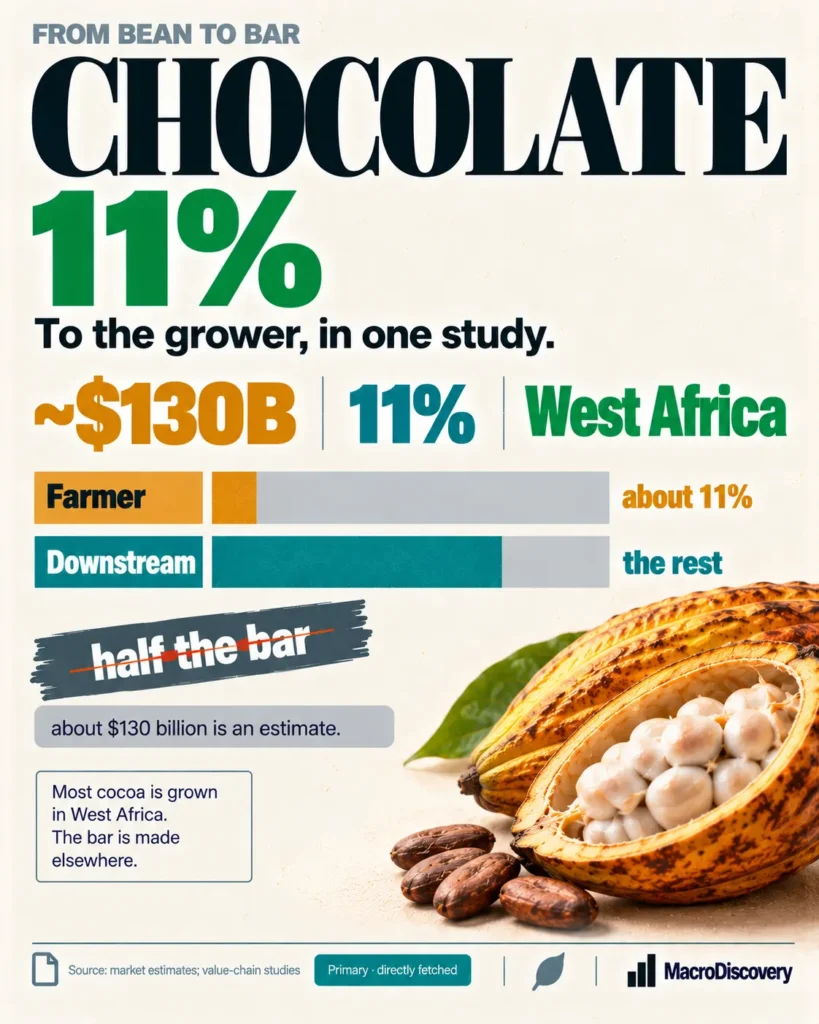
The global market is about $130 billion. Côte d’Ivoire and Ghana supply roughly 60% of the world’s cocoa. Farmers typically receive about 6–11% of the retail price of a bar.
Three numbers
- About $130 billion — recent estimates of the global chocolate market. Source: market research reports for 2025–2026.
- Roughly 60% — the share of world cocoa production from Côte d’Ivoire and Ghana. Source: industry and trade data.
- 6–11% — typical farmer share of the retail price of a chocolate bar. Source: value-chain studies.
What the data shows
A common claim is that a chocolate bar mostly pays the farmer who grew the cocoa. The fact is that farmers typically receive about 6–11% of the retail price. Studies of European chocolate chains show that manufacturers and retailers capture the majority of the value and most of the margin. One analysis found that about 70% of total value and 90% of total margins accrue to brands and retailers. Upstream actors in producing countries, from farm to export, generate a much smaller share.
Côte d’Ivoire and Ghana together supply roughly 60% of the world’s cocoa. Most of the rest comes from other tropical countries. Almost all of the value is added after the beans leave the farm. Beans are exported, ground into liquor, butter and powder, then combined with sugar, milk and other ingredients, molded, packaged and sold. The final bar is a manufactured product. The farm-gate price is only one input.
The global chocolate market is about $130 billion in recent estimates. Figures vary by source and year. Europe is the largest regional market. A handful of large manufacturers — Mars, Mondelēz, Ferrero, Hershey and Nestlé — account for a substantial share of sales. Premium and dark segments are growing faster than the mass market in some forecasts, but the structure of the value chain remains the same. The farmer’s share of retail has declined over decades. In the 1970s, when cocoa prices were high, cocoa accounted for a much larger fraction of the bar’s value. Today it is a small fraction.
| Stage | Typical share of retail value |
|---|---|
| Cocoa farmer | 6–11% |
| Collection, export, processing | Smaller upstream share |
| Manufacturers and retailers | Majority of value and margin |
Shares vary by product, country and contract. Sources: BASIC / FAO value-distribution studies, Fairtrade and industry analyses.
How it was measured
Market size comes from recent industry research reports that estimate global retail or industry value in the range of roughly $128–133 billion for 2025–2026. Production shares come from trade and industry data on Côte d’Ivoire and Ghana. Farmer share comes from value-chain studies that track the retail price of a finished bar back to the farm-gate price of the cocoa used in it. These are averages. Specialty and direct-trade bars can return more to the farmer in absolute terms, but the share of retail remains small in most cases.
What it means
It is settled that the chocolate market is on the order of $130 billion and that Côte d’Ivoire and Ghana supply most of the world’s cocoa. It is settled that farmers receive a small share of the retail price of a typical bar. It is not settled that every bar returns the same percentage. Use about $130 billion for the market. Use roughly 60% for Côte d’Ivoire plus Ghana. Use 6–11% for the farmer share of retail. Do not treat the retail price of a bar as a direct measure of farm income.
Common misreadings
- A chocolate bar does not mostly pay the farmer. The share is about 6–11% in most studies.
- Most cocoa is grown in West Africa. Most of the value is added after the beans leave the farm.
- Specialty premiums raise the absolute farm price. They do not automatically raise the share of retail.
Where the numbers come from
How we built this
- Dataset: Recent market research reports on chocolate market size, trade data on cocoa production, and value-chain studies of European chocolate chains.
- Scope: Commodity and mass-market chains as the baseline. Specialty and direct-trade noted as raising absolute prices but not automatically the retail share. Market size is industry or retail value, not farm-gate value.
- Figures: About $130 billion is the market. Roughly 60% is Côte d’Ivoire plus Ghana. 6–11% is the farmer share of retail. The retail price is treated as not a direct measure of farm income.