How Airlines Actually Make Money
Airline tickets are often sold at a loss. Here is where the profit comes from.
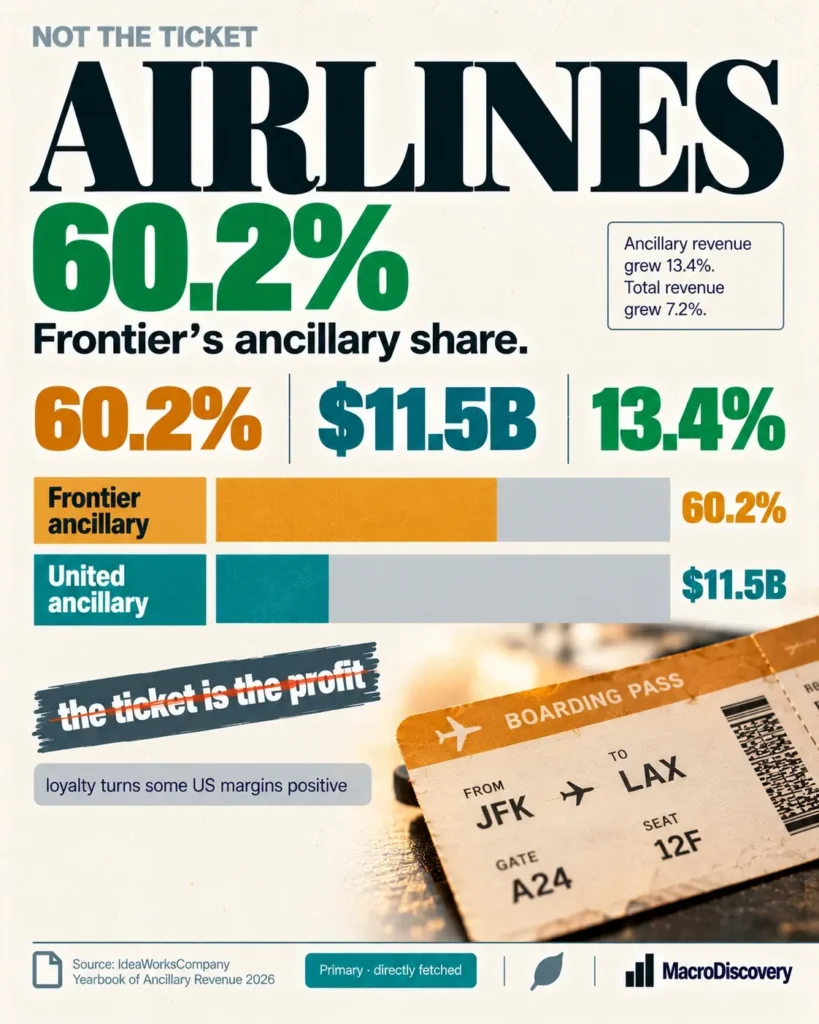
Base fares are frequently priced near cost. Ancillary revenue from bags, seats and loyalty programs is where the margin concentrates. Frontier gets 60% of its revenue from extras. Four large U.S. airlines generated $27.9 billion from frequent flyer programs in 2025. Industry net margins are about 4%.
Three numbers
- 60% — Frontier Airlines’ ancillary revenue as a share of total revenue in 2025. Source: IdeaWorks Yearbook of Ancillary Revenue.
- 13.4% — growth in ancillary revenue among comparable airlines, nearly twice the 7.2% growth in total revenue. Source: IdeaWorks.
- $27.9 billion — combined frequent flyer program revenue for American, Delta, Southwest and United in 2025. Source: IdeaWorks.
What the data shows
A common claim is that airlines make their money from the ticket price. The fact is that base fares are often priced near or below the cost of operating the seat, especially on ultra-low-cost carriers. Profit is concentrated in ancillary revenue — checked bags, seat selection, branded fares, onboard sales — and in loyalty programs that sell miles to banks. Industry net margins are thin, around 4% in recent IATA estimates. The seat itself is frequently the loss leader.
Among 58 airlines tracked in both the 2025 and 2026 IdeaWorks Yearbooks, ancillary revenue rose 13.4% while total revenue rose 7.2%. That is nearly twice as fast. Thirty airlines generated at least $1 billion in ancillary revenue in 2025. Frontier led the share ranking at 60.2%. Spirit and Allegiant were close behind. For these carriers, extras are larger than the base ticket. United led in absolute ancillary revenue at $11.5 billion.
For the largest U.S. network airlines, loyalty is the dominant piece. American, Delta, Southwest and United generated a combined $27.9 billion from their frequent flyer programs in 2025 — about $38 per passenger on average. Most of that cash comes from selling miles to credit-card issuers. The bank pays the airline whether or not the cardholder is flying. Cargo is a separate, smaller stream. The structure is the same across the industry: the ticket gets the passenger on the plane; the fees and the miles generate the margin.
| Source | Share or amount |
|---|---|
| Frontier ancillary share | 60.2% of total revenue |
| Ancillary growth (comparable set) | +13.4% |
| Four U.S. loyalty programs | $27.9 billion |
| Industry net margin | ~4% |
Ancillary includes a la carte fees, branded fares and loyalty. Sources: IdeaWorksCompany Yearbook of Ancillary Revenue 2026, IATA.
How it was measured
Ancillary revenue is defined by IdeaWorks as revenue beyond the base fare: bags, seats, branded products, commissions and frequent flyer programs. Growth figures compare the same 58 airlines across two yearbook editions. Loyalty totals are disclosed by the carriers and compiled in the yearbook. Industry margin comes from IATA’s outlook. The claim that tickets are sold at a loss is strongest for ultra-low-cost carriers; network carriers still earn substantial ticket revenue, but their highest-margin streams are ancillary and loyalty.
What it means
It is settled that ancillary revenue is growing faster than total revenue and that ultra-low-cost carriers can derive more than half their revenue from extras. It is settled that the four largest U.S. loyalty programs generated $27.9 billion in 2025. It is not settled that every airline loses money on every ticket. Use 60% for Frontier’s ancillary share. Use 13.4% for the growth differential. Use $27.9 billion for the four U.S. loyalty programs. Do not treat the base fare as the main source of airline profit.
Common misreadings
- The ticket price is not the main profit source. Bags, seats and loyalty programs are.
- 60% is Frontier’s share, not the industry average. Most network carriers are lower.
- Loyalty revenue is mostly miles sold to banks, not the cost of free flights.
Where the numbers come from
How we built this
- Dataset: IdeaWorks Yearbook of Ancillary Revenue for carrier-level shares and growth; IATA for industry margins.
- Scope: Ancillary defined as revenue beyond the base fare. Loyalty includes miles sold to banks. Ultra-low-cost carriers separated from network carriers where the economics differ.
- Figures: 60% is Frontier’s share. 13.4% is the growth differential. $27.9 billion is the four U.S. loyalty programs. The base fare is treated as the loss leader for many carriers.