The Economics of Diamonds
Diamonds are common. Their value is entirely constructed. Here is how.
Diamonds are common. Their value was constructed by supply control and marketing. Lab-grown diamonds are chemically identical and now account for about 61% of US engagement rings by units. Wholesale lab-grown prices have fallen roughly 90% since 2018.
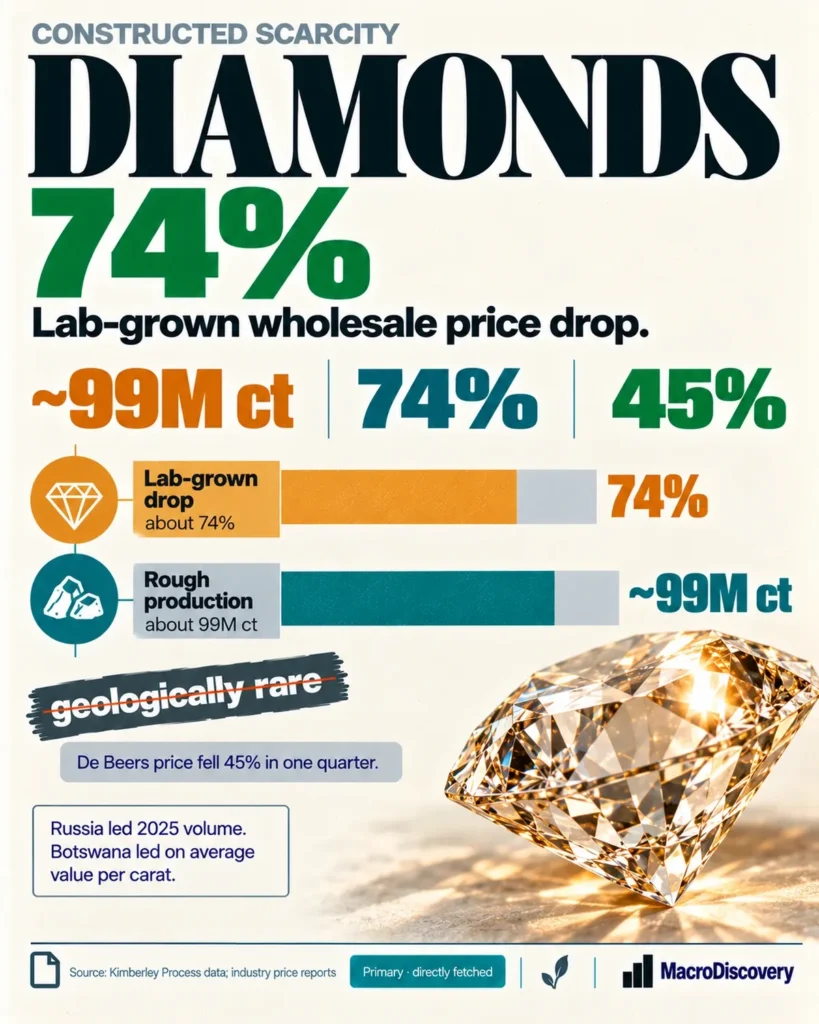
Three numbers
- 61% — share of US engagement ring purchases by units that were lab-grown in 2025. Source: industry reports cited at Dubai Diamond Conference and other trade data.
- ~90% — approximate decline in wholesale lab-grown diamond prices since 2018. Source: De Beers and industry tracking.
- Identical — lab-grown diamonds are chemically and structurally the same as mined diamonds. They are not simulants. Source: standard gemology.
What the data shows
A common claim is that diamonds are rare and therefore intrinsically valuable. The fact is that gem-quality diamonds were never scarce in the absolute geological sense that the price implies. Their high retail value was constructed. For decades De Beers controlled a large share of rough supply, stockpiled stones to manage availability, and funded the “A Diamond Is Forever” campaign that linked diamonds to engagement and lasting commitment. That combination of supply restriction and cultural marketing set the price far above production cost. When supply can be controlled and demand is shaped by advertising, price is not a pure reflection of geological rarity.
Lab-grown diamonds broke that construction. They are real diamonds — the same carbon lattice formed under high pressure and temperature, grown in reactors in days rather than over billions of years. They are not cubic zirconia or glass. As production capacity expanded, especially in China, wholesale prices collapsed. Multiple industry sources put the decline at roughly 90% since De Beers launched its own Lightbox lab-grown line at $800 per carat in 2018. By 2025 lab-grown stones accounted for about 61% of US engagement ring purchases by units, up from low single digits earlier in the decade. Finished lab-grown stones now routinely sell for 80–90% less than comparable natural stones. The scarcity narrative that supported natural diamond prices no longer holds for the majority of engagement rings.
Natural diamond prices have also fallen. De Beers has reported sharp declines in average realised price per carat while volumes fluctuated. The company has taken large write-downs and is being sold by its owner. Some mines have paused or closed. The economics have shifted from a managed scarcity model to a bifurcated market: natural stones still command a premium based on origin and marketing, while lab-grown stones price closer to production cost. The claim that diamond value is inherent has been tested by the ability to grow identical stones at industrial scale. The data show that value was constructed — and that construction is now under direct pressure from unlimited supply.
| Element | What changed |
|---|---|
| Supply control | De Beers managed rough availability for decades |
| Marketing | “A Diamond Is Forever” linked stones to commitment |
| Lab-grown share | ~61% of US engagement rings by units (2025) |
| Price decline | Lab-grown wholesale down ~90% since 2018 |
Lab-grown share from industry reports on US engagement rings. Price decline from De Beers statements and industry tracking. Chemical identity is standard gemology. Historical supply control and marketing are documented industry history.
How it was measured
Lab-grown market share comes from industry surveys of US engagement ring purchases by units. Price declines are tracked by De Beers and independent diamond research. Chemical identity is established by gemological analysis. The claim of inherent rarity is contradicted by the ability to produce identical stones at scale and by the historical role of supply management and advertising in setting prices.
What it means
It is settled that lab-grown diamonds are chemically identical to mined diamonds and that their prices have fallen sharply. It is settled that they now represent a majority of US engagement ring purchases by units. It is settled that diamond value was shaped by supply control and marketing. It is not settled that natural diamonds will lose all premium — origin and branding still support higher prices for some buyers. Use the ~90% price drop and the 61% unit share as the measurable shift. Do not treat diamond prices as a pure reflection of geological scarcity.
Common misreadings
- Diamonds are not inherently rare in the way the historical price suggested. Value was constructed.
- Lab-grown diamonds are real diamonds, not fakes or simulants.
- The collapse in lab-grown prices and their high share of engagement rings has undercut the scarcity model.
Where the numbers come from
How we built this
- Dataset: Industry reports on lab-grown share, De Beers price data, gemological identity of lab-grown stones.
- Scope: Constructed value through supply control and marketing. Lab-grown disruption. Price collapse and market share shift.
- Figures: 61% US engagement ring share. ~90% lab-grown price drop since 2018. Chemically identical.