
How the Banking System Works
Every time you make a payment, here is exactly what happens in the next 3 seconds.
A card payment is authorized in 1–3 seconds. The issuer checks funds and places a hold. No money moves at that moment. Clearing and settlement occur later, typically over 1–3 business days. Interbank settlement uses systems such as Fedwire.
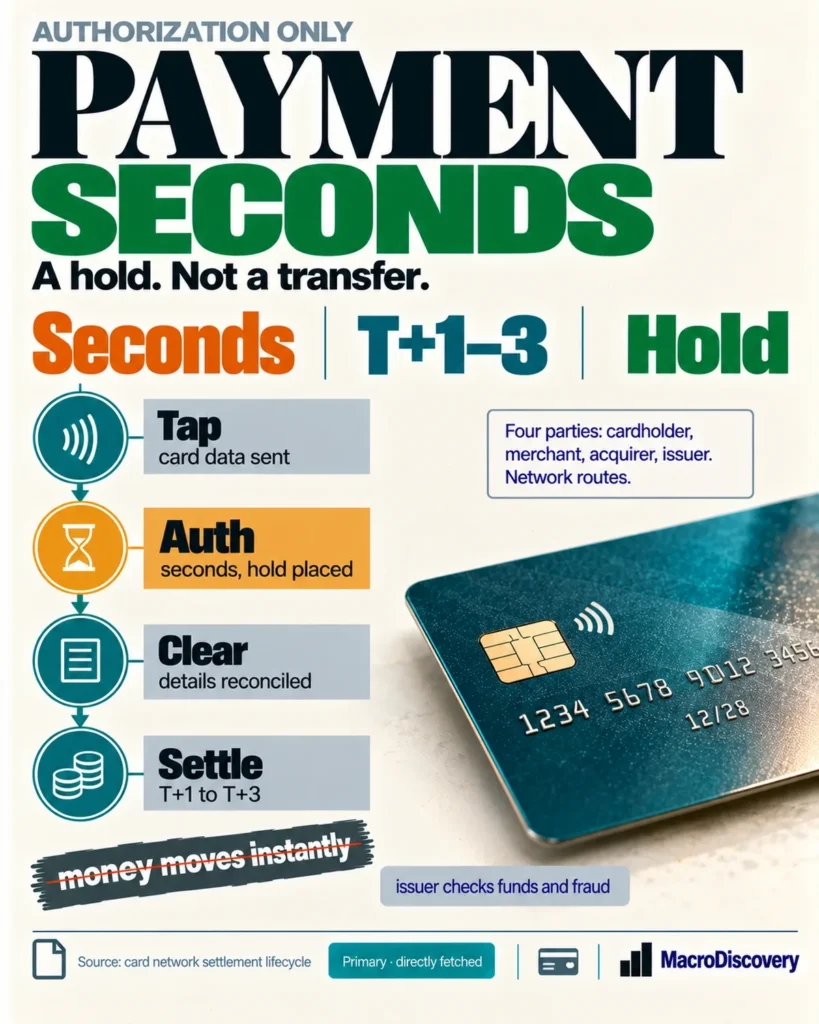
Three numbers
- 1–3 seconds — typical time for card authorization from terminal to issuer and back. Source: standard card network authorization process.
- Hold only — an approval reserves funds or credit. No money is transferred during authorization. Source: card network rules and issuer practice.
- 1–3 business days — typical window for clearing and settlement of card payments. Interbank transfers use systems such as Fedwire. Source: Federal Reserve and network settlement cycles.
What the data shows
A common claim is that money moves the moment a card is approved. The fact is that the first 1–3 seconds contain only authorization. When you tap or insert a card, the terminal sends an encrypted request to the merchant’s bank (the acquirer). The acquirer routes it through the card network (Visa or Mastercard) to the bank that issued the card (the issuer). The issuer checks that the account is open, that sufficient funds or credit exist, and that fraud rules are satisfied. It returns an approval or decline code. The entire round trip normally finishes in 1–3 seconds. An approval places a temporary hold on the available balance or credit line. No funds leave the issuer, and the merchant has not yet been paid. The message is a promise, not a transfer.
Clearing and settlement come later. The merchant typically batches the day’s approved transactions and submits them to the acquirer. The network routes the finalized amounts to the issuers. Fees are calculated. Settlement then moves the net amounts between banks. For most card payments this occurs over 1–3 business days. Interbank transfers in the United States use the Federal Reserve’s Fedwire Funds Service for large-value or final settlement. Fedwire is a real-time gross settlement system: each payment is processed individually, debited and credited simultaneously, and is immediate and irrevocable once settled. ACH operates on a deferred net settlement model and typically takes one to three business days (or same-day windows). Instant systems such as FedNow settle in seconds for participating banks, but they are not the default rail for ordinary card purchases.
The three-second window therefore ends with an authorization code and a hold. The merchant can release the goods. The cardholder sees a pending charge. Actual money movement waits for clearing and settlement. An authorization can expire if not captured within the network window. The distinction is structural: authorization answers whether the payment can proceed; settlement executes the transfer. The banking system separates the real-time decision from the later movement of funds.
| Step | What happens | Timing |
|---|---|---|
| Authorization | Issuer checks and places hold | 1–3 seconds |
| Clearing | Final amounts and fees confirmed | Batch, same or next day |
| Settlement | Funds move between banks | 1–3 business days |
| Fedwire | Real-time gross interbank settlement | Immediate and irrevocable |
Authorization timing and hold-only nature are standard card network practice. Settlement windows from network cycles. Fedwire description from Federal Reserve operating rules: real-time gross settlement with immediate finality.
How it was measured
Authorization timing is the observed round-trip of card network messages. The hold-only rule is defined in network operating rules: an approval reserves funds but does not transfer them. Settlement timing follows network cycles and the Federal Reserve’s Fedwire and ACH schedules. The claim that money moves in the first three seconds is contradicted by the separation of authorization from settlement.
What it means
It is settled that card authorization completes in 1–3 seconds and creates only a hold. It is settled that clearing and settlement occur later, typically over 1–3 business days. It is settled that Fedwire provides immediate irrevocable settlement for interbank transfers. It is not settled that every payment type follows the same timeline — ACH, wires and instant rails differ. Use the 1–3 second authorization and the later settlement window as the measured sequence for ordinary card payments. Do not treat an “approved” message as completed money movement.
Common misreadings
- An “approved” message does not mean money has moved. It means a hold has been placed.
- The first 1–3 seconds contain only authorization. Settlement is separate and later.
- Different rails (ACH, Fedwire, FedNow) settle on different schedules.
Where the numbers come from
How we built this
- Dataset: Federal Reserve Fedwire and ACH rules. Standard card network authorization and settlement cycles.
- Scope: Ordinary card payment sequence. Distinction between authorization and settlement. Interbank rails.
- Figures: 1–3 seconds authorization. Hold only. 1–3 business days settlement.