The Future of Surveillance
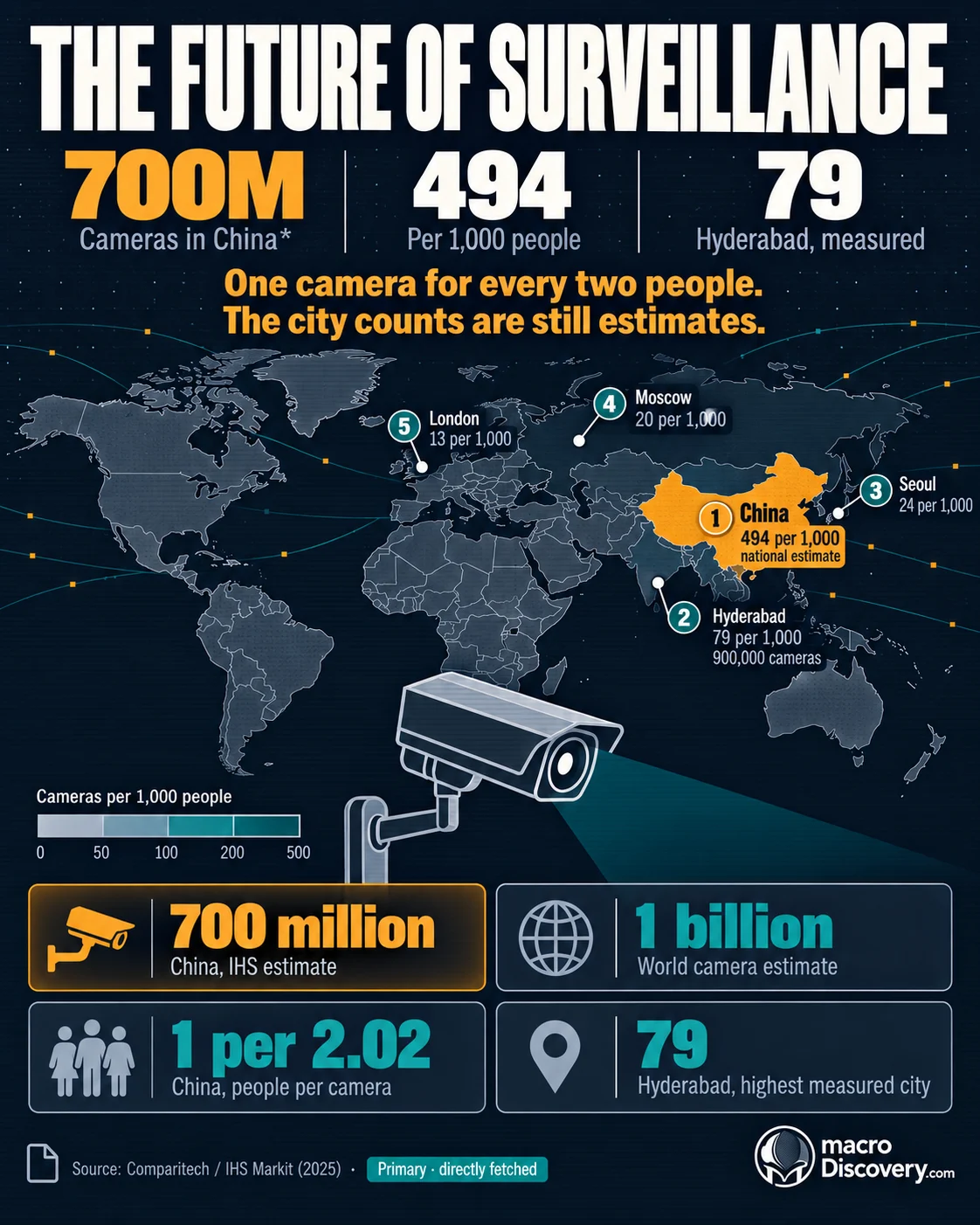
China has more CCTV cameras than any country. One for every two people.
That ratio is a national estimate divided by population, not a census. Cities with published camera counts are far lower.
Three numbers
- 700 million — the camera estimate Comparitech uses for China. It is an IHS Markit-style figure, not an inventory. Source: Comparitech.
- 494 per 1,000 — that estimate divided by 1.42 billion people. Almost one for every two, only if the estimate is right. Source: Comparitech.
- 79 per 1,000 — Hyderabad, the highest city in the later ranking with a published camera count. Source: Comparitech.
What the data shows
A common claim is that China has more CCTV cameras than any country, one for every two people. The fact is that the ratio is not a count of cameras. Comparitech, updated in June 2025, takes an IHS Markit suggestion of about 1 billion cameras worldwide from 2021, assigns 700 million of them to China, and divides by a UN population of 1.42 billion. The result is 494 cameras per 1,000 people. That is almost one for every two. Comparitech says Chinese city figures are old, inconsistent, and often unpublished, so it applied this national ratio to cities. A Shanghai bar at 494 per 1,000 is the national estimate pasted onto the city population.
Older public-camera counts were lower. Comparitech’s earlier city file put Chongqing at 168 cameras per 1,000, Shenzhen at 159, Shanghai at 113, and Beijing at 40. An older IHS-based report put China’s share of a 2021 global billion nearer 540 million, not 700 million. A 2019 industry roundup put China at 200 million cameras and the United States at 50 million, with the United States slightly ahead per person. The series do not match. Public cameras, private cameras, and projected installs are different stocks.
Where a city count is published, the densities are smaller. In Comparitech’s later ranking, Hyderabad leads at 79 cameras per 1,000 people, about 900,000 cameras. Indore is 72. Bangalore is 41. London is about 13. New York is about 10. Los Angeles is about 12. Those are mostly public cameras. Private cameras are often left out, so the lived total can be higher. A camera on a pole is not the same as a face match. The 700 million figure is not a measure of recognition coverage.
One for every two people is 500 per 1,000. The China bar is 494 only if the 700 million estimate is right.
| Count | Figure | What it is |
|---|---|---|
| China, Comparitech | 700 million | Estimate. Not an inventory |
| China ratio | 494 per 1,000 | 700 million divided by 1.42 billion |
| Chongqing, older file | 168 per 1,000 | Published public-camera count |
| Hyderabad | 79 per 1,000 | Highest later city with a published count |
| London / New York | 13 / 10 per 1,000 | Public cameras in the same ranking |
How it was measured
Comparitech collects government reports, police pages, and news counts for public cameras, then divides by population. For China it does not do that city by city. It uses the national estimate and spreads it. IHS Markit is a market-research projection of installed cameras, including private systems. A projection is not a register of working cameras.
Public and private stocks should not be compared as if they were one series. A shop camera and a police camera both count in some national estimates. City rankings often keep only government cameras. Density per 1,000 people is not cameras per square kilometre, and neither is a measure of who is identified.
What it means
It is settled that published estimates put China far above other countries in camera stock, and that the 494-per-1,000 line is that estimate divided by population. It is not settled that the country has been counted at one camera for every two people. Use 700 million as an estimate. Use 79 per 1,000 for the highest city with a published count in the later ranking. Do not use a city chart that copies the national ratio as a city census.
Common misreadings
- This ratio is not a census. It is 700 million divided by 1.42 billion.
- A Chinese city bar at 494 per 1,000 is the national ratio, not a city count.
- A camera count is not facial-recognition coverage. Public and private cameras are different stocks.
Where the numbers come from
How we built this
- Dataset: Comparitech city surveillance file, June 2025 update; Visual Capitalist tabulation of the published-city ranking; IHS Markit estimates as cited by those sources.
- Scope: Camera stock and cameras per 1,000 people. Recognition accuracy, arrests, and crime rates excluded.
- Figures: 700 million and 494 per 1,000 kept as an estimate. City bars use published public-camera counts. The national ratio is not treated as a city census.