How Companies Die
The average Fortune 500 company lasts 15 years. Here is why they disappear.
That line is an S&P 500 index-tenure forecast, not company life. Fortune put the 2024 average age at 83 years.
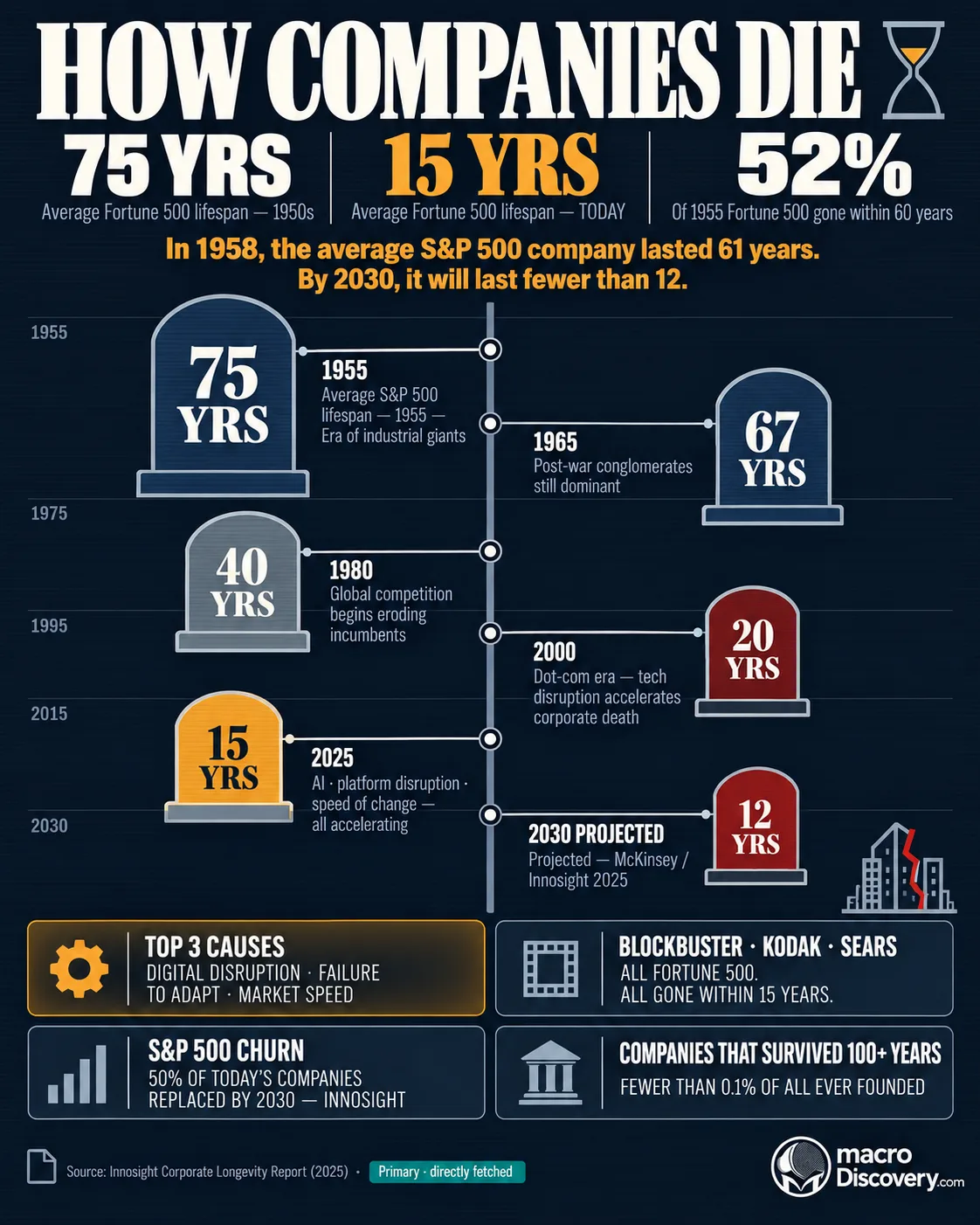
Three numbers
- 83 years — average age of a Fortune 500 company in 2024, from founding. Source: Fortune.
- 49 — companies from the first 1955 list still on the 2024 list. Source: Fortune.
- 15–20 years — Innosight’s forecast of average tenure on the S&P 500 this decade. Index tenure, not firm death. Source: Innosight.
What the data shows
A common claim is that the average Fortune 500 company lasts 15 years. The fact is that figure is not company age, and it is not the Fortune 500. Fortune put the average age of a company on the 2024 list at 83 years. The oldest, Molson Coors, was founded in 1774. The youngest, GXO Logistics, was a 2021 spinoff, three years old. Age and list rank are different counts.
The 15-year line comes from Innosight’s work on the S&P 500, a market-value index, not a revenue list. Innosight’s 2021 forecast said the 30- to 35-year average tenure of the late 1970s would shrink to 15 to 20 years this decade. An earlier briefing put tenure at 33 years in 1965, 20 years in 1990, and a forecast of 14 years by 2026. A 2012 note, using a seven-year rolling average, put 1958 tenure at 61 years and the then-current figure at 18. These are years in the index. A firm leaves if its market value falls below the cutoff, or if it is bought.
Leaving the Fortune 500 is also not a death. The list ranks U.S. companies by revenue. Fortune reported that 49 of the 1955 names were still on the 2024 list. The rest merged, fell below the revenue cutoff, were renamed or split, or failed. Exxon and Mobil left as separate names and remained as Exxon Mobil. General Electric split. Bankruptcy is one path. It is not the definition of the 15-year figure.
Age is years since founding. Tenure is years in the S&P 500. They are not the same clock.
| Count | Figure | What it is |
|---|---|---|
| Fortune 500 average age, 2024 | 83 years | From founding. Not years on the list |
| 1955 names still listed, 2024 | 49 of 500 | Still large enough by revenue |
| S&P tenure, late 1970s | 30–35 years | Years in the index. Innosight |
| S&P tenure forecast, this decade | 15–20 years | Forecast. Not a death count |
| New establishments, 5 years | 51% still open | BLS, March 2020 cohort. Not Fortune 500 |
How it was measured
The Fortune 500 ranks U.S. companies by annual revenue. A company can be old and new to the list, or young and already on it. DoorDash, founded in 2013, made the 2024 list. A firm founded in 1859 made it in the same year. Innosight measures how long a name stays in the S&P 500, then fits a trend. The 15-year figure is the low end of a forecast range, not an average of closed firms.
Small-firm survival is a third count, often mixed in. Bureau of Labor Statistics establishment tables, observed in March 2025, show 77.9% of the March 2024 birth cohort still open after one year, and 51.4% of the March 2020 cohort still open after five years. An establishment is a location with jobs. Closing one is not a Fortune 500 bankruptcy.
What it means
It is settled that the 2024 Fortune 500 is old on average, that only 49 of the 1955 names are still listed, and that S&P 500 tenure is shorter than it was in the 1970s. It is not settled that the average Fortune 500 company dies at 15. Use 83 years for age. Use 49 for list survival since 1955. Use 15 to 20 years only as Innosight’s index-tenure forecast. Do not use 15 years as a lifespan.
Common misreadings
- This figure is not Fortune 500 age. It is a forecast of years in the S&P 500.
- Leaving a list is not closing. A merger, a spinoff, or a revenue drop all remove a name.
- The five-year small-business rate is not the Fortune 500 rate. BLS counts establishments.
Where the numbers come from
How we built this
- Dataset: Fortune 2024 list notes; Innosight 2016 and 2021 S&P 500 tenure series; BLS establishment survival tables observed in March 2025.
- Scope: U.S. large-company lists. Private firms and non-U.S. lists excluded. Small-firm survival shown only as a contrast.
- Figures: 83 is age from founding. 49 is names still ranked. 15 to 20 is a forecast of index tenure, not an average of closed companies.