The Global Vaccine Divide
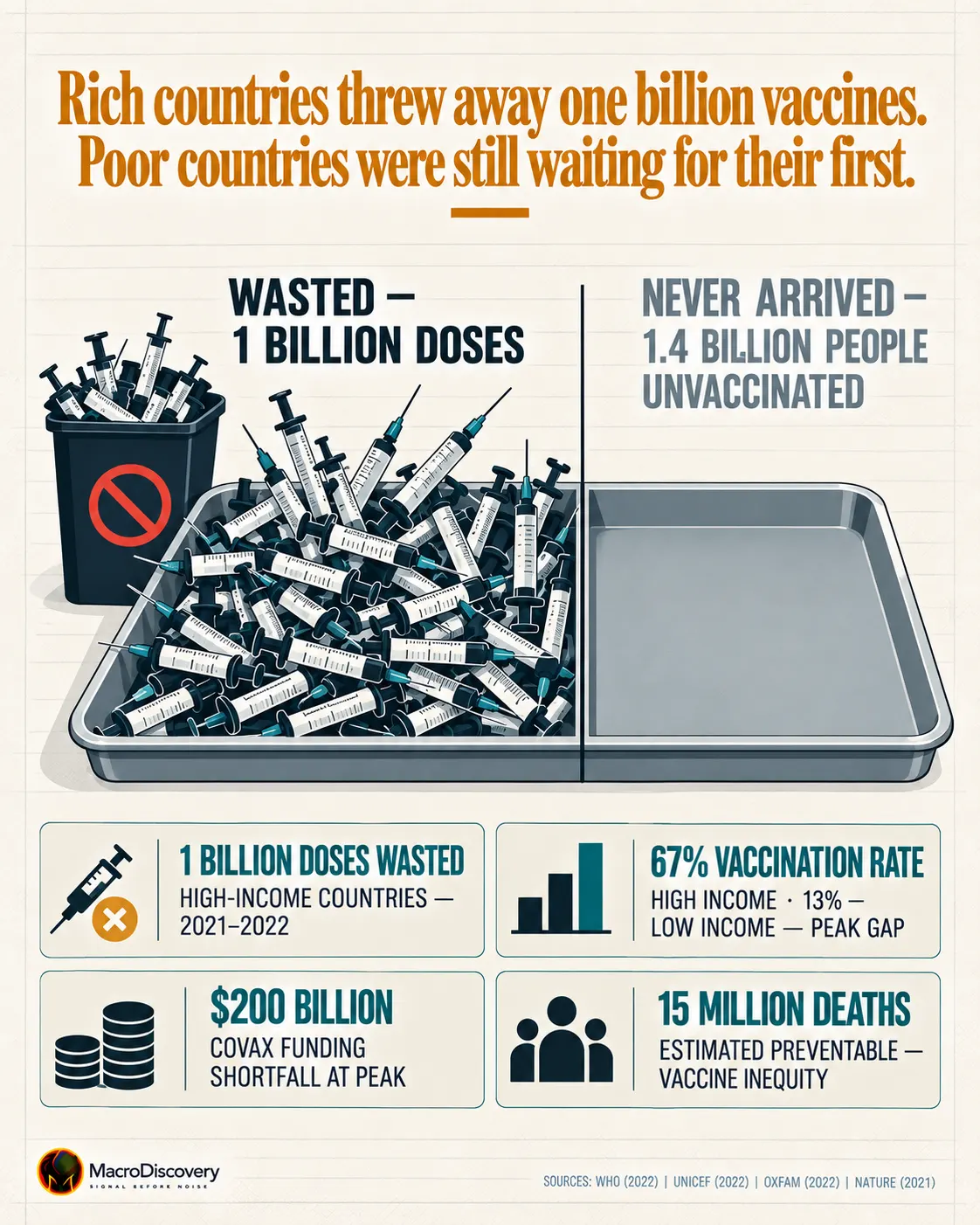
About 1.1 billion COVID doses may have been wasted. Poor countries did not have none.
The 1.1 billion figure is a global model. Primary-series coverage in low-income countries reached 27% by May 2023.
Three numbers
- 1.1 billion — COVID doses Airfinity estimated wasted worldwide by July 2022, using a 10% rate. Source: Airfinity.
- 27 — percent of people in low-income countries who had finished a primary series by May 2023. Source: WHO.
- 76 — percent primary-series coverage in high-income countries by the same date. Source: WHO.
What the data shows
A common claim is that rich countries wasted 1 billion COVID vaccines while poor countries had none. The fact is the 1.1 billion figure is a global estimate, not an audited count of rich-country bins. Airfinity applied a 10% waste rate from June 2021, taken from confirmed US waste and a six-month shelf life. Public reports at the time totaled about 158 million discarded doses.
Low-income countries did receive doses. By May 2023, WHO reported primary-series coverage of 27% in low-income countries and 76% in high-income countries. The early gap was wider. By 1 October 2021, low-income countries had given about 3.6 doses per 100 people. UNICEF said poorer countries rejected more than 100 million COVAX doses in December 2021, mainly because expiry was close. About 15.5 million of those rejected doses were destroyed.
| Measure | Figure |
|---|---|
| Modeled global waste, July 2022 | 1.1 billion doses |
| Publicly reported discards, same period | about 158 million doses |
| COVAX doses rejected, December 2021 | more than 100 million |
| Primary series, low-income, May 2023 | 27% |
| Primary series, high-income, May 2023 | 76% |
| At least one booster, low-income, May 2023 | 3.5% |
Waste estimate from Airfinity. Coverage from WHO. Rejection count from UNICEF.
How it was measured
Airfinity counted supply and assumed 10% of doses produced six months earlier were unused. Gavi had also used a 10% planning rate. The firm said reported waste was lower, which it read as underreporting. The model does not split rich-country bins from doses that expired after donation.
WHO coverage is people who completed a primary series, not doses bought. A country can receive doses and still have low coverage if shots arrive late, lack cold storage, or are refused. UNICEF’s rejection figure is doses offered through COVAX and turned down, mostly for short shelf life.
What it means
It is settled that high-income coverage ran far ahead of low-income coverage, and that late donations with short dates were refused. It is not settled that rich countries alone threw away 1 billion doses, or that poor countries received none. Use the 1.1 billion figure as a model. Use 27% and 76% as the coverage gap.
Common misreadings
- This figure is not an audited count of rich-country waste. It is a 10% global model.
- This does not mean poor countries had no doses. Primary coverage there was 27% by May 2023.
- A rejected donation is not the same as a dose that never left a rich-country warehouse.
Where the numbers come from
How we built this
- Dataset: Airfinity July 2022 waste note; WHO May 2023 coverage; UNICEF December 2021 rejection count.
- Scope: COVID-19 vaccines only. Routine childhood vaccines excluded.
- Figures: 1.1 billion kept as an estimate. 158 million kept as reported discards. Coverage used as published.