The Global Hunger Map
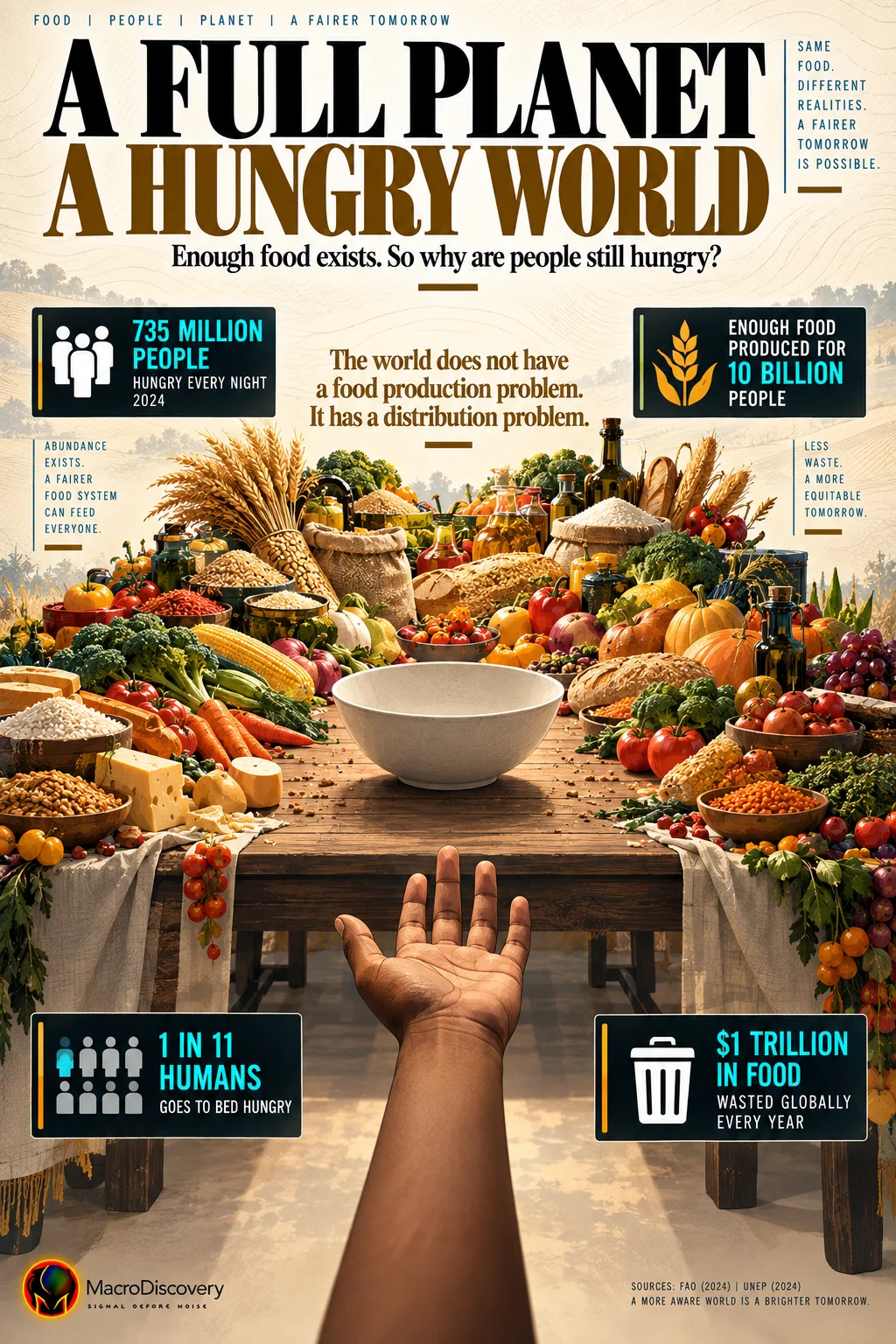
The world already grows more calories than 8 billion people need — enough, on paper, for a 10-billion headcount. In 2025, 645 million people were still hungry.
735 million was an older SOFI snapshot. Africa now holds more of the hungry than Asia. The field is full. The plate is not.
The number that still travels is 735 million. That was the undernourishment point estimate in an earlier State of Food Security and Nutrition in the World vintage. SOFI 2026, covering 2025, puts the point estimate at 645 million — 7.8% of the planet — inside a range of 608 to 696 million. Down about 14 million from 2024 and about 43 million from the 2022 peak. Not zero. Not 735.
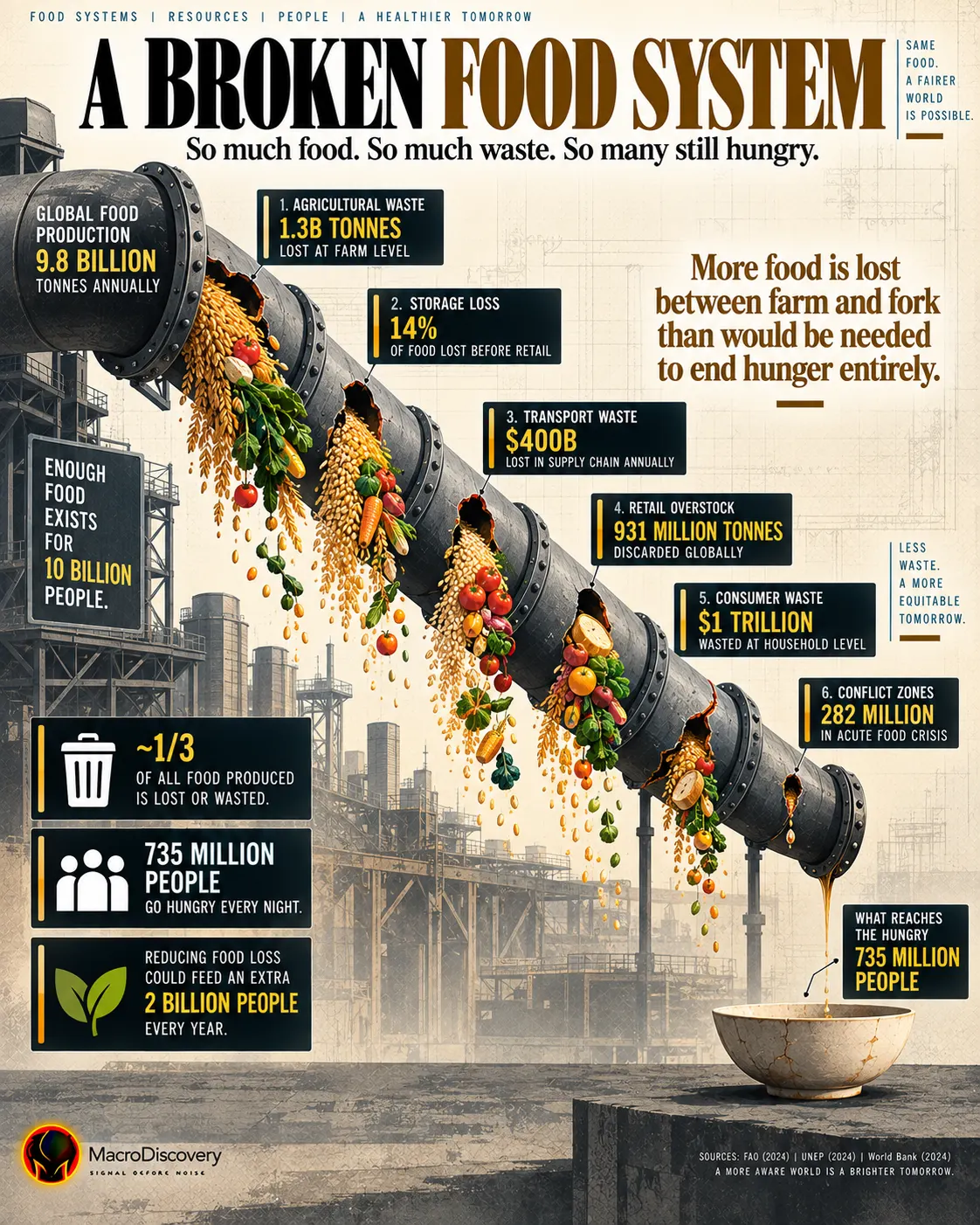
The other half of the subtitle is older still, and it is about calories on farms, not meals. Global crop output already supplies more dietary energy than the current population requires. Researchers tracking cropland calories have shown that farms can theoretically cover well over 10 billion people — one 2020 accounting put the raw calorie pile near 15 billion person-equivalents — but only about half of those calories reach human plates. The rest go to feed, fuel and waste. Hunger, in that frame, is not an empty field. It is a locked pantry.
Africa passed Asia in headcount. Not in share.
- —Africa309M
- —Asia292M
- —Latin America & Caribbean32M
- —World645M
Prevalence: Africa 20.0%, Asia 6.0%, LAC 4.8%. Africa’s share of people who are hungry is still four times Asia’s. The headcount flip is population growth, not a sudden African collapse.
Calories exist. Access does not always.
FAOSTAT food-balance sheets have shown dietary energy supply near 3,000 kilocalories per person per day at the world average — above a basic energy need. That average hides continents. It also hides what happens after the farm gate: animals eat a large share of the crop calorie pile; biofuels take another; households and retailers throw food away.
So the “food for 10 billion” line is a production-capacity claim. Keep it on that shelf. SOFI’s 645 million is a prevalence-of-undernourishment claim. Do not subtract one from the other and call the remainder waste. They are not the same census.
SOFI point estimate
Range 608–696 million. 7.8% of the world.
Earlier SOFI vintage
Do not print it as the 2025 number.
Moderate or severe · 2025
25.8% of the world. Broader than chronic hunger.
SOFI projection
Zero Hunger by 2030 is off the table on this path.
A full field and an empty plate can live in the same year. That is the map. Not a missing harvest.Macro Discovery reading of SOFI 2026 and global calorie-supply accounts
The 10-billion line is a farm. The 645 million line is a kitchen.
People repeat “we grow food for 10 billion” as if hunger were a rounding error in agronomy. The calorie studies that support a 10-billion-plus headcount count grain and oilseed energy before livestock and engines eat it. Once you follow those calories, the surplus shrinks. Hunger then looks like what SOFI says it is: income, conflict, inflation, and a continent whose population is growing faster than its food access.
Africa’s new first-place in the hunger headcount is the quiet sentence in SOFI 2026. Prevalence ticked down from 20.3% to 20.0%. Absolute numbers still rose past Asia because more people live there each year. Asia cut its count hard (India is the large story inside that cut). Latin America kept falling. The global total improved. The geography got worse for Africa.
Editorial reading of SOFI 2026 point estimates and published calorie-allocation research. FAO did not write this box.If you remember two things
645 million hungry. Not 735 million.
7.8% of the world. Range 608–696 million. Third year of decline. Africa 309 million, Asia 292 million.
Farms can cover 10 billion. Plates do not.
Raw crop energy is a surplus. Feed, fuel and waste take a large cut. Hunger is access.
Short answers
One UN hunger book. One calorie shelf.
- Hunger: SOFI 2026 — 645 million undernourished in 2025 (7.8%); range 608–696 million; Africa 309M / 20.0%; Asia 292M / 6.0%; LAC 32M / 4.8%; food insecurity 2.1 billion / 25.8%; 2030 projection 510–520 million.
- 735 million: treated as a prior SOFI point estimate, not the 2025 figure.
- 10 billion: production-capacity claim from global calorie-supply and cropland-energy studies (farms cover well over today’s population; much of the energy never becomes a human meal). Not a SOFI sentence.