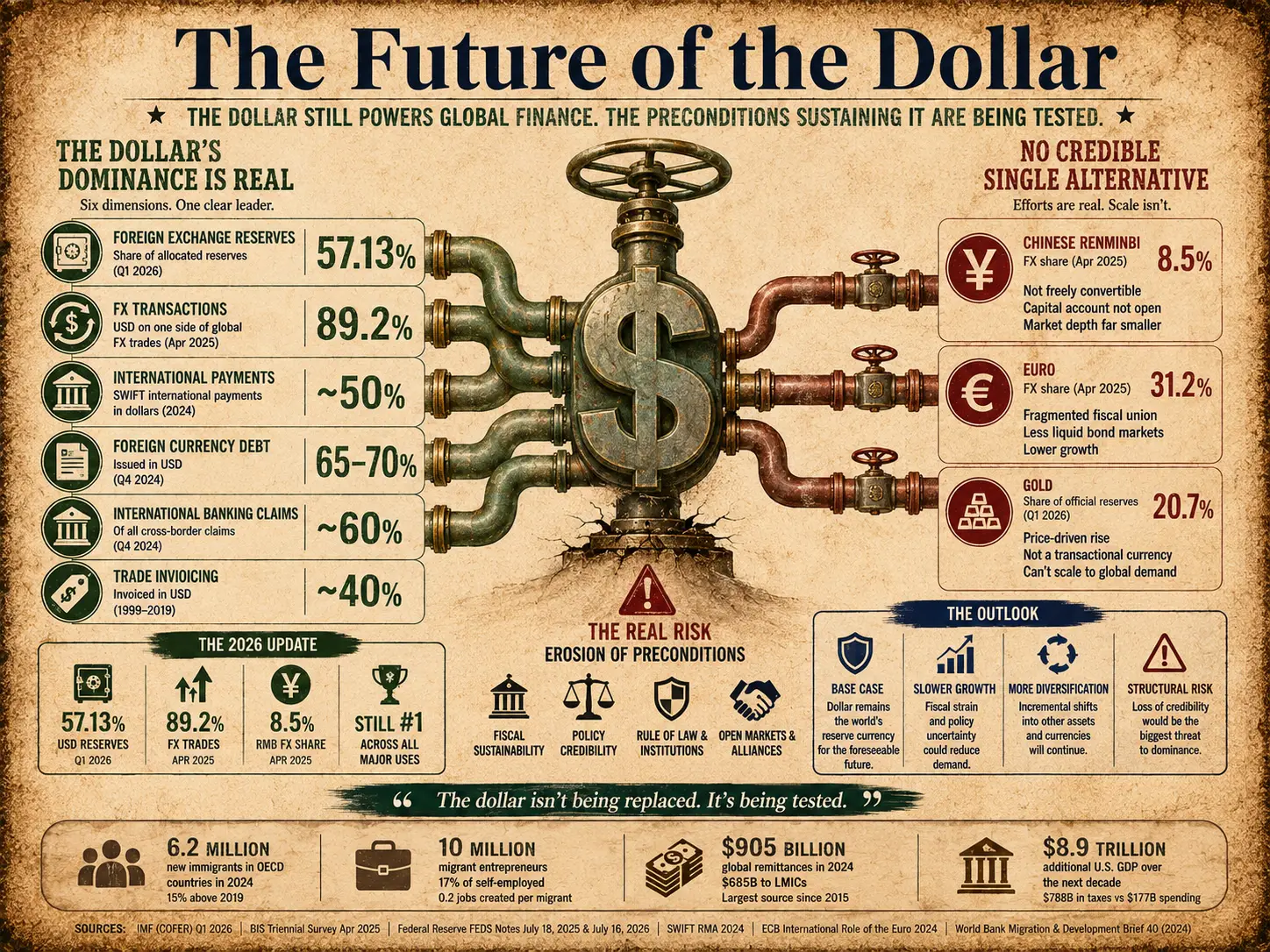
Every major measure of global currency usage tells the same story. The dollar is used in 88% of FX transactions. It anchors half of all SWIFT payments. It denominates 60% of all foreign currency debt outstanding. Its composite index — a weighted average of five measures — has remained between 65 and 70 since 2010. No other currency is close. And yet in 2025, the debate about the dollar’s future has intensified. The question is not whether the dollar is dominant. It clearly is. The question is whether the foundations of that dominance are eroding.
Federal Reserve — “The International Role of the U.S. Dollar – 2025 Edition” · PRIMARY · federalreserve.gov · directly fetched · July 18, 2025 · DOI: doi.org/10.17016/2380-7172.3856 · Authors: Bertaut, von Beschwitz, Curcuru
58%
“The U.S. dollar comprised 58 percent of disclosed global official foreign reserves in 2024 and far surpassed all other currencies including the euro (20 percent), Japanese yen (6 percent), British pound (5 percent), and the Chinese renminbi (2 percent).” — Fed 2025 primary verbatim
The dollar’s 58% reserve share in 2024 is simultaneously a record of decline and a record of endurance. It has fallen from 72% in 2001 — but the Fed’s own framing is clarifying: it “only returned to about the share it had in 1995.” The peak was an anomaly of the dot-com era, when US technology assets made dollar-denominated portfolios uniquely attractive. The return to 1995 levels is the normalization of an exceptional overshoot. More importantly: the dollar’s share has been “basically unchanged since 2022, when it accounted for 58 percent of reserves, suggesting that U.S. sanctions on Russia following the invasion of Ukraine have not led to fears of dollar ‘weaponization’ causing a notable reallocation of reserves out of dollars.” The most cited geopolitical threat to dollar dominance — that US sanctions would prompt a flight from dollar assets — has not materialized in the reserve data. The reason: most foreign holdings of safe US assets are in countries with military ties to the United States. Geopolitical adversaries have nowhere to go. Neither the renminbi (capital controls, trust deficit) nor gold (illiquid, yield-free) nor any other currency offers a credible alternative at scale.
Source: Federal Reserve — “The International Role of the U.S. Dollar – 2025 Edition” (PRIMARY · directly fetched · federalreserve.gov/econres/notes/feds-notes/the-international-role-of-the-u-s-dollar-2025-edition-20250718.html · July 18, 2025 · DOI: doi.org/10.17016/2380-7172.3856 · Authors: Carol Bertaut, Bastian von Beschwitz, Stephanie Curcuru · KEY VERBATIM: “the U.S. dollar comprised 58 percent of disclosed global official foreign reserves in 2024 and far surpassed all other currencies including the euro (20 percent), Japanese yen (6 percent), British pound (5 percent), and the Chinese renminbi (2 percent)” · “the dollar remains by far the dominant reserve currency and only returned to about the share it had in 1995” · “basically unchanged since 2022, when it accounted for 58 percent of reserves, suggesting that U.S. sanctions on Russia following the invasion of Ukraine have not led to fears of dollar ‘weaponization’ causing a notable reallocation of reserves out of dollars” · “The U.S. dollar share of international payments is about 50 percent and has even slightly increased in recent years. If intra-euro area payments are included, the dollar share is even higher at about 60 percent” · “the U.S. dollar was bought or sold in about 88 percent of global FX transactions in April 2022. This share has remained stable over the past 20 years” · “The dollar index level has remained in a narrow range between 65 to 70 since 2010, well ahead of all other currencies”)
“Absent any large-scale, lasting disruptions which damage the value of the U.S. dollar as a store of value or medium of exchange and simultaneously bolster the attractiveness of dollar alternatives, the dollar will likely remain the world’s dominant international currency for the foreseeable future.”
— Federal Reserve — “The International Role of the U.S. Dollar – 2025 Edition” (PRIMARY · directly fetched · federalreserve.gov · July 18, 2025 · DOI: doi.org/10.17016/2380-7172.3856)
Why Gold’s Rise Misleads — and What the Physical Numbers Actually Show
The headline that most concerns dollar watchers is not the reserve share — it is gold. The share of gold in official reserve assets “has more than doubled from below 10 percent in 2015 to over 23 percent now.” Central banks added 1,045 metric tons in 2024, the third consecutive year exceeding 1,000 metric tons. This looks like a flight from dollars. But the Fed’s own primary data reveals a critical nuance: this increase “mostly reflects the over 200 percent increase in the gold price over that period. In contrast, the physical quantity of gold holdings has only increased by less than 10 percent over this period.” Central banks are wealthier in gold because gold got more expensive — not because they systematically bought more of it. The Fed’s research further finds that “increases in gold holdings are generally not associated with a decline in U.S. dollar reserves except for China, Russia, and Turkey.” The gold story is mostly a price story. The de-dollarization interpretation requires more evidence than central bank balance sheets currently provide.
Why it matters: the gold price surge has created a statistical artefact that makes reserve diversification look more dramatic than it is. Most central banks — including in Japan and India — have not significantly increased physical gold holdings. Those that have (Russia, China, Turkey) are acting for geopolitical reasons that don’t apply to the 149 economies tracked in IMF COFER.
Federal Reserve 2025 (PRIMARY · directly fetched) + Atlantic Council Dollar Dominance Monitor (March 9, 2026) + IMF COFER Q2 2025 (PRIMARY)
88%
“The U.S. dollar was bought or sold in about 88 percent of global FX transactions in April 2022. This share has remained stable over the past 20 years.” — Fed 2025 primary verbatim (BIS 2022 Triennial Survey). SWIFT payments: “about 50 percent and has even slightly increased in recent years.”
The 88% FX transaction figure is perhaps the single most striking number in dollar dominance data — and also the most underappreciated. Reserves are what central banks hold on their balance sheets. FX transactions are what the global private market actually uses to buy and sell everything. Every time a Korean electronics manufacturer pays a Taiwanese semiconductor supplier, both are likely using dollars. The dollar is the global vehicle currency: even two non-dollar currencies are often exchanged through the dollar because dollar markets are deeper and cheaper than any bilateral cross-currency pair. This is the “medium of exchange” role — and it is nearly impervious to the forces driving reserve diversification. Even if central banks slowly reduce dollar reserves, the private market will keep using dollars for as long as dollar liquidity is unmatched. The 88% figure has not moved meaningfully in two decades. The SWIFT data tells the same story: the dollar share of international payments is “about 50 percent and has even slightly increased in recent years.” The narrative of a dollar in retreat from transactional dominance is not supported by any primary data source.
Source: Federal Reserve (PRIMARY · directly fetched · July 18, 2025 · verbatim: “the U.S. dollar was bought or sold in about 88 percent of global FX transactions in April 2022. This share has remained stable over the past 20 years” · “The U.S. dollar share of international payments is about 50 percent and has even slightly increased in recent years. If intra-euro area payments are included, the dollar share is even higher at about 60 percent” · citing BIS 2022 Triennial Central Bank Survey) · Atlantic Council Dollar Dominance Monitor (March 9, 2026 · CIPS: 1,573 indirect + 193 direct participants · mBridge: $55.49B cumulative volume by November 2025 · “Trump’s trade policies are causing more countries to signal their intent to diversify from the dollar” · “A large-scale sale of US assets remains unlikely given the depth of US markets and the lack of viable alternatives”) · IMF COFER Q2 2025 (PRIMARY · 56.32% share · “92% of that decline was driven by exchange-rate effects, not central bank portfolio changes” · DXY −10.7% H1 2025)
The Real Risk Is Not Replacement — It Is the Erosion of the Preconditions
The Federal Reserve’s 2025 note contains a critical caveat. It states explicitly that it “is not yet able to show any potential results of the change in the U.S. credit rating or changes to tariff rates in 2025. Rather, it provides a baseline for where the international role of the dollar stood before these announcements.” Moody’s downgraded US government debt in 2025. Tariffs reduced US openness to trade. The DXY fell 10.7% in H1 2025 — the worst drop since 1973. None of this has yet shown up in the reserve and transaction data. But the Fed identifies what would create long-term risk: damage to the dollar’s role as a store of value OR medium of exchange, combined with a simultaneous bolstering of alternatives. The first condition requires sustained policy erosion of US fiscal credibility. The second condition requires China to open its capital account — which it has not done. Neither condition is close to being met. But both are more plausible in 2026 than they were in 2020. The dollar faces no credible replacement. It faces credibility risk.
Why it matters: dollar dominance is not a natural law. It rests on specific preconditions: US fiscal credibility, open capital flows, rule of law, and the depth of US financial markets. These have been the most stable features of the US economy for 80 years. The question of the dollar’s future is ultimately a question about the durability of those preconditions under stress.
Federal Reserve 2025 (PRIMARY · directly fetched) — Challenges Section · also: Moody’s US downgrade 2025 · DXY data H1 2025
~3
The renminbi’s composite index of international currency usage: only about 3 out of 70 for the dollar. “The renminbi is not freely exchangeable, the Chinese capital account is not open, and investor confidence in Chinese institutions is relatively low.” — Fed 2025 primary verbatim. “Their effect has been rather limited thus far.”
The renminbi challenge to dollar dominance is real in China’s bilateral relationships — China now conducts approximately 53% of its own trade in yuan, and mBridge (the CBDC-based cross-border settlement system) reached $55.49 billion in cumulative volume by November 2025 (Atlantic Council). But these are drops in the bucket of global finance. SWIFT clears trillions of dollars daily. The BIS estimates $7.5 trillion in daily FX transactions. The renminbi’s absence from freely convertible international markets — a deliberate policy choice by Beijing, not an accident — means it cannot perform the primary function of a reserve currency: being available to any holder who needs to liquidate it into other assets at any time, in any amount, without restrictions. The Fed notes that “geopolitical adversaries do not have many attractive alternatives to the dollar or the currencies of U.S. allies.” Even Russia, which has made the most aggressive push to de-dollarize its economy since 2022, has found the renminbi’s capital controls to be a substantial constraint. For the EU euro: jointly-backed EU debt reached $700 billion by May 2025 — “a large amount for the EU” but “small compared to the over $28 trillion of U.S. Treasuries outstanding.” No single EU government debt instrument provides the safe haven depth that US Treasuries offer. Until it does, the euro’s reserve role will remain regional rather than global.
Source: Federal Reserve (PRIMARY · directly fetched · July 18, 2025 · verbatim: “the renminbi is not freely exchangeable, the Chinese capital account is not open, and investor confidence in Chinese institutions is relatively low. These factors all make the Chinese renminbi relatively unattractive for international investors” · “China has recently increased various efforts to promote international use of the renminbi, but their effect has been rather limited thus far” · “the EU started to issue an unprecedented amount of jointly-backed debt, which reached about $700 billion by May 2025. While this is a large amount for the EU, it is small compared to the over $28 trillion of U.S. Treasuries outstanding” · “geopolitical adversaries do not have many attractive alternatives to the dollar or the currencies of U.S. allies” · “about 99 percent of stable coin market capitalization is linked to the dollar, implying that crypto assets are de facto traded in dollars” · “By April 2025, the total market capitalization of dollar stablecoins had reached about $220 billion” · “the share of gold in official reserve assets has more than doubled from below 10 percent in 2015 to over 23 percent now. However, this increase mostly reflects the over 200 percent increase in the gold price over that period. In contrast, the physical quantity of gold holdings has only increased by less than 10 percent” · “absent any large-scale, lasting disruptions…the dollar will likely remain the world’s dominant international currency for the foreseeable future”) · Atlantic Council Dollar Dominance Monitor (March 9, 2026 · CIPS: 1,573 indirect + 193 direct participants · mBridge: $55.49B cumulative)