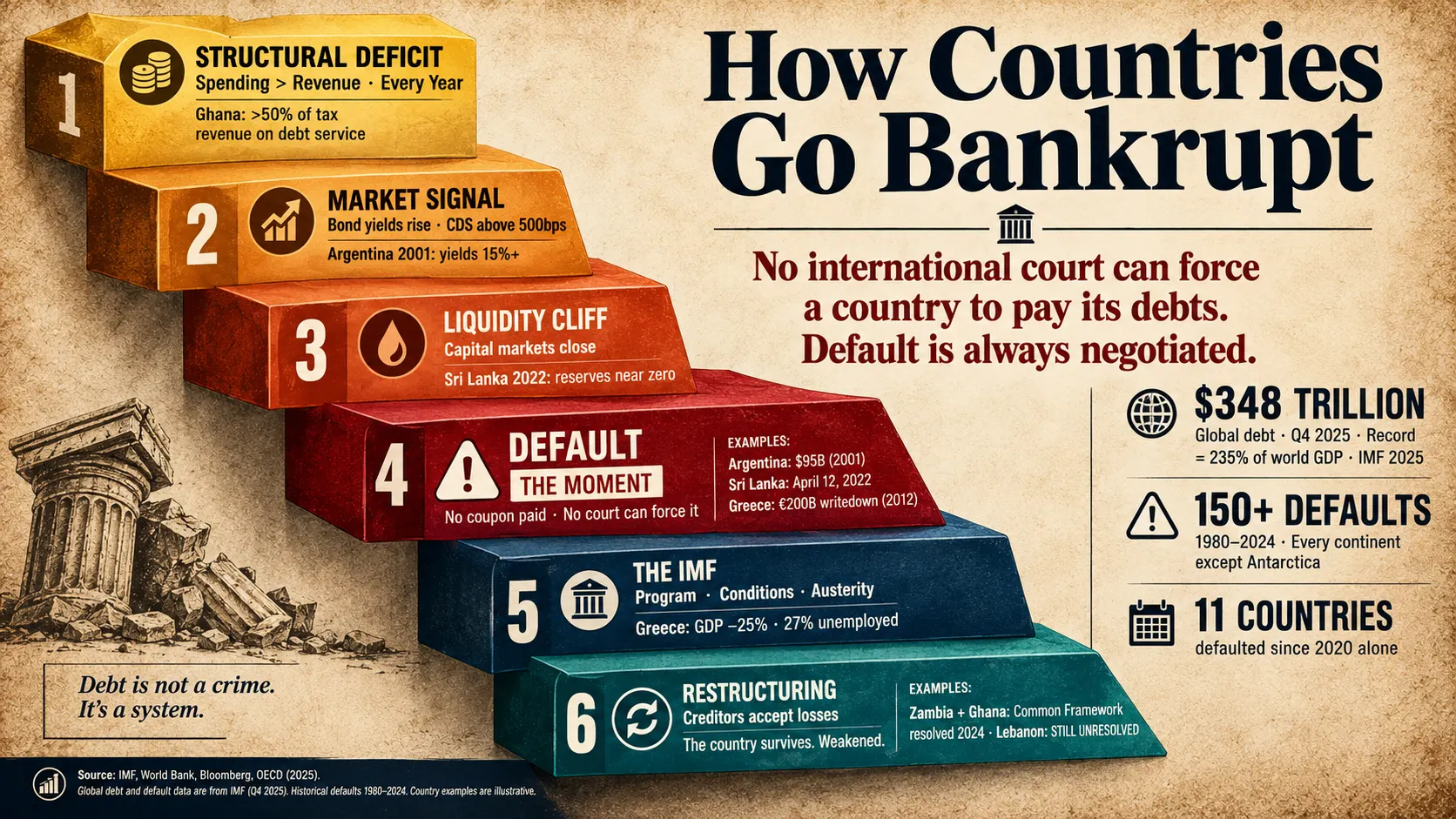
Most people think “bankruptcy” is the same for countries as it is for companies. It is not. When a company cannot pay its debts, a court takes over. Assets are seized. Creditors are paid in order of priority. The process has rules. Sovereign debt has none of these things. When a country cannot pay, what follows is negotiation — chaotic, political, and often very slow. Understanding why requires understanding the fundamental architecture of global finance.
IMF · “Global Debt Remains Above 235% of World GDP” (PRIMARY · imf.org · directly fetched · September 17, 2025) · IIF Global Debt Monitor Q4 2025 (PRIMARY · iif.com)
$348T
“Global Debt Remains Above 235% of World GDP.” — IMF Blog, September 17, 2025. The IIF confirms total global debt hit a record $348 trillion in Q4 2025 — with nearly $29 trillion added in 2025 alone. Debt is “higher and rising faster in 80% of the global economy.” — IMF, May 2025.
The $348 trillion figure encompasses government, corporate, household, and financial sector debt globally. Of this, public (government) debt has grown the most rapidly since 2020. The United States general government debt reached 121% of GDP in 2024, up from 119%. Japan leads at 230%. The IMF’s Fiscal Monitor for April 2026 is titled “Fiscal Policy under Pressure: High Debt, Rising Risks.” The OECD confirms that EMDE (emerging market and developing economy) central government gross borrowing crossed $4 trillion in 2025 — up from $3 trillion in 2024 — with the top five borrowers (China, India, Brazil, Egypt, Argentina) accounting for 78% of the total. Rising debt at this scale does not cause defaults directly. But it increases the sensitivity of the entire system to rising interest rates, currency depreciation, commodity price shocks, and political disruption — all of which can quickly turn a manageable debt position into a crisis.
Source: IMF — “Global Debt Remains Above 235% of World GDP” (PRIMARY · directly fetched · imf.org/en/blogs/articles/2025/09/17/global-debt-remains-above-235-of-world-gdp · September 17, 2025 · © 2026 IMF · Authors: Vitor Gaspar, Carlos Eduardo Goncalves, Marcos Poplawski-Ribeiro · title confirmed via direct URL fetch) · IMF — “Debt is Higher and Rising Faster in 80 Percent of Global Economy” (PRIMARY · imf.org · May 29, 2025 · visible in related content of fetched page) · IIF — Global Debt Monitor Q4 2025 (PRIMARY · iif.com · “$348 trillion in Q4 2025” · “Nearly $29 trillion was added to global debt stockpiles in 2025”) · OECD — Global Debt Report 2026 (PRIMARY · oecd.org · EMDEs crossed $4T borrowing in 2025)
“Global Debt Remains Above 235% of World GDP.”
— IMF Blog, “Global Debt Remains Above 235% of World GDP” (PRIMARY · directly fetched · imf.org · September 17, 2025 · Authors: Vitor Gaspar, Carlos Eduardo Goncalves, Marcos Poplawski-Ribeiro · © 2026 International Monetary Fund)
Why There Is No International Bankruptcy Court — and Why That Matters
The most important fact about sovereign default is structural: there is no international court with the authority to seize state assets, impose a restructuring, or force payment. A country that refuses to pay cannot be compelled. Its government continues to operate. Its army remains intact. This is why sovereign default resolution typically takes years rather than weeks. Greece’s restructuring took from 2010 to 2012. Zambia’s took from 2020 to 2024. Lebanon defaulted in 2020 and remained unresolved in 2025 — five years of legal and political limbo. The negotiation is complicated by the modern creditor mix: the days when a handful of Western commercial banks and the Paris Club of official creditors could be gathered in a room have passed. Today’s sovereign borrowers owe money to international bondholders, bilateral lenders (including China), multilateral institutions, and domestic banks. Each creditor class has different legal claims, different incentives, and different willingness to accept losses.
Why it matters: the absence of a legal framework means that every sovereign default is resolved by power and politics, not by law. Creditors who bought bonds under New York or English law have rights in those courts — but cannot enforce against a foreign government’s assets easily. The gap between what creditors are legally owed and what they will actually collect is where sovereign debt negotiations happen.
Multiple primary sources · IMF PP/25/002 (January 2025) · ODI · Lazard 2020-2025 analysis
11
Eleven countries defaulted on sovereign debt between 2020 and 2025 — the worst wave of sovereign defaults since the 1980s. The cases include Zambia, Ghana, Sri Lanka, Ethiopia, Argentina, Lebanon, Russia, and Suriname. The G20 Common Framework was tested — and found to be slow.
The 2020-2025 sovereign debt wave was triggered by the simultaneous impact of COVID-19 (which destroyed tourism and commodity revenues), the subsequent global inflation shock (which raised import costs and tightened fiscal space), and the 2022-2023 interest rate surge in advanced economies (which raised refinancing costs and caused capital outflows from emerging markets). Zambia and Ghana became the first real tests of the G20’s Common Framework for debt restructuring — a mechanism designed to coordinate creditor groups including China, which had become the world’s largest bilateral sovereign creditor. China’s projected $22 billion in debt repayments from developing countries in 2025 illustrates the scale of its new creditor role. The Common Framework achieved results in Zambia (2024) and Ghana (2024), but both took significantly longer than hoped. Ethiopia’s negotiations remain ongoing. Lebanon never engaged the framework at all.
Source: “Since 2020, 11 countries have already defaulted on their debt obligations, including Zambia, Ghana, Sri Lanka, and Ethiopia” (Global Governance Reimagined, June 2025, citing IMF and World Bank data) · ODI — “Common framework, uncommon challenges: lessons from the post-COVID debt restructuring architecture” (odi.org · “Three landmark bondholder restructurings were concluded by the end of 2024: two, in Ghana and Zambia, were finalised under the Common Framework, and one, Sri Lanka, outside of the CF”) · Lazard — “The 2020-2025 Sovereign Debt Crisis: What have we learnt and what lies ahead?” (lazard.com · acted as sole financial advisor to Argentina, Ecuador, Lebanon, Suriname, Zambia, Ethiopia, Ghana and Sri Lanka) · China $22B: Lowy Institute projection for 2025 repayments
Who Is Next — and Why $348 Trillion of Debt Makes the Question Urgent
The scale of global debt creates systemic fragility. More than half of low-income countries were already in or at high risk of debt distress as of June 2025, according to IMF and World Bank assessments. African government debt stocks more than doubled from $283 billion to $655 billion between 2012 and 2022. Egypt carries a debt-to-GDP ratio near 95% and has a near-term calendar of large bond maturities. Pakistan has stabilised under an IMF program but remains vulnerable. Ethiopia’s Common Framework restructuring has not concluded. The countries that are most at risk share common features: high debt-to-revenue ratios (not just debt-to-GDP), significant foreign currency debt exposure, reliance on commodity exports for foreign exchange, and limited access to domestic capital markets at sustainable rates. History suggests that the catalyst for the next wave will not be predictable in advance — it will be a combination of an external shock (rising rates, commodity crash, regional conflict) and a domestic vulnerability that reaches the breaking point.
Why it matters: the $348 trillion global debt figure is relevant not because high debt always causes crisis, but because it reduces the margin for error. Countries with manageable debt can absorb shocks. Countries that are already over-extended cannot. The question is not if the next sovereign debt crisis will occur. It is when, and where.
IMF / World Bank Assessment (citing June 2025) · IMF Policy Paper PP/25/002 (PRIMARY · January 2025) · IMF Fiscal Monitor April 2026 (PRIMARY)
>50%
More than half of low-income countries are in, or at high risk of, debt distress as of June 2025. African debt stocks more than doubled from $283 billion to $655 billion between 2012 and 2022. The IMF’s April 2026 Fiscal Monitor is titled: “High Debt, Rising Risks.”
The IMF’s own assessment of countries at high risk or in debt distress puts their median debt-to-GDP at 57% — lower than the peak before the Heavily Indebted Poor Countries (HIPC) Initiative of the late 1990s, which itself resolved a major wave of debt crises. But the comparison is imperfect: today’s debt includes far more market debt (eurobonds held by international investors) and Chinese bilateral loans, both of which are harder to restructure quickly than the Paris Club debt that dominated the HIPC era. The IMF’s Global Debt Database and the Common Framework were designed to address these new complexities — but five years of post-COVID restructuring have exposed significant limits. The slowness of the Common Framework, the complexity of China’s creditor role, and Lebanon’s complete inability to progress a restructuring suggest the international architecture for sovereign debt crises needs substantial reform. The world does not lack the mechanisms to identify the next crisis. It lacks the mechanisms to resolve it quickly.
Source: “As of June 2025, more than half of low-income countries are in, or at high risk of, debt distress” (Global Governance Reimagined, June 25, 2025, citing IMF/World Bank) · IMF Policy Paper PP/25/002 “Debt Vulnerabilities and Financing” (PRIMARY · imf.org · January 31, 2025 · “countries assessed at high risk or in debt distress: median debt to GDP ratio of 57 percent”) · IMF Fiscal Monitor April 2026 “Fiscal Policy under Pressure: High Debt, Rising Risks” (PRIMARY · imf.org · title confirmed) · African debt: “African debt stocks more than doubling from USD 283 billion to USD 655 billion between 2012 and 2022” (Global Governance Reimagined citing World Bank data) · OECD Global Debt Report 2025: “G20 Common Framework…four countries have applied: Chad, Ethiopia, Ghana and Zambia. As of December 2024…”)