Compared: The Future of
Work From Home
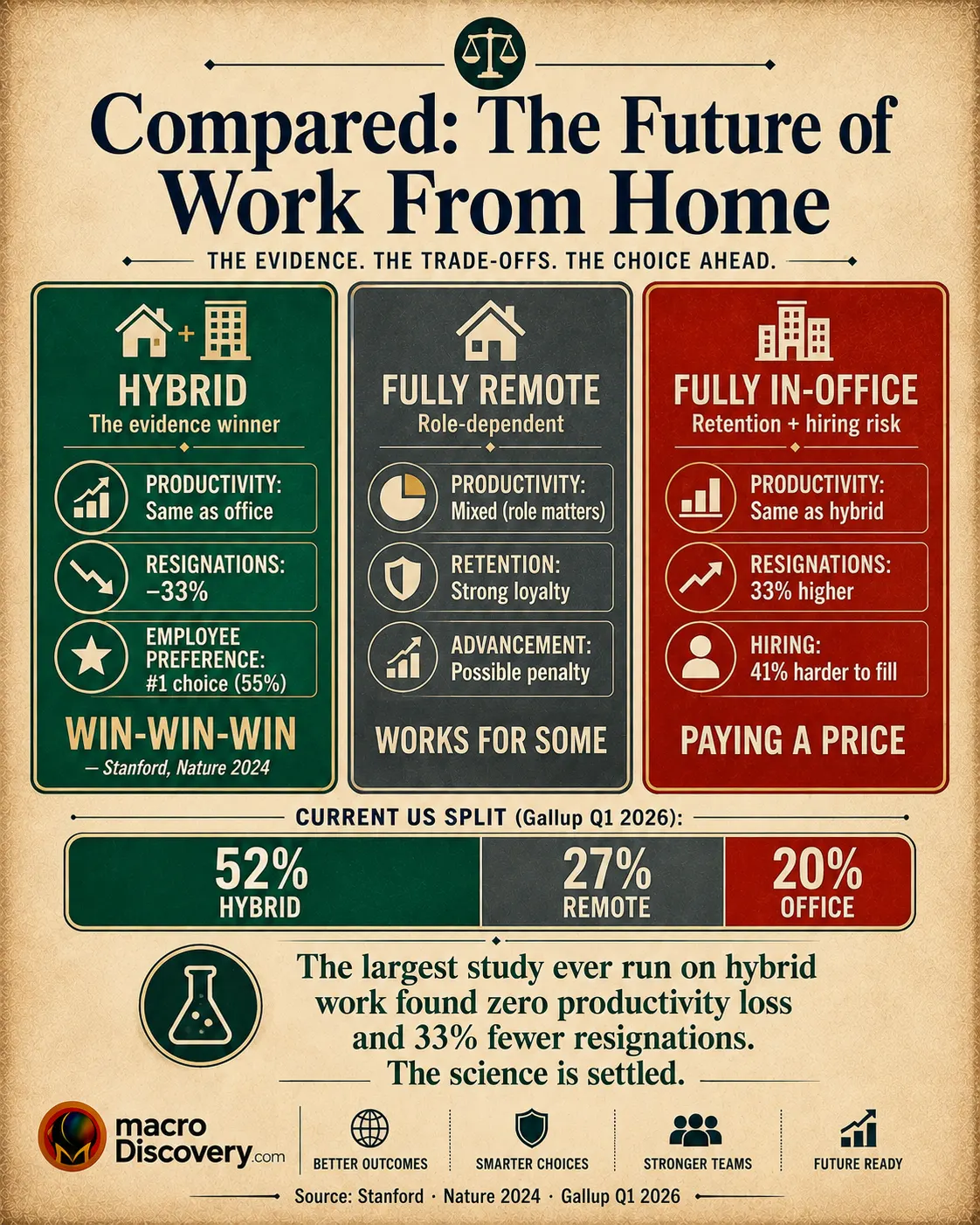
The debate is largely over. Hybrid work won. The largest randomised controlled trial ever run on the question found zero impact on productivity, zero impact on promotions, and 33% fewer resignations. The Bureau of Labor Statistics counts 35 million Americans working remotely right now. And only 44% of workers say they’d comply with a full return-to-office mandate. Here is what the evidence actually says.
A comparison of the three main work arrangements across productivity evidence, retention, employee preference, and hiring impact. Sources: Stanford/Nature (primary · directly fetched) · BLS · Gallup Q1 2026 · Pew Research · McKinsey 2025 · Robert Half Q1 2026 · KORE1 (April 2026) · Cisco 2025.
| Dimension | 🏠🏢 Hybrid | 🏠 Fully Remote | 🏢 Fully On-Site |
|---|---|---|---|
| Productivity (RCT evidence) |
Same as in-office Stanford/Nature RCT (primary): “zero effect on workers’ productivity or career advancement” vs fully in-office peers |
Mixed evidence Strong for solo tasks (CTrip +13% call centre); weaker for collaboration-heavy roles (Gibbs et al. negative) |
The baseline No controlled difference from hybrid; used as control arm in Stanford/Nature study |
| Employee Retention |
33% fewer quits Stanford/Nature: resignations fell 33% vs fully in-office · Cisco 2025: 69% of employers report retention improved after introducing hybrid |
Strong Pew: 61% of fully remote workers say they would leave if remote work was eliminated · high loyalty to arrangement |
Attrition risk McKinsey 2025: 17% of recent job quitters left due to office policy change — one of the top 3 voluntary exit triggers |
| Employee Preference |
#1 choice Robert Half Q1 2026: 55% of job seekers rank hybrid as top choice · Gallup: 52% of remote-capable workers currently hybrid |
Strong demand Gallup Q1 2026: 27% of remote-capable workers fully remote · Pew: 71% say improves work-life balance · 56% say improves productivity |
Low demand Robert Half Q1 2026: only 16% of job seekers want fully in-office as top choice · 25% would even consider a 5-day office role |
| Hiring Difficulty |
Fastest to fill Hybrid roles fill fastest and have lowest offer-decline rates (~8% at final stage) · strongest hiring lever for knowledge roles |
Strong pull ~12% of new job postings in Q4 2025 were fully remote · still a premium signal for candidates · strong in tech (47% of tech workers fully remote) |
Hardest to fill KORE1 2026: fully on-site roles take 41% longer to fill than equivalent hybrid roles · offers declined 23% vs 8% on hybrid at final stage |
| Career Advancement |
No penalty Stanford/Nature: “zero effect on career advancement” — promotion rates statistically identical to fully in-office peers in the RCT |
Possible penalty Some evidence of “proximity bias” — fully remote workers may be overlooked for promotions at companies without deliberate equity policies |
Traditional path Historically the default path for advancement; still preferred by some managers; mentorship and visibility easier on-site |
| Overall verdict | ✓ Best overall outcomes | ↔ Role-dependent | ↓ Retention + hiring risk |
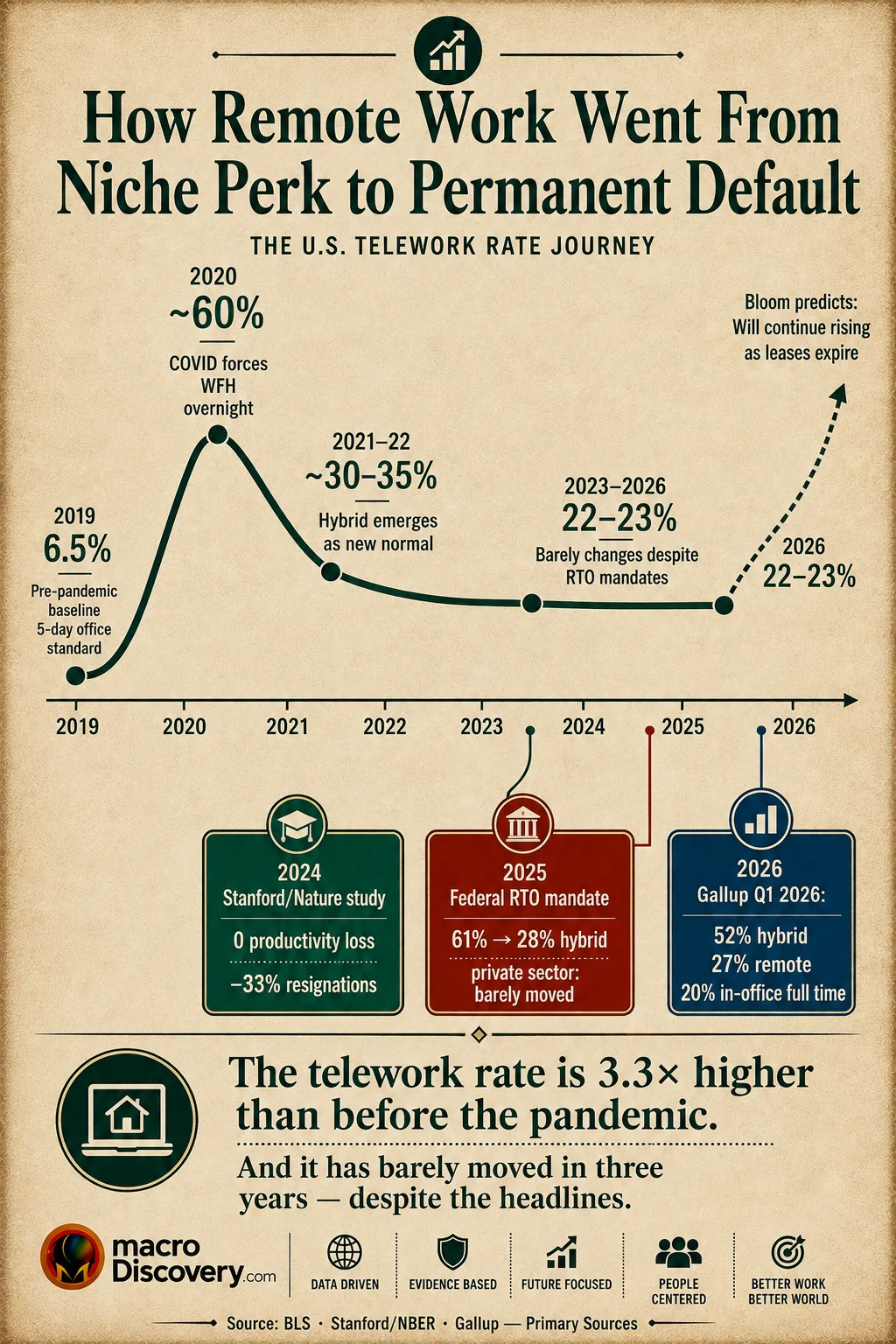
The share of US workers teleworking before the pandemic was around 6.5%. It will never return there. Sources: BLS (primary) · Stanford/NBER (primary) · Gallup (primary).
For four years, the dominant narrative about remote work has been about its end. Every major RTO announcement made headlines. Every CEO who called workers back to the office was quoted extensively. What received less attention was the data: the share of Americans working from home has barely changed in three years. The executives were loud. The Bureau of Labor Statistics was quiet. The data sided with the Bureau.
“From an economic policymaking standpoint, hybrid work is one of the few instances where there aren’t major trade-offs with clear winners and clear losers. There are almost only winners.”
— Nicholas Bloom, William D. Eberle Professor of Economics, Stanford University · news.stanford.edu (primary · directly fetched)The RTO Paradox — Why CEOs Can’t Win an Argument Against Their Own Data
KPMG surveyed 1,300 CEOs in 2024 and found 83% expected a full return to office by 2027. Gallup surveyed those same executives’ actual plans and found only 12% had any RTO mandate scheduled for the coming year. These two numbers describe the same group of people. One reflects what CEOs say when asked about the ideal future. The other reflects what they actually plan to do when they consider attrition, hiring difficulty, and employee satisfaction. The gap between aspiration and action is the real data point. The federal government provides the most honest evidence. When a mandate is actually enforced — as the US government did in 2025 — hybrid rates fall dramatically. In the private sector, where enforcement is softer, they barely move.
Who Actually Works From Home — and Who Doesn’t
Remote and hybrid work is not evenly distributed. Technology workers are its biggest beneficiaries — Gallup found 47% of tech workers are fully remote, and 45% hybrid, leaving just 9% fully on-site. Workers aged 35 to 44 have the highest WFH rates, around 27%. Workers aged 16 to 24 have the lowest, around 6% — a finding consistent with Gen Z’s preference for social connection that the office provides. Women telework at slightly higher rates than men. The federal government’s 2025 mandate caused the sharpest shift seen in any sector, with hybrid federal workers falling from 61% to 28% in months. Globally, English-speaking countries lead on WFH: the US, UK, Australia, and Canada average significantly above the global average of 1.27 days per week at home.