The Map of Frontier Technology Leadership
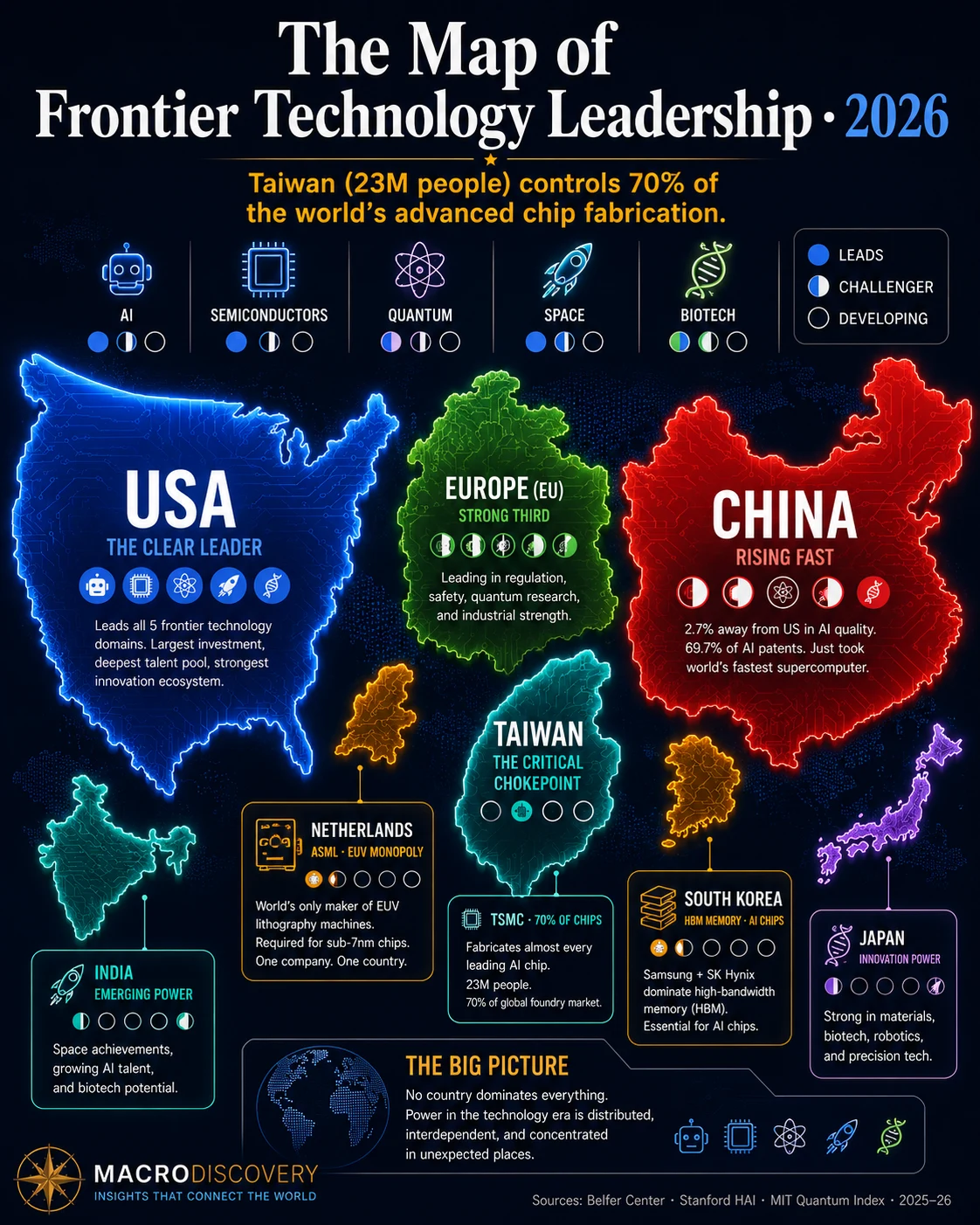
The Map of
Frontier Technology Leadership
The US leads every frontier technology domain — but China is 2.7% away on AI model quality, controls 70% of AI patents, and just took the world’s fastest supercomputer. Taiwan controls 70% of chip fabrication. The Netherlands holds a chokepoint monopoly on one machine that makes it all possible. Power in the technology era is not where most people think it is.
Five technologies will define which countries hold power in the 21st century: artificial intelligence, semiconductors, quantum computing, space, and biotechnology. No country leads all five outright. The map of who leads what — and by how much — is the most important geopolitical map in the world right now. Here is what the data actually shows.
- The US leads all five frontier technology domains by the Belfer Center’s index — but its lead is narrowing rapidly in AI and quantum, and its talent pipeline is weakening. AI researchers moving to the US fell 89% since 2017.
- The US–China AI quality gap has collapsed to 2.7% (March 2026 Arena leaderboard). China produces 23.2% of all AI publications, 69.7% of all AI patents, and 9× more industrial robots than the US.
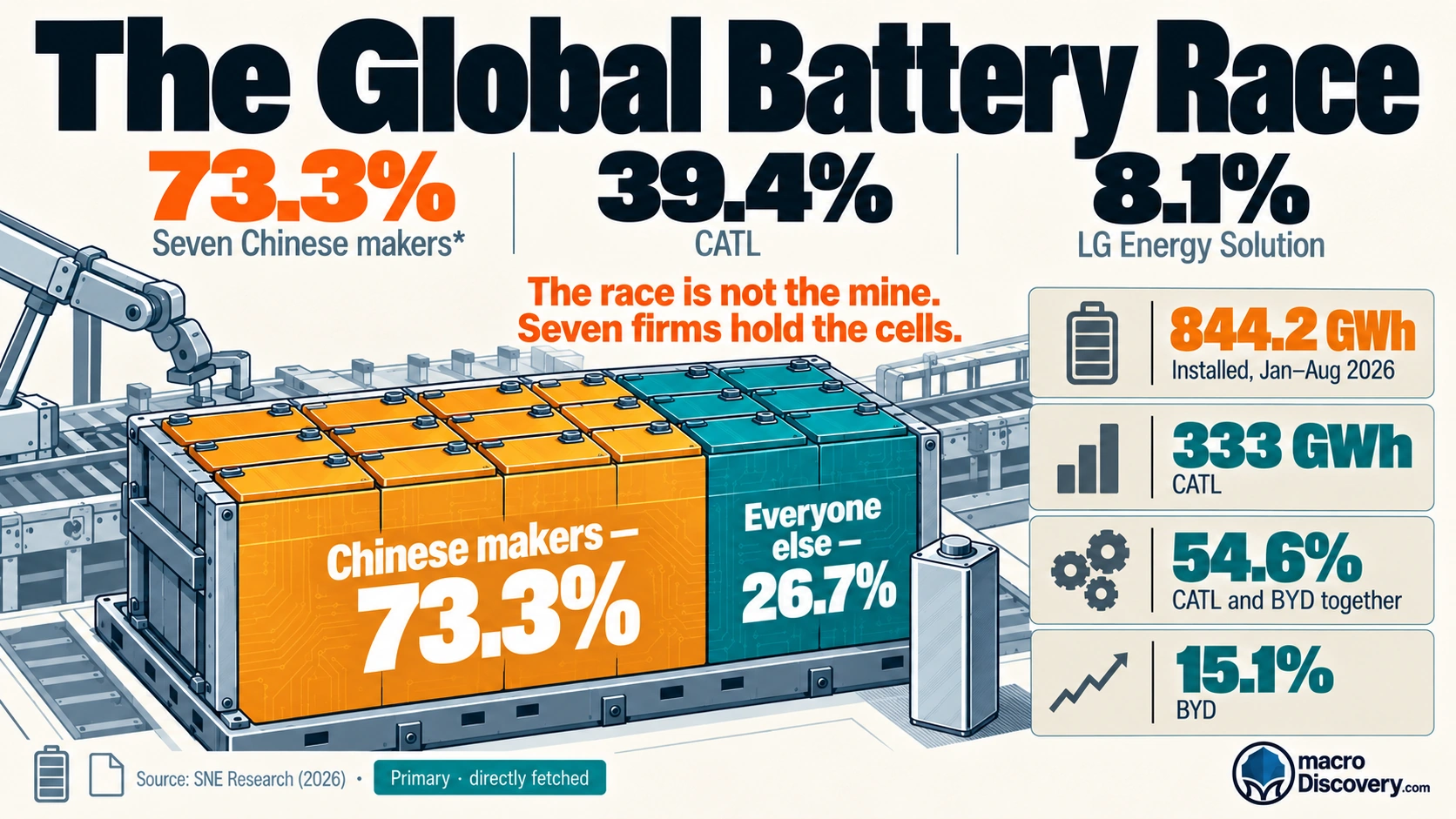
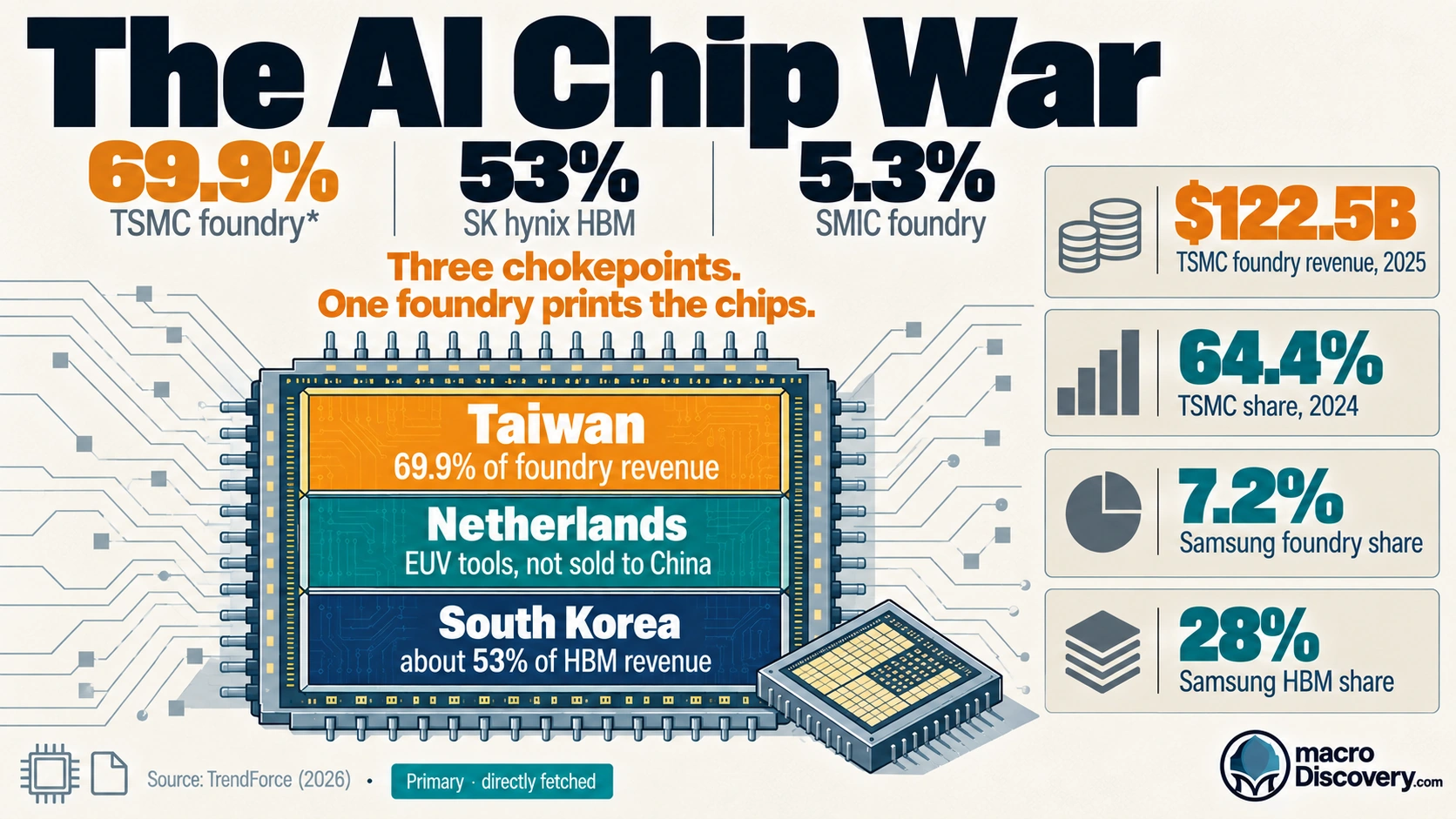
- Taiwan’s TSMC controls ~70% of the global foundry market — fabricating almost every leading AI chip. One company, on one island of 23 million people, is the single most critical chokepoint in the global technology supply chain.
- The Netherlands’ ASML is the world’s only maker of EUV lithography machines — the equipment required to fabricate advanced chips below 7nm. No ASML machine means no leading-edge semiconductor. Every country’s chip ambitions run through one Dutch company.
- In quantum computing, there is no clear leader — the MIT Quantum Index 2025 found “no single modality or manufacturer has emerged as a clear leader.” The race is genuinely open.
| Domain | Leader | Challenger | Notable Third | Key Fact |
|---|---|---|---|---|
|
Artificial
IntelligenceStanford AI Index 2026 |
🇺🇸 USA
50 notable models in 2025. $285.9B private investment. 5,427 data centres.
|
🇨🇳 China
30 notable models 2025. 69.7% of AI patents. 23.2% of publications. Gap to US: 2.7%.
|
🇬🇧 UK / EU
UK: DeepMind, frontier labs, safety leadership. EU: AI Act, emerging ecosystem.
|
US 23× more private AI investment than China — but China’s research volume and patent output already leads globally.
|
|
SemiconductorsBelfer CETI 2025
|
🇺🇸 USA · Chip Design
Nvidia, Apple, Qualcomm, AMD, Broadcom. Also: ASML (NL) monopoly on EUV equipment.
|
🇹🇼 Taiwan · Fabrication
TSMC: ~70% of global foundry market. Fabricates almost every leading AI chip.
|
🇰🇷 S. Korea · Memory
Samsung + SK Hynix dominate DRAM and HBM (AI memory). 5th in Belfer overall.
|
“No country has complete end-to-end control of an advanced semiconductor supply chain.” — Belfer CETI 2025
|
|
Quantum
ComputingMIT Index 2025 · USCC 2025 |
🇺🇸 USA
IBM, Google, IonQ. NQI: $1.8B (2025–29). “America still leads in most quantum research.” — USCC 2025
|
🇨🇳 China
Zu Chongzhi III: world record superconducting (Mar 2025). Leads in quantum communication (QKD). Est. $15B invested.
|
🇪🇺 Europe
Germany: leads globally in quantum master’s programmes. UK: £2.5B over 10 years. Canada: first networked quantum computer (Xanadu, Jan 2025).
|
“No single modality or manufacturer has emerged as a clear leader.” — MIT Quantum Index 2025. The hardware race is genuinely open.
|
|
SpaceBelfer CETI 2025
|
🇺🇸 USA
SpaceX dominates commercial launch. NASA. Belfer: US leads overall.
|
🇨🇳 China
Tiangong space station operational. High launch cadence. “China outpaces Europe in space.” — Belfer 2025
|
🇮🇳 India
Chandrayaan-3: first country to land on lunar south pole (Aug 2023). ISRO expanding rapidly.
|
India became the fourth country ever to reach the Moon’s surface — and the only one to reach the south pole — at a fraction of NASA or ESA mission costs.
|
|
BiotechnologyBelfer CETI 2025
|
🇺🇸 USA ≈ 🇨🇳 China
US: 17.2 / China: 16.8 on Belfer pillar score. Near tie. US leads pharma R&D; China leads production scale and clinical speed.
|
🇪🇺 Europe
Belfer: 11.6. Germany: BioNTech mRNA leadership. Strong pharma (Bayer, Novartis, Roche).
|
🇯🇵 Japan
Belfer: 4.7. Strong in diagnostics and cancer treatment research.
|
Biotechnology is the most evenly contested domain. The US and China are effectively tied. AI-assisted drug discovery is rapidly accelerating both countries.
|
|
Critical
Chokepointssupply chain vulnerabilities |
🇳🇱 ASML · EUV
World’s only maker of EUV lithography machines. Required for sub-7nm chips. One company, one country.
|
🇹🇼 TSMC · Fabs
~70% of global foundry market. Stanford AI Index 2026: “makes the global AI hardware supply chain dependent on one foundry in Taiwan.”
|
🇰🇷 Samsung/Hynix · HBM
High-bandwidth memory (HBM) used in every AI chip. South Korea controls the supply.
|
Three small countries — Taiwan (23M), Netherlands (18M), South Korea (52M) — hold the three most critical chokepoints in the global technology supply chain.
|
Sources: Belfer Center Critical and Emerging Technologies Index (June 2025) · Stanford HAI AI Index 2026 (April 2026, R&D chapter directly verified) · MIT Quantum Index 2025 · US-China Economic and Security Review Commission (USCC) Quantum Report 2025 · TrendForce / Taipei Times (TSMC foundry share 2025) · Wikipedia TSMC (June 2026). Belfer CETI sector weights: semiconductors 48%, AI 35%, biotech 25%, space 20%, quantum 15%.
The AI Race: America Still Leads — but the Gap Has Collapsed
A year ago, the US led China on AI model quality by as much as 17 percentage points on major benchmarks. As of March 2026, the Stanford AI Index reports the gap is 2.7% — 39 points on the Arena leaderboard. DeepSeek’s R1 model briefly equalled the top US model in February 2025. American and Chinese models have since traded the lead multiple times. In terms of sheer output, the US produced 50 notable AI models in 2025 against China’s 30. But in terms of research volume — where the ideas come from — China leads by every measure. China produces 23.2% of all AI publications, 22.6% of all citations, and a striking 69.7% of all AI patent grants globally.
The deeper worry for the US is talent. The number of AI researchers and developers choosing to move to the US has fallen 89% since 2017 — and dropped 80% in the last year alone. Meanwhile, private investment is overwhelming: the US deployed $285.9 billion in 2025, compared to China’s $12.4 billion. But Stanford’s 2026 report cautions that China’s state-directed funding — through guidance funds and government programmes — is not captured in those private figures. The true gap in total capital mobilised is smaller than the headline number suggests.
The Semiconductor Supply Chain Nobody Fully Controls
The most important technology supply chain in the world has no single owner — and that is precisely what makes it so fragile. Advanced semiconductor production requires at minimum: chip design software (US), chip design companies (US, UK, Europe), fabrication fabs (Taiwan), lithography equipment (Netherlands for EUV; US and Japan for other tools), materials (Japan, South Korea), memory (South Korea), and packaging (Taiwan, South Korea). Remove any one of these links and advanced chips stop being made.
TSMC alone — a single company on a single island of 23 million people — fabricated roughly 70% of the world’s contracted chips in 2025 and almost every leading AI chip. The Stanford AI Index 2026 states plainly that this makes “the global AI hardware supply chain dependent on one foundry in Taiwan.” TSMC’s nearest competitor, Samsung, holds about 7%. Every Nvidia GPU, every Apple chip, every AMD processor used in the AI boom runs through one facility in Hsinchu.
The Netherlands’ ASML adds another layer of concentration. Its extreme ultraviolet (EUV) lithography machines — costing around €200 million each and containing over 100,000 parts — are the only equipment in the world capable of printing chip features below 7 nanometres. Without an ASML machine, no country can make leading-edge semiconductors. The Netherlands is a country of 18 million people holding a monopoly over the most critical piece of equipment in the technology economy.
Quantum: The Race Nobody Has Won Yet
Unlike AI — where US dominance is well-established even if narrowing — quantum computing has no clear leader. The MIT Quantum Index 2025, the most comprehensive assessment of the field, found that over 160 quantum processors are in development across 80 manufacturers in 17 countries, and that “no single modality or manufacturer has emerged as a clear leader.” The race between superconducting qubits (IBM, Google, China), trapped ions (IonQ, Quantinuum), neutral atoms (Pasqal), and photonics (Xanadu) is genuinely open.
The US-China competition is closest here. The US-China Economic and Security Review Commission concluded in 2025 that “America still leads the world in most quantum research” — but also that China has “deployed industrial-scale funding and centralized coordination to seize dominance in quantum systems.” China’s Zu Chongzhi III superconducting processor set a new world record for quantum computational advantage in March 2025. China also leads globally in quantum communication — its Micius satellite demonstrated quantum entanglement over 1,200 kilometres — a capability with major implications for encryption and secure communications.
Germany leads the world in dedicated quantum master’s degree programmes, according to the MIT index. The UK committed £2.5 billion over ten years in its National Quantum Strategy. Canada’s Xanadu introduced the world’s first networked, modular quantum computer in January 2025. The geography of quantum leadership is genuinely distributed in a way that AI is not.
Three Small Countries, Three Global Chokepoints
The most striking finding in the map of frontier technology is not about the superpowers. It is about three mid-sized countries that hold irreplaceable positions in the global supply chain: Taiwan (23 million people), the Netherlands (18 million), and South Korea (52 million). Together they control chip fabrication, chip equipment, and AI memory — the three components without which no advanced AI system can be built.
This concentration creates enormous geopolitical risk. The US has invested tens of billions in domestic semiconductor manufacturing through the CHIPS Act. TSMC opened its first US fabrication facility in Arizona in 2025. But leading-edge production — the 2nm and 3nm chips that power frontier AI — remains concentrated in Taiwan. A conflict over Taiwan would not just be a regional crisis. It would immediately halt the production of almost every advanced chip on Earth. That is the strategic reality underlying every conversation about AI, semiconductors, and global power.
The Biotech Near-Tie — and Why It Matters for Everything Else
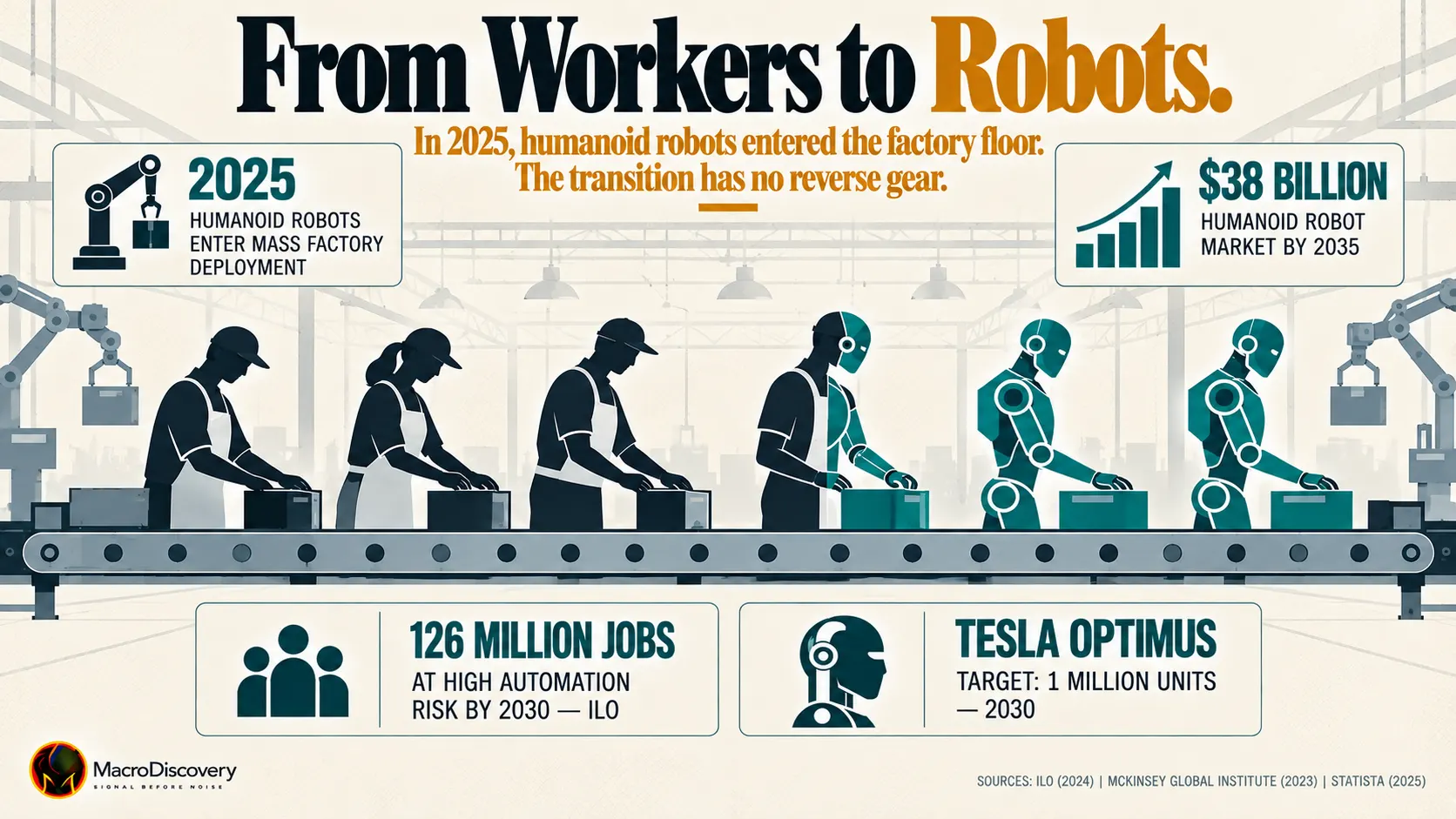
Biotechnology is the most evenly contested domain. The Belfer Center’s 2025 index gives the US a score of 17.2 and China 16.8 on its biotech pillar — effectively a tie. The US leads in pharmaceutical research, biotech venture capital, and early-stage innovation. China leads in pharmaceutical production scale, clinical trial speed, and the application of AI to drug discovery at industrial scale. China installed 295,000 industrial robots in the most recent reporting period — nearly nine times the US total of 34,200 — and that automation advantage extends to pharmaceutical manufacturing as much as to any other industry.
The intersection of AI and biotechnology is where the next decade’s most consequential advances are likely to emerge. AlphaFold’s 2020 breakthrough in protein structure prediction was just the beginning. AI-designed drug candidates are now entering clinical trials in both the US and China. The country that leads AI is likely to pull ahead in biotech as well — which is why the 2.7% quality gap in AI models matters for far more than just chatbots and coding assistants.
- Belfer Center — Critical and Emerging Technologies Index 2025 (June 5, 2025 · covers 25 countries, 5 domains)
- Stanford HAI — AI Index 2026, Chapter 1: Research and Development (April 2026 · directly fetched)
- Stanford HAI — AI Index 2025 (AI patents, publications base data)
- US-China Economic and Security Review Commission — “Vying for Quantum Supremacy” (2025)
- Taipei Times — TSMC foundry market share 69.9% in 2025 (citing TrendForce, March 2026)
- Wikipedia — TSMC (approximately 70% global foundry market share · June 2026)
- MIT Quantum Computing Index 2025 — MIT Initiative on the Digital Economy / Accenture (May 2025)
- The Quantum Insider — “Leading Quantum Computing Countries in 2026” (March 2026)
- Alcott Global — Belfer CETI interactive dashboard scores (semiconductors, biotech, AI pillar values)