Every Time Zone on Earth —
and the Countries That Ignore Them
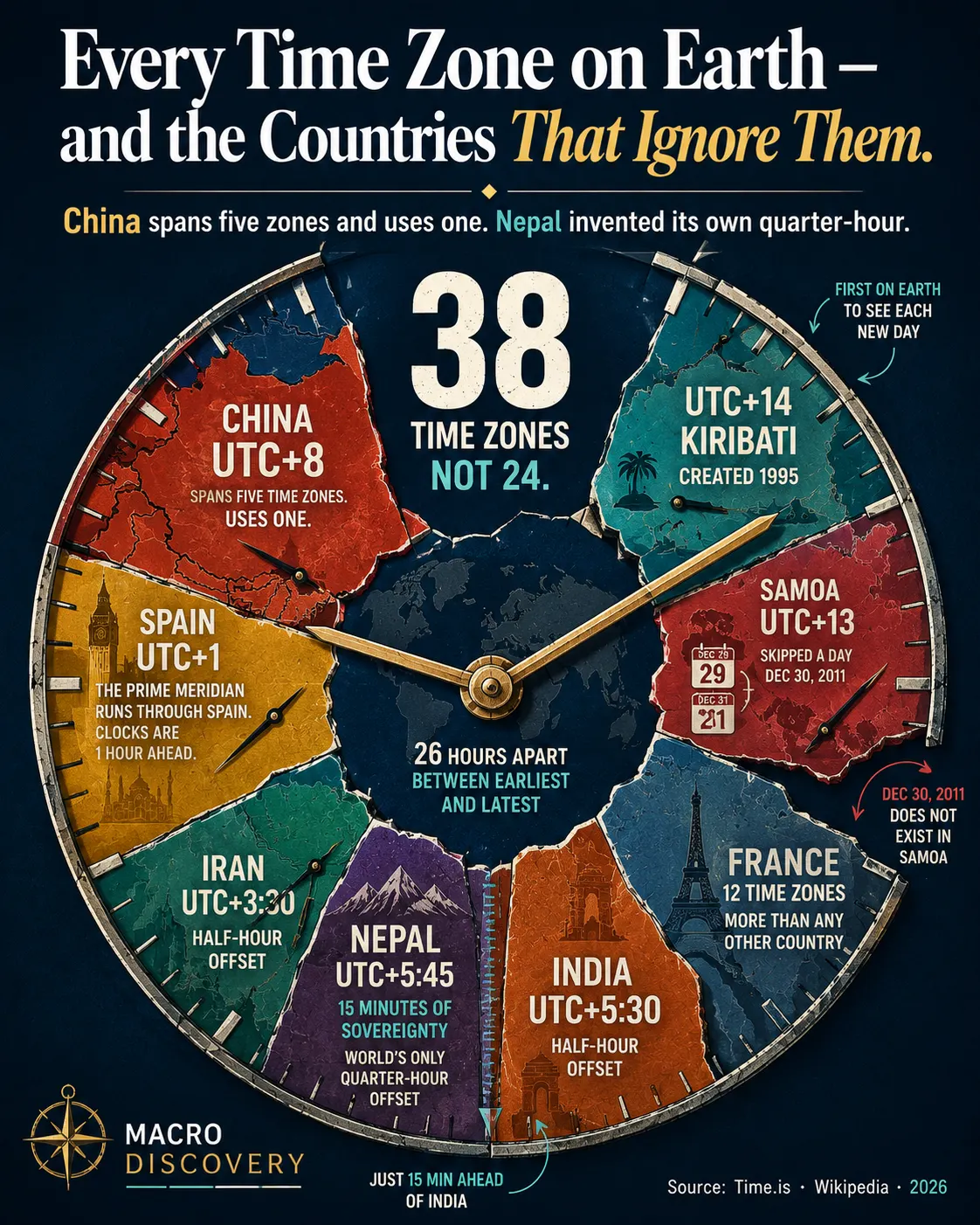
The world should have 24 time zones. It has 38. China spans five and uses one. Nepal invented its own quarter-hour offset. Samoa skipped an entire day. And a tiny Pacific nation created a time zone that did not exist before 1995. Time, it turns out, is a political decision.
Time zones were invented in 1876 by a Scottish-Canadian engineer named Sanford Fleming, who proposed dividing the Earth into 24 neat bands of one hour each. The world agreed — in principle. In practice, politics, trade, national pride, and geography have twisted those 24 bands into 38 distinct offsets, some measured in fractions of an hour, and at least one that did not exist until a Pacific island president decided to create it.
- China spans five geographic time zones but uses one — Beijing Time (UTC+8) — meaning the sun rises after 10am in winter in the country’s far west.
- Nepal uses UTC+5:45 — a deliberate 15-minute step away from India, anchored to the longitude of a sacred Himalayan peak, and adopted in 1986 as an assertion of sovereignty.
- On December 29, 2011, Samoa skipped a day — jumping from UTC−11 to UTC+13 overnight to align its working week with Australia and New Zealand. December 30, 2011 does not exist in Samoa.
- Kiribati created UTC+14 on January 1, 1995 — a time zone that had never existed before — by redrawing the International Date Line around its islands.
| Place | Offset | Type | Why It Matters |
|---|---|---|---|
🇫🇷 Franceincl. overseas territories |
UTC−10 to UTC+12 | Most zones: 12 | Beats the US and Russia (both 11) due to scattered overseas territories across every ocean. Colonial geography frozen in time. |
🇨🇳 China1.4 billion people · one clock |
UTC+8 only | Ignores geography | Geographically spans 5 zones. “One nation, one time” imposed in 1949. Sun rises after 10am in winter in Xinjiang. China-Afghanistan border: 3.5hr jump — the world’s largest terrestrial gap. |
🇮🇳 India29° of longitude · one clock |
UTC+5:30 | Ignores geography | Single time zone across a continent-sized country. The half-hour offset was chosen at independence to stand apart from neighbours on both sides. |
🇪🇸 Spaingeographically UTC+0 |
UTC+1 | Ignores geography | The Prime Meridian runs through Spain. It should share a time zone with the UK and Portugal. Instead it has been UTC+1 since March 1940 — solar noon in Vigo falls at 14:41 on the clock. |
🇳🇵 Nepalworld’s only quarter-hour offset |
UTC+5:45 | Fractional | Anchored to the longitude of Mt. Gaurishankar (86°E). Advanced 15 minutes beyond India in 1986 as a mark of sovereignty. Nepal is 15 min ahead of India — and 2h15m behind China. |
🇮🇷 Iran |
UTC+3:30 | Fractional | Half-hour offset, year-round. Iran abandoned daylight saving time in 2016 and has stayed at UTC+3:30 ever since. |
🇦🇺 Australiamultiple fractional offsets |
UTC+8 to UTC+11 | Fractional | Northern Territory and South Australia use UTC+9:30. The remote Eucla region uses UTC+8:45 — shared by fewer than 1,000 people. Each state decides its own rules. |
🇰🇮 Kiribaticreated a new time zone in 1995 |
UTC+14 | Extreme · first on Earth | UTC+14 did not exist before January 1, 1995. President Teburoro Tito moved the International Date Line eastward around Kiribati so all islands shared the same calendar day. Kiritimati is now first on Earth to begin each new day. |
🇼🇸 Samoaskipped December 30, 2011 |
UTC+13 | Skipped a day | At midnight on December 29, 2011, Samoa jumped from UTC−11 to UTC+13. December 30 never happened. Reason: 70% of trade with Australia and New Zealand — being a day behind cost two business days per week. |
🇺🇸 Baker Island (USA)uninhabited · world’s last time zone |
UTC−12 | Extreme · last on Earth | The most westward time zone on Earth. 26 hours behind Kiribati’s UTC+14. For two hours each day, three different calendar dates exist simultaneously on Earth. |
Sources: Time.is (“38 observed UTC offsets”) · Wikipedia: Time Zone, Time in China, Nepal Standard Time, Time in Kiribati, Time in Samoa, Time in Spain · Euronews (March 2026) · Timetranslator.com · Guinness World Records (France time zones)
Why the World Has 38 Time Zones Instead of 24
The 1884 International Meridian Conference in Washington agreed on Greenwich as the world’s prime meridian — zero degrees longitude. That set up the logic for 24 time zones, each 15 degrees of longitude wide, each one hour apart. In theory, the system is elegant. In practice, no country is obliged to follow it.
Countries can choose any offset they like. Some pick half-hour steps to better match solar noon in their territory. Some pick unusual offsets for political reasons. Some ignore the zones entirely and pick a single clock for the whole country regardless of how many zones they cross. The result is 38 distinct UTC offsets today — and the number keeps shifting as countries occasionally change their minds.
China: One Nation, One Time — No Matter the Sun
China is wider than the continental United States, which uses four time zones. China uses one. Beijing Time (UTC+8) applies to all 1.4 billion people, from the eastern coast near Japan’s longitude to the western reaches of Xinjiang, which geographically belongs in UTC+5.
The “one nation, one time” policy was imposed by the Communist government in 1949 as a symbol of national unity. For most Chinese people — 94% of whom live in the east — the offset barely matters. But in Xinjiang, the consequences are stark: the sun rises after 10am in winter and sets after 10pm in summer on the official clock. Many Uyghur residents informally observe Ürümqi Time (UTC+6) instead. Cross the border from Xinjiang into Afghanistan and the clock jumps 3.5 hours in one step — the world’s largest terrestrial time zone gap.
Spain Has Been in the Wrong Time Zone Since 1940
The Prime Meridian — zero degrees longitude, the reference point for all global time — runs through Spain. By every geographic logic, Spain should share a time zone with the UK and Portugal. Instead, Spain has been on Central European Time (UTC+1) since March 1940, putting its clocks permanently one hour ahead of where the sun says they should be.
What is not in dispute: the practical effect. In Vigo, Spain’s westernmost city, solar noon falls at 14:41 by the clock. The sun sets after 22:00 near the summer solstice — later than Stockholm, which is 17 degrees further north. A 2013 parliamentary committee recommended reverting to UTC+0. Nothing has changed.
Nepal’s Quarter-Hour: 15 Minutes of Sovereignty
Until 1986, Nepal shared India’s time zone — UTC+5:30. Then it advanced its clocks by 15 minutes, creating UTC+5:45: the world’s only national quarter-hour offset. The meridian was anchored to 86°E longitude, the position of Mt. Gaurishankar — a Himalayan peak sacred in Nepalese culture, roughly 100km east of Kathmandu.
The 15-minute gap is small enough not to seriously disrupt cross-border life, but large enough to make a point. Nepal is one of the few countries in Asia never to have been colonised, and its timekeeping reflects that independence. Cross from Nepal into China and the clock jumps 2 hours and 15 minutes forward in a single step. Cross back south into India and it drops 15 minutes. Nepal sits in its own precise pocket of time, by deliberate choice.
Samoa Skipped a Day. Kiribati Invented a New One.
At midnight on December 29, 2011, the clocks in Samoa jumped to midnight on December 31. December 30, 2011 does not exist in Samoan history. The reason was purely economic: 70% of Samoa’s trade flows to Australia and New Zealand. When those countries were starting Monday, Samoa was still on Sunday — losing two effective working days per week to the date mismatch. By crossing to the other side of the International Date Line, Samoa bought back those days. American Samoa, just 100km away and part of the US, did not follow — the two islands are now permanently 24 hours apart on the calendar while sharing the same clock time.
Kiribati made an even more dramatic move sixteen years earlier. In 1995, its far-flung island groups straddled the International Date Line, meaning only four days a week both sides could conduct government business simultaneously. President Teburoro Tito simply moved the date line eastward around the entire country — and in doing so, created UTC+14, a time zone that had never existed before. Kiritimati (Christmas Island) became the first inhabited place on Earth to begin each new calendar day. In 2000, the government renamed Caroline Island — the easternmost point — “Millennium Island” to mark the occasion. One island. One president. One decree. A new hour of global time, from nothing.
France Has the Most Time Zones on Earth — By Accident of Empire
France beats every country in the world for time zone count — 12 in total, 13 if you include its Antarctic territorial claim. But this has almost nothing to do with France itself. Metropolitan France — the hexagon — uses a single zone: UTC+1. The remaining 11 come from overseas territories scattered across every ocean: French Polynesia in the Pacific (UTC−10), French Guiana in South America (UTC−3), Réunion in the Indian Ocean (UTC+4), Wallis and Futuna in the South Pacific (UTC+12), and several more.
The US and Russia each have 11 time zones. But France’s colonial geography, frozen in place by history, means a country of 68 million people technically spans more of the world’s time than either of them. It is less an achievement than a map of where French power once reached — and, in many places, still does.
- Time.is — “List of countries grouped by UTC offset” (live database: 38 observed UTC offsets)
- Wikipedia — “Time Zone” (China, Spain, India, Nepal, Australia time zone geography)
- Wikipedia — “Time in France” (12 time zones confirmed)
- Wikipedia — “Time in Kiribati” (UTC+14 creation, 1994–1995)
- Wikipedia — “Time in Samoa” (December 2011 date line shift)
- Wikipedia — “Nepal Standard Time” (UTC+5:45 history and meridian)
- Euronews — “The ‘hoax’ of the Nazi time zone in Spain” · March 29, 2026 (Pere Planesas interview)
- Timetranslator.com — “All 38+ UTC Offsets” (DST counts, Africa, fractional zones)
- Guinness World Records — “Country with the most time zones” (France: 12)
- Geographical Magazine — “The curious geography of time” (Sanford Fleming 1876, China/Xinjiang)