AI Tech Gaming Future Automobile Top 10 Space Innovation Trending How To Reviews Discover

---Advertisement---

Visualized: Every Mass Extinction in Earth’s History

Macro Discovery
On: June 26, 2026 9:46 AM
Follow Us:
---Advertisement---
Visualized: Every Mass Extinction in Earth's History
Visualized: Every Mass Extinction in Earth’s History
Every Mass Extinction in Earth’s History · MacroDiscovery
MacroDiscovery
Science & Earth · 5 min read · Scientific Consensus
540 Million Years Ago → NOW — Paleontology · Earth Science · Conservation
Science & Earth History

Every Mass Extinction
in Earth’s History

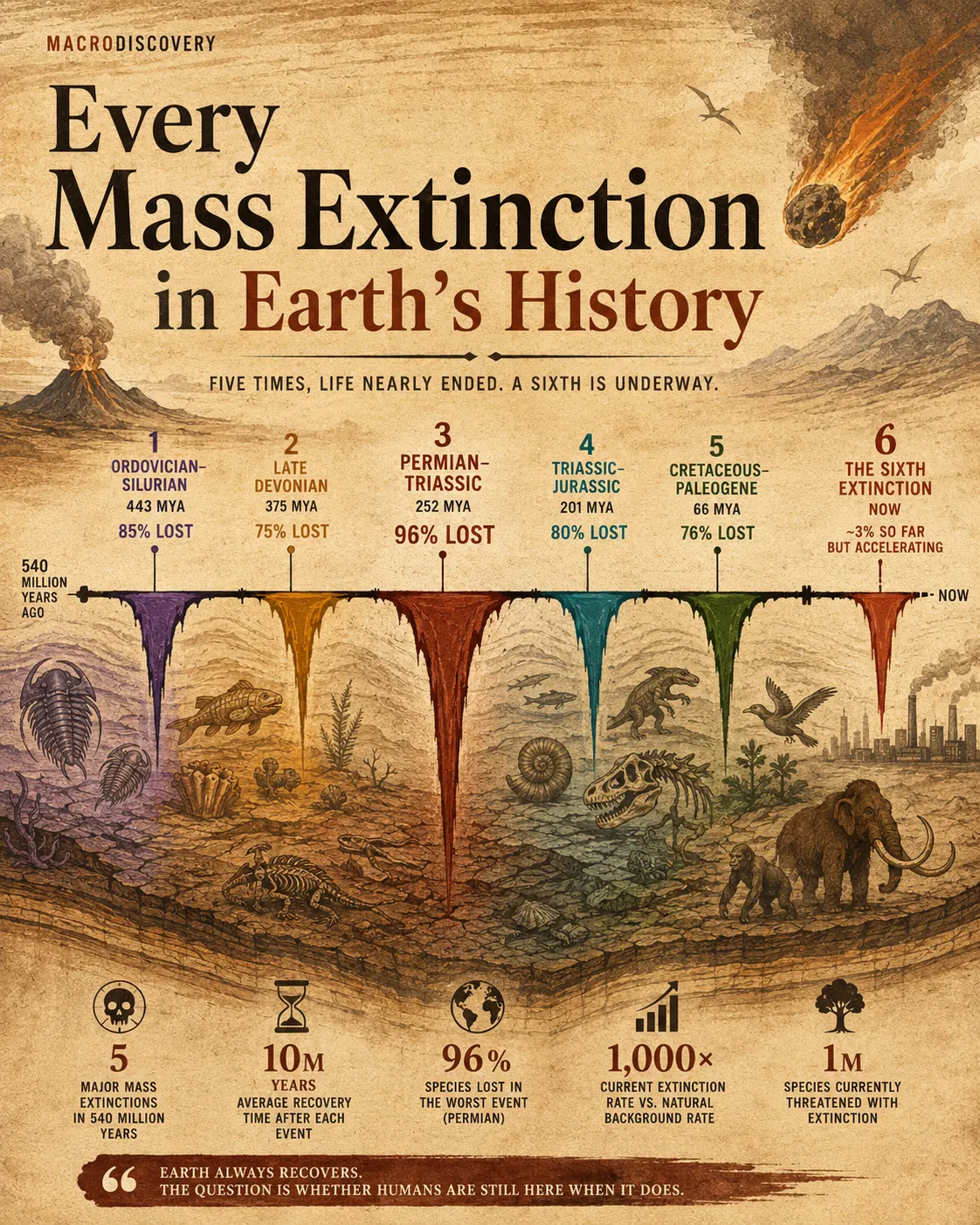
Five times in Earth’s history, life nearly ended. The worst killed 96% of all species. Recovery took 10 million years. A sixth extinction is now underway — caused not by asteroids or volcanic winters, but by a single species.

By MacroDiscovery
Sources: IPBES · IUCN · Nature · Science
Data: Paleontological consensus 2024
5
Major mass extinctions in 540M years
96%
Species lost in worst event (Permian)
10M yrs
Average recovery time after each event
1,000×
Current extinction rate vs. background rate
1M
Species currently threatened with extinction
Visualization 01 — 540 Million Years of Life
Biodiversity Through Deep Time — The Five Mass Extinctions

Estimated marine animal genera diversity over geological time. Each spike downward = a mass extinction event. Right edge = today. Source: Rohde & Muller 2005, Sepkoski 2002, Raup & Sepkoski 1982 — updated with modern paleontological data.

High Low Biodiversity (marine genera) Cambrian Ordov. Sil. Devonian Carbonif. Permian Triassic Jurassic Cretaceous Cenozoic 540 MYA 443 358 252 145 66 NOW ORDOVICIAN 443 MYA · 85% lost DEVONIAN 375 MYA · 75% lost THE GREAT DYING PERMIAN · 252 MYA 96% OF ALL SPECIES TRIASSIC 201 MYA · 80% lost K-PG / ASTEROID 66 MYA · 76% lost 6TH · NOW Human-caused ← Permian recovery: 10 million years → Sources: Rohde & Muller 2005 · Sepkoski 2002 · Raup & Sepkoski 1982 · updated paleontological consensus
Visualization 02 — How Bad Was Each One?
Species Lost in Each Mass Extinction — Ranked by Severity

Estimated % of all species (marine and terrestrial) that went extinct in each event. Note: estimates vary by study; figures reflect scientific consensus ranges. Source: Raup & Sepkoski 1982, Barnosky et al. 2011, updated 2024.

☠ Permian–Triassic 252 MYA · “The Great Dying”
96% of all species — life nearly ended
96%
☠ Triassic–Jurassic 201 MYA · Volcanism
80% lost — opened the door for dinosaurs
80%
☠ Ordovician–Silurian 443 MYA · Ice age + sea level
85% of marine species lost
85%
☠ Cretaceous–Paleogene 66 MYA · Asteroid + Deccan Traps
76% — ended the dinosaurs, opened mammals
76%
☠ Late Devonian 375 MYA · Multiple pulses
75% lost over ~25M year period
75%
⚠ Sixth Extinction NOW · Human-caused · ongoing
~3% so far — but rate is 1,000× background
~3%
Visualization 03 — What Killed Everything
The Big Five — Cause, Scale, and Recovery Time

Each mass extinction had a distinct kill mechanism. Understanding the pattern reveals what makes the sixth extinction structurally different.

EXTINCTION 01 · 443 MYA
Ordovician–Silurian
2nd largest by marine species loss · 85%
85% LOST 5M YR RECOVERY
Primary Cause
Rapid glaciation of Gondwana lowered sea levels by 100m, draining the shallow marine environments where most Ordovician life lived.
What Died
Primarily marine invertebrates — trilobites, brachiopods, graptolites. Life was almost entirely ocean-based; land was largely barren.
What Survived
Deep-water species that escaped temperature swings. Early jawless fish survived — ancestors of all vertebrate life today.
What Came After
Silurian explosion of new marine life. First vascular plants began colonizing land — setting up the Devonian terrestrial revolution.
EXTINCTION 02 · 375 MYA
Late Devonian
Multiple extinction pulses over ~25 million years
75% LOST 15M YR RECOVERY
Primary Cause
Ocean anoxia — widespread loss of oxygen in shallow seas, likely triggered by massive algal blooms from land plant nutrients. Several distinct pulses over millions of years.
What Died
Reef ecosystems collapsed for 100 million years. Placoderms (armoured fish), most coral groups, and 70% of marine invertebrate species.
What Survived
Sharks — their earliest major radiation. Lobe-finned fish that would eventually crawl onto land. Insects were largely unaffected.
What Came After
The Carboniferous coal forests — Earth’s greatest era of terrestrial plant expansion. The origin of most coal deposits we still burn today.
EXTINCTION 03 · 252 MYA · ☠ THE WORST
Permian–Triassic · “The Great Dying”
The most severe extinction in Earth’s history · 96% of all species
96% LOST 10M YR RECOVERY
Primary Cause
Siberian Traps volcanism — one of the largest volcanic events in history, releasing enough CO₂ and SO₂ to raise global temperatures by 8–10°C and acidify the oceans. Ocean warming depleted oxygen. Duration: ~60,000 years.
What Died
Nearly everything. 96% of marine species. 70% of terrestrial vertebrates. The trilobites — which had survived two previous extinctions — were finally wiped out after 270 million years of existence.
What Survived
Small, metabolically flexible generalists. Lystrosaurus — a pig-sized herbivore — may have comprised 95% of all land vertebrates immediately after. The ancestor of all mammals survived.
What Came After
Recovery took 10 million years — the longest of any extinction. Then the Age of Dinosaurs. The surviving mammal lineage spent 185 million years as small nocturnal creatures before our turn came.
EXTINCTION 04 · 201 MYA
Triassic–Jurassic
Cleared the path for dinosaur dominance
80% LOST 8M YR RECOVERY
Primary Cause
Central Atlantic Magmatic Province (CAMP) — massive volcanism as the supercontinent Pangaea began to break apart, releasing CO₂ and causing rapid warming and ocean acidification.
What Died
Large land reptiles called crurotarsans — the main competitors to early dinosaurs. Most large marine reptiles. A massive restructuring of terrestrial vertebrate fauna.
What Survived
Early dinosaurs — which had coexisted with crurotarsans at low diversity. The extinction removed all competition and allowed dinosaurs to diversify explosively into every ecological niche.
What Came After
The Jurassic — peak dinosaur diversity. Sauropods, stegosaurs, early birds (theropods). Also the first mammals — tiny, shrew-like, living in the margins of a world ruled by giants.
EXTINCTION 05 · 66 MYA
Cretaceous–Paleogene (K-Pg)
The most famous extinction — ended the non-avian dinosaurs
76% LOST 3M YR RECOVERY
Primary Cause
Chicxulub asteroid impact (10km wide) in modern-day Mexico, releasing energy equivalent to 1 billion Hiroshima bombs. Impact winter blocked sunlight for years. Compounded by ongoing Deccan Traps volcanism in India.
What Died
All non-avian dinosaurs. Mosasaurs, plesiosaurs, pterosaurs. 75% of all plant species. Ammonites — which had survived the previous four extinctions — finally vanished after 330 million years.
What Survived
Birds (avian dinosaurs). Small mammals. Crocodilians. Turtles. Snakes. The species that survived shared traits: small body size, dietary flexibility, ability to survive on limited resources.
What Came After
The Cenozoic — Age of Mammals. In just 10 million years, mammals diversified from small generalists into whales, bats, horses, elephants, and primates. The lineage leading to humans began here.
Visualization 04 — The Sixth Extinction
The Sixth Mass Extinction — It Is Already Underway
Human-caused · Holocene Epoch · ~10,000 years ago → accelerating since 1950
⚠ ACTIVE · ONGOING · ACCELERATING

Unlike all five previous extinctions, the sixth is not caused by volcanism, asteroids, or ice ages. It is caused by habitat destruction, overexploitation, invasive species, pollution, and climate change — all products of a single species.

1,000×
Current extinction rate vs. natural background rate
1M
Species currently threatened with extinction (IUCN 2024)
68%
Decline in vertebrate population sizes since 1970 (WWF)
3%
Estimated species lost so far — but rate is accelerating
50%
Of known species could be extinct by 2100 if current trends continue
10M yrs
Minimum recovery time if extinction continues at current pace

Every Extinction Followed by an Explosion

Mass extinctions do not end evolution — they restart it, under radically different rules.

The most consistent pattern across all five extinctions is that the survivors inherit a world with almost no competition. The Permian extinction eliminated 96% of species — and the 4% that survived diversified into every ecological niche left empty. Crises create winners as much as they create losers.

  • The Ordovician extinction cleared the ocean floor for the Silurian reef revolution
  • The Devonian extinction eliminated fish competitors and enabled the first land vertebrates
  • The Triassic extinction removed crurotarsans and unleashed dinosaur dominance
  • The K-Pg extinction ended the dinosaurs and gave mammals 66 million years to produce us
Key Insight
We exist because of the K-Pg extinction. Without the asteroid, dinosaurs would likely still dominate Earth and mammals would remain small nocturnal creatures. Every mass extinction in Earth’s history eventually enabled more complex life — but only after 3–10 million years of recovery.

Extinction is creative destruction at the planetary scale — but the timescale of recovery is longer than civilization has existed.

Why the Sixth Is Structurally Different

All previous extinctions had a single cause that ended. This one has five concurrent causes that are accelerating.

The Permian extinction — the worst in history — was caused by one mechanism: volcanic CO₂ warming oceans over 60,000 years. The sixth extinction is simultaneously driven by habitat destruction, climate change, overexploitation, invasive species, and pollution — five compounding stressors that reinforce each other.

Why It Matters
The geological record shows that extinctions caused by a single rapid event (asteroid) recover faster than extinctions caused by prolonged environmental degradation (volcanism). The sixth extinction is closer to the prolonged degradation model — suggesting recovery timescales in the millions of years, not thousands.

The sixth extinction is the first in Earth’s history where the cause is aware of what it is doing.

Macro Takeaway — 5 to 10 Year Outlook

The Tipping Point Window Is Now

Scientists estimate we are in the critical 20-year window to prevent irreversible mass extinction outcomes.

The IPBES (Intergovernmental Science-Policy Platform on Biodiversity) 2024 report identifies 2030 as a critical threshold — beyond which ecosystem collapse becomes self-reinforcing. The Kunming-Montreal Global Biodiversity Framework (2022) committed 196 nations to protecting 30% of land and ocean by 2030, but implementation is running years behind.

De-Extinction Changes the Equation

For the first time in Earth’s history, a species can deliberately reverse extinction.

Colossal Biosciences is advancing woolly mammoth de-extinction (target: 2028 birth). The thylacine, passenger pigeon, and dodo are all active de-extinction projects. This is genuinely unprecedented in 540 million years of extinction history — but critics argue it risks distracting from preventing current extinctions.

The Recovery Lesson From Deep Time

Earth always recovers. The question is whether humans are still here when it does.

Every previous mass extinction was followed by a recovery — but recovery took 3–10 million years. Human civilization is 10,000 years old. The geological record does not offer comfort on human timescales: if a sixth mass extinction proceeds to its logical conclusion, the world that recovers will be one that evolved without us as a reference point.

Sources & Methodology
  • Raup, D.M. & Sepkoski, J.J. — “Mass Extinctions in the Marine Fossil Record” Science 1982
  • Sepkoski, J.J. — Compendium of Fossil Marine Animal Genera 2002
  • Rohde, R.A. & Muller, R.A. — “Cycles in fossil diversity” Nature 2005
  • Barnosky, A.D. et al. — “Has the Earth’s sixth mass extinction already arrived?” Nature 2011
  • IPBES — Global Assessment Report on Biodiversity and Ecosystem Services 2024
  • IUCN — Red List of Threatened Species 2024 (iucnredlist.org)
  • WWF — Living Planet Report 2024 (vertebrate population decline data)
  • Ceballos, G. et al. — “Accelerated modern human-induced species losses” Science Advances 2023
Macro Discovery

Sukh Dhaliwal

Sukh Dhaliwal is the founder of Macro Discovery, an independent digital publication covering AI, technology, science, future trends, and global innovation through visual storytelling and data-driven analysis.

Join WhatsApp

Join Now

Join Facebook

Follow us

Leave a Comment