AI Tech Gaming Future Automobile Top 10 Space Innovation Trending How To Reviews Discover

---Advertisement---

Mapped: Every Active Border Dispute on Earth Right Now

Macro Discovery
On: June 25, 2026 5:23 PM
Follow Us:
---Advertisement---
Every Active Border Dispute on Earth Right Now
Every Active Border Dispute on Earth Right Now · MacroDiscovery
MacroDiscovery
Countries & Geopolitics · 5 min read · 2025 Current
NOW — Territorial Disputes · Armed Conflict · Nuclear Risk · 2025
Countries & Geopolitics

Every Active Border Dispute
on Earth Right Now

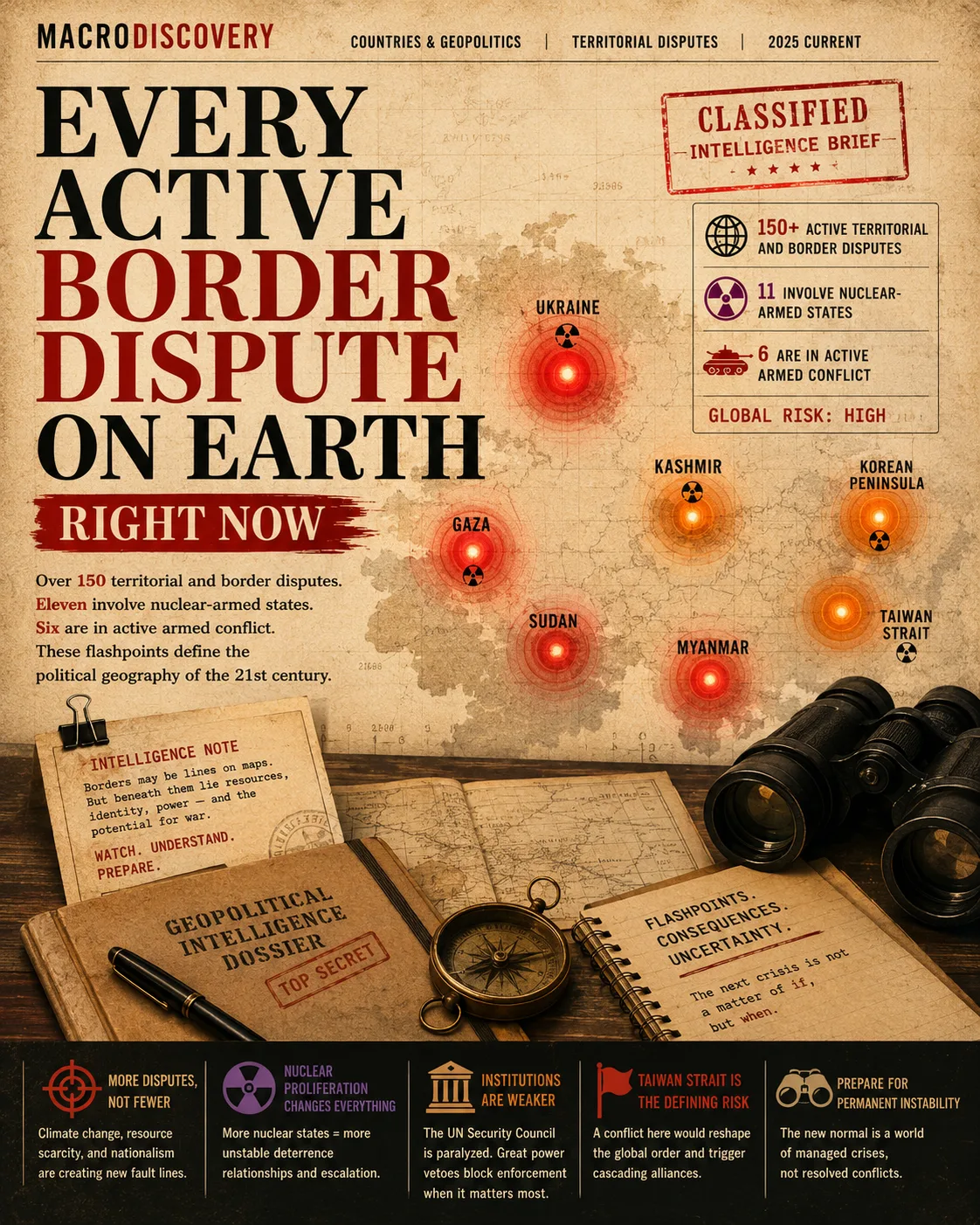
There are over 150 active territorial and border disputes on Earth today. Eleven involve nuclear-armed states directly or by proxy. Six are in active armed conflict. Most will never appear in a single news cycle — but together they define the political geography of the 21st century.

By MacroDiscovery
Sources: ICJ · IISS · CFR · Geopolitical Futures
Updated: 2025
150+
Active territorial disputes worldwide
6
Currently in active armed conflict
11
Involve nuclear-armed states
38
Disputes in Asia-Pacific alone
60+
Years: average age of a frozen dispute
Visualization 01 — Global Dispute Map
Active Territorial & Border Disputes — 2025

Each marker represents an active dispute. Color = severity level. ☢ = nuclear-armed state involved. Sources: ICJ, IISS Military Balance 2025, CFR Global Conflict Tracker.

Ukraine Gaza Sudan Myanmar Ethiopia Yemen Taiwan LAC Kashmir Korea S. China Sea Iran/Gulf Armenia/AZ W.Sahara Kosovo Cyprus Libya Somalia Senkaku Essequibo Durand Falklands Gibraltar Crimea* Transn. Abkhazia Antarctica Arctic Kurils Dokdo Belize Sahel SEVERITY LEGEND Armed conflict (active) High tension / military Medium / diplomatic Low / latent Frozen conflict ☢ Nuclear state involved Sources: ICJ · IISS Military Balance 2025 · CFR Global Conflict Tracker · Geopolitical Futures
Visualization 02 — Ranked by Severity
The 25 Most Significant Active Disputes

Ranked by current risk level. Status assessed as of Q1 2025. ☢ = nuclear-armed state directly involved or adjacent. Sources: IISS, CFR, ICJ 2025.

# Dispute Status Nuclear
01
Russia–UkraineDonbas, Zaporizhzhia, Kherson, Crimea · 2014–present
ARMED ☢☢
02
Israel–Gaza / West BankIsrael, Hamas, PA · Oct 2023–present
ARMED
03
Myanmar Civil WarMilitary junta vs. PDFs, ethnic armies · 2021–present
ARMED
04
Sudan Civil WarSAF vs. RSF · Darfur, Khartoum · 2023–present
ARMED
05
YemenHouthis, Saudi coalition, Hodeida · 2015–present
ARMED
06
Ethiopia (Tigray / Amhara)Federal government vs. Fano, TPLF remnants · ongoing
ARMED
07
Taiwan StraitPRC vs. Taiwan (ROC) · US security guarantee
HIGH ☢☢
08
Kashmir (Line of Control)India vs. Pakistan · 1947–present · two nuclear states
HIGH ☢☢
09
India–China (LAC / Ladakh)India vs. PRC · Galwan, Tawang · 2020 clashes
HIGH ☢☢
10
South China SeaChina, Vietnam, Philippines, Malaysia, Brunei, Taiwan
HIGH
11
Korean PeninsulaDPRK vs. ROK · armistice since 1953 · nuclear DPRK
HIGH ☢☢
12
Iran Nuclear / Strait of HormuzIran vs. US, Israel, Gulf States · proxy network
HIGH
13
Venezuela–Guyana (Essequibo)Venezuela claims 70% of Guyana · 2023 referendum
MEDIUM
14
Armenia–AzerbaijanNagorno-Karabakh resolved 2023 · border demarcation ongoing
MEDIUM
15
East China Sea (Senkaku/Diaoyu)Japan vs. China · US treaty obligation triggers
MEDIUM ☢☢
16
Kosovo–SerbiaKosovo independence vs. Serbian non-recognition
MEDIUM
17
Sahel (Mali, Burkina, Niger)Wagner/Russian-backed juntas, jihadist groups
MEDIUM
18
Libya (East–West split)GNU vs. LNA · Tripoli vs. Benghazi
MEDIUM
19
DRC–Rwanda (eastern DRC)M23 rebels, RDF presence · Kivu region
MEDIUM
20
Durand Line (Af-Pak)Afghanistan (Taliban) vs. Pakistan · fencing, clashes
MEDIUM
21
Kuril IslandsJapan vs. Russia · no peace treaty since 1945
FROZEN ☢☢
22
Cyprus (Green Line)Greek Cyprus vs. Turkish North · UN buffer zone
FROZEN
23
Falkland IslandsUK vs. Argentina · 1982 war · sovereignty unresolved
LOW
24
Western SaharaMorocco vs. Polisario Front (Algeria-backed)
LOW
25
Arctic SovereigntyRussia, Canada, USA, Norway, Denmark · UNCLOS claims
LOW ☢☢
Visualization 03 — Regional Breakdown
Where Disputes Concentrate by Region

Number of active territorial or border disputes per region. Severity weighted — one armed conflict counts more than ten latent claims.

Asia-Pacific 38
The most dispute-dense region on Earth. China is party to at least 17 active disputes — maritime, land, and airspace. Three of the world’s highest-risk flashpoints (Taiwan, Kashmir, Korean Peninsula) exist here simultaneously.
Highest risk: Taiwan Strait
Africa 34
Most African borders were drawn by colonial powers with no reference to ethnic, linguistic, or geographic logic. 54 of 55 African nations have at least one disputed border. Three disputes are currently in active armed conflict.
Highest risk: Sudan Civil War
Middle East 22
The highest density of armed conflict per square kilometer of any region. Every active dispute here involves at least one external power — US, Russia, Iran, or Turkey — providing arms, financing, or direct forces.
Highest risk: Gaza / West Bank
Europe 18
Europe’s dispute count is driven almost entirely by the fallout of Soviet collapse: 6 frozen conflicts from Moldova to Georgia remain unresolved. Russia’s invasion of Ukraine escalated the region from its lowest post-1945 risk level to its highest in 80 years.
Highest risk: Russia–Ukraine
Americas 14
Predominantly latent or legal disputes resolved through ICJ arbitration. The most significant active escalation is Venezuela’s claim to Essequibo — 70% of Guyana’s territory — intensified after massive offshore oil discoveries in 2023.
Highest risk: Venezuela–Guyana
Arctic / Antarctic 8
Climate change is activating previously theoretical disputes. Melting Arctic sea ice is opening shipping routes and exposing seabed resources — triggering competing UNCLOS extended continental shelf claims from Russia, Canada, Denmark, Norway, and the US.
Fastest escalating: Arctic Claims
Visualization 04 — Five Highest-Risk Flashpoints
What Each One Is, Why It Matters, What Happens Next

The five disputes most likely to escalate significantly in the next 3–5 years, based on military posturing, political signaling, and structural drivers.

⬛ HIGH TENSION · NUCLEAR RISK
Taiwan Strait
PRC vs. Taiwan (ROC) · US Treaty Obligation
☢ TWO NUCLEAR STATES Since 1949
Root Cause
The 1949 civil war never formally ended. Beijing considers Taiwan a breakaway province. Taiwan’s 23 million people have lived under functional self-governance for 75 years. The US does not formally recognize Taiwan but is legally committed to ensure it has defensive weapons.
Why It Escalates
Xi Jinping has repeatedly stated reunification as a historic mission, with increasing signals of a 2027–2035 window. PLA military exercises around Taiwan increased dramatically after 2022. Taiwan manufactures over 90% of the world’s most advanced semiconductors — making it a global economic chokepoint.
What Happens Next
The most likely near-term scenario is not invasion but gray-zone pressure: blockade simulations, air identification zone violations, undersea cable interference, and cyberattacks. A full military conflict would trigger the US treaty obligation — the most dangerous nuclear-state confrontation since the Cuban Missile Crisis.
⬛ HIGH TENSION · NUCLEAR RISK
Kashmir (Line of Control)
India vs. Pakistan · Three Wars Since 1947
☢ TWO NUCLEAR STATES Since 1947
Root Cause
The 1947 partition of British India created an unresolved boundary through a Muslim-majority region ruled by a Hindu maharaja who acceded to India. Three major wars and continuous cross-border insurgency have failed to resolve the fundamental disagreement over sovereignty.
Why It Escalates
India’s 2019 revocation of Article 370 — Kashmir’s special status — and direct integration of the region heightened tensions. Both states have operational nuclear arsenals with no reliable communication hotline. The 2019 Balakot air strikes were the first cross-border airstrikes between two nuclear-armed states in history.
What Happens Next
Pakistan’s economic crisis reduces its conventional military capacity but increases its reliance on nuclear deterrence at lower thresholds. India’s growing economic and military advantage creates asymmetric pressure. Any major terrorist attack on Indian soil attributed to Pakistan risks a military response with nuclear escalation pathways.
⬛ ACTIVE ARMED CONFLICT
Russia–Ukraine
Russia vs. Ukraine · NATO-adjacent · 2014–present
☢ NUCLEAR STATE ACTIVE WAR
Root Cause
Russia’s refusal to accept a sovereign Ukraine choosing Western alignment. The underlying dispute began with the 2014 Crimea annexation and Donbas proxy war, escalating to full-scale invasion in February 2022 — the largest land war in Europe since 1945.
Why It Matters
This is the first time a nuclear-armed state has directly invaded a neighbor in the post-Cold War era. Russia has repeatedly made implicit and explicit nuclear threats. The precedent — that nuclear states can invade neighbors with limited direct response — has been closely watched by China, North Korea, and Iran.
What Happens Next
The most likely outcome is a frozen conflict along current lines of control rather than full Ukrainian reconquest or Russian victory. A negotiated settlement requires territorial concessions neither side’s political system can easily sell domestically. The war will define European security architecture for a generation regardless of how it ends.
⬛ HIGH TENSION · MULTI-PARTY
South China Sea
China, Vietnam, Philippines, Malaysia, Brunei, Taiwan
☢ NUCLEAR ADJACENT $3.4T trade/yr
Root Cause
China’s “nine-dash line” claims approximately 90% of the South China Sea — overlapping with the exclusive economic zones of five other states. The 2016 Permanent Court of Arbitration ruled China’s claims had no legal basis. China rejected the ruling and has continued island-building and militarization.
Why It Matters
One-third of global maritime trade — $3.4 trillion annually — passes through the South China Sea. Beneath the seabed lie an estimated 125 billion barrels of oil and 500 trillion cubic feet of gas. The Philippines, a US treaty ally, is in direct conflict with Chinese coast guard vessels at Scarborough Shoal and Second Thomas Shoal.
What Happens Next
China’s strategy is incrementalist — salami-slicing: small individual steps that each fall below the threshold of a military response but cumulatively establish facts on the water. The risk is a Philippine vessel being sunk or personnel killed in a confrontation that triggers the US-Philippines Mutual Defense Treaty for the first time.
◆ MEDIUM · RAPIDLY ESCALATING
Venezuela–Guyana (Essequibo)
Venezuela claims 70% of Guyana’s territory
NEW OIL TRIGGER Since 1899
Root Cause
A 19th-century border arbitration Venezuela has never accepted. The Essequibo region — 160,000 km² — is larger than Greece. Venezuela held a 2023 referendum in which 95% voted to annex the territory. Maduro deployed troops to the border, triggering Caribbean crisis-level mobilization.
Why It Escalated Now
ExxonMobil discovered 11 billion barrels of recoverable oil offshore Guyana starting in 2015 — one of the largest oil finds of the 21st century. Guyana, population 800,000, is now one of the world’s fastest-growing economies. Venezuela’s economic collapse has made the territorial claim a domestic political necessity for Maduro.
What Happens Next
The ICJ has provisional jurisdiction but Venezuela refuses to participate. The US has deployed naval assets to the region and ExxonMobil’s presence creates a de facto American interest. An actual Venezuelan invasion would trigger US, UK, and CARICOM response — but Maduro may calculate that the threat alone extracts concessions without military cost.

The geography of conflict has a structural logic that rarely changes between generations. Most of the disputes on the map above are not new — they are old disputes that were managed, suppressed, or ignored until the conditions that made them manageable changed. What is new is the convergence of three accelerants that are simultaneously destabilizing frozen conflicts, intensifying active ones, and creating new territorial claims where none previously existed: resource scarcity, nuclear proliferation, and the declining capacity of international institutions to enforce legal rulings.

The nuclear dimension is the least-discussed structural shift. In 1990 there were five confirmed nuclear states. Today there are nine, with Iran widely assessed to be within weeks of breakout capacity. Every new nuclear state adds a new set of deterrence relationships that did not previously exist — and each relationship introduces its own escalation ladder and red lines. The Kashmir dispute is the clearest example: the 2019 Balakot strikes established that two nuclear-armed states can conduct airstrikes against each other without triggering nuclear use, but only because both sides chose restraint. That restraint is not guaranteed the next time.

“Most border disputes are not about where the line is drawn. They are about what lies underneath it — oil, water, rare earths, shipping lanes — and which generation of leadership decides the prize is worth the risk.”

The Venezuela–Guyana escalation is the clearest current example of resource discovery as a conflict trigger. The pattern is consistent across history: the discovery of extractable value beneath disputed territory reliably converts latent claims into active ones. The same dynamic is now playing out in the Arctic, where melting ice is revealing seabed resources and opening shipping routes that were theoretical for most of the 20th century, and in the South China Sea, where seabed hydrocarbon estimates drove China’s nine-dash line from diplomatic position to physical infrastructure.

Macro Takeaway — 5 to 10 Year Outlook

The structural trend over the next decade is toward more disputes, not fewer. Three forces are driving this. First, climate change is redrawing resource maps — exposing Arctic seabed, changing river flows that define borders, and creating water scarcity disputes in regions where borders were drawn assuming current hydrology. Second, the post-Cold War institutional order — the ICJ, UNCLOS, UN Security Council — has been rendered partly inoperative by great-power veto and selective compliance. When China can reject a binding Permanent Court of Arbitration ruling without consequence, and Russia can invade a neighbor that signed a sovereignty guarantee, the deterrent value of international law collapses for every other state watching.

Third, and most consequentially, the Taiwan Strait remains the single highest-consequence unresolved dispute on the planet. A military conflict there would not be a regional crisis — it would be the first direct military confrontation between the world’s two largest economies, involving the most advanced semiconductor manufacturing capacity on Earth, triggering alliance obligations that would draw in Japan, Australia, the Philippines, and the US simultaneously. Every other dispute on this map would be secondary. The question that defines the 2020s and 2030s is whether that confrontation can be indefinitely deterred, or whether the window Xi Jinping has publicly signaled for resolution will eventually produce a decision to test it.

Sources & Methodology
  • IISS — The Military Balance 2025 (International Institute for Strategic Studies)
  • CFR — Global Conflict Tracker, Council on Foreign Relations 2025
  • ICJ — International Court of Justice: Active Cases and Pending Disputes 2025
  • Geopolitical Futures — Border Dispute Database 2024–2025
  • UNCLOS — UN Convention on the Law of the Sea: Active Claims Registry
  • ACLED — Armed Conflict Location & Event Data Project 2025
  • SIPRI — Stockholm International Peace Research Institute: Conflict Data 2024
  • UN OCHA — Office for the Coordination of Humanitarian Affairs: Active Emergencies 2025
Macro Discovery

Sukh Dhaliwal

Sukh Dhaliwal is the founder of Macro Discovery, an independent digital publication covering AI, technology, science, future trends, and global innovation through visual storytelling and data-driven analysis.

Join WhatsApp

Join Now

Join Facebook

Follow us

Leave a Comment