AI Tech Gaming Future Automobile Top 10 Space Innovation Trending How To Reviews Discover

---Advertisement---

Ranked: How Big Is Space — A Scale Visualization

Macro Discovery
On: June 25, 2026 4:19 PM
Follow Us:
---Advertisement---
How Big Is Space — A Scale Visualization
How Big Is Space — A Scale Visualization · MacroDiscovery
MacroDiscovery
Space & Science · 4 min read · Current Data
NOW → 13.8 Billion Years · Observable Universe · Cosmology
Space & Cosmology

How Big
Is Space
A Scale Visualization

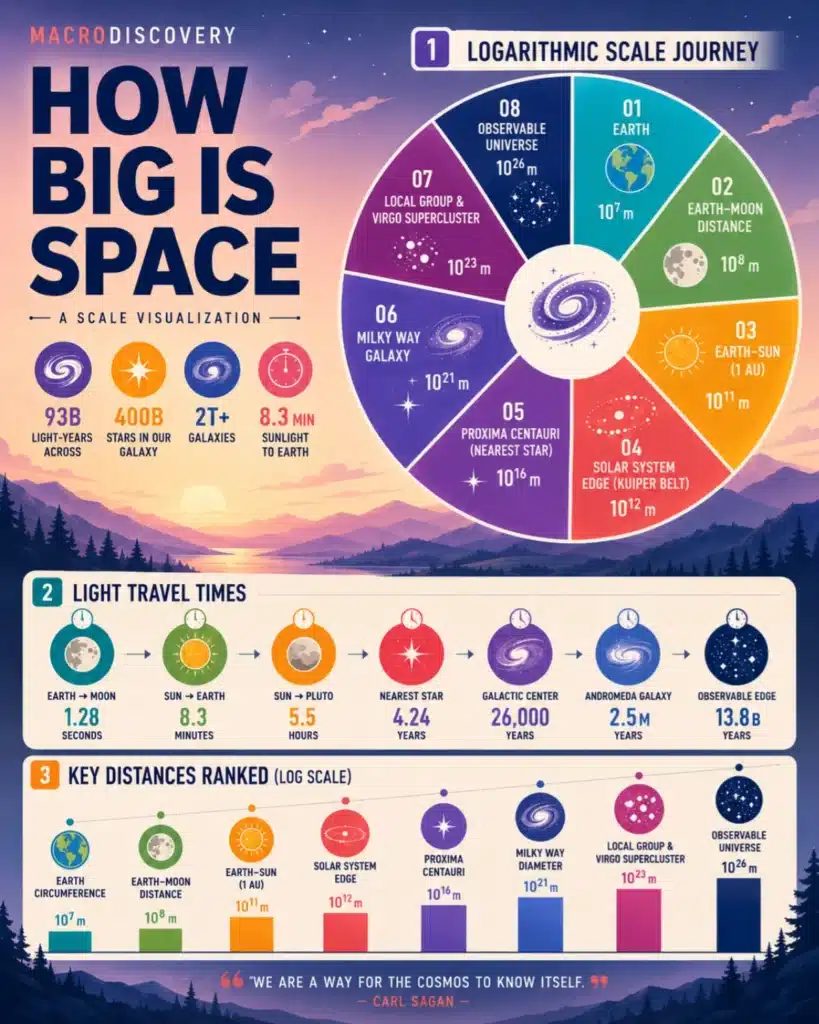
The observable universe is 93 billion light-years across. The Milky Way alone contains 400 billion stars. Earth, at galactic scale, is not a dot — it is beneath the resolution of any instrument that could measure it. A logarithmic journey from your feet to the edge of everything.

By MacroDiscovery
Sources: NASA · ESA · IAU · Caltech
Updated: 2024
93B
Light-years across (observable universe)
400B
Stars in the Milky Way alone
2T+
Galaxies in the observable universe
8.3 min
Light travel time, Sun to Earth
10²⁶ m
Radius of observable universe in meters
Visualization 01 — Logarithmic Scale Journey
From Earth’s Surface to the Edge of Everything

Each step on this scale is exponentially larger than the last. Note: distances shown on a log₁₀ scale — each row represents a 10× to 1,000× increase over the previous.

LEVEL 01 · 10⁷ m Earth Diameter: 12,742 km · Surface to ISS: 408 km If Earth = basketball, ISS orbits 3 cm above surface LEVEL 02 · 10⁸ m Earth–Moon Distance 384,400 km · Light travel: 1.28 seconds 30 Earths lined up = Earth to Moon. You could drive in 130 days. LEVEL 03 · 10¹¹ m Earth–Sun Distance (1 AU) 149.6 million km · Light travel: 8.3 minutes If Earth = period at end of sentence, Sun is a grapefruit 15m away LEVEL 04 · 10¹² m Edge of Solar System (Kuiper Belt) ~50 AU from Sun · Light travel: 7 hours Voyager 1 has traveled here since 1977. It’s still in our neighborhood. LEVEL 05 · 10¹⁶ m Proxima Centauri (nearest star) 4.24 light-years · 40 trillion km · Light: 4.24 years At Voyager 1’s speed: 73,000 years to reach our nearest neighbor LEVEL 06 · 10²¹ m Milky Way Galaxy 100,000 light-years wide · 400 billion stars If Milky Way = continent of US, solar system = a coffee cup LEVEL 07 · 10²³ m Local Group & Virgo Supercluster 10 million light-years · 54 galaxies in local group Andromeda — 2.5M ly away — is visible to the naked eye from Earth LEVEL 08 · 10²⁶ m · THE EDGE OF THE OBSERVABLE UNIVERSE 93 billion light-years wide · 2 trillion+ galaxies · Light travel: 13.8 billion years “Observable” — not because it ends, but because light beyond hasn’t reached us yet Sources: NASA · ESA · IAU · Caltech · NED · Scale: Logarithmic (not proportional) MacroDiscovery · macrodiscovery.com
Visualization 02 — Scale Analogies
Translating the Impossible Into the Graspable

Astronomical distances resist human intuition. These analogies rebuild scale from objects you can hold.

🍊
Sun–Earth Distance · 1 AU
The Grapefruit Model
149.6 million km · 8.3 light-minutes
If the Sun is a grapefruit (14cm diameter), Earth is a grain of sand 15 meters away. Jupiter is a marble 78 meters away. The nearest star, Proxima Centauri, is another grapefruit sitting 4,100 kilometers away — roughly the distance from New York to Los Angeles, scaled.
🚗
Earth–Moon Distance · 384,400 km
The Driving Analogy
384,400 km · 1.28 light-seconds
If you could drive to the Moon at 100 km/h without stopping, the journey would take 160 days. If you could drive to the Sun at the same speed: 171 years. To the nearest star: 46 million years. Cars are not the right tool.
🌌
Milky Way · 100,000 light-years
The Coffee Cup Galaxy
100,000 ly · 9.46×10²⁰ m
If the Milky Way were scaled to the continental United States, our entire solar system would be the size of a coffee cup sitting somewhere in Kansas. Earth itself would be a single atom inside that coffee cup. The Andromeda Galaxy would be another continent, sitting in the Atlantic Ocean.
🚀
Voyager 1 · Nearest Star
Our Fastest Object
Proxima Centauri · 4.24 light-years
Voyager 1, humanity’s most distant spacecraft, travels at 61,500 km/h. At that speed, reaching Proxima Centauri — our nearest stellar neighbor — would take 73,000 years. It launched in 1977 and is currently just 24 light-hours from Earth.
🔭
Observable Universe · 93 billion ly
The Edge Is Not a Wall
93 billion light-years across
The observable universe is not the whole universe — it’s the portion from which light has had time to reach us in 13.8 billion years. Space beyond that exists, but its light hasn’t arrived yet. The total universe may be 250 times larger than what we can observe — or infinite.
🌊
2 Trillion Galaxies
The Sand Grain Perspective
2,000,000,000,000 galaxies (est.)
There are more stars in the observable universe than there are grains of sand on all of Earth’s beaches — estimated at 10²⁴ stars vs. 7.5×10¹⁸ grains of sand. Each grain of sand would represent roughly 133 stars. The beach analogy undersells it by a factor of 100.
Visualization 03 — Distance Ranking
Key Distances in the Universe — Ranked by Scale

Ordered from nearest to farthest. Log-scale bar shows relative magnitude — each row is orders of magnitude larger than the last.

# Object / Distance Kilometers Light Travel Time Log Scale
01
Earth CircumferenceAround the equator once 40,075 km 0.13 seconds
02
Earth to MoonAverage distance 384,400 km 1.28 seconds
03
Earth to Sun (1 AU)Average orbital distance 149,597,871 km 8.3 minutes
04
Edge of Solar SystemKuiper Belt / heliopause ~100 AU ~15 billion km ~14 hours
05
Proxima CentauriNearest star system to Earth 40.1 trillion km 4.24 years
06
Galactic CenterMilky Way core / Sgr A* black hole 248 quadrillion km 26,000 years
07
Milky Way DiameterEdge to edge of our galaxy 946 quadrillion km 100,000 years
08
Andromeda GalaxyNearest large galaxy — visible naked eye 2.37×10¹⁹ km 2.5 million years
09
Virgo SuperclusterOur supercluster — Laniakea — diameter 4.73×10²¹ km 500 million years
10
Observable UniverseEverything light has reached us from 8.8×10²³ km 13.8 billion years
Visualization 04 — Light Travel Times
How Long Light Takes — From Seconds to Billions of Years

Light travels 299,792 km per second — the fastest anything in the universe can move. These are its journey times.

Earth → Moon
1.28 sec
Earth–Moon
The light reflecting from the Moon left its surface 1.28 seconds before it hits your eye. Apollo astronauts experienced a 2.6-second communication delay.
Sun → Earth
8.3 min
1 Astronomical Unit
The sunlight warming your skin right now left the Sun 8.3 minutes ago. The photon itself may have taken 100,000 years to escape the Sun’s core before that.
Sun → Pluto
5.5 hr
40 AU — Outer Solar System
Sending a command to the New Horizons probe near Pluto takes over 5 hours to arrive. Mission control gets no response for 11 hours after sending a signal.
Nearest Star
4.24 yr
Proxima Centauri
If Proxima Centauri had an Earth-like planet and its inhabitants could see Earth’s light — they would be watching us from 4 years in the past.
Galactic Core
26,000 yr
Sagittarius A* Black Hole
The light we observe from the Milky Way’s central black hole left during Earth’s last Ice Age. We are watching ancient history in real time.
Andromeda Galaxy
2.5M yr
M31 · Nearest major galaxy
Andromeda is visible to the naked eye, yet we see it as it was 2.5 million years ago — before Homo sapiens existed on Earth. It is the most distant object visible to the naked eye.
Observable Edge
13.8B yr
Cosmic Microwave Background
The oldest light we can detect left its source 380,000 years after the Big Bang — 13.8 billion years ago. We are looking at the literal edge of the observable universe.

The core problem with understanding space is that human intuition is calibrated for distances between zero and roughly 40,000 kilometers — the circumference of Earth. Beyond that, our brains use the same word, “far,” for distances that differ by a factor of one trillion. The Moon is 384,000 km away. The observable universe is 93 billion light-years across. These are not “far” and “very far.” They are categorically different scales separated by 26 orders of magnitude.

The most instructive number is the speed of light: 299,792 kilometers per second. Nothing in the universe travels faster. Light circles Earth 7.5 times in a single second. Yet light takes 8.3 minutes to reach us from the Sun, 4.24 years to cross to the nearest star, and 100,000 years to traverse the Milky Way. At every scale, the universe reveals a new level of incomprehensibility. Voyager 1 — the fastest human-built object to leave the solar system — has been traveling since 1977. It would need 73,000 more years to reach Proxima Centauri.

“The universe is not only stranger than we imagine — it is stranger than we can imagine.”

What the logarithmic scale reveals is that each new threshold of cosmic distance is not an incremental increase but a complete reimagining of what “distance” means. The step from the solar system to the nearest star is a factor of 10,000 times larger than the step from Earth to the edge of the solar system. The step from the nearest star to the Milky Way’s diameter is another factor of 25,000. And the observable universe is 930 times wider than the Milky Way. At galactic scale, Earth has no visual representation — it is below the resolution of any instrument that exists.

Macro Takeaway — The Next 5–10 Years of Space Exploration

The next decade will produce the most detailed map of cosmic structure ever assembled. The James Webb Space Telescope, now operational, is capturing light from galaxies formed fewer than 400 million years after the Big Bang — a direct window into the universe’s first era. The Vera Rubin Observatory, coming online in 2025, will survey 20 billion galaxies and fundamentally change our understanding of dark matter distribution.

Meanwhile, humanity’s practical exploration horizon remains confined to our own solar system. NASA’s Artemis program aims to return humans to the Moon by 2026. Mars crewed missions are targeted for the 2030s. The nearest star — 4.24 light-years away — remains a generational project: the Breakthrough Starshot initiative proposes laser-propelled nanoprobes reaching 20% of light speed, arriving at Proxima Centauri in roughly 20 years after launch. We are, by any cosmic measure, still local — and the universe is almost entirely unexplored.

Sources & Methodology
  • NASA — Solar System Exploration · Distance data and Voyager mission telemetry 2024
  • European Space Agency (ESA) — Gaia Mission parallax measurements, stellar distances 2024
  • International Astronomical Union (IAU) — Official astronomical constants and definitions
  • Caltech / NASA Jet Propulsion Laboratory — Voyager 1 & 2 mission data 2024
  • NASA Webb Space Telescope — Early universe observations, first light data 2024
  • Planck Collaboration — Cosmic Microwave Background temperature maps, age of universe
  • NASA Extragalactic Database (NED) — Galaxy distances and Local Group catalog
  • Breakthrough Initiatives — Starshot mission parameters and propulsion estimates
Macro Discovery

Sukh Dhaliwal

Sukh Dhaliwal is the founder of Macro Discovery, an independent digital publication covering AI, technology, science, future trends, and global innovation through visual storytelling and data-driven analysis.

Join WhatsApp

Join Now

Join Facebook

Follow us

Leave a Comment