The True Cost of Owning
a Car Over a Lifetime
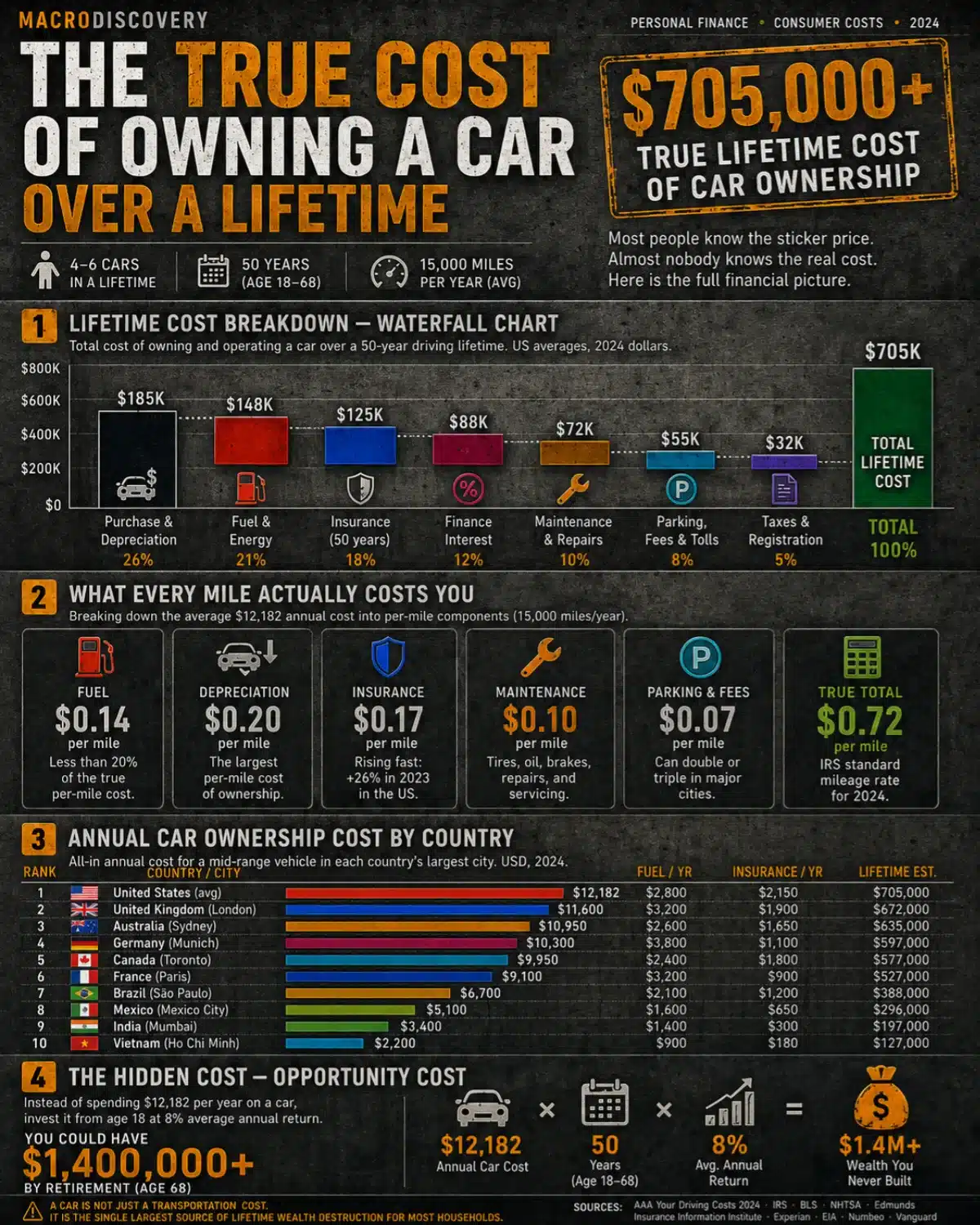
Most people know what they paid for their car. Almost nobody knows what it actually costs them — across fuel, insurance, depreciation, financing, maintenance, parking, and the investment returns they never earned. The real number is much larger than the sticker price.
Based on owning 4–6 cars across a 50-year driving lifetime (age 18–68). US averages, 2024. Inflation-adjusted to today’s dollars.
Breaking the annual cost of $12,182 (AAA 2024 average for a new vehicle) into its per-mile components at 15,000 miles per year.
Annual all-in cost for a mid-range vehicle in each country’s largest city. Purchasing power adjusted to USD. Source: Numbeo, KPMG, local auto associations 2024.
| Country / City | Annual Cost (USD) | Fuel Cost/yr | Insurance/yr | Lifetime Est. |
|---|---|---|---|---|
|
🇺🇸
United States (avg)
|
$2,800 | $2,150 | $705,000 | |
|
🇬🇧
United Kingdom (London)
|
$3,200 | $1,900 | $672,000 | |
|
🇦🇺
Australia (Sydney)
|
$2,600 | $1,650 | $635,000 | |
|
🇩🇪
Germany (Munich)
|
$3,800 | $1,100 | $597,000 | |
|
🇨🇦
Canada (Toronto)
|
$2,400 | $1,800 | $577,000 | |
|
🇫🇷
France (Paris)
|
$3,200 | $900 | $527,000 | |
|
🇧🇷
Brazil (São Paulo)
|
$2,100 | $1,200 | $388,000 | |
|
🇲🇽
Mexico (Mexico City)
|
$1,600 | $650 | $296,000 | |
|
🇮🇳
India (Mumbai)
|
$1,400 | $300 | $197,000 | |
|
🇻🇳
Vietnam (Ho Chi Minh)
|
$900 | $180 | $127,000 |
When people think about the cost of their car, they think about the monthly payment. Sometimes they think about insurance and fuel too. Almost nobody calculates the full picture — and the full picture, when you actually run the numbers, is one of the most striking data points in personal finance.
The average American spends approximately $12,182 per year on their vehicle according to AAA’s 2024 Driving Costs Study. Over a 50-year driving lifetime — from age 18 to 68, owning four to six vehicles — that compounds to approximately $705,000 in direct costs. This does not include the investment returns foregone by spending that money on a depreciating asset rather than investing it.
“A new car loses approximately 20% of its value in the first year of ownership. It loses roughly 47% of its value in the first three years. The moment you drive it off the lot, you have already paid the most expensive mile you will ever drive.”
The Depreciation Problem
The Electric Vehicle Calculation
Electric vehicles change several components of this calculation — but do not eliminate the problem. EVs have substantially lower fuel costs (electricity is cheaper per mile than gasoline), significantly lower maintenance costs (no oil changes, fewer brake jobs due to regenerative braking, fewer moving parts), and often lower insurance costs for base models.
What EVs do not change: depreciation (which is currently worse for EVs than for comparable ICE vehicles in many segments), financing costs (EVs carry higher sticker prices), and the fundamental opportunity cost calculation. A $55,000 EV still costs $55,000 — which still compounds to well over $1 million over a lifetime if invested instead.
The AAA estimates that EV ownership currently costs approximately $10,700 per year — roughly $1,500 less than the average ICE vehicle. Over a lifetime, this represents approximately $75,000 in savings versus the ICE alternative — meaningful, but not transformative at the scale of the full lifetime cost calculation.
The car is the most expensive consumer product most people will ever own — and most of them have no accurate idea what it costs. The gap between perceived cost (the monthly payment) and actual cost ($0.72 per mile across all categories) is one of the largest systematic miscalculations in personal finance.
The data does not argue that cars are irrational purchases. In most of the United States, car ownership is not a luxury — it is a prerequisite for employment, healthcare access, and participation in civic life. The built environment of the US was designed around the automobile, and for most Americans there is no practical alternative. The question is not whether to own a car but whether to own the car you own — or a less expensive one.
The calculation that most changes behavior is the opportunity cost one: every upgrade from a $25,000 used car to a $45,000 new car costs not $20,000 but approximately $200,000 in compounded lifetime wealth — the $20,000 price difference plus 50 years of compound returns on that difference. This is the number that personal finance textbooks discuss and most car advertisements are designed to make you forget.