The Device in Your Pocket
Rewired Human Attention
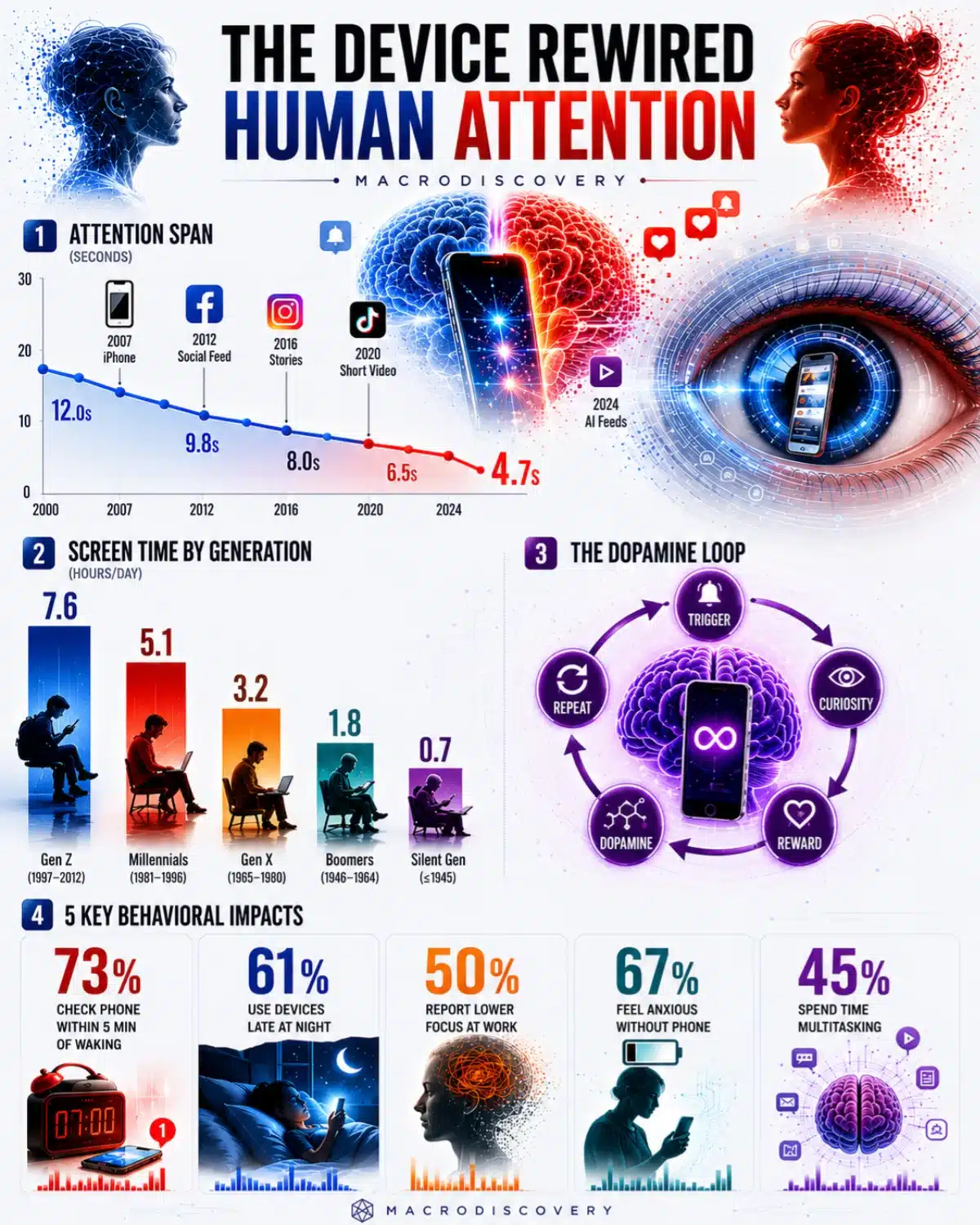
In 2000, the average human attention span was measured at 12 seconds. By 2015 it had fallen to 8 seconds — below the goldfish. The smartphone arrived in 2007. The timing is not coincidental. Here is the data on what happened next.
Measured attention span in seconds for sustained focus tasks. Based on EEG and behavioral studies. The smartphone era began in 2007.
Average daily smartphone screen time by age group, 2024. Younger generations spend more time on screen than on school or work.
(age 8–11)
(age 12–27)
(age 28–43)
(age 44–59)
(age 60–78)
The dopamine feedback loop that makes smartphones compulsive — and why it was built this way deliberately.
Annual revenue of the major platforms that monetize human attention. Ranked by revenue derived directly from selling access to human focus.
Behavioral data on how often and why people check their phones. Source: Asurion, IDC, Pew Research 2024.
The smartphone is 17 years old. In that time, it has become the most widely adopted consumer technology in human history — faster than electricity, faster than television, faster than the internet itself. Approximately 6.9 billion people now carry one. Most of them check it 96 times per day. Most of them feel anxious without it. Most of them cannot sit through a meeting, a meal, or a film without reaching for it at least once.
This did not happen by accident. It happened by design — and the design principles are now well documented, openly discussed by the engineers who built them, and increasingly regulated by governments that have concluded the outcome represents a public health problem rather than a consumer preference.
“We have created a world in which online connection has become primary — a world in which a constant stream of stimulation provides no opportunity for the mind to rest. The smartphone is the cigarette of the 21st century — completely normalized, highly addictive, and with long-term consequences we are only beginning to understand.”
The Attention Architecture
The Counterargument — and Its Limits
The data above does not mean smartphones are uniformly harmful or that the pre-smartphone world was cognitively superior. Several counterarguments have genuine weight. Moral panics about new communication technologies are not new — the printing press, the novel, the telephone, and the television each generated similar concerns about cognitive and social deterioration. Most of those concerns were eventually moderated by adaptation.
The smartphone may be genuinely different in degree rather than kind — it is ambient in a way that previous technologies were not, it is interactive in a way that television was not, and it arrived in children’s lives at younger ages than any previous mass communication technology. But the evidence that it constitutes a categorical break from previous technology transitions rather than a large version of a familiar pattern is not yet settled.
What is settled is the structural fact: a technology optimized for engagement — not for wellbeing, not for productivity, not for attention — was distributed to 6.9 billion people in 17 years. The measurable consequences are only now becoming visible in longitudinal data. The full picture will take another decade to clarify.
The smartphone is the most significant behavioral intervention ever deployed at civilizational scale. It was not designed as an intervention — it was designed as a product. But the behavioral consequences are of the scale and character that, in any other domain, would be classified as public health outcomes requiring regulatory response.
The attention economy’s business model creates a structural conflict of interest that individual choice cannot resolve. When the product is free and the monetization mechanism is time-on-platform, the incentive structure pushes every design decision toward engagement maximization — regardless of the cognitive or psychological cost to the user. This is not a conspiracy: it is the rational outcome of a market structure.
The coming decade will see the first generation — Gen Alpha — to grow up from birth with smartphones and social media reach adulthood. The longitudinal data on their cognitive development, attention capacity, and mental health outcomes will be the most important data in this space. The hypothesis being tested, at civilizational scale, is whether a technology optimized for engagement can coexist with sustained human attention — or whether the two are structurally incompatible.