AI Tech Gaming Future Automobile Top 10 Space Innovation Trending How To Reviews Discover

---Advertisement---

Visualized: The Human Body as a Data System

Macro Discovery
On: June 25, 2026 4:16 PM
Follow Us:
---Advertisement---
The Human Body as a Data System
The Human Body as a Data System — MacroDiscovery
MacroDiscovery
Health & Science · 8 min read · Current Data
NOW — Human Biology · Data Systems · Science
Health & Science

The Human Body
as a Data System

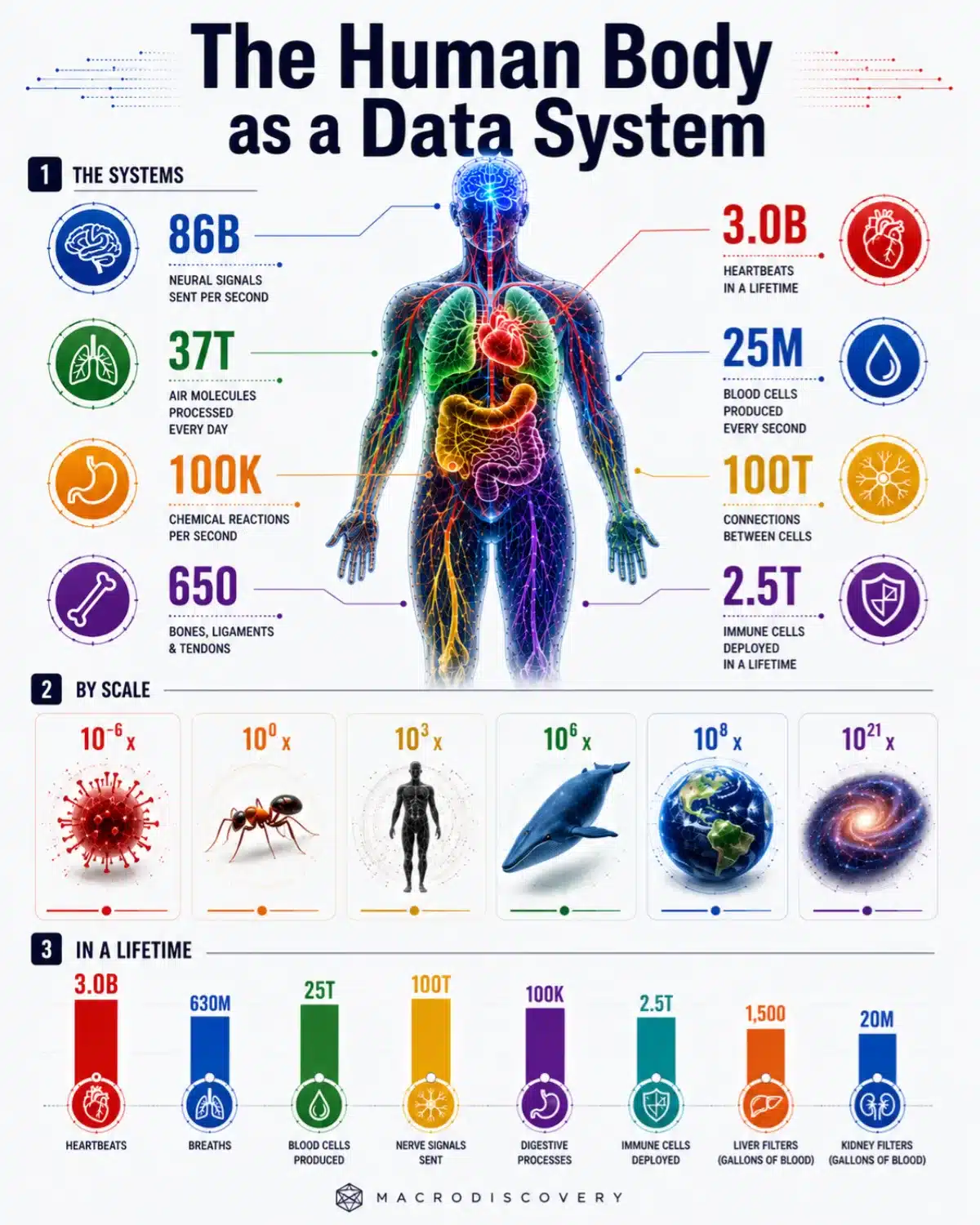
37 trillion cells. 86 billion neurons. 100,000 heartbeats per day. 2 million red blood cells produced every second. The human body is the most complex operating system ever constructed — and it runs without a manual.

By MacroDiscovery
Sources: NIH · Nature · The Lancet · WHO
Systems: 8 major systems analyzed
37T
Total cells in the body
86B
Neurons in the brain
100K
Heartbeats per day
8m
Length of digestive tract
2M
Red blood cells/second made
Visualization 01 — Systems Dashboard
The Human Body — System by System

Eight major body systems, each displayed as a live instrument panel with key operational metrics.

❤️
Cardiovascular
The body’s pump and delivery network
Primary metric
100,000
Heartbeats per day — 3 billion in a lifetime
Blood vessels total 100,000 km
Blood volume ~5 litres
Full circulation time ~60 seconds
RBC produced/second 2,000,000
Litres pumped per day 7,570 L
🧠
Nervous System
The body’s command and control
Primary metric
86 Billion
Neurons in the brain — equal to stars in the Milky Way
Synaptic connections 100–500T
Nerve signal speed 432 km/h
Brain power draw ~20 watts
Nerve cells in body ~100 billion
Brain share of body weight 2% / 20% energy
🫁
Respiratory
The body’s gas exchange engine
Primary metric
23,000
Breaths per day — 672 million in a lifetime
Lung surface area 70 m²
Alveoli count ~480 million
Air inhaled per day 11,000 litres
O₂ consumed per minute 250 ml (rest)
Max lung capacity 6 litres
🫀
Digestive
The body’s fuel processing system
Primary metric
8 metres
Total digestive tract length — mouth to colon
Gut bacteria species ~1,000
Gut microbiome cells 38 trillion
Saliva produced/day 1–2 litres
Small intestine length 6–7 metres
Food transit time 24–72 hours
🛡️
Immune System
The body’s defense and surveillance
Primary metric
1 Billion
White blood cells in the body at any given time
Antibody types possible 10 billion+
Pathogens killed/day Billions
Cancer cells neutralized ~1,000/day
Lymph nodes in body 600–700
Memory cell lifespan Decades
🦴
Skeletal System
The body’s structural framework
Primary metric
206
Bones in the adult human body (300 at birth)
Joints in the body ~360
Bone renewal cycle ~10 years
Femur strength Stronger than concrete
Smallest bone Stapes: 3mm
Bone marrow output 500B cells/day
⚗️
Endocrine System
The body’s chemical messenger network
Primary metric
50+
Hormones regulating every bodily function
Endocrine glands 9 major
Insulin response time <1 minute
Cortisol peak timing 30 min after waking
Thyroid hormone range Controls metabolism
ADH kidney control Water balance
🧬
Integumentary
The body’s largest organ — skin
Primary metric
1.7 m²
Average skin surface area — the body’s largest organ
Skin cells shed/hour 30,000–40,000
Full skin renewal ~2–3 weeks
Skin layers 3 (epidermis/dermis/hypo)
Hair follicles ~5 million
Sweat glands 2–4 million
Visualization 02 — Scale Analogies
The Numbers Made Real

The body’s operating statistics are so large they require analogies to comprehend. Here is each one anchored to something tangible.

Blood Vessels · Cardiovascular
100,000 km
Total length of blood vessels in the human body.
That is 2.5 times around the Earth’s equator — inside a single human being. Laid end to end, your blood vessels would stretch from New York to Los Angeles and back 17 times.
Neurons · Nervous System
86 Billion
Neurons in the human brain — roughly equal to stars in the Milky Way galaxy.
Each neuron connects to up to 10,000 others, creating a network of 100–500 trillion synapses. The number of possible brain states exceeds the number of atoms in the observable universe.
Lung Surface · Respiratory
70 m²
The surface area of both lungs when all alveoli are unfolded.
That is roughly the size of a tennis court — folded into two fist-sized organs in your chest. The density of this folding is what makes gas exchange fast enough to sustain life.
Cells · Total Body Count
37 Trillion
Estimated total cells in the adult human body.
If each cell were a person, the body would contain 4,600 Earths’ worth of population. These 37 trillion cells operate simultaneously, each performing hundreds of chemical reactions per second, without central coordination.
Heartbeats · Lifetime
3 Billion
Heartbeats in a typical 80-year human life — without a single planned maintenance break.
The heart is the only muscle that never rests. It begins beating approximately 22 days after conception and does not stop until death. No engineered pump has ever matched its reliability at this scale.
DNA · Genetic Data
~1.5 GB
Approximate data equivalent of the human genome — 3.2 billion base pairs.
Every cell in your body contains a complete copy of this 1.5 GB instruction manual. Stretched out, the DNA in a single cell would be 2 meters long. The DNA in all your cells combined would stretch from Earth to the Sun — and back 400 times.
Visualization 03 — Lifetime Operating Statistics
What the Body Produces in 80 Years

Cumulative lifetime output of each major body system, based on an 80-year lifespan.

System / Metric Per Day Per Year 80-Year Lifetime
Heartbeats
~100,000 ~36.5M ~3 Billion
Breaths taken
~23,000 ~8.4M ~672 Million
Blood pumped (litres)
7,570 L ~2.7M L ~216M litres
Red blood cells made
173B ~63T ~5 Quadrillion
Skin cells shed
~840,000 ~307M ~24.5 Billion
Food processed (kg)
~2 kg avg ~730 kg ~58,400 kg
Air inhaled (litres)
11,000 L ~4M L ~320M litres
Neural signals fired
Trillions Quadrillions Incalculable
Immune threats neutralized
Billions Trillions ~Quadrillions
Steps walked (average)
~8,000 ~2.9M ~216M steps

No engineer has ever built anything close to the human body. Not in complexity, not in efficiency, not in the elegance of its solutions to the problem of keeping 37 trillion semi-autonomous units alive and coordinated simultaneously — for 80 years, without a single planned shutdown.

When you look at the body as a data system — treating its biological processes as operating metrics rather than medical facts — the numbers become difficult to process. Not because they are abstract, but because they are concrete and still incomprehensible. The cardiovascular system pumps 216 million litres of blood in a lifetime. The immune system neutralizes billions of threats per day. The brain fires trillions of signals before breakfast.

“The brain consumes 20% of the body’s total energy while representing just 2% of its weight. No computer in existence achieves this ratio of computational output to power consumption — not even close.”

The Cardiovascular System

Heart · The Pump That Never Rests
3 Billion
The heart beats approximately 3 billion times in a human lifetime — without a single scheduled maintenance stop.
The heart is a muscle approximately the size of a fist, weighing between 230 and 350 grams. It begins beating around 22 days after conception and does not stop until death. Its 100,000 daily beats pump approximately 7,570 litres of blood through a network of blood vessels that, if laid end to end, would circle the Earth 2.5 times. The efficiency of this system — running continuously for 80 years on roughly 20 watts of power — has never been replicated by any engineered pump at any scale.
Source: American Heart Association · NIH National Heart, Lung, and Blood Institute

The Nervous System

Brain · The Universe’s Most Complex Structure
100–500T
The brain contains 100 to 500 trillion synaptic connections — the number of possible brain states exceeds the number of atoms in the observable universe.
The human brain’s 86 billion neurons are not the most remarkable number — it is the connections between them. Each neuron can connect to up to 10,000 others, creating a network of staggering complexity. The brain processes this network while consuming roughly 20 watts of power — the equivalent of a dim light bulb. No artificial neural network yet built approaches the energy efficiency or parallel processing capability of biological neural tissue. The fastest nerve signals travel at 432 kilometers per hour — from stimulus to response in milliseconds.
Source: Azevedo et al. (2009) “Equal numbers of neuronal and nonneuronal cells make the human brain an isometrically scaled-up primate brain” — Journal of Comparative Neurology · Nature Neuroscience

The Immune System

Immunity · A Surveillance System That Never Sleeps
1,000/day
The immune system identifies and eliminates approximately 1,000 cancerous or pre-cancerous cells in the human body every single day.
The immune system is perhaps the most underappreciated system in the body in popular understanding. It does not simply respond to illness — it is continuously active, scanning every cell in the body for malfunction, mutation, and invasion. Its ability to distinguish “self” from “non-self” is one of the most elegant solutions in biology. The system can generate over 10 billion distinct antibody configurations — more than enough to theoretically respond to any pathogen that has ever existed or could exist. When this system fails to identify cancerous cells, the result is cancer. The system’s daily success in neutralizing pre-cancerous cells is what keeps most people cancer-free for decades.
Source: Hanahan, D. & Weinberg, R.A. (2011) “Hallmarks of Cancer” — Cell · NIH National Cancer Institute

The Digestive System

Gut · A Civilization Within a Body
38 Trillion
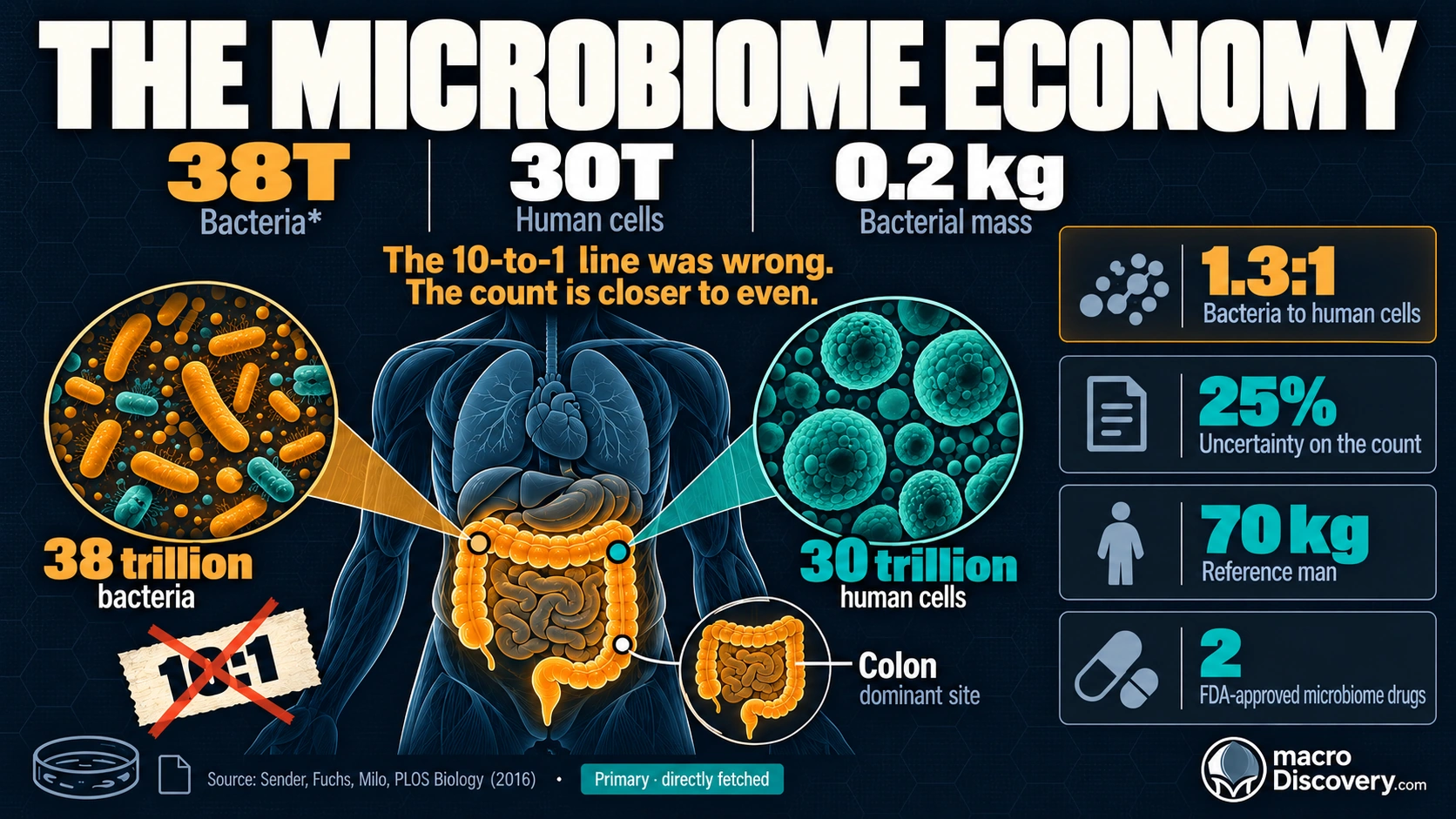
The gut microbiome contains approximately 38 trillion microbial cells — roughly equal to the number of human cells in the body itself.
The human gut is not simply a food processing system. It is a complex ecosystem containing approximately 1,000 species of bacteria, viruses, fungi, and other microorganisms that collectively outnumber human cells in the body. This microbiome influences immune function, mental health (via the gut-brain axis), metabolism, and disease risk in ways that science is still mapping. The gut is often called the “second brain” — it contains over 500 million neurons, more than the spinal cord, and can operate independently of the central nervous system.
Source: Sender, R. et al. (2016) “Revised Estimates for the Number of Human and Bacteria Cells in the Body” — Cell · Nature Reviews Microbiology

The Body as Engineering Problem

What makes the human body remarkable from an engineering perspective is not any single system. It is the integration. The cardiovascular system delivers oxygen that the respiratory system captures to cells that the nervous system coordinates to perform work that the digestive system fuels while the immune system monitors every component for failure — simultaneously, continuously, for decades.

No human-engineered system achieves this level of integrated redundancy. The body has multiple backup systems for almost every critical function. The liver can regenerate up to 75% of its mass if damaged. Bone can heal. The brain can reroute neural pathways around damage through neuroplasticity. The immune system adapts to novel threats it has never encountered before.

MacroDiscovery Take

The human body is the most sophisticated data system ever studied. It processes more information per second than any computer yet built, runs more parallel processes than any software ever written, maintains more complex feedback loops than any engineered system ever designed — and does all of this at approximately 37°C, on roughly 2,000 calories per day, for eight decades.

The data also reveals the body’s vulnerabilities. A system this complex has correspondingly complex failure modes. The same immune sophistication that neutralizes 1,000 cancerous cells per day can turn against the body itself in autoimmune disease. The same neural plasticity that allows the brain to recover from damage also makes it susceptible to addiction. Every adaptive feature has a corresponding failure mode — which is the defining characteristic of biological, rather than engineered, complexity.

Understanding the body as a data system — rather than just a medical subject — changes how you read its outputs. Every symptom is a signal. Every physiological response is feedback. The body is communicating constantly, in the only language it has: the language of biology.

Forecast Cards — Key Data Points
Health & Science · Heart
3B
Heartbeats in a human lifetime — the only muscle that operates continuously from before birth until death.
American Heart Association, 2024
Health & Science · Brain
86B
Neurons in the human brain — each connecting to up to 10,000 others, creating a network more complex than any computer ever built.
Journal of Comparative Neurology, 2009
Health & Science · Lungs
70 m²
Surface area of the human lungs — the size of a tennis court folded into your chest to enable gas exchange fast enough to sustain life.
NIH National Heart, Lung, and Blood Institute
Health & Science · Immune
1,000
Cancerous or pre-cancerous cells eliminated by the immune system every single day in a healthy human body.
NIH National Cancer Institute, 2024
Sources & Methodology
  • Azevedo, F.A.C. et al. (2009) “Equal numbers of neuronal and nonneuronal cells” — Journal of Comparative Neurology
  • Sender, R., Fuchs, S. & Milo, R. (2016) “Revised Estimates for the Number of Human and Bacteria Cells in the Body” — Cell
  • American Heart Association — Heart Disease and Stroke Statistics 2024
  • NIH National Heart, Lung, and Blood Institute — Anatomy of the Heart and Lungs
  • NIH National Cancer Institute — The Immune System and Cancer
  • Hanahan, D. & Weinberg, R.A. (2011) “Hallmarks of Cancer: The Next Generation” — Cell
  • WHO — Global Health Estimates 2024
  • Nature Neuroscience — Special Issue: The Human Brain Project (2023)
Macro Discovery

Sukh Dhaliwal

Sukh Dhaliwal is the founder of Macro Discovery, an independent digital publication covering AI, technology, science, future trends, and global innovation through visual storytelling and data-driven analysis.

Join WhatsApp

Join Now

Join Facebook

Follow us

Leave a Comment