AI Tech Gaming Future Automobile Top 10 Space Innovation Trending How To Reviews Discover

---Advertisement---

Visualized: Life at $1, $10, $100 Per Day

Macro Discovery
On: June 27, 2026 3:06 PM
Follow Us:
---Advertisement---
Life at $1, $10, $100 Per Day
NOW
CIVILIZATION'S DASHBOARD · DEMOGRAPHICS & WEALTH

Life at $1, $10, $100 Per Day

Eight billion people. Four income worlds. One planet. The distance between them is not measured in miles — it's measured in what a single day buys, and who controls what happens next.

NOW
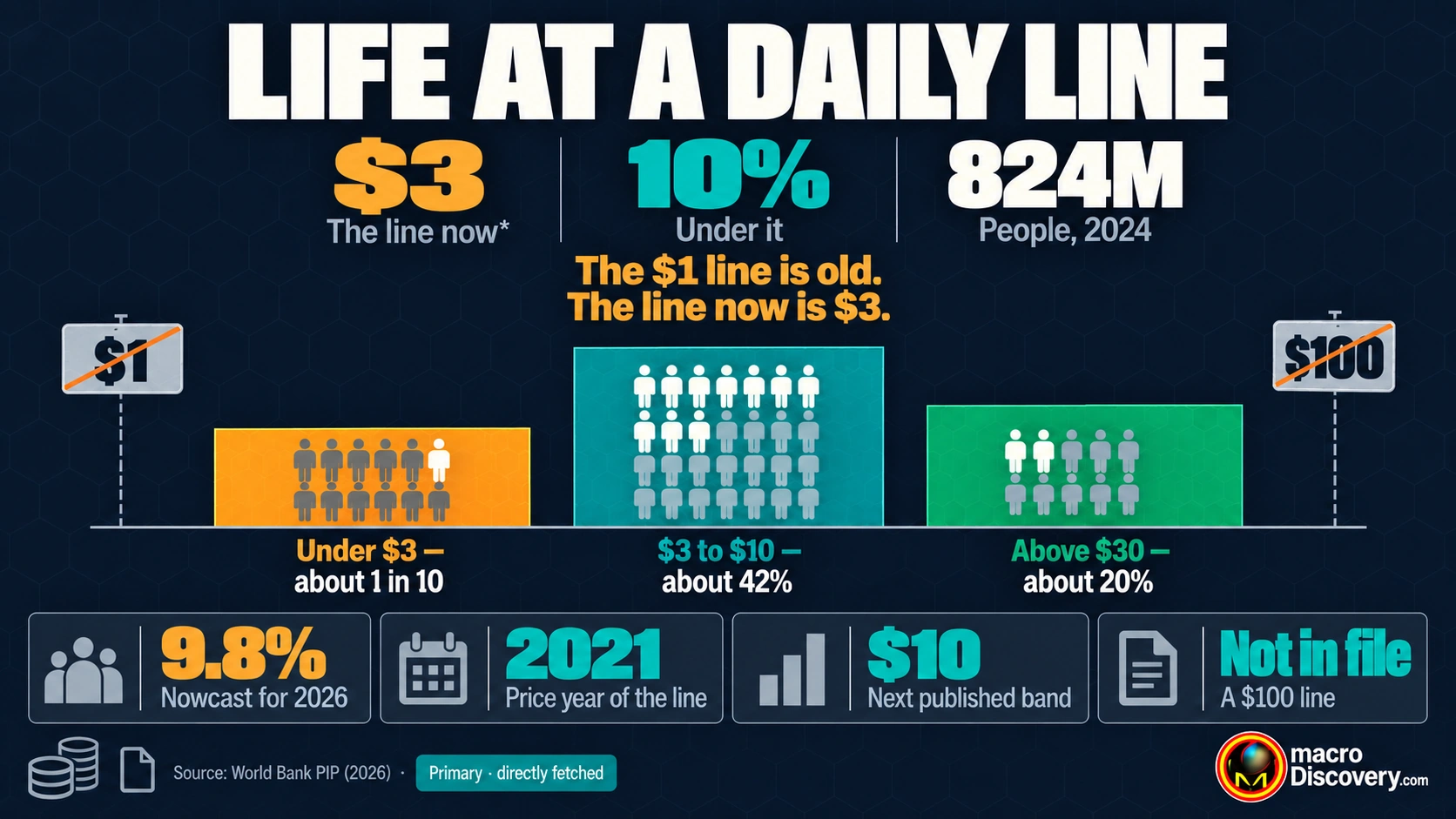
People still below the $2.15/day extreme poverty line
~700M
Global median income
~$8–10/day (PPP)
Share above $100/day
~15% of humanity
Direction
Middle tier expanding fastest
The Global Income Distribution — 8 Billion People
Every person on Earth lives somewhere in this spectrum
Share of world population by daily income (PPP), 2024
~9%<$2.15
~28%$2–$10
~39%$10–$30
~24%>$30
Extreme povertyBelow $2.15/day · ~700M people
Low income$2–$10/day · ~2.2B people
Middle income$10–$30/day · ~3B people
High incomeAbove $30/day · ~1.9B people
$1/day
EXTREME POVERTY · <$2.15 LINE
~700 million people. Mostly in Sub-Saharan Africa and pockets of South Asia.
A day buys Enough calories to survive. Not reliably. No medical care. No school fees. No buffer for any crisis — a sick child, a drought, a price spike — is immediately catastrophic.
Countries: Chad, Niger, DRC, Somalia
$5/day
LOW INCOME · $2–$10 BAND
~2.2 billion people. Much of rural India, Sub-Saharan Africa, and Southeast Asia.
A day buys Food security most days, a shared living space, basic clothing. Children likely in school. A serious illness can still erase years of savings. No internet, or 2G mobile data at best.
Countries: India (rural), Bangladesh, Ethiopia
$10–30/day
MIDDLE INCOME · THE EMERGING CONSUMER
~3 billion people. Urban India, China's middle class, Latin America, Eastern Europe.
A day buys Stable shelter, three meals, a smartphone, occasional travel. Healthcare access — imperfect but present. Susceptible to downturns but not destroyed by them. This is the tier growing fastest.
Countries: China, Brazil, Mexico, Indonesia
$100/day
HIGH INCOME · $30+ BAND
~1.9 billion people. North America, Western Europe, Japan, South Korea, Australia.
A day buys Choice. Housing stability, full healthcare, education optionality, international travel, savings, insurance. The defining feature isn't any single thing — it's insulation from crisis.
Countries: U.S., Germany, Japan, UK, Australia

The numbers that define global poverty are deceptively simple: $2.15 a day, the World Bank's extreme poverty line as of 2022, revised from the previous $1.90 threshold using updated purchasing power parity data. But the number itself is almost beside the point. What these thresholds actually measure is the presence or absence of a buffer — the difference between a life where one bad event is survivable and a life where one bad event is everything.

Confidence Snapshot

Known — approximately 700 million people live below the World Bank's $2.15/day extreme poverty line as of the most recent available data. The global median income is estimated at roughly $8–10/day in purchasing power parity terms. About 15% of humanity lives above $30/day — roughly the threshold at which basic financial insulation becomes structurally reliable.

Projected — the middle income tier ($10–$30/day) is the fastest-growing segment of the global income distribution, driven primarily by urbanisation and income growth in South and Southeast Asia. The World Bank projects the number in extreme poverty continues declining, though the pace of reduction has slowed since 2020.

Speculative — the 2030 targets set under the UN Sustainable Development Goals called for ending extreme poverty entirely. That goal will not be met — the remaining extreme poor are increasingly concentrated in regions with compounding crises (conflict, climate, governance failure) where income growth alone isn't sufficient.

What the Tiers Actually Mean

The most important thing a daily income number buys is not food or shelter on their own — it's the ability to absorb a shock without losing everything. Below $2.15/day, a single crop failure, a hospitalization, or a price spike in staple foods can permanently set back a family by years. Between $2 and $10/day, the same shocks are serious but usually survivable. Above $30/day, most shocks are inconveniences rather than catastrophes. The progression from $1 to $10 to $100 isn't primarily about consumption — it's about the structural thickness of a person's safety net.

The Good News — 40 Years of Progress

Extreme poverty is declining. The pace has slowed, but the direction hasn't reversed.

36%
Share of world living in extreme poverty in 1990 — now below 9%
1.94B
People in extreme poverty in 1982 — now approximately 700 million
~30yr
Time it took to cut the extreme poverty rate by roughly three-quarters

The Middle Is Where Everything Is Happening

The most consequential shift in the global income distribution isn't happening at the extremes — it's happening in the middle. The $10–$30/day band, roughly 3 billion people, is the fastest-growing tier and the one that is reshaping global consumer markets, political expectations, and energy demand simultaneously. When an Indian manufacturing worker crosses the $10/day threshold, they don't just buy more food — they buy a smartphone, switch from a kerosene lamp to electricity, join a digital payments platform, and start sending money to relatives in rural areas. Each of those transitions has a macro-level effect when multiplied by hundreds of millions of people making the same crossing within a decade.

Global Extreme Poverty — The Long-Run Decline (% of World Population)

The $100/Day Gap Is Still Enormous

Even as the middle tier expands, the gap between it and the high-income tier remains structurally enormous. A person in the $10/day band in urban India or Indonesia lives materially better than their parents did at the same age — but they are still roughly 10 times poorer than the median person in the United States or Germany by daily income. That gap doesn't close with a few years of GDP growth. It closes over decades of compounding productivity gains, institutional development, and infrastructure investment — and it doesn't close at all in countries where those foundations aren't being built.

$5/day budget
Food for the day ~$2.50
Shelter (shared, prorated) ~$1.00
Transport (if any) ~$0.50
Healthcare, savings, other ~$1.00
Buffer for emergencies $0
$100/day budget
Housing (prorated) ~$25
Food ~$20
Transport ~$10
Healthcare / insurance ~$15
Savings / discretionary ~$30
$8–10
Estimated global median daily income (PPP) — right at the boundary of the middle tier
430M+
Of the ~700M in extreme poverty living in Sub-Saharan Africa alone
12x
Approximate ratio of U.S. median daily income to global median — even on PPP terms

What This Actually Tells You

The distance between $1/day and $100/day is not a spectrum — it's a series of qualitative thresholds where the rules of daily life change structurally, not just materially. The progress made since 1990 is real and historically unprecedented: the share of humanity in extreme poverty dropped from roughly 36% to below 9% in three decades. But the 700 million people still below the $2.15 line are increasingly concentrated in places where the mechanisms that drove progress elsewhere — urbanization, manufacturing exports, institutional strengthening — are either absent or actively undermined. The next phase of poverty reduction requires something different from the last phase, and nobody has fully identified what that is yet.

Forecast Section
2030 OUTLOOK
The UN's extreme poverty elimination target for 2030 will not be met. The remaining extreme poor are now concentrated in conflict-affected and climate-exposed regions in Sub-Saharan Africa where growth-driven poverty reduction alone is insufficient. The middle-income tier continues expanding rapidly, driven by South and Southeast Asia.
Confidence
High
2050 OUTLOOK
The structural trajectory points toward a global income distribution where the middle tier ($10–$30/day) becomes the largest single segment globally — driven by African urbanization joining the Asian middle-class expansion already underway — absent major disruptions to development trajectories in those regions.
Confidence
Low-Medium
Sources
World Bank Poverty and Inequality Platform (PIP), 2026 release · Our World in Data, "Population by income level," World Bank via UN Population Division, 2026 · Our World in Data, "Share of population living on less than $2.15/$10/$30 a day," World Bank PIP, 2026 · World Bank, "Poverty Rate by Country 2026" · World Population Review, poverty rate data 2026 · Bain & Company, "Labor 2030" (middle-class growth projections)

Macro Discovery

Sukh Dhaliwal

Sukh Dhaliwal is the founder of Macro Discovery, an independent digital publication covering AI, technology, science, future trends, and global innovation through visual storytelling and data-driven analysis.

Join WhatsApp

Join Now

Join Facebook

Follow us

Leave a Comment