
Where the World’s Billionaires
Actually Made Their Money
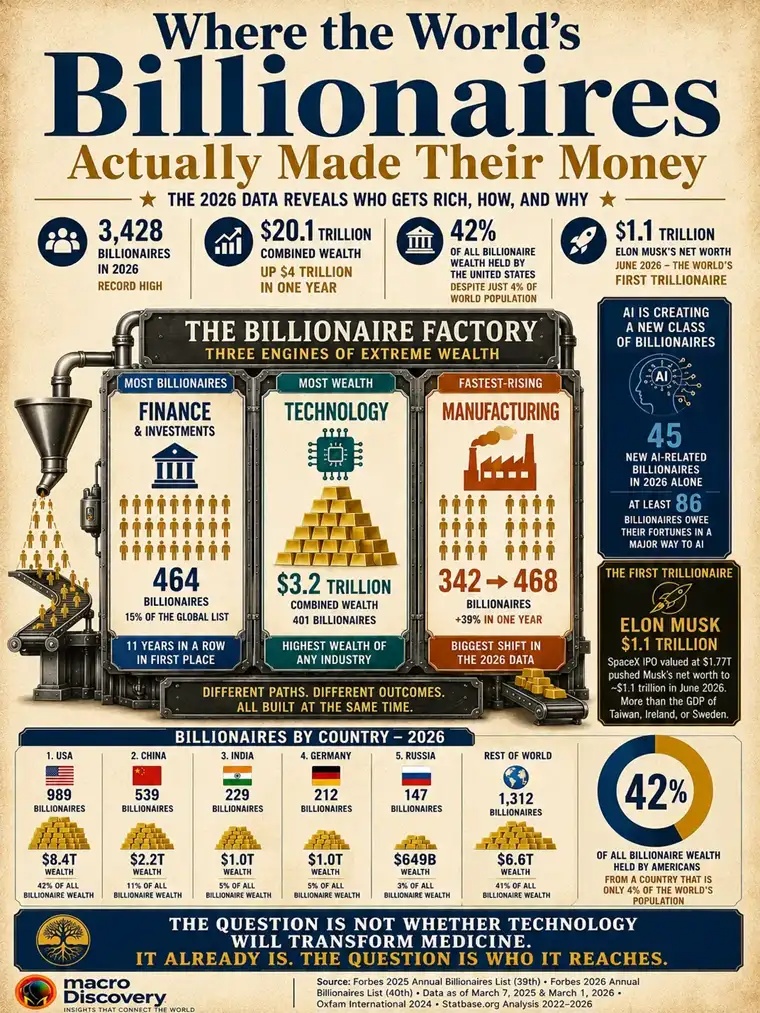
Finance produces the most billionaires. Technology creates the most wealth. Manufacturing is the fastest-rising sector. The US holds 42% of all billionaire wealth despite having 4% of the world’s population. And in June 2026, Elon Musk became the first person in recorded history to accumulate a trillion dollars. Here is what the data actually shows about who gets rich, how, and why.
- Finance is the most reliable path to a billion dollars — producing 464 billionaires in 2025, 15% of the global total, for the 11th consecutive year in first place. But finance billionaires are not the richest: the 401 technology billionaires collectively hold $3.2 trillion — more than any other sector — because technology creates winner-take-all markets where one product can reach a billion users.
- Manufacturing overtook technology for second place by count in 2026, jumping from 342 billionaires in 2025 to 468 in 2026 — a 39% increase in a single year. This reflects supply chain restructuring, industrial reshoring, and China’s industrial expansion. It is the most significant shift in the billionaire sector map in years.
- AI is the fastest wealth-creation machine in history. In 2026 alone, 45 AI-related billionaires appeared on the Forbes list for the first time. At least 86 total billionaires owe their fortunes in a major way to artificial intelligence. The youngest self-made billionaires in Forbes history are three 22-year-olds who co-founded AI recruiting startup Mercor.
- The US holds a structurally disproportionate share of billionaire wealth. With 989 billionaires and $8.4 trillion in combined wealth in 2026, US billionaires account for 42% of all billionaire wealth on earth — roughly four times China’s $2.2 trillion — despite the US representing only about 4% of the global population.
- In June 2026, Elon Musk became the world’s first trillionaire when SpaceX’s IPO valued the company at $1.77 trillion. His ~43% stake, combined with his Tesla holdings, pushed his net worth to approximately $1.1 trillion — more than the GDP of Taiwan, Ireland, or Sweden. He is now wealthier than the next four richest people on earth combined.
| # | Industry | Billionaires | % of List | Total Wealth | Richest Person | 2026 Trend | Wealth |
|---|---|---|---|---|---|---|---|
| 1 | Finance & Investmentshedge funds · PE · VC · banking |
464 | 15% | $2.6T | Warren Buffett $154B (Berkshire Hathaway) | 512 in 2026 ↑ | |
| 2 | Technologysoftware · hardware · platforms · AI |
401 | 13% | $3.2T ★ | Mark Zuckerberg $216B (Meta). Note: Musk $342B classified as Automotive — not counted here. | 467 in 2026 | |
| 3 | Manufacturingindustrials · materials · components |
342 | 11% | $1.1T | Reinhold Wuerth $35.1B (Wuerth Group — fasteners) | 468 in 2026 🔺 | |
| 4 | Fashion & Retailluxury · apparel · e-commerce |
297 | 10% | $2.0T | Bernard Arnault $178B (LVMH) | 317 in 2026 | |
| 5 | Healthcarebiotech · pharma · hospitals · medtech |
230 | 8% | — | Thomas Frist Jr. $27B (HCA Healthcare) | 260 in 2026 ↑ | |
| 6 | Food & Beverageconsumer food · beverages · agri |
223 | 7% | — | Zhong Shanshan $57.7B (Nongfu Spring) | 254 in 2026 ↑ | |
| 7 | Diversifiedconglomerates · multi-sector empires |
210 | 7% | — | Mukesh Ambani $92.5B (Reliance — oil, retail, telecom) | 215 in 2026 | |
| 8 | Real Estateresidential · commercial · development |
206 | 7% | — | Harry Triguboff $19.1B (Meriton — Australia) | 212 in 2026 | |
| 9 | Media & Entertainmentsports · film · music · broadcasting |
116 | 4% | — | Rupert Murdoch $23B (News Corp / Fox). Dr. Dre, Beyoncé joined in 2026. | 121 in 2026 | |
| 10 | Energyoil · gas · renewables · mining |
106 | 4% | — | Vagit Alekperov $28.7B (Lukoil — Russia) | 117 in 2026 ↑ |
Source: Forbes — “The 10 Most Popular Industries for Billionaires 2025” (primary, April 3, 2025, directly fetched · data as of March 7, 2025 · 3,028 total billionaires). ★ Technology has the highest combined sector wealth ($3.2T) despite ranking second by count. Elon Musk ($342B) is classified by Forbes as “Automotive” and NOT included in technology sector totals. 2026 trend column uses Statbase.org’s analysis of Forbes 2026 data (March 2026). Wealth figures for ranks 5–10 not publicly broken out by Forbes in primary source. Click column headers to sort.
Source: Forbes — “The Countries With the Most Billionaires 2026” (primary, March 11, 2026) · Forbes 40th Annual Billionaires List (March 10, 2026 · data as of March 1, 2026). Canada (76 billionaires) ranked 6th in 2025 but full 2026 country breakdown beyond top 5 not confirmed. Combined wealth data for countries ranked 4–5 not confirmed in primary sources.
Why Does Finance Produce More Billionaires Than Any Other Industry?
Finance and investments produced 464 billionaires in 2025 — 15% of the global total and the top sector for the eleventh consecutive year. The structural reason is elegant: finance is the only industry that multiplies money directly, without the operational complexity of manufacturing products or delivering services. A successful hedge fund or private equity firm compounds returns across its entire portfolio simultaneously. There are no factories to run, no supply chains to manage, no customers to support at scale. The mathematics of compounding, applied to large capital pools over long time horizons, is an extraordinarily efficient wealth-creation engine.
The finance sector added 41 new billionaires in 2025 and $400 billion in collective wealth — both significant numbers but not the largest of any sector. Technology added more new billionaires (46) and more new wealth ($600 billion) than any other sector in 2025. Finance remains #1 by total count because its billionaires are distributed more broadly across the wealth spectrum — most are in the $1-5 billion range, not in the centibillionaire tier. Technology has fewer billionaires but they tend to be richer: the average tech billionaire’s fortune is higher than the average finance billionaire’s. Warren Buffett at $154 billion is the undisputed champion of finance; but Zuckerberg at $216 billion, and several other tech founders, exceed him on the list.
The deeper question is where the next generation of finance billionaires will come from. Private equity and venture capital have driven most of the recent growth — not traditional banking. The rise of sovereign wealth funds, family offices, and crypto-native investment vehicles is creating new billionaire paths in finance that did not exist twenty years ago.
Why Does Technology Create More Wealth Than Any Other Sector — Even With Fewer Billionaires?
The 401 technology billionaires on the Forbes 2025 list collectively held $3.2 trillion — more than any other sector, and more than the next two sectors (fashion at $2.0 trillion and finance at $2.6 trillion) combined. The explanation lies in the economics of software: a piece of technology can be replicated at near-zero marginal cost and deployed globally from a single location. A software product that reaches one billion users generates revenues that no comparable physical-goods manufacturer could approach with the same headcount. Winner-take-all market dynamics mean the company that achieves scale first tends to dominate indefinitely — and the founders who owned it from the beginning accumulate wealth proportional to the total market served.
The official Forbes numbers significantly understate technology’s contribution to billionaire wealth. Elon Musk — classified as an “Automotive” billionaire because Forbes uses Tesla as his primary wealth source — held $342 billion in 2025 and $839 billion in 2026, growing to approximately $1.1 trillion following the SpaceX IPO in June 2026. SpaceX is an aerospace and technology company; xAI is an AI company; X (formerly Twitter) is a social media platform. If Musk were classified as a technology billionaire, the technology sector’s combined wealth would easily exceed $4 trillion. The classification reveals the difficulty of applying traditional industry categories to the conglomerate founders who dominate the top of the modern wealth distribution.
The AI wave has further accelerated technology’s dominance. At least 86 members of the 2026 Forbes list owe their fortunes in a major way to artificial intelligence. In 2026 alone, 45 AI-related billionaires appeared for the first time, including the founders of Perplexity, Mistral, Cursor, Lovable, and Mercor. Edwin Chen, founder of AI data company Surge, debuted as the richest newcomer at $18 billion. Three co-founders of AI recruiting startup Mercor, all aged 22, became the youngest self-made billionaires in Forbes history — beating the record previously held by Mark Zuckerberg, who debuted at 23.
Why Did Manufacturing Overtake Technology in 2026 — the Biggest Shift in the Billionaire Sector Map in Years?
The most striking structural story in the 2026 Forbes data is manufacturing’s surge: from 342 billionaires in 2025 to 468 in 2026 — a 39.3% increase in a single year — overtaking technology (467) for the second position by count. This is the largest single-year sector movement in recent Forbes history and represents a meaningful shift in where billionaire wealth is being created.
Three forces explain it. First, supply chain restructuring: the disruptions of 2020-2024 — pandemic shortages, geopolitical tensions, tariff wars — persuaded governments and companies to reshore manufacturing and build domestic industrial capacity. Companies positioned to supply this reshoring wave created significant value quickly. Second, Chinese industrial expansion: China’s manufacturing sector, particularly in electric vehicles, batteries, solar panels, and advanced materials, has created large fortunes at speed. Third, the materials economy: metals and mining billionaires grew 55.1% since 2022 — driven by demand for copper, lithium, rare earths, and other materials essential to the energy transition.
The manufacturing surge does not mean manufacturing has become the most lucrative path to extreme wealth — technology still produces higher individual fortunes. But it signals a broadening of the billionaire factory. The “two-engine” model of capital (finance) and technology that dominated the 2010s and early 2020s is now accompanied by a real-sector engine that is growing faster than either. Logistics is the fastest-growing billionaire sector since 2022 (+108.6%), sports the second-fastest (+107.4%) — both reflecting economy-scale infrastructure plays and cultural franchise value that previous eras did not monetize at comparable scale.
Why Does the United States Have 42% of All Billionaire Wealth?
The US concentration of billionaire wealth is one of the most striking facts in the Forbes data. With 989 billionaires holding $8.4 trillion, American billionaires account for 42% of all billionaire wealth on earth — from a country with roughly 4% of the global population and approximately 25% of global GDP. The average US billionaire holds approximately $8.5 billion; the average Chinese billionaire holds approximately $4.1 billion.
The structural explanation is the US capital markets system. American equity markets are the world’s deepest and most liquid — allowing entrepreneurs to convert company stakes into measurable net worth at scale and speed that no other market system matches. The US venture capital ecosystem is the most developed globally, channeling capital into high-growth companies at every stage. The dominance of US technology platforms — which captured global markets from American servers — means that US founders accumulated wealth proportional not to the US market but to the entire global market of users. Zuckerberg’s $216 billion reflects Meta’s three billion users; Bezos’s wealth reflects Amazon’s global retail and cloud dominance. No other country has built consumer technology platforms at comparable global scale.
China comes second with 539 billionaires and $2.2 trillion — but the wealth-per-billionaire ratio is notably lower. Chinese billionaires face capital controls, regulatory interventions (several of which erased hundreds of billions of wealth in 2021-2022), and a domestic market that, while vast, has not produced the global platform dominance that drives the largest American fortunes. India is third with 229 billionaires and $1 trillion — still building the institutional infrastructure needed to scale the next generation of wealth creation, but on a trajectory that most forecasters project will produce 400+ billionaires by 2030.
Who Are the World’s Billionaires — Are They Really Self-Made?
The image of the self-made billionaire — the garage startup founder who built something from nothing — is culturally dominant but statistically partial. In the US, Forbes estimates approximately 73% of billionaires are self-made by its definition, which includes a spectrum from those who “overcame substantial obstacles” (score 10) to those who “built a company” using inherited capital as a head start (score 7-8). Globally, Oxfam’s 2024 research found that 36% of all billionaire wealth is inherited — a meaningful fraction that challenges the universal self-made narrative.
The gender breakdown is particularly stark. Women make up 14% of billionaires (481 in 2026) — and 75% of them inherited their wealth. Only 122 women globally are self-made billionaires. The richest woman in the world is Alice Walton at approximately $134 billion — an heir to the Walmart fortune. The wealthiest self-made woman is Swiss shipping tycoon Rafaela Aponte-Diamant at $44.5 billion. The gap between these figures and the very top of the male wealth distribution (Musk at $1.1 trillion) is a reflection of structural inequalities in access to capital, entrepreneurial networks, and the industries that generate the largest fortunes.
The age distribution is also revealing. 87.2% of Forbes 2026 billionaires are over 50. Extreme wealth accumulation at the scale that lands people on the Forbes list takes decades — even in technology, where the founding generation is now aging into the mid-50s and 60s. The exceptions are genuinely remarkable: the three 22-year-old Mercor co-founders represent AI’s ability to compress the timeline from founding to billion-dollar valuation to near-zero. The pace at which AI is creating new fortunes — 45 newcomers in 2026 alone, with the youngest self-made billionaires in Forbes history — suggests the age distribution may shift meaningfully in the next decade.
- Forbes — “The 10 Most Popular Industries for Billionaires 2025” (primary · April 3, 2025 · directly fetched · data March 7, 2025 · all 10 sector breakdowns with counts and wealth · Finance $2.6T · Tech $3.2T)
- Forbes — “The Countries With the Most Billionaires 2026” (primary · March 11, 2026 · US 989/$8.4T · China 539/$2.2T · India 229/$1T · Germany 212 · Russia 147)
- Forbes — “Inside Forbes’ 2026 Billionaires List” (primary · March 10, 2026 · 3,428 billionaires · $20.1T · +400 members · 45 AI newcomers · 86 AI-linked billionaires · youngest Mercor founders)
- Statbase.org — “Number of Billionaires by Industry 2022–2026” (Forbes data cited · 2026: Finance 512 · Manufacturing 468 overtakes Tech 467 · fastest growing sectors Logistics +108.6%)
- Forbes — “The Countries With the Most Billionaires 2025” (primary · US 902/$6.8T · China 450/$1.7T · India 205/$941B · record US billionaire count)
- Visual Capitalist — “Ranked: Top Sources of Billionaire Wealth by Industry in 2025” (September 2025 · Finance 464/15.3% · Technology 401/13.8% · Musk automotive classification explained)
- Wikipedia — “The World’s Billionaires” (Forbes 2026: 3,428/$20.1T · Forbes 2025: 3,028/$16.1T · historical trend data · Musk first and second at top 2025/2026)
- Oxfam — “Survival of the Richest” (January 2023) + Oxfam 2024 reports (richest 1% captured 63% of new wealth since 2020 · 36% of billionaire wealth inherited)

I know this if off topic but I’m looking into starting my own blog
and was wondering what all is required to get set up?
I’m assuming having a blog like yours would cost a pretty penny?
I’m not very internet smart so I’m not 100% sure. Any suggestions or advice would be
greatly appreciated. Thank you