The Future of Farming —
How Agriculture Is Being Reinvented
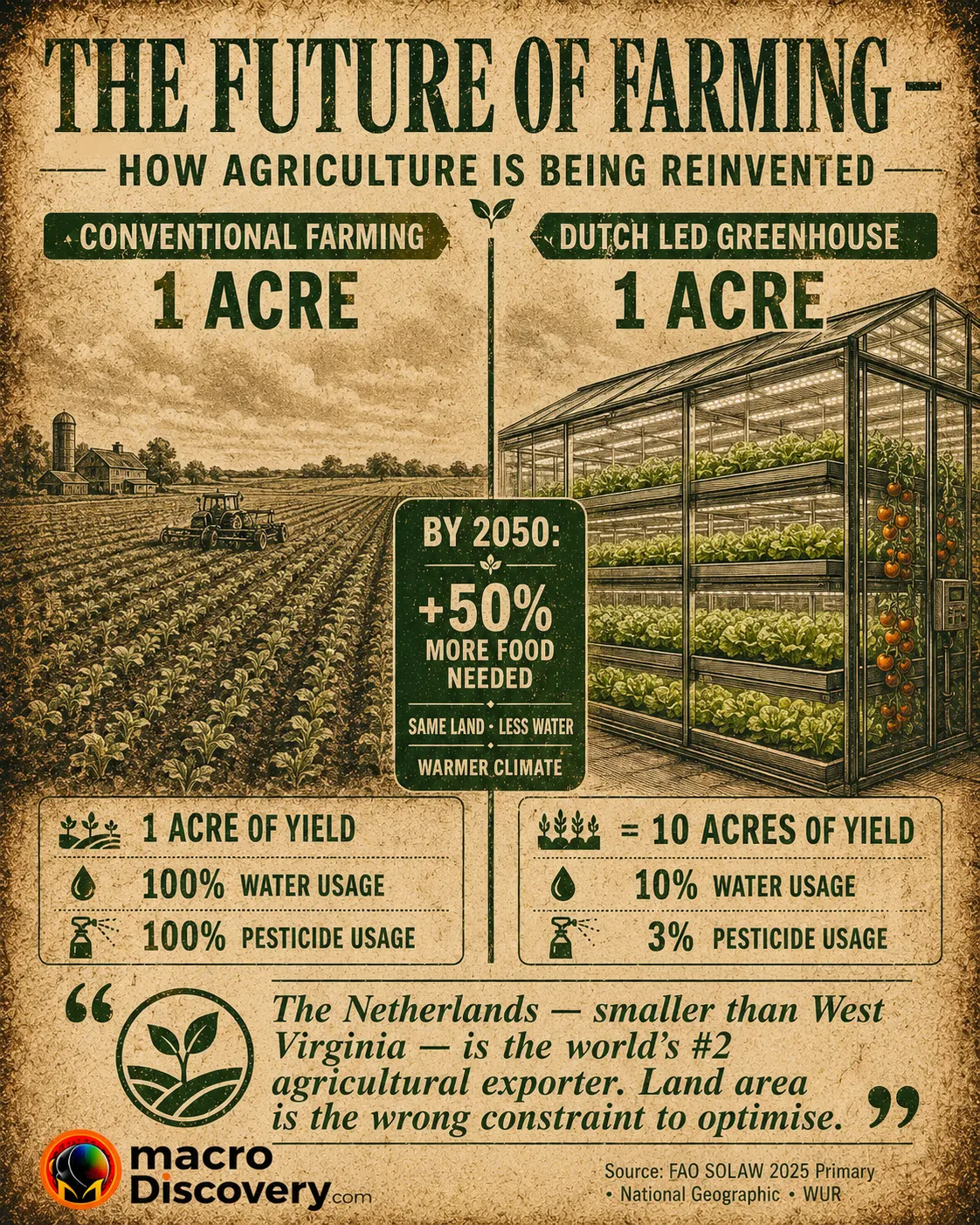
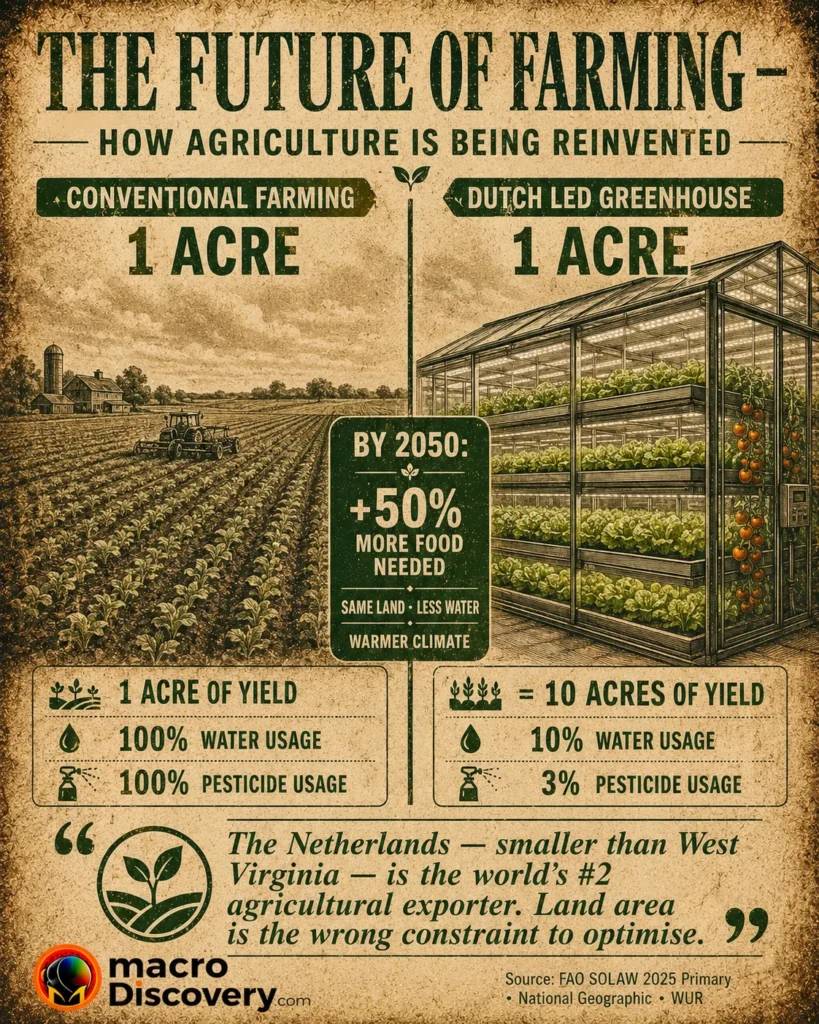
By 2050, the world needs to produce 50% more food than it did in 2012 — using the same or less farmland, with 25% more freshwater, in a significantly warmer climate. Ernst van den Ende, Plant Sciences Director at Wageningen University & Research, frames the challenge plainly: the planet must produce more food in the next four decades than all farmers in history have harvested over the past 8,000 years. The Netherlands — a country smaller than West Virginia — has already shown one path forward: it is the world’s second-largest agricultural exporter by value, producing extraordinary quantities of food from almost no land.
| Method | Water use | Pesticide use | Land efficiency | Scale & status |
|---|---|---|---|---|
| 🌿 Conventional open-field | Baseline (100%) | Baseline (100%) | 1 acre = 1 acre yield | Dominant globally · degrading land |
| 🏠 Dutch LED greenhouse | 10% of conventional | 3% of conventional | 1 acre = 10 acres lettuce output | 🇳🇱 24,000 acres operating |
| 🏭 Vertical farming (indoor) | ~5% of conventional | Near zero | Stacked layers: 10–100× density | $5.1B market (2023) → $15.3B (2028) |
| 📈 Precision agriculture (GPS/AI) | Reduced (sensor-optimised) | Reduced (targeted only) | Same area, higher yields | Drone + tractor AI now standard in NL |
| 🦐 Aquaponics | ~10% of conventional | Near zero | Fish waste fertilises crops; closed loop | Growing; WUR + Dutch commercial scale |
| 🏴️☠️ Degraded conventional (risk) | Rising (less water retains) | Rising (pest resistance) | Falling yield per hectare over time | 1.6B ha degraded · FAO SOLAW 2025 |
Sources: Water and pesticide efficiency for Dutch greenhouses: National Geographic (citing Siberia B.V. greenhouse data). Vertical farming: ScienceDirect citing MarketsandMarkets (2024). Precision agriculture: Sensoterra citing Wageningen University & Research. Aquaponics: National Geographic (The Hague rooftop example). Land degradation: FAO SOLAW 2025 (primary, fao.org, February 26, 2025).
What the 2050 Food Challenge Actually Requires
The FAO’s SOLAW 2025 report (primary, directly fetched) is unambiguous: feeding a world population of 9.7 billion by 2050 requires 50% more food, feed, and fibre than was produced in 2012 — alongside 25% more freshwater — while expanding farmland is no longer viable. This is a constraint that has no precedent. For the past 60 years, production kept pace with population by expanding land; that option is largely exhausted. Sub-Saharan Africa and South Asia face the steepest challenge, requiring production to more than double (+112%). In 2024, 673 million people went hungry — not because not enough food existed globally, but because of distribution failures, poverty, and local production shortfalls. The structural challenge by 2050 is not distributional. It is physical: not enough food will exist without fundamental changes to how it is grown.
Why it matters: the 2050 food gap cannot be closed by expanding farmland — it can only be closed by producing dramatically more from land already under cultivation.
How the Netherlands — Smaller Than West Virginia — Became the World’s #2 Agricultural Exporter
The Netherlands exported approximately $150 billion worth of agricultural products in 2024 — the second largest in the world by value, behind only the United States (NFIA, investinholland.com). It achieved this from a country smaller than West Virginia through a systematic bet on technology over territory. Dutch greenhouses now cover approximately 24,000 acres — roughly twice the size of Manhattan — producing food year-round in precisely controlled conditions that use 90% less water and 97% fewer pesticides than conventional open-field farming. One greenhouse acre produces as much lettuce as 10 outdoor acres (National Geographic, Siberia B.V. data). More than a third of all global vegetable seed trade originates in the Netherlands; approximately 2.5 billion people eat vegetables daily grown from Dutch-developed seeds (Wageningen University & Research data).
Why it matters: the Dutch proof of concept shows that land area is the wrong constraint to optimise — the right constraint is intelligence per square metre.
The Specific Technologies Reinventing Farming — From Dutch Drones to Vertical Farms
Ernst van den Ende, Plant Sciences Director at Wageningen University & Research (WUR) — consistently ranked the world’s top agricultural research institution — has stated the challenge directly: the planet must produce more food in the next four decades than all farmers in history have harvested over the past 8,000 years. WUR and its surrounding Food Valley ecosystem — home to approximately 1,500 companies, labs, and startups, with R&D centres for 15 of the world’s top 20 agri-food companies — is where many of the answers are being developed. Dutch farmer Jacob van den Borne operates his potato farm via drones and driverless tractors, receiving real-time data on water content, soil chemistry, and individual plant yield. The global vertical farming market is growing from $5.1 billion in 2023 to a projected $15.3 billion by 2028 — driven by China, Japan, Singapore, and the US.
LED greenhouse growing: Custom-spectrum LED lighting enables 24-hour growing cycles in fully climate-controlled environments. Tomatoes, peppers, and lettuce grow faster, more uniformly, and with far less waste than outdoor equivalents.
Drone and sensor crop monitoring: Farmers like Jacob van den Borne use aerial drones and autonomous ground vehicles to map every plant individually — measuring water content, soil chemistry, and yield projections in real time across thousands of acres.
Aquaponics: Fish waste is used as fertiliser for adjacent crop systems in closed-loop growing environments, eliminating chemical inputs and reducing water waste simultaneously.
Precision irrigation: Soil moisture sensors and AI-driven irrigation deliver water only where it is needed, at the moment it is needed — eliminating the chronic overwatering that accounts for most agricultural water waste globally.
Robotic harvesting: Robots handle harvesting, packing, and plant health monitoring in greenhouse environments, reducing labour dependence and improving consistency.
Climate-resilient seed development: Seed Valley (North Holland) develops and exports high-yield, drought- and disease-resistant seeds used on every continent. One-third of all global vegetable seed trade originates there.
Sources: National Geographic (2017) · Sensoterra (July 2025, citing WUR) · Washington Post (2022) · NFIA (investinholland.com).
Why it matters: these technologies are not experimental in the Netherlands — they are commercially operational at national scale, which makes the Dutch model an instruction manual, not a theory.
What the Rest of the World Needs to Learn Before 2050
The Dutch model is not automatically transferable. It requires capital investment, technical expertise, reliable energy, and institutional support that many of the countries with the greatest food need do not yet have. South Asia and sub-Saharan Africa — where FAO projects production must more than double — face different constraints than the Netherlands. But the structural lessons are clear: expanding farmland further is the wrong answer, because most remaining land is either ecologically fragile or climatically unsuitable; increasing yield per hectare through technology is the right one. WUR’s Farm of the Future initiative in Lelystad, Flevoland, is explicitly designed to generate knowledge applicable to global food systems, not only Dutch ones. The question is not whether this transformation is necessary. It is whether it will arrive fast enough — and be accessible to the farmers who need it most.
Why it matters: the countries that most need to transform agriculture are the least equipped to do so — making knowledge transfer, investment, and open-source seed technology questions of food security, not just innovation.
- The world must produce 50% more food by 2050 than it did in 2012, alongside 25% more freshwater, while expanding farmland is no longer viable (FAO SOLAW 2025, primary, directly fetched).
- 673 million people went hungry in 2024 — a baseline that must be eliminated while simultaneously scaling production for 2 billion more people (FAO).
- The Netherlands — smaller than West Virginia — exported $150 billion in agricultural products in 2024, making it the world’s second-largest agricultural exporter by value.
- Dutch greenhouses use 90% less water and 97% fewer pesticides than conventional farming, producing 10 times more lettuce per acre (National Geographic / Siberia B.V.).
- Wageningen University & Research (WUR) is ranked the world’s #1 agricultural institution and anchors Food Valley — approximately 1,500 companies and 15 of the world’s top 20 agri-food companies have R&D presence nearby.
- One-third of all global vegetable seed trade originates in the Netherlands; approximately 2.5 billion people eat vegetables daily grown from Dutch-developed seeds (WUR data).
- The global vertical farming market is projected to grow from $5.1 billion (2023) to $15.3 billion by 2028 (MarketsandMarkets), led by China, Japan, Singapore, and the US.
The food system that got the world to 8 billion people cannot get it to 10 billion. The math is clear: 50% more food, no more land, less water, in a warmer climate. The Netherlands has already demonstrated that this is a solvable engineering problem — that intelligence per square metre can substitute for area. The question is whether the world will adopt the Dutch model fast enough, at large enough scale, and with sufficient equity of access, to feed everyone by 2050. The deadline is fixed. The transformation is optional. The consequences of not choosing it are not.
- FAO — “Better land, soil and water management key to feeding 10 billion people, FAO warns” (primary · directly fetched · February 26, 2025 · SOLAW 2025 · “50% more food, feed and fibre by 2050 vs 2012” · “+25% freshwater” · population 9.7B by 2050 · 1.6B ha degraded · 60 years: production tripled on 8% more land · expanding farmland not viable · 673M hungry in 2024)
- FAO SOLAW 2025 — Chapter 3.2: Looking to the Future (primary · “FAO estimates that by 2050, agriculture will need to produce almost 50 percent more food, fibre and biofuel than in 2012” · S.Asia + Sub-Sah Africa: +112% · rest of world: +30%)
- NFIA — “AgTech Ecosystem Thrives in the Netherlands” (primary · investinholland.com · Netherlands #2 global agrifood exports · WUR = “world’s number one agrifood university” · 15 of top 10 [sic top 20] agrifood companies in Food Valley · circular agriculture leadership)
- National Geographic — “How the Netherlands Feeds the World” (2017 · updated 2025 · “10 outdoor acres’ worth of lettuce from 1 greenhouse acre” · “90% less water” · “97% fewer pesticides” · Siberia B.V. confirmed · #1 potatoes/onions · #2 vegetables by value · “1/3 of global vegetable seed trade” · drone farming Jacob van den Borne)
- Sensoterra — “How Dutch Agriculture Is Feeding the World” (July 2025 · WUR Plant Sciences Director Ernst van den Ende confirmed · Quote: “Planet should produce more food in the next four decades than all farmers in history have harvested over the past 8,000 years” · drone farming confirmed · Netherlands #2 exporter)
- ScienceDirect — “Food for Future: Exploring cutting-edge technology and practices in vertical farming” (2024 · vertical farming market 2023: $5.1B → 2028: $15.3B · MarketsandMarkets cited · Japan ~200 vertical farms · China CAGR 27.91% · energy challenge: artificial lighting dominant cost)