The Countries That Imprison
the Most People
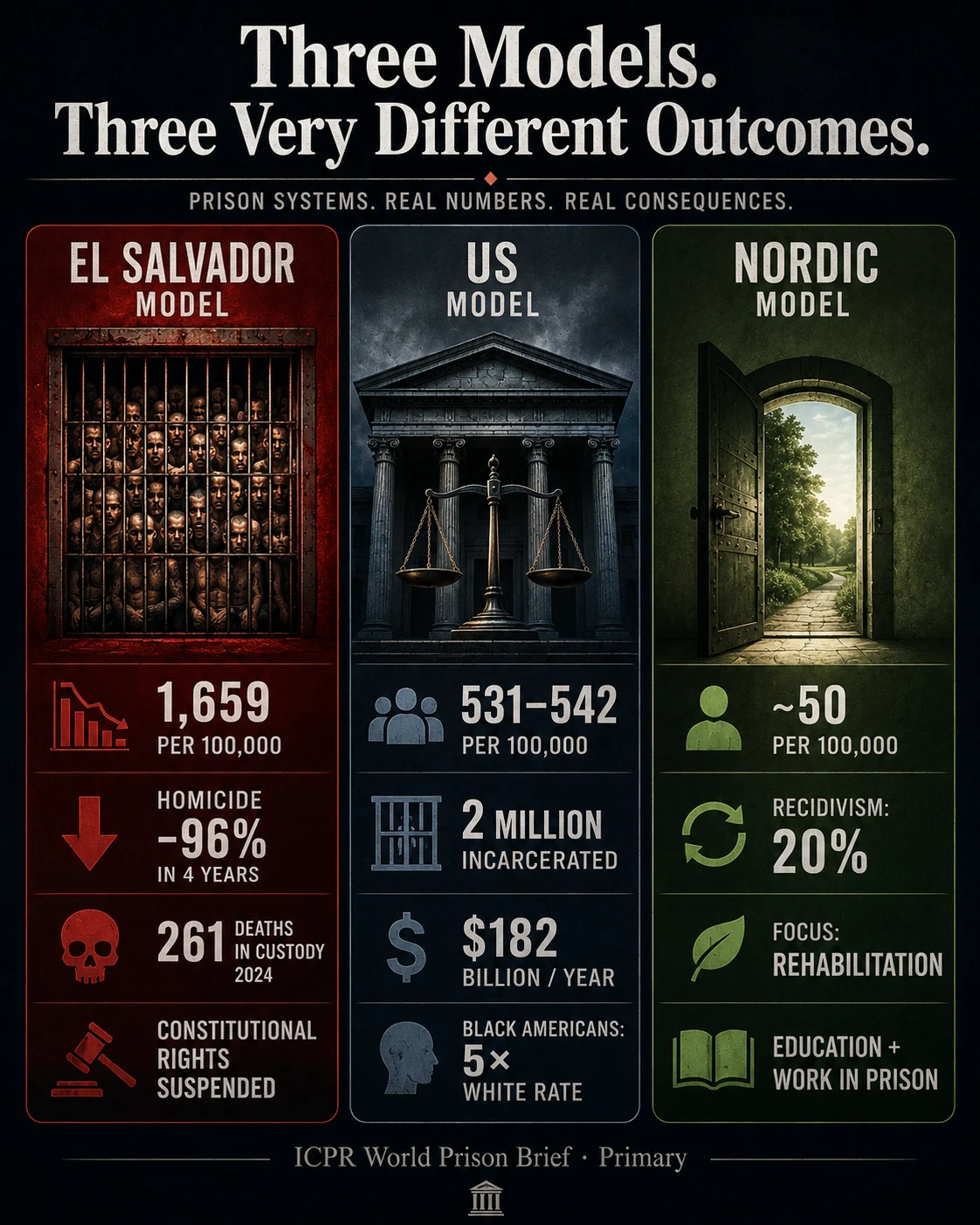
El Salvador has gone from the world’s murder capital to the world’s highest incarceration rate — imprisoning approximately 1 in every 60 of its adults, with a rate that rose from 1,086 to 1,659 per 100,000 between mid-2024 and early 2025. The United States, despite declining from its peak, remains the highest-incarcerating independent democracy on earth, with approximately 2 million people across all its systems of confinement — including two-thirds of its jail population held without conviction. Black Americans are imprisoned at approximately five times the rate of white Americans. Europe, by contrast, has reduced its prison population by 26% since 2000. The same question — how many people should a society lock up, and for what? — is answered very differently in different places.
- El Salvador has achieved the highest incarceration rate ever recorded for any country by systematically suspending constitutional rights. President Nayib Bukele declared a state of exception on March 27, 2022, following 87 gang murders in three days. It has been renewed every 30 days since — 52 times as of June 2026. Under this emergency framework, authorities can arrest without a warrant and hold people without the usual pretrial rights. More than 92,000 people accused of gang affiliation have been arrested, pushing El Salvador’s incarceration rate from 1,086 per 100,000 (WPPL 14th edition, May 2024) to approximately 1,659 per 100,000 by early 2025. El Salvador’s homicide rate fell from 53.1 per 100,000 in 2018 to an official 1.9 per 100,000 in 2024 — though Foreign Policy (August 2024) documented government undercounting averaging approximately 27% since 2021. Sources: ICPR primary (May 2024) · World Prison Brief (Feb 2025) · CRS (January 2025) · Foreign Policy (August 2024).
- The United States is the highest-incarcerating independent democracy on earth, with approximately 2 million people across all its systems of confinement. The US incarcerates 531–542 per 100,000 people (ICPR WPPL 14th edition, May 2024) — more than five times the Western European median of 73 per 100,000. Only El Salvador, Cuba, and Rwanda report higher national rates among fully reporting nations. This is not a reflection of higher crime: US violent crime in 2024 sat 53% below its 1991 peak, while the prison population continued rising. The US prison population grew 4% between 2021 and 2023, with 39 states recording increases in 2023 alone. Sources: ICPR (primary · May 2024) · Bureau of Justice Statistics (primary · September 2025) · Sentencing Project (April 2026).
- Two-thirds of people in US local jails have not been convicted of anything. At midyear 2023, 70% of the 657,500 people held in local jails were legally presumed innocent — awaiting court action, often because they cannot afford cash bail (Prison Policy Initiative, 2025). This pretrial detention population is one of the fastest-growing segments of US incarceration and a primary driver of racial and economic disparity. Research consistently shows that even short pretrial stays cause job loss, housing instability, and family separation — and increase the likelihood of a guilty plea regardless of actual guilt. The US is almost unique among wealthy democracies in using commercial cash bail as a default pretrial detention mechanism. Sources: Bureau of Justice Statistics · Prison Policy Initiative (2025).
- Black Americans are imprisoned at approximately five times the rate of white Americans — a disparity that has narrowed slightly but remains vast. According to the Bureau of Justice Statistics’ Prisoners in 2023 report (primary, September 2025), Black adults are imprisoned at 1,218 per 100,000 adults, compared to 231 per 100,000 for white adults — a ratio of approximately 5.3:1. Black Americans comprise approximately 13% of the US population but approximately 33% of state and federal prisoners, and approximately 41% of the combined prison and jail population (Prison Policy Initiative, 2025). The disparity reflects cumulative effects across every stage of the criminal justice system: differential policing, wealth-based pretrial detention, and sentencing disparities compound across arrests, charges, and sentences. Sources: BJS (primary · September 2025) · Prison Policy Initiative (2025) · Sentencing Project (April 2026).
- Europe has reduced its total prison population by 26% since 2000 — proving that declining incarceration is compatible with public safety. Europe is the only continent where the total prison population has decreased since 2000 (ICPR WPPL 14th edition, primary, May 2024). Russia alone has driven much of this decline (−59% since 2000), but central and eastern European countries have also reduced prison populations by 48%. Western European countries maintain a median incarceration rate of 73 per 100,000 — roughly one-seventh the US rate — through shorter sentences, greater use of non-custodial alternatives, and rehabilitation-focused prison systems. Recidivism rates in Nordic countries (20–30%) are far below US rates (approximately 43% re-incarcerated within three years). Sources: ICPR (primary · May 2024) · Multiple European justice system analyses.
*El Salvador: 1,086 per 100,000 in World Prison Population List 14th edition (ICPR, primary, directly fetched, May 1, 2024); rising to approximately 1,659 per 100,000 by February 2025 (World Prison Brief / ICPR updated data, via Statista February 2026), as detentions under the state of exception continued. Cuba 794, Rwanda 637, Turkmenistan 576, American Samoa 538 (US territory), US 531, Tonga 516: all from ICPR WPPL 14th edition primary. Global rate 140 and Western European median 73: ICPR primary. Russia, Brazil, Australia: from WPPL 14th and WPB database. Norway and Iceland approximate from WPB. All rates = prisoners per 100,000 national population, excluding juvenile detention. Comparison note: rates can shift significantly as countries update figures; ICPR WPB data reporting dates vary by country. Bar lengths proportional to rate; anchored at El Salvador 1,659.
| Country | Rate/100K | Total prisoners | Trend since 2000 | Key driver | Level |
|---|---|---|---|---|---|
🇸🇻 El SalvadorState of Exception since 2022 |
1,086→1,659 | ~109,519 (Feb 2025) | ▲▲▲ Explosive rise since March 2022. Was ~350/100K pre-2022. Bukele state of exception: 92,480+ arrested as of June 2026. CECOT mega-prison: 40,000 capacity, expanding to 80,000. | Mass gang arrests under state of exception. Suspension of constitutional rights. No warrant required. Pre-trial detention extended up to 2 years. | ⚠ Extreme |
🇨🇺 CubaPolitical + criminal detention |
794 | ~90,000 est. | Consistently high. Political prisoners mixed with criminal prison population. July 2021 protest crackdowns added significant political detainees. Cuba does not publish full breakdown. | Single-party state enforcement. Long sentences for political dissent and common offenses. Limited due process. | Very High |
🇷🇼 RwandaPost-genocide justice + control |
637 | ~80,000 est. | Historically high partly from genocide-era prosecutions (gacaca courts). Rate elevated by centralised government control. Has declined from peak post-genocide years. | Post-1994 genocide prosecutions plus ongoing authoritarian governance. RPF government maintains strict control and limited political dissent space. | Very High |
🇺🇸 United StatesHighest-incarcerating democracy |
531–542 | ~1.8M prisons; ~2M total | ▼ Down ~25% from 2006-08 peak of 750+/100K, but rising again +4% 2021–2023. 39 states saw increases in 2023. US still incarcerates more than any democracy. 2/3 of jail pop not convicted. | War on Drugs, mandatory minimums, three-strikes laws, cash bail, thousands of overlapping federal/state/local systems. $182B annual system cost. | High · Declining from peak |
🇷🇺 RussiaMajor decline since 2000 |
~325 | 433,000+ (ICPR primary) | ▼ -59% since 2000, the largest absolute decline of any major country. Prison reform and amnesties drove significant decarceration. Rate still elevated by Western standards. Ukraine war has added military-justice detentions. | Soviet-era mass incarceration legacy. Post-2000 reform drove dramatic declines. Penal colonies remain harsh by Western standards. | Elevated |
🇨🇳 ChinaFigures incomplete by design |
Not fully reported | ~1.7M (official); real total unknown | Official figures exclude: pre-trial detention, administrative detention, Xinjiang political camps (estimated 1M+), North Korean-style facilities. Real total significantly higher than official 1.7M. ICPR: “plus unknown number in pre-trial detention and other forms.” | One-party state enforcement. Xinjiang mass detention (unofficial). “Re-education” camps not counted as prisons. | High · Data incomplete |
🇩🇪 GermanyModerate, declining |
~75 | ~55,000 | Slightly above Western European median. Germany uses extensive fines, community service, and conditional sentences instead of imprisonment for non-violent offenses. Day fines calibrated to offender income. Rehabilitation emphasis in sentencing philosophy. | Fines + community service for minor offenses. Suspended sentences common. Short average sentence length. Strong legal aid system. | Low |
🇳🇴 NorwayThe rehabilitation model |
~50 | ~3,500 | Declining or stable. Maximum sentence 21 years (preventive detention extendable). Focus on rehabilitation, reintegration, humane conditions. Recidivism: 20% (vs ~43% US). Bastoy prison island famous for conditions comparable to Norwegian village. Sweden now renting cells from Estonia due to rising gang violence pressures. | Rehabilitation-centred justice philosophy. Short sentences. High quality prison conditions. Strong welfare state reducing root causes of crime. | Very Low |
🇯🇵 JapanLowest major economy |
~38 | ~47,000 | Declining. Extremely high conviction rate (~99.9% of those charged are convicted) but very few charges brought — prosecutors only charge when conviction is near-certain. Alternative to incarceration widely used. Long sentences rare. Ageing prison population. | Prosecutorial conservatism (only charge strong cases). Heavy use of suspended sentences. Social homogeneity and compliance-oriented culture. | Very Low |
🇮🇸 IcelandAmong world’s lowest |
~15–22 | <200 total prisoners | Consistently among world’s lowest. Small population amplifies per-capita effects but system is genuinely low-incarceration. Prisons resemble open facilities. Long waiting lists to serve sentences — not enough prisoners to fill capacity. | Nordic model: rehabilitation, alternatives to custody, strong social safety net. Low inequality, low poverty, strong community ties reduce crime root causes. | World’s Lowest |
Sources: ICPR — World Prison Population List 14th edition (primary · directly fetched · May 1, 2024 · icpr.org.uk). Top rates (El Salvador 1,086, Cuba 794, Rwanda 637, Turkmenistan 576, US 531) directly confirmed from ICPR primary. El Salvador rising to 1,659 from World Prison Brief (ICPR) via Statista (February 2026). Brazil +224% since 2000, Europe -26%, Russia -59%, US -half million since 2006–08: ICPR primary. US total ~2M: Prison Policy Initiative “Mass Incarceration: The Whole Pie 2025.” US rate 531–542: ICPR WPPL 14th and updated WPB. Norway recidivism 20% vs US 43%: The Sentencing Project and Nordic penal literature. Japan 99.9% conviction rate: Wikipedia / criminal justice literature. Iceland figures: WPB / Grokipedia. China data caveat from ICPR primary: “plus unknown number in pre-trial detention and other forms.” Click column headers to sort.
What Did El Salvador Actually Do — and Did It Work?
On March 25–27, 2022, El Salvador’s two main gangs — MS-13 and Barrio 18 — killed 87 people in a three-day period. President Nayib Bukele responded by asking the Legislative Assembly to declare a state of exception, which passed immediately. The measure suspended several constitutional rights, including the right to be informed of the reason for arrest, the right to a lawyer at the moment of arrest, and protections against incommunicado detention. Authorities were empowered to arrest without warrant anyone suspected of gang membership or affiliation. Within weeks, thousands of arrests were being made daily.
The results in measurable crime terms were dramatic. El Salvador’s official homicide rate fell from 53.1 per 100,000 in 2018 (the year before Bukele took office) to an official 1.9 per 100,000 in 2024 — a reduction of over 96% — according to the National Civil Police, confirmed by the Congressional Research Service (primary, January 2025). The State Department downgraded its travel advisory in November 2024. Business investment returned. Residents described neighbourhoods becoming safe for the first time in decades. Bukele’s approval rating has consistently exceeded 80%, reaching 85% in a May 2025 poll. He was re-elected in February 2024 with approximately 84.7% of the vote.
The costs are also documented and significant. Human Rights Watch’s World Report 2026 (primary) found that the government “continued to remove checks on executive power and increased its repression of human rights defenders and critics.” Cristosal, a Central American human rights organisation, documented 261 deaths in custody in 2024 linked to the crackdown. Bukele himself acknowledged that approximately 8,000 innocent people had been detained and released (November 2024 statement, confirmed by CRS). Foreign Policy’s August 2024 analysis found that the government was undercounting homicides by approximately 27% on average since 2021 — partly by excluding prison deaths from official homicide statistics. Human rights lawyer Ruth López was arrested in May 2025. In July 2025, Bukele’s legislative supermajority amended the constitution to remove presidential term limits. The state of exception has been renewed 52 consecutive times and shows no sign of ending.
CECOT became internationally known in March 2025 when the Trump administration paid the Salvadoran government approximately $6 million to transfer 252 Venezuelans alleged to be gang members — including Tren de Aragua members — to CECOT. A subsequent transfer included 23 Salvadorans, among them an MS-13 leader whose removal from the US prevented him from testifying in US federal court about negotiations between his gang and the Bukele government (Human Rights Watch World Report 2026). US courts blocked further deportations to El Salvador, though the administration sought to continue the programme.
Bukele offered to “outsource part of [the US] prison system” to El Salvador in exchange for a fee (Secretary Rubio meeting, February 2025). The proposal drew both interest and legal challenge. At approximately $20,000 per transferred person, El Salvador’s prison system had become a commercial service as well as a domestic security instrument.
Sources: WOLA (March 2025) · HRW World Report 2026 (primary) · CRS IN12510 (primary · January 2025) · Wikipedia (Salvadoran gang crackdown · updated June 2026).
Why Does the United States Imprison So Many People Despite Declining Crime?
The United States criminal justice system is not one system but approximately 51 systems — federal plus one for each state — layered over thousands of local systems. There are 1,566 state prisons, 98 federal prisons, 3,116 local jails, 1,277 juvenile correctional facilities, 133 immigration detention facilities, and dozens of additional specialised facilities, operating at a combined annual cost of approximately $182 billion (Prison Policy Initiative, 2025). This fragmented architecture makes comprehensive reform difficult: reducing federal drug sentences, as the First Step Act did in 2018, leaves state mandatory minimums untouched. Bail reform in one city leaves neighbouring jurisdictions unchanged.
The drivers of US mass incarceration are well-documented. The War on Drugs, launched in the 1970s and intensified in the 1980s with mandatory minimum sentences for drug offenses, drove an explosive increase in incarceration: from approximately 360,000 people in custody in the early 1970s to approximately 2 million today — a nearly five-fold increase over five decades (Sentencing Project, April 2026). Three-strikes laws, truth-in-sentencing requirements, and prosecutorial practices that leverage pretrial detention to obtain guilty pleas all contributed. The most important driver, however, is not drug policy alone: releasing every person serving time for a drug offense would reduce the state prison population by only approximately 13% (Prison Policy Initiative). The deeper driver is how the US handles violent crime — with sentences far longer than comparable democracies.
The central paradox is the disconnect between crime and incarceration. US violent crime in 2024 sat 53% below its 1991 peak; property crime was 66% lower (Sentencing Project, LegalClarity). Yet between 2021 and 2023, the US prison population grew by 4%, with 39 states recording increases in 2023 alone. Seven states imprisoned more people in 2023 than before the pandemic. Texas alone accounted for approximately 31% of all state prison growth over 2022–2023. A country with historically low crime rates is simultaneously running historically large prison systems. The evidence that this scale of incarceration reduces crime at the margin — beyond what lower incarceration levels would achieve — is weak.
Imprisonment rates (sentenced state and federal prison, per 100,000 adults):
· Black adults: 1,218 per 100,000
· White adults: 231 per 100,000
· Hispanic adults: intermediate between Black and white
· Ratio: approximately 5.3:1 (BJS primary, adult rate)
Prison population share vs population share:
· Black Americans: ~13% of US population / ~33% of state and federal prisoners / ~41% of combined prison and jail population
· White Americans: ~59% of population / ~31% of state and federal prisoners
The disparity is largest in specific states: In California, Connecticut, Iowa, Minnesota, New Jersey, Maine, and Wisconsin, Black residents are imprisoned at over nine times the rate of white residents (Sentencing Project).
In local jails: Black residents at 552 per 100,000; white residents 155 per 100,000; Hispanic residents 143 per 100,000 (BJS 2023).
The Sentencing Project documents that these disparities reflect cumulative effects across every stage: Black Americans face higher rates of police stops, higher bail amounts, higher rates of pretrial detention, harsher charging decisions, longer sentences, and more technical violations of supervision. Each stage contributes a modest disparity; together they produce the 5:1 gap. Drug enforcement is the clearest example: Black and white Americans use drugs at similar rates but Black Americans are arrested and incarcerated for drug offenses at 3–4 times the rate (OpenCrime / Sentencing Project).
Sources: BJS Prisoners in 2023 (primary · September 2025) · Prison Policy Initiative (2025) · Sentencing Project (April 2026).
What Do Countries With Low Incarceration Rates Do Differently?
The contrast between the United States (531–542 per 100,000) and Norway (approximately 50 per 100,000) is not primarily a crime-rate difference. Crime rates in Norway are lower than in the US, but not by a factor of ten. The difference is in how each society answers the question of what prison is for. In the US, the dominant answer — embedded in law through mandatory minimums, truth in sentencing, and prosecutorial charging practices — is punishment and incapacitation. In Norway, the answer is rehabilitation and reintegration. This philosophical difference produces concrete policy outcomes: Norway’s prisons offer education, vocational training, and individualised treatment programmes; its recidivism rate is approximately 20%. The US recidivism rate is approximately 43% re-incarcerated within three years.
Europe as a whole has reduced its total prison population by 26% since 2000 — the only continent to do so — through a combination of sentencing reform, expanded use of community sentences, administrative decriminalisation of minor offenses, and investment in social programmes that address root causes of crime. Germany, with a rate of approximately 75 per 100,000, extensively uses day fines calibrated to offender income as an alternative to short custodial sentences. The Netherlands has closed prisons due to insufficient prisoner numbers. Scotland, unlike England and Wales, has moved explicitly toward shorter sentences and community alternatives.
Japan offers a different model again. With an incarceration rate of approximately 38 per 100,000 — the lowest of any major economy — Japan achieves low incarceration not primarily through lenient sentencing but through prosecutorial conservatism: prosecutors only charge cases they are near-certain to win, meaning that the vast majority of criminal matters are resolved without reaching the courts, through mediation, compensation, or warning. Japan’s conviction rate is approximately 99.9% of those charged — not because the system is harsh, but because the filter before charging is extremely rigorous. This approach is culturally specific and not straightforwardly exportable, but it illustrates that low incarceration can be achieved through mechanisms other than lenient sentencing.
The Nordic model is not naive about punishment. Norwegian prisons impose real restrictions on liberty; they are not hotels. The philosophical difference is in the goal: Norwegian law explicitly states that prisons should “prepare for release from day one of entry”. Education, vocational training, mental health treatment, and family contact are provided as standard, not as privileges to be earned. Prison officers are trained professionals with a university-level qualification.
Important caveat: The Nordic model operates in societies with lower inequality, stronger social safety nets, lower poverty rates, and higher baseline social trust than most countries where high incarceration is common. The model is not simply transferable without addressing the social conditions that produce crime in the first place. This is precisely the Nordic argument: the most effective crime policy is social policy. Norway spends far more on welfare, education, and mental health than on incarceration — and the outcome is visible in its incarceration and recidivism figures.
Pressure on the model: Sweden is currently renting prison cells from Estonia due to a wave of gang violence that has strained its domestic prison capacity — a reminder that even Nordic countries face challenges when the social conditions underpinning low crime are disrupted.
Sources: Multiple Nordic penal justice analyses · Grokipedia citing academic sources · ICPR WPPL 14th edition (primary).
Does Incarceration Actually Reduce Crime — and What Does the Evidence Show?
The relationship between incarceration and crime is the central empirical question in criminal justice policy, and the honest answer is: it depends on the starting point and the scale. At low levels of incarceration, increasing imprisonment for genuinely dangerous offenders can demonstrably reduce crime through incapacitation: incarcerated people cannot commit street offenses during their sentences. The ICPR and academic literature confirm this basic mechanism. El Salvador’s experience — whatever its human rights costs — is consistent with this: removing a large fraction of active gang members from streets did coincide with dramatic crime reduction. Ecuador, which launched a similar crackdown on prison gang control in 2024, has reported similar patterns.
But the evidence for marginal benefits of incarceration at high levels is much weaker. The United States provides the clearest natural experiment: it increased its incarceration rate nearly five-fold between 1970 and 2010 while crime initially rose and then fell, with the decline beginning in the 1990s and driven primarily by factors independent of incarceration (demographic shifts, reduced lead exposure, improved policing strategies, economic conditions). Since the US prison population began declining in 2009, crime has also continued declining — offering no support for the proposition that reducing incarceration from very high levels increases crime. The criminological consensus is that the marginal crime-reduction return to additional imprisonment falls sharply as incarceration levels rise — and may become negative if incarceration at scale destabilises families and communities in ways that increase long-run crime.
The Italian “collective pardons” evidence (1962–1995, cited in ICPR-adjacent academic literature) suggests that releasing prisoners does increase crime in the short term at the individual level — confirming incapacitation works. But this effect applies to releases from lower-incarceration baselines. It does not establish that high-incarceration systems produce better public safety outcomes than moderate-incarceration ones, which is the relevant comparison for US policymakers. The most rigorous international comparison is straightforward: Japan (38 per 100,000, very low crime) and the US (542 per 100,000, much higher crime) share no simple relationship between incarceration scale and public safety outcomes.
Is Pretrial Detention a Form of Punishment Without Conviction?
At midyear 2024, approximately 657,500 people were held in US local jails. At midyear 2023, 70% of the jail population — approximately 460,000 people — had not been convicted of any offense and were legally presumed innocent (Bureau of Justice Statistics, 2023; Prison Policy Initiative, 2025). Most were held because they could not afford to post cash bail. This is not a peripheral issue in American criminal justice; it is one of its defining structural features. Pretrial detention has driven jail population growth over the past 25 years far more than changes in sentencing for convicted offenders.
The consequences of pretrial detention are well-documented and severe. Even short stays — a matter of days or weeks — are associated with job loss, housing instability, and family separation. People detained pretrial are significantly more likely to plead guilty than those released — not because they are more likely to be guilty, but because pleading guilty offers release while fighting charges requires remaining in detention. This “plea pressure” effect means that pretrial detention produces guilty pleas that may not reflect actual guilt. Research consistently shows that controlling for offense type and criminal history, people detained pretrial receive longer sentences than those who were released — compounding the initial detention with its downstream effects.
The US is almost uniquely dependent on commercial cash bail as its primary pretrial release mechanism among wealthy democracies. In most European countries, pretrial detention requires a judicial finding of specific risk (flight risk or risk of reoffending) and is time-limited by statute. Commercial bail — in which a commercial bail bond company posts bail for a fee, typically 10% of the bail amount non-refundable — exists almost nowhere else in the developed world. Kentucky eliminated commercial bail in 1976 and replaced it with a risk assessment system; New Jersey substantially reformed its bail system in 2017 with results showing significant reductions in pretrial detention without increases in failure-to-appear rates. As of 2025, Illinois became the first state to fully eliminate cash bail.
China: ICPR reports approximately 1.7 million in official prisons, but explicitly notes “plus an unknown number in pre-trial detention and other forms of detention.” The Xinjiang mass detention programme — estimated to have held more than one million Uyghurs and other Muslim minorities in facilities officially described as “vocational education and training centres” — is not counted in prison statistics. Administrative detention, drug detention centres, and “residential surveillance at a designated location” also hold unknown numbers. China’s real total incarcerated population is substantially higher than official figures indicate.
North Korea: An estimated 80,000–130,000 people are held in political prison camps (kwanliso), where conditions involve forced labour, severe food deprivation, and systematic violence. These are not counted in prison statistics. North Korea does not publish any figures.
Eritrea: Known for indefinite detention without trial of political dissidents, journalists, and religious practitioners in undisclosed locations. No data reported.
Pretrial detention: In many countries, pretrial detainees constitute a large fraction of those counted — in India, approximately 75–80% of the prison population is pretrial, meaning the 573,000 figure represents primarily unconvicted people.
Immigration detention: Not consistently counted. US immigration detention (68,289 as of February 2026) is held separately from criminal incarceration statistics but involves jail-like confinement for civil, not criminal, proceedings.
Sources: ICPR WPPL 14th edition (primary · directly fetched) · HRW · Amnesty International · UNODC.
- ICPR — “Prison populations continue to rise in many parts of the world, with 11.5 million held in prisons worldwide” (primary · directly fetched · May 1, 2024 · WPPL 14th edition · Fair H & Walmsley R · Birkbeck University of London · US 1.8M · China 1.7M · Brazil 840K · India 573K · Russia 433K · El Salvador 1,086 · Cuba 794 · Rwanda 637 · Turkmenistan 576 · US 531 · Global rate 140 · W.Europe median 73 · Americas N220.5 C310.5 · Europe -26% · Russia -59% · S.America +224%)
- Statista citing ICPR — “The World Behind Bars” (December 2025 · El Salvador 1,659 per 100,000 as of Feb 2025 from World Prison Brief · Cuba second at 794 · US 542 · China 1.7M · Brazil 900K+ · India 500K+ · Russia 400K+)
- Bureau of Justice Statistics — “Prisoners in 2023 — Statistical Tables” (primary · September 2025 · NCJ 310197 · 1,254,200 state/federal prisoners yearend 2023 · Black adults 1,218/100K · White adults 231/100K · 5.3:1 ratio · Black 33% of prison pop · prison pop +4% 2021–2023)
- Prison Policy Initiative — “Mass Incarceration: The Whole Pie 2025” (2025 · ~2 million across all systems · $182B system cost · 2/3 of jail pop unconvicted · 657,500 in jails midyear 2024 · 70% unconvicted at midyear 2023 · Black 41% of prison + jail pop · 1,566 state prisons · 3,116 local jails)
- The Sentencing Project — “Mass Incarceration Trends” (April 2026 · 360,000 in 1970s → 2M today · 4M disenfranchised 2024 · 4.5% Black voting-eligible disenfranchised · 1.7% overall · Drug sentences 2005 avg 7 years · Black incarceration 5× white rate · reform history)
- Congressional Research Service — “El Salvador’s State of Exception and U.S. Interests” IN12510 (primary · January 2025 · state of exception March 27 2022 · 84,000 detained to Jan 29 2025 · homicide rate 53.1 (2018) → 1.9 (2024) official · 8,000 innocents released · State Dept travel advisory downgrade Nov 2024 · Rubio meeting Feb 2025 · $6M payment for Venezuelan deportees)
- Human Rights Watch — World Report 2026: El Salvador (primary · February 2026 · democratic backsliding · executive power removal of checks · 252 Venezuelans transferred to CECOT · MS-13 leader transferred to block US court testimony · Ruth López arrested May 2025 · constitution amended July 2025 to remove term limits · abortion cases)
- WOLA — “Mass Incarceration and Democratic Deterioration: Three Years of the State of Exception in El Salvador” (March 2025 · 110,000+ in prison · 85,000 detained since exception · Cristosal 261 deaths in custody 2024 · Foreign Agents Law 30% tax on NGOs May 2025 · homicide rate -80% official · democratic backsliding analysis)
- Foreign Policy — “El Salvador Has Undercounted Homicides Under Bukele” (August 2024 · undercounting avg 27% since 2021 · 47% in 2023 specifically · real 2023 homicide rate 4.5 vs claimed 2.4 · prison homicides excluded from official count · 1.6% of adult population incarcerated · “more than twice Cuba and Rwanda”)
- LegalClarity — “US Incarceration Rate: Trends, Facts, and Disparities” (May 2026 · citing BJS · WPB · Sentencing Project · 542/100K WPB · peak 750+ 2000s · “highest-incarcerating independent democracy on earth” · only El Salvador, Cuba, Rwanda higher · Canada 98/100K comparison · US violent crime 53% below 1991 peak · 39 states increased 2023 · prison pop +4% 2021–2023)