The Countries Where Young People
Cannot Afford to Have Children
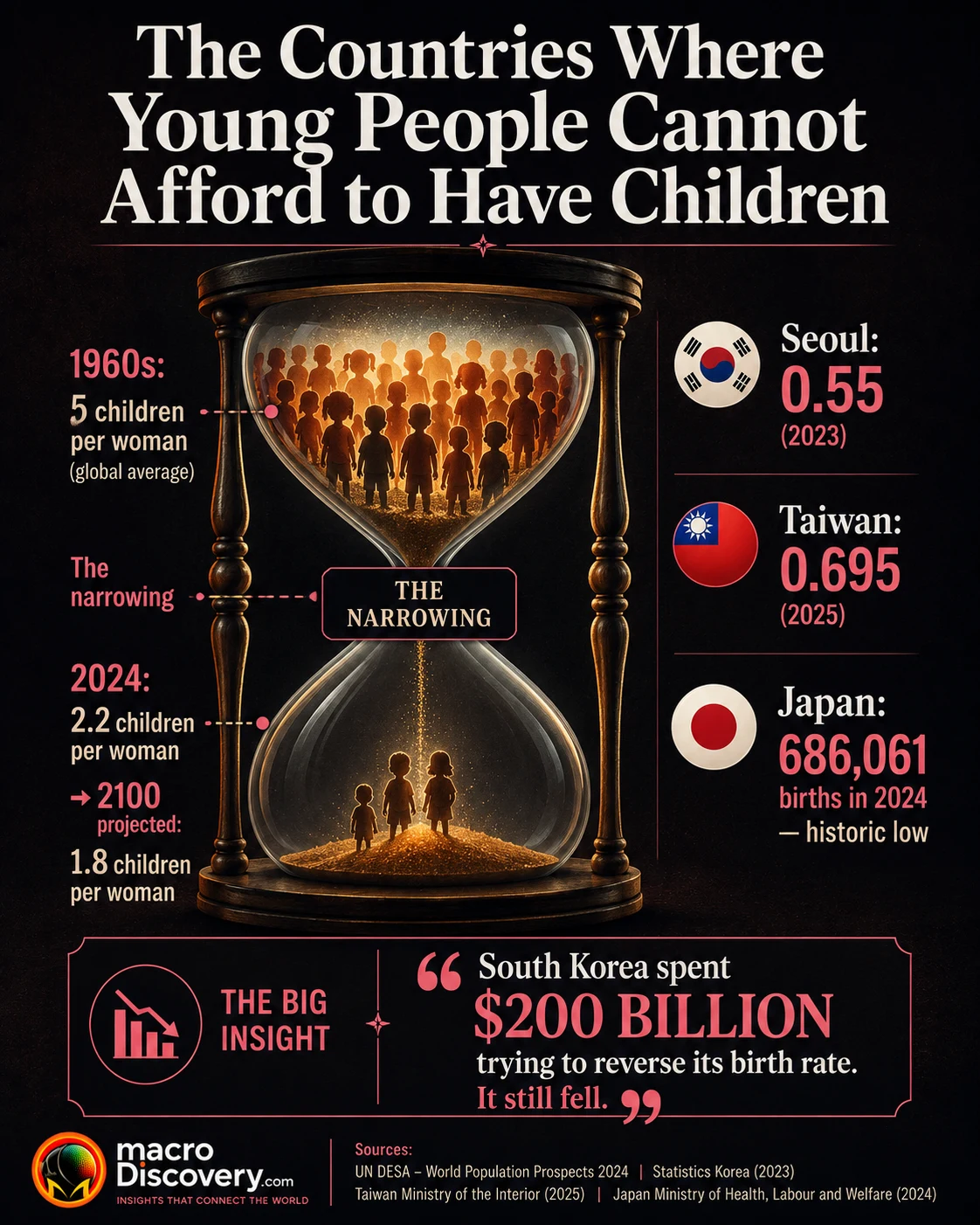
South Korea recorded a fertility rate of 0.72 in 2023 — the lowest ever measured for a major country, less than a third of the replacement rate. Seoul’s rate is 0.55. The country spent an estimated $200 billion trying to reverse the trend. It failed. Taiwan is now at 0.695. Japan recorded its lowest-ever birth total in 2024. Italy, Spain, Poland, and Canada have all reached historic lows. And the UN projects that global fertility will fall to just 1.8 births per woman by 2100. This is not a story about people not wanting children. It is a story about a world in which having children has become economically impossible for a growing proportion of young people.
- South Korea recorded a total fertility rate of 0.72 in 2023 — less than a third of the 2.1 replacement rate. Seoul’s fertility rate in the same year was 0.55 — the lowest ever recorded for a major city. South Korea became a “super-aged society” in December 2024, with over 20% of its population aged 65 or older. Its working-age population could halve over the next 40 years. The government has spent an estimated $200 billion on pronatalist policies. Fertility still fell.
- This is not a story about people not wanting children. The UN’s “World Fertility 2024” report confirms directly: “In low-fertility countries, individuals and couples tend to have fewer children than they desire and to remain childless more often than intended.” The fertility crisis is a gap between intention and achievement — driven by economic conditions, not by a preference for childlessness. In Italy and Spain, surveys show average desired family size is above two children; actual TFR is around 1.2.
- Four specific costs explain most of the low-fertility cluster in East Asia. Housing prices surged 80% in South Korea over the last decade. Private tutoring accounts for 12% of Korean household spending — more than food or basic necessities. Nearly 80% of Korean schoolchildren attend private tutoring costing families approximately 10% of disposable income. Women face a structural binary choice between career and family that most find impossible to bridge. These are not cultural preferences — they are economic constraints.
- The problem is now global. 131 of 237 countries and territories are below replacement fertility, together home to two-thirds of the world’s population (UN WFF 2024). Canada recorded its lowest-ever TFR of 1.26 in 2023, joining the “lowest-low” fertility group. India has recently crossed below replacement. Japan recorded its lowest-ever birth total of 686,061 in 2024. Italy’s prime minister has said her country is “destined to disappear.” The Lancet/IHME 2024 Global Burden of Disease study projects 97% of countries will fall below replacement by 2100.
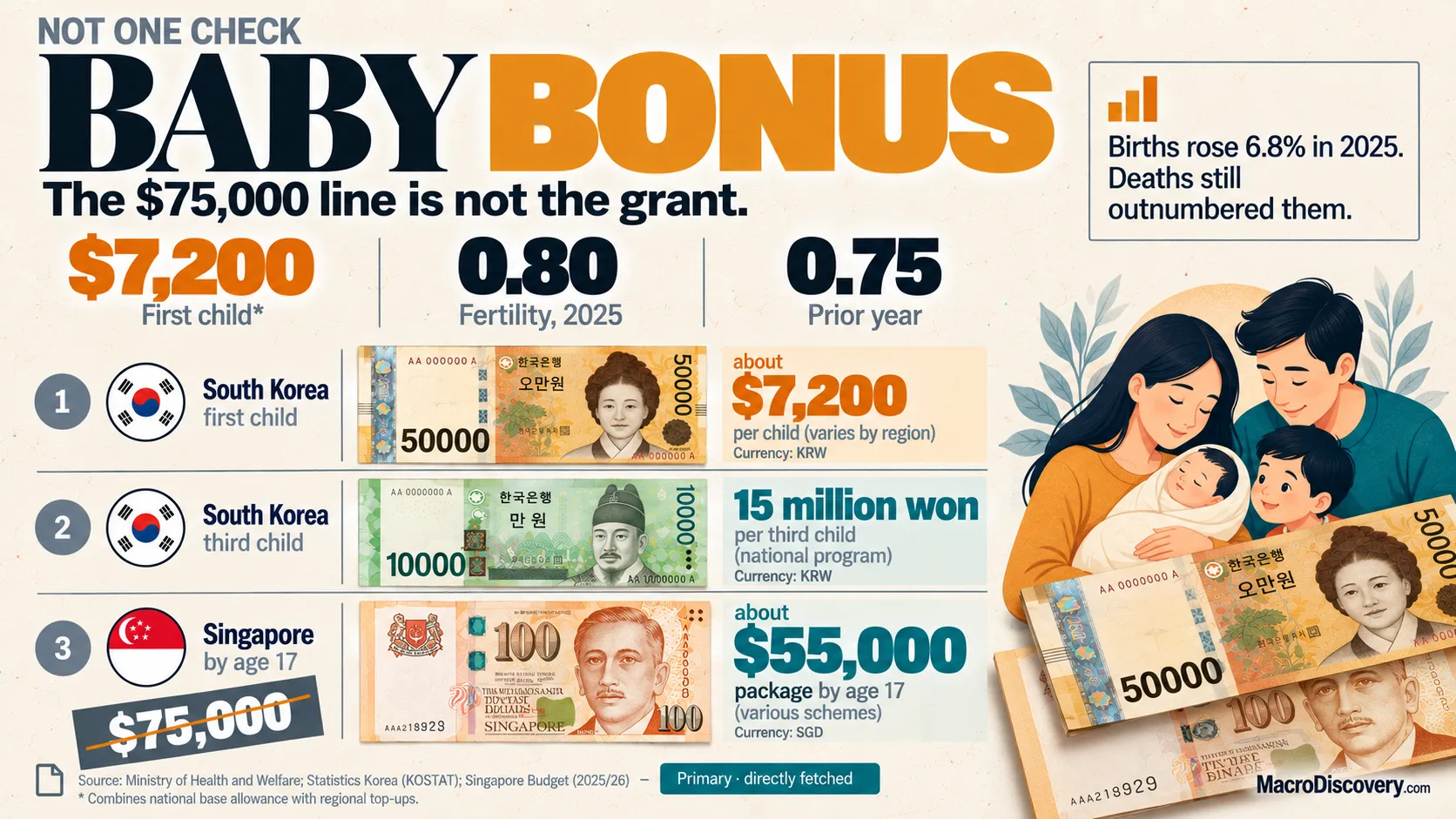
- Governments have spent billions trying to reverse the trend, with very limited success. The UN’s primary assessment is stark: “Financial transfers appear to have a positive but weak effect on fertility. Short-term baby bonus payments also seem to have a limited effect, mostly affecting the timing of childbearing rather than the total number.” Hungary achieved partial success through comprehensive family support combined with gender equality measures. But the OECD concluded in 2025 that it is “unlikely that such policies will enable countries to approach replacement fertility rates again.” The structural causes — especially housing costs and gender inequality — require systemic change that no government has yet delivered at scale.
Sources: UN “World Fertility 2024” (UNDESA · UN DESA/POP/2024/TR/NO.11 · primary · directly fetched) · UN World Population Prospects 2024 Revision (primary) · OECD “Korea’s Unborn Future” WP No. 1824 Oct 2024 (primary) · Wikipedia: Total Fertility Rate (July 2026 · citing national statistics agencies). South Korea 2023: 0.72 (national); Seoul city 2023: 0.55 (OECD WP 1824). Taiwan 2025: ~0.695 (NDC report via Wikipedia April 2026). South Korea rebounded to approximately 0.8 in 2025 (Hankyoreh, May 2026 via Wikipedia). The vertical reference marks the 2.1 replacement rate threshold. Bar lengths are capped at 100% of the chart width for display; Nigeria’s full bar at 4.30 would extend beyond the chart.
| Country | TFR | Data Year | Category | Key context | TFR |
|---|---|---|---|---|---|
🇹🇼 TaiwanNDC 2025 report · national statistics |
0.695 | 2025 | World’s Lowest 2025 | Births down 20% in single year to ~107,000. Rapid economic development, high female workforce participation, intense education competition. | |
🇰🇷 South KoreaStatistics Korea · 2023 national minimum |
0.72 | 2023 (low) | Historic Low | Seoul TFR: 0.55 (2023). Became “super-aged society” Dec 2024. Spent ~$200B on pronatalist policies. Rebounded to ~0.8 in 2025 — first increase in years. | |
🇨🇳 ChinaUN WPP 2024 · post one-child policy |
1.02 | 2022-2024 | Below 1.0 (UN) | UN lists China below 1.0. Population declined 2M in 2023. One-child policy (1980-2015) and now pro-natalist push. “No country with a decline as steep has fully recovered.” | |
🇯🇵 JapanUN WPP 2024 · 2024 births: 686,061 |
1.20 | 2023-2024 | Very Low | 686,061 births in 2024 — historic low. Population peaked 128M (2008); projected 87M by 2070. Working-age: 75M (2020) → 45M (2070). Turning to automation. | |
🇮🇹 ItalyUN primary 2024 · PM: “destined to disappear” |
1.20 | 2024 | Very Low | Was 1.2 in 1990s, recovered slightly, declined again. Youth unemployment + rigid labour market. Desired family size in surveys: 2+ children. Actual: 1.2. | |
🇪🇸 SpainEurostat 2023 · record low |
1.19 | 2023 | Very Low | Fell to 1.19 in 2023 (record low). High youth unemployment, housing crisis, precarious employment contracts for young workers. | |
🇵🇱 PolandEurostat / UN WPP 2024 |
1.14 | 2024 | Very Low | Sharp post-communist decline. Economic development without matching family support infrastructure. High emigration of young adults to Western Europe. | |
🇩🇪 GermanyUN WPP 2024 |
~1.35 | 2024 | Low | Below replacement since 1970. One of the longest-running low fertility histories globally. Immigration offsets decline. Relatively generous family support vs southern Europe. | |
🇨🇦 CanadaStatistics Canada 2023 · record low |
1.26 | 2023 | Lowest-Low | “Canada has now joined the group of ‘lowest-low’ fertility countries” (Statistics Canada). High immigration keeps population growing, masking severity of birth rate decline. | |
🇺🇸 United StatesUN WPP 2024 primary · “just above 1.6” |
~1.62 | 2023 | Below Replacement | Below replacement since 2007 (with brief recovery to 2010). Immigration prevents population decline. Births among women 40+ now exceed teenage births for first time. | |
🇮🇳 IndiaUN WPP 2024 · recently crossed below replacement |
~1.95 | 2024 | Just Below Replacement | World’s most populous country has crossed below replacement. Fertility declining rapidly in urban areas. Still above replacement in some rural states. | |
🇳🇬 NigeriaUN WPP 2024 · among world’s highest |
4.30 | 2024 | Well Above Replacement | Africa will add 2.26B people by 2100 as most other regions stagnate or decline. High fertility concentrated in Sub-Saharan Africa, Pakistan, parts of Middle East. |
Sources: UN “World Fertility 2024” (UNDESA primary · directly fetched · 2025 · ISBN 9789210034883) · UN World Population Prospects 2024 Revision · OECD WP No. 1824 “Korea’s Unborn Future” (Oct 2024 · primary) · Statistics Korea · Eurostat · Statistics Canada · Wikipedia “Total Fertility Rate” (July 2026). Singapore, Ukraine, Hong Kong, and Macao also below 1.0 per UN primary but not shown in this table. All figures represent most recent data year available. Click column headers to sort.
Why Does South Korea Have the World’s Lowest Fertility Rate?
South Korea recorded a total fertility rate of 0.72 in 2023 — less than a third of the 2.1 replacement rate and the lowest national TFR ever recorded for a major country with a large population. Seoul’s TFR in the same year was 0.55. The government declared a demographic national emergency and intensified a pronatalist spending programme that has run for nearly two decades. None of it has worked.
The OECD’s 2025 primary publication “Korea’s Unborn Future” — the most comprehensive authoritative analysis available — identifies four interlocking causes. First, housing: South Korean house prices surged approximately 80% over the past decade. A 2023 government survey found that 40% of respondents cited the financial burden of child-rearing and high housing expenses as the reason they chose not to have children or more children. The OECD confirms directly that increasing housing prices reduce the likelihood of marriage — and marriage in South Korea is still closely tied to childbearing. Second, education costs: approximately 80% of Korean schoolchildren attend private tutoring academies (hagwons), costing families roughly 10% of disposable income. Private education accounts for 12% of total household spending — more than food or basic necessities. The competitive education system creates a financial treadmill in which parents feel they cannot afford to have children because they cannot afford the education that South Korean society expects children to receive.
Third, gender inequality: the OECD’s conclusion is direct — “the main reason is that many Korean women are constrained to choose either career or family, while men have little choice but to become the family breadwinner.” South Korean women are among the most highly educated in the OECD. They enter the workforce in large numbers. And they face a labour market and a social structure in which motherhood effectively ends career progression. The opportunity cost of having a child is not just financial — it is a woman’s entire professional identity. The rational response, for a highly educated woman in Seoul, is not to have children. The fourth driver is precarious employment: South Korea’s dual labour market — a small core of high-pay permanent jobs and a large periphery of unstable contract positions — forces young people to delay career establishment and therefore family formation, often until their mid-30s when fertility is naturally declining.
Is This Really About Money — or Have People Simply Chosen Not to Have Children?
The most important finding in the UN’s “World Fertility 2024” primary report — directly confirmed from the primary text — is this: “In low-fertility countries, individuals and couples tend to have fewer children than they desire and to remain childless more often than intended.” This is not a story of changing preferences. It is a story of a gap between what people want and what they can achieve.
In Italy and Spain, where fertility rates have dropped to approximately 1.2, surveys consistently show that the average desired family size is above two children. Italians and Spaniards, on average, want larger families than they have. The gap between intention and outcome is explained by economic and structural barriers: housing costs that make family-sized accommodation impossible for young adults in cities; employment conditions that offer short-term contracts with no stability; childcare systems that are either unavailable or unaffordable; and — as in East Asia — persistent gender inequality that places the burden of caregiving almost exclusively on women who also hold jobs.
The “desire-achievement gap” is also visible in the United States, where for the first time in 2025, women over 40 are having more babies than teenagers — not because older women suddenly became more fertile, but because the conditions that would allow younger women to start families have deteriorated. High housing costs, student debt, precarious employment, and inadequate childcare systems have pushed the average age of first birth steadily upward. The fertility crisis is not a cultural preference for childlessness. It is the economic consequence of systems that have made children unaffordable.
Why Are Southern and Eastern Europe Facing the Same Crisis as East Asia?
Italy, Spain, Poland, Greece, and most of Eastern Europe share the fertility crisis with East Asia — but for partly different reasons. In Southern Europe, the structural problems are well-documented: extremely high youth unemployment (in Spain, youth unemployment has historically exceeded 30%), precarious short-term employment contracts that offer no financial security for family planning, a severe housing shortage that has driven young adults back to living with parents into their 30s, and childcare systems that are either expensive or unavailable.
Italy’s prime minister Giorgia Meloni has publicly said her country is “destined to disappear.” She is not wrong about the trajectory. Italy’s TFR of 1.2 means each generation is approximately 43% smaller than its predecessor if the rate is sustained. Italy, which once had one of the most vibrant young populations in Europe, now has one of the oldest: the median age has risen to approximately 48 years. The working-age population is declining, the pension system is under mounting pressure, and immigration — the only mechanism that has prevented population collapse — remains politically contested.
Eastern Europe adds an additional layer: mass emigration of young adults. Poland, Romania, Bulgaria, and the Baltic states saw significant outflows of young workers to Western Europe after EU accession. This emigration removes exactly the demographic group most likely to have children. The countries that remain are older, smaller, and less fertile. Eastern Germany in 1994 recorded a TFR of 0.80 following reunification — the lowest non-wartime TFR recorded outside Asia before the current South Korean/Taiwanese figures. The post-communist fertility collapse in Eastern Europe was a preview of what is now unfolding more broadly across the rich world.
Have Any Countries Successfully Reversed Declining Fertility — and What Actually Works?
The UN’s primary assessment of what works is sobering: “Financial transfers appear to have a positive but weak effect on fertility. Short-term baby bonus payments also seem to have a limited effect, mostly affecting the timing of childbearing” rather than increasing lifetime totals. One-off cash payments shift births forward in time — parents have children slightly earlier than they otherwise would — but do not systematically increase the total number of children families have. The OECD’s 2025 review concluded that it is “unlikely that such policies will enable countries to approach replacement fertility rates again.”
The countries that have had the most relative success share a specific combination of policies. Hungary achieved the most significant improvement in recent years: cash benefits for second, third, and fourth births produced fertility increases of approximately 26%, 32%, and 14% respectively in those birth orders, according to peer-reviewed research (PMC), pushing Hungary’s TFR from approximately 1.25 to approximately 1.55. But the mechanism was not primarily the cash — it was the comprehensive package combining financial support, generous and flexible parental leave, subsidised childcare, and critically, a labour market structure that allows both parents to maintain employment after having children. Sweden, Norway, and France — the European countries with the highest fertility among rich nations — share the same pattern: universal childcare, generous and flexible parental leave for both genders, active labour market policies that prevent the career penalty for motherhood, and housing policies that keep family-sized homes accessible.
The OECD’s 2024 “Society at a Glance” reached a clear conclusion: “the most durable lever is greater gender equality and a fairer sharing of childcare, backed by paid parental leave, affordable childcare, child allowances and — crucially — tackling the cost of raising children, especially housing.” The countries that have best maintained fertility are those where having children does not require a woman to choose between professional identity and family. Where the conditions of parenthood are compatible with full participation in economic and social life for both parents, fertility holds up. Where they are not, it collapses.
What Happens to Countries That Cannot Reverse Their Fertility Decline?
The economic consequences of sustained very low fertility accumulate slowly at first and then accelerate. Japan offers the clearest preview. Japan’s population peaked at 128 million in 2008. It is now declining. The working-age population is projected to fall from 75 million in 2020 to 45 million by 2070 — a 40% reduction. Japan has responded by investing in robotics and automation to compensate for labour shortages in manufacturing and services, and by gradually and reluctantly opening immigration channels that were historically closed. These are adaptive responses, but they do not solve the underlying demographic mathematics.
South Korea faces a more acute version of the same trajectory. Its working-age population could halve over the next 40 years, according to Morgan Stanley’s analysis. The pension system — which depends on contributions from working-age people to fund retirees — faces mounting strain as the ratio of workers to retirees deteriorates. Healthcare systems face growing demand from an aging population with a shrinking workforce to fund them. Universities are already closing in South Korea’s provincial cities, with insufficient young people to fill lecture halls. A TFR of 0.72, if sustained, means each generation is approximately one-third the size of its parents’ generation. Three generations is sufficient to shrink the population from 50 million to under 2 million — though this is a mathematical projection of current rates, not a prediction, since rates are unlikely to remain constant.
The global demographic divide that results from these trends is the defining demographic fact of the 21st century. Sub-Saharan Africa will add approximately 2.26 billion people by 2100 as most of the rest of the world stagnates or declines in population. Europe and East Asia will be smaller, older, and more dependent on immigration than ever before. The UN projects that 97% of countries will be below replacement fertility by 2100. The age of global population growth, which was the dominant demographic reality of the 20th century, is ending. The age of demographic divergence — between a shrinking, aging rich world and a growing, young developing world — has begun.
- UN DESA — “World Fertility 2024” (primary · directly fetched · UN DESA/POP/2024/TR/NO.11 · ISBN 9789210034883 · New York 2025 · global TFR 2.2 · 131/237 countries below replacement · 4 countries below 1.0 · desire-achievement gap · policy assessment · MAC 28.2 yrs · 132M births 2024)
- OECD — “Korea’s Unborn Future: Understanding Low-Fertility Trends” (primary · 2025 · doi:10.1787/005ce8f7-en · women constrained to choose career or family · housing cost impact · 80% in private tutoring · 10% income on tutoring · gender inequality as main cause)
- OECD Economics Department Working Paper No. 1824 — “Korea’s Unborn Future” (October 2024 · primary · Seoul TFR 0.55 · housing prices reduce marriage likelihood · Sejong city exception · labour market duality · parental leave take-up low)
- Morgan Stanley — “South Korea Population Decline Crisis” (January 2025 · +80% house prices decade · 40% cite financial burden+housing · private education 12% spending · workforce could halve in 40 years · super-aged society December 2024)
- Wikipedia — “Total Fertility Rate” (July 2026 · current · Spain 1.19 2023 · Italy 1.2 2023 · Canada 1.26 2023 “lowest-low” · SK 0.72 2023 → 0.8 2025 · Taiwan 0.695 2025 · Eastern Germany 0.80 1994 · Lancet 97% below 2100)
- Visual Capitalist — “The Fertility Rate of Every Country in the World” (May 2026 · UN WPP 2024 basis · India 1.94 below replacement · China 1.02 one-child policy legacy · Nigeria 4.30 · Africa adds 2.26B by 2100 · 71% global population below replacement)
- Mappr — “Mapped: Every Country’s Fertility Rate in 2024” (May 2026 · World Bank + UN WPP 2024 · 131/237 below replacement · “Italy destined to disappear” Meloni · OECD 2024 policy conclusion · immigration solution limits · Lancet/IHME 97% by 2100)
- OECD Ecoscope — “Addressing Korea’s Fertility Crisis” (October 2024 · primary · “high opportunity cost of having children in Korea” · faster old-age dependency ratio increase than any other OECD country · structural reform recommendations)
- PMC — “Reversing fertility decline in Japan with foreign pro-natalist policies” (2025 · peer-reviewed · 61 studies · cash benefits most influential · Hungary 2nd/3rd/4th birth increases 26%/32%/14% · Japan monthly payment structure · tuition-free university plan)
- Global Health Inquirer — “When Fertility Becomes Political” (June 2025 · South Korea ~$200B spent · TFR fell 1.1→0.81 over 15 years · Taiwan $3B → record low 0.87 · “most people not on the fence” · Jales quote on incentive size needed)