Home AI Technology Gaming Future Economy Geography Automobile Science Web Stories

The Amazon Loses a Denmark-Sized Area of Forest Every Year: Global Deforestation Map

Macro Discovery
On: September 7, 2026 7:26 AM
Follow Us:
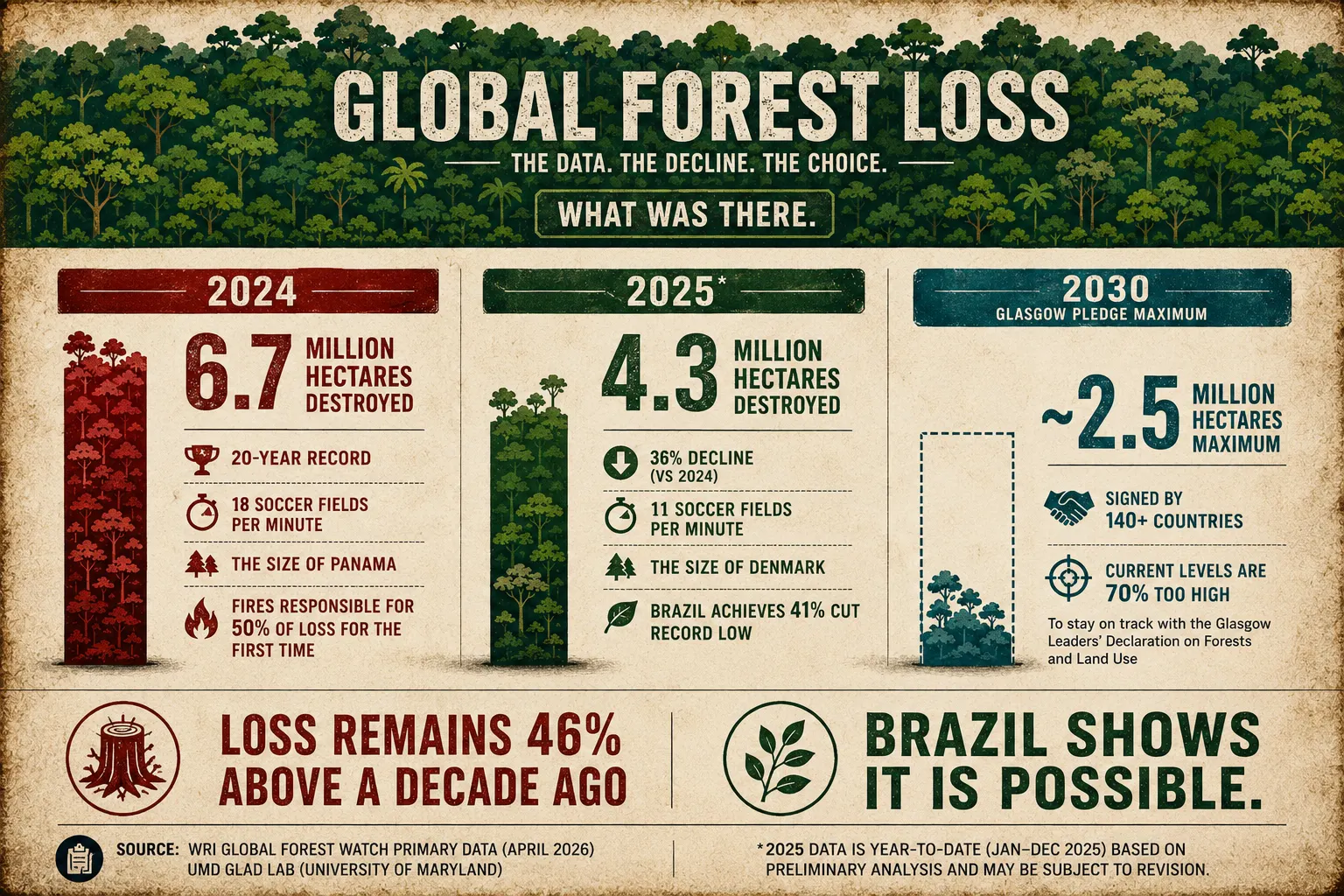
Infographic comparing global forest loss in 2024 and 2025 with the 2030 Glasgow forest-loss target, showing 6.7 million hectares lost in 2024, 4.3 million in 2025, and a target maximum of about 2.5 million hectares.
Mapped: The Global Deforestation Map — MacroDiscovery
MacroDiscovery
Forests & Climate · Deforestation · 5 min read · WRI · Global Forest Watch · April 2026 · Primary · Directly Fetched
WRI — Global Forest Watch / GLAD Lab, University of Maryland (PRIMARY · wri.org · directly fetched · April 29, 2026 — 2025 data · May 21, 2025 — 2024 data) · FAO — Global Forest Resources Assessment 2025 (PRIMARY · fao.org · October 2025) · INPE Brazil (PRIMARY · gov.br · PRODES Amazon monitoring)
Forests · Climate · Deforestation Crisis · 2025 Data

Mapped: The Global
Deforestation Map

2024 was the worst year for tropical forest loss on record: 6.7 million hectares destroyed — equivalent to 18 soccer fields vanishing every minute. For the first time, fires overtook agriculture as the leading cause. In 2025, loss fell 36% — driven by Brazil’s historic turnaround. But the world still loses 11 soccer fields of rainforest every minute. And it is still 70% above the pace needed to meet the 2030 Glasgow pledge.

By MacroDiscovery
Source: WRI / Global Forest Watch (primary · directly fetched · April 29, 2026)
Key quote: “A global red alert.” — Elizabeth Goldman, Co-Director of GFW, WRI
6.7M ha
tropical primary forest lost in 2024 · RECORD ALL-TIME · “unlike anything in over 20 years of data” · WRI primary · 18 soccer fields/minute
−36%
tropical primary forest loss in 2025 vs 2024 · WRI primary (directly fetched) · 4.3M ha lost · size of Denmark · “decisive government action”
70%
current levels are above what’s needed to meet the Glasgow 2030 goal · WRI primary verbatim · “about 70% too high” · 140+ countries signed
46%
tropical primary forest loss in 2025 is still above the level of a decade ago · WRI primary · “not a return to trend”
Visualization 01 — Where Forests Are Being Lost · 2024 & 2025 Data
Three Critical Forest Regions — Amazon, Congo, Southeast Asia — Each Telling a Different Story

Tropical primary forest loss by region and key country, 2024–2025. Tap any region to expand country detail. Sources: WRI — Global Forest Watch (PRIMARY · wri.org · directly fetched · April 29, 2026 for 2025 data · May 21, 2025 for 2024 data · data from University of Maryland GLAD Lab) · FAO Global Forest Resources Assessment 2025 (PRIMARY · October 2025) · INPE Brazil PRODES (PRIMARY).

Global Tropical Primary Forest Loss · 2024 vs 2025 · Million Hectares
2024
6.7M ha
Record · 2× 2023
“This level of forest loss is unlike anything we’ve seen in over 20 years of data.” — Elizabeth Goldman, WRI · 18 soccer fields/minute · size of Panama · Fires: first time leading cause (50% of loss)
2025
4.3M ha
−36% · Denmark
“A drop of this scale in a single year is encouraging — it shows what decisive government action can achieve.” — Goldman · But: still 46% above decade ago · Still 70% above 2030 target pace · 11 soccer fields/minute
2030 target
~2.5M ha
Glasgow goal
Approximate pace needed to meet Glasgow Leaders’ Declaration goal to halt and reverse forest loss by 2030. Signed by 140+ countries at COP26 (2021). Current 2025 levels: approximately 70% too high.
🌿 Amazon Basin — Latin America
The world’s largest rainforest. Brazil #1 globally in 2024. Bolivia #2 for first time. In 2025: Brazil achieved record-low deforestation while Bolivia remained second.
Brazil: historic low 2025 Bolivia: +200% in 2024 Fire as clearing tool
Brazil: 42%
of global tropical loss · 2024
▾ Expand
Brazil · 2024 (record year)
42% of all tropical forest loss globally
Brazil accounted for the largest absolute area of tropical primary forest loss in 2024, driven by a surge in fire — both climate-amplified and deliberately set to clear land. Brazil’s 2024 loss was partly a reversal of 2023 progress under President Lula da Silva.
Brazil · 2025 (record low)
−41% non-fire loss · “lowest level on record”
WRI primary (directly fetched, April 29, 2026): “Brazil cut non-fire primary forest loss by 41% compared to 2024, reaching its lowest level on record.” Rate relative to forest area: 0.5% — lower than several other tropical countries. INPE PRODES: 5,796 km2 Amazon deforestation (2024-25, −11% year-on-year).
Bolivia · 2024 (catastrophic)
+200% · 1.5 million ha · NEW #2 globally
Bolivia’s primary forest loss skyrocketed by 200% in 2024 — from 441,000 to 1.5 million hectares — making it the second-largest source of tropical deforestation globally for the first time, overtaking DRC. Driven by drought + fires set to clear land for soy, cattle, sugarcane. Government policies promoting agricultural expansion worsened the crisis. Fires hit roughly 12% of the country.
Bolivia · 2025
Still #2 globally · “second-highest on record”
WRI primary (April 29, 2026): “Bolivia recorded its second-highest level of primary forest loss on record after severe fires in 2024 and now ranks second for tropical primary forest loss — surpassing the Democratic Republic of the Congo despite Bolivia having 60% less primary forest.”
Brazil policy: PPCDAm federal anti-deforestation plan relaunched under Lula · increased penalties for environmental crimes · Mirela Sandrini (WRI Brasil): “But Brazil’s landscape is becoming more flammable, and growing fire risk means enforcement alone won’t be enough.”
🌿 Congo Basin — Central Africa
The world’s second-largest tropical rainforest. DRC: persistent loss driven by smallholder farming, charcoal, mining and conflict. Non-fire loss hit a record high in 2025.
Persistent loss · DRC Mining under-recognised Non-fire record high 2025
~1.3M ha
DRC primary forest loss · 2023 baseline
▾ Expand
DRC · 2025 key finding
Non-fire loss hit a record high
WRI primary (April 29, 2026): “In the DRC, total loss dipped slightly in 2025, but non-fire loss hit a record high, largely linked to small-scale farming, firewood and charcoal production, conflict-related displacement, and pressure from mining.” — This distinction matters: DRC’s loss is structural, not fire-driven.
DRC drivers
Farming · charcoal · mining · conflict
The Congo Basin’s deforestation drivers differ from the Amazon: in DRC, it is predominantly small-scale subsistence farming and charcoal production by local communities who depend on forests for survival. WRI Africa: “Mining is a far greater indirect driver of deforestation than previously recognized.” Conflict-related displacement is also a significant factor.
Congo Basin broader
Republic of Congo: +150% in 2024
The crisis extends beyond DRC into neighbouring Congo Basin countries. Republic of Congo saw a 150% increase in primary forest loss in 2024. The Congo Basin holds the world’s largest tropical peatlands — which store carbon accumulated over thousands of years — making degradation here especially damaging for global climate.
Indigenous + community land
Rights recognition key to solution
Teodyl Nkuintchua, WRI Africa: “Support and investment are essential to making community forest management viable and enabling Indigenous Peoples and local communities to meet their basic needs.” The Congo Basin requires fundamentally different solutions than the Amazon — community-based rather than enforcement-based.
🌿 Southeast Asia
Indonesia and Malaysia: deforestation has declined significantly from its 2012–2016 peak. Moratoriums on new permits in primary forest and peatlands have worked — but Indonesia’s loss rose again in 2025.
Indonesia: moratorium working 2025: modest rise in Indonesia Laos: rubber + cassava driving loss
296K ha
Indonesia primary forest loss · 2025
▾ Expand
Indonesia · success + risk
242K ha (2024) → 296K ha (2025) · +14%
Indonesia implemented a permanent moratorium on new permits in primary forests and peatlands. Long-term decline from 2012-2016 peak has been substantial. But 2025 saw a 14% rise to 296,000 hectares. Arief Wijaya, WRI Indonesia: “Rising economic pressures could test that progress.” Government food estate programme in South Papua: 10,000 ha of primary forest cleared in 2025.
Laos · agriculture exports
Still top 10 globally · −31% from 2024
Laos’s primary forest loss fell 31% from 2024 but remained in the global top 10. Driver: exports of rubber, cassava, bananas and other crops to markets in China, Thailand and Vietnam. Land concessions granted to Chinese and Vietnamese companies for industrial agriculture are a major structural pressure. Small-scale subsistence farming also significant.
Peru · gold mining crisis
Gold mining: 33% of Madre de Dios loss
In Peru’s Madre de Dios region, gold mining drove 33% of all primary forest loss from 2002 to 2025. Illegal artisanal mining operations in the Amazon’s most biodiverse zone have accelerated, linked to rising gold prices. Colombia reversed its 2024 deforestation spike in 2025, credited by WRI to governance maintaining the line.
Malaysia · palm oil
28M+ ha cumulative loss since 2001
Malaysia has lost more than 28 million hectares of tree cover since 2001, primarily driven by oil palm expansion followed by pulp and paper plantations. Corporate sustainability commitments have had some effect on large-scale industrial deforestation, but smallholder conversion continues. Malaysia’s loss rate in 2024-25 remained lower than its 2010-2016 peak.
🔥 The Fire Front — Canada, Europe, Boreal Regions
Deforestation is not only a tropical phenomenon. In 2025, Canada suffered its second-worst wildfire year on record. Climate change is intensifying fire cycles beyond the tropics. Fires accounted for 42% of total global tree cover loss in 2025.
Canada: 2nd worst year on record 42% of all 2025 tree loss = fires Climate amplifying cycle
5.3M ha
Canada wildfires · 2025
▾ Expand
Canada 2025 (WRI primary)
5.3 million ha = 2nd-worst fire year on record
WRI primary (directly fetched, April 29, 2026): “wildfires burned 5.3 million hectares (13.0 million acres), making 2025 the country’s second-worst fire year on record.” Significant fires were also recorded in parts of southern Europe. The boreal forest — the world’s largest biome, containing more carbon than all tropical forests combined — is burning at increasing frequency.
Fires as % of 2025 loss
42% of 25.5M ha total tree cover loss
WRI primary (April 29, 2026): fires accounted for “42% of the 25.5 million hectares (63.1 million acres) of tree cover loss worldwide, an area slightly larger than the United Kingdom.” In 2024 (tropical record year), fires alone emitted 4.1 gigatonnes of greenhouse gases — “more than four times the emissions from all commercial air travel in 2023.”
Prof. Matthew Hansen (UMD GLAD Lab): “Climate change and land clearing have shortened the fuse on global forest fires. They are turning seasonal disturbances into a near-permanent state of emergency.” Goldman warns: “with El Niño on the horizon for 2026, investments in prevention and response will be critical.”
Visualization 02 — A Decade of Loss · 2015 to 2030 Target
The Glasgow Pledge Was to Halt Deforestation by 2030. Here Is Where the World Stands.

The Glasgow Leaders’ Declaration (COP26, 2021) committed 140+ countries to halt and reverse forest loss by 2030. Five years in, the world is 70% above the pace required to meet that target. Sources: WRI Global Forest Watch (PRIMARY · directly fetched · April 29, 2026) · WRI Global Forest Watch (PRIMARY · May 21, 2025 — 2024 data) · FAO Global Forest Resources Assessment 2025 (PRIMARY · October 2025).

Pre-2015
Baseline
The World Loses ~3 Million Hectares of Tropical Primary Forest Per Year. Agriculture Is the Clear Driver.
In the decade before 2015, tropical primary forest loss was roughly 3 million hectares per year — driven almost entirely by agricultural conversion. Cattle ranching in Brazil’s Amazon, palm oil in Indonesia and Malaysia, and soy expansion were the primary forces. Indonesia was the second-largest source of deforestation behind Brazil. The FAO’s Global Forest Resources Assessment 2025 reports that 10.9 million hectares of forest were lost to gross deforestation annually in the period 2015–2025, and that 489 million hectares of forest have been lost since 1990 — approximately 11% of the world’s total forest area. Since the beginning of human civilization, an estimated 46% of all trees have been cut down.
~3M ha/yr baseline tropical primaryAgriculture: dominant driver489M ha lost since 1990 (FAO)
2021
Glasgow
The Glasgow Leaders’ Declaration: 140+ Countries Pledge to Halt and Reverse Forest Loss by 2030.
At COP26 in Glasgow in November 2021, more than 140 countries — representing more than 90% of the world’s forests — signed the Glasgow Leaders’ Declaration on Forests and Land Use, pledging to halt and reverse forest loss and land degradation by 2030. It was the most ambitious international forest commitment ever made, backed by $19.2 billion in public and private finance. The commitment came with targets, money, and political will. What it has not produced, so far, is sufficient results. In the four years since Glasgow, tropical primary forest loss has not declined — it accelerated dramatically in 2024 before partially recovering in 2025, and remains far above the trajectory the declaration requires.
140+ countries signed$19.2B pledgedHalt + reverse by 2030
2024
Record
“Global Red Alert.” 6.7 Million Hectares Lost — Nearly Twice 2023. For the First Time in 20 Years of Records, Fires Were the Leading Cause.
WRI/Global Forest Watch confirmed on May 21, 2025 that 2024 saw a record 6.7 million hectares of tropical primary forest destroyed — nearly twice the 2023 figure, at a rate of 18 soccer fields every minute, an area nearly the size of Panama. For the first time in more than 20 years of GFW data, fires — not agricultural conversion — were the leading cause, accounting for nearly 50% of tropical primary forest loss. Fires from the 2024 tropical season emitted 4.1 gigatonnes of greenhouse gases — more than four times the emissions from all commercial air travel in 2023. Bolivia saw a 200% surge to 1.5 million hectares, claiming second place globally for the first time, overtaking DRC. Elizabeth Goldman, Co-Director of GFW: “This level of forest loss is unlike anything we’ve seen in over 20 years of data. It’s a global red alert.”
6.7M ha · record all-timeFires: first time leading cause (50%)Bolivia: +200% · new #24.1 Gt GHG from fires alone
2025
Recovery
Loss Falls 36% to 4.3 Million Hectares. Brazil Achieves Its Lowest Deforestation on Record. But the World Is Still 70% Above the 2030 Pace.
WRI’s April 29, 2026 primary release (directly fetched) confirmed a 36% decline in tropical primary forest loss in 2025, to 4.3 million hectares — an area roughly the size of Denmark, still disappearing at 11 soccer fields every minute. Brazil drove much of the improvement, cutting non-fire primary forest loss by 41% to its lowest recorded level, crediting the PPCDAm anti-deforestation plan and stronger enforcement under President Lula. Colombia also reversed a 2024 spike. Indonesia maintained relatively low rates despite a 14% rise. But DRC’s non-fire loss hit a record high. Bolivia remained second globally. Canada experienced its second-worst wildfire year on record at 5.3 million hectares. Goldman: “A drop of this scale in a single year is encouraging — it shows what decisive government action can achieve. But part of the decline reflects a lull after an extreme fire year.”
−36% · 4.3M ha · “size of Denmark”Brazil: record low non-fire lossStill 46% above decade agoStill 70% above 2030 target pace
2030
Target
Five Years to the Glasgow Deadline. The World Is 70% Above the Required Pace. El Niño May Intensify 2026 Fire Season. Multiple Forest Countries Face Key Elections.
The Glasgow Leaders’ Declaration requires halting and reversing forest loss by 2030. Five years into the pledge, forest loss in 2025 was approximately 70% above the rate required to meet it, according to WRI. Goldman warned that El Niño conditions expected in 2026 could intensify fire risk and test recent gains. Several major forest countries face elections in 2026 that will shape whether progress continues or reverses. Rod Taylor, WRI’s Global Director of Forests: “The progress we’re seeing in countries like Brazil and Colombia is heartening — but far from assured. These are inspiring examples of what can be done to curb deforestation, but also a reminder of how much the fate of our forests hinges on political will.” Meeting 2030 targets would require consistent years of reduction at a pace the world has never before sustained.
70% above 2030 required paceEl Niño risk for 2026Forest elections: political risk5 years to deadline

Forests cover about 30% of the Earth’s land surface. They contain more than three-quarters of the world’s terrestrial biodiversity. They absorb roughly a third of all carbon dioxide emissions from fossil fuels. And the world is losing them faster than at any point in the 20-year history of satellite-based monitoring — with climate change itself now supercharging the destruction.

WRI — Global Forest Watch / University of Maryland GLAD Lab (PRIMARY) · wri.org · May 21, 2025 — 2024 Data Release
6.7M ha
“This level of forest loss is unlike anything we’ve seen in over 20 years of data. It’s a global red alert — a collective call to action for every country, every business and every person who cares about a liveable planet.” — Elizabeth Goldman, Co-Director of Global Forest Watch, WRI
The 2024 figure of 6.7 million hectares of tropical primary forest destroyed is both a record and a turning point in how we understand what is driving forest loss. For the first time in more than 20 years of Global Forest Watch records, fires — not agriculture — were the leading cause of tropical primary forest loss, accounting for nearly 50% of all destruction. Previously, fire accounted for around 20% of tropical primary forest loss; agricultural conversion was the dominant driver. The shift reflects climate change amplifying human-set fires in increasingly drought-stressed forests. Fires alone from the 2024 tropical season emitted 4.1 gigatonnes of greenhouse gases — more than four times the emissions from all commercial air travel in 2023. Total global tree cover loss in 2024 reached 30 million hectares — an area the size of Italy — up 5% from 2023.
Source: WRI — “RELEASE: Global Forest Loss Shatters Records in 2024, Fueled by Massive Fires” (PRIMARY · wri.org/news/release-global-forest-loss-shatters-records-2024-fueled-massive-fires · May 21, 2025 · data: University of Maryland GLAD Lab, available on Global Forest Watch · “Loss of tropical primary forests alone reached 6.7 million hectares — nearly twice as much as in 2023 and an area nearly the size of Panama, at the rate of 18 soccer fields every minute” · “For the first time on our record, fires — not agriculture — were the leading cause of tropical primary forest loss, accounting for nearly 50% of all destruction” · “Bolivia’s primary forest loss skyrocketed by 200% in 2024, totaling 1.5 million hectares” · “Globally, fires emitted 4.1 gigatonnes of greenhouse gases, more than four times the emissions from all commercial air travel in 2023” · Goldman: “This level of forest loss is unlike anything we’ve seen in over 20 years of data. It’s a global red alert.”)

“Climate change and land clearing have shortened the fuse on global forest fires. They are turning seasonal disturbances into a near-permanent state of emergency.”

— Prof. Matthew Hansen, Director of the GLAD Lab, University of Maryland · WRI Global Forest Watch press release (PRIMARY · directly fetched · wri.org · April 29, 2026)

Brazil’s 41% Cut — The Clearest Evidence That Political Will Works

Brazil’s turnaround is the most important data point in the 2025 WRI report. The country cut non-fire primary forest loss by 41% in one year — reaching its lowest recorded level. The mechanism was straightforward: the Lula administration relaunched the PPCDAm federal anti-deforestation plan, increased penalties for environmental crimes, and elevated forest protection as a national priority. Brazil still has the largest absolute area of primary forest loss of any country — its sheer size makes that nearly inevitable. But its rate relative to its forest area fell to 0.5%, lower than several countries with far less forest. Mirela Sandrini, WRI Brasil: “Brazil’s progress shows what’s possible when forest protection is treated as a national priority.” The lesson for other countries — particularly Bolivia, which remains chronically under-regulated — is that the tools to reduce deforestation exist. The constraint is political will, not technology.

Why it matters: Brazil holds approximately 60% of the Amazon, the world’s largest tropical rainforest and one of the most critical carbon stores on Earth. A sustained reduction in Brazilian deforestation would have more impact on global climate than almost any other single national policy action available to any country today.
WRI — Global Forest Watch · PRIMARY · wri.org · directly fetched · April 29, 2026 — 2025 Data Release
4.3M ha
“In 2025, the world lost 4.3 million hectares (10.6 million acres) of tropical primary rainforest, an area roughly the size of Denmark. Despite the decline, loss remains 46% higher than a decade ago, with primary forests disappearing at a rate of 11 football (soccer) fields every minute.” — WRI verbatim
The 36% decline from 2024’s record is real and significant — driven by Brazil’s enforcement, Colombia’s governance and favorable weather patterns following an extreme fire year. But Goldman’s caution is equally real: “part of the decline reflects a lull after an extreme fire year.” Total global tree cover loss in 2025 reached 25.5 million hectares — an area slightly larger than the United Kingdom — with fires accounting for 42% of that total. Canada alone lost 5.3 million hectares to wildfires, its second-worst fire year on record. In the DRC, while total loss dipped slightly, non-fire deforestation hit a record high. The 2025 figure remains 70% above the pace required to meet the Glasgow 2030 target. “It’s a better year, but it’s just one year,” Goldman said.
Source: WRI — “RELEASE: Tropical Rainforest Loss Drops 36% in 2025, but Fires Threaten Global Progress” (PRIMARY · directly fetched · wri.org/news/release-tropical-rainforest-loss-drops-36-2025-fires-threaten-global-progress · April 29, 2026 · © 2026 World Resources Institute · data: University of Maryland GLAD Lab on Global Forest Watch · verbatim: “In 2025, the world lost 4.3 million hectares (10.6 million acres) of tropical primary rainforest, an area roughly the size of Denmark” · “Despite the decline, loss remains 46% higher than a decade ago, with primary forests disappearing at a rate of 11 football (soccer) fields every minute” · “Current levels are about 70% too high” · “In 2025, Brazil cut non-fire primary forest loss by 41% compared to 2024, reaching its lowest level on record” · “Bolivia recorded its second-highest level of primary forest loss on record…surpassing the Democratic Republic of the Congo despite Bolivia having 60% less primary forest” · “In the DRC, total loss dipped slightly in 2025, but non-fire loss hit a record high” · “wildfires burned 5.3 million hectares (13.0 million acres), making 2025 the country’s second-worst fire year on record” [Canada] · “fires were a major contributor in 2025, accounting for 42% of the 25.5 million hectares (63.1 million acres) of tree cover loss worldwide, an area slightly larger than the United Kingdom”)

The 2030 Target — What “70% Too High” Actually Means

The Glasgow Leaders’ Declaration committed 140+ countries to halt and reverse forest loss by 2030. Four years after that pledge, the world’s deforestation rate sits roughly 70% above the pace required to meet it, according to WRI’s primary analysis. Even the improved 2025 figure is dramatically above the required trajectory. The gap is not narrowing fast enough. The FAO’s Global Forest Resources Assessment 2025 found that 489 million hectares of forest have been lost since 1990 — approximately 11% of total forest area. Government subsidies that are harmful to forests outweigh beneficial ones by a ratio of 200 to 1. The structural incentives — tax breaks for cattle ranching, concessions for palm oil, no economic value attributed to standing forests — point systematically in the wrong direction. What Brazil and Colombia demonstrate is that political will and enforcement can override those incentives temporarily. What Bolivia and the DRC demonstrate is what happens when they don’t.

Why it matters: tropical forests are not just a biodiversity issue. They are a climate mechanism. The Amazon, Congo Basin, and Southeast Asian rainforests collectively absorb and store carbon at a scale that no human technology can replicate. Losing them accelerates warming. Warming accelerates fires. Fires destroy more forest. The cycle that Matthew Hansen described — “seasonal disturbances into a near-permanent state of emergency” — is already underway.
WRI (PRIMARY · directly fetched · April 29, 2026) · FAO FRA 2025 (PRIMARY · October 2025)
70%
Current forest loss levels are “about 70% too high” to meet the Glasgow 2030 goal. The FAO FRA 2025 reports 489 million hectares of forest lost since 1990. Government subsidies harmful to forests outweigh beneficial ones by 200 to 1.
Rod Taylor, WRI’s Global Director of Forests: “The progress we’re seeing in countries like Brazil and Colombia is heartening — but far from assured. These are inspiring examples of what can be done to curb deforestation, but also a reminder of how much the fate of our forests hinges on political will and the resilience that can be built now in the face of a changing climate.” Goldman adds a further warning: El Niño conditions expected in 2026 could intensify fire risk globally, threatening to erase recent gains. The FAO also notes that government subsidies harmful to forests outweigh forest-positive subsidies by a ratio of 200 to 1 — meaning the financial architecture of many countries actively rewards deforestation. Without structural reform of those incentives, Brazil-style enforcement successes will remain the exception rather than the norm.
Source: WRI (PRIMARY · directly fetched · April 29, 2026 · “Current levels are about 70% too high” [for 2030 Glasgow target] · Rod Taylor, Global Director of Forests, WRI: “The progress we’re seeing in countries like Brazil and Colombia is heartening — but far from assured”) · FAO — Global Forest Resources Assessment 2025 (PRIMARY · fao.org · October 2025 · 489 million hectares lost since 1990 · “about 11% of total forest area” · “world is not on track to meet important global forest targets” — Dr Qu Dongyu, FAO Chief · government subsidies harmful to forests outweigh beneficial: 200:1 ratio)

Key Numbers at a Glance
2024 Record · WRI Primary
6.7M ha
Tropical primary forest destroyed in 2024 — the highest on record in 20+ years of data. 18 soccer fields/minute. Fires led for the first time (50% of loss).
WRI / GFW primary (May 21, 2025)
2025 Recovery · WRI Primary
4.3M ha
Tropical primary forest lost in 2025 — 36% below 2024. Size of Denmark. Still 46% above decade ago. Still 70% above Glasgow 2030 pace. “Decisive government action.”
WRI / GFW primary (Apr 29, 2026)
Glasgow Gap · 2030 Target
70%
Current forest loss levels are “about 70% too high” to meet the Glasgow 2030 pledge. 140+ countries committed to halt and reverse. Five years in. Still far off track.
WRI primary (directly fetched)
Brazil Turnaround · 2025
−41%
Brazil cut non-fire primary forest loss by 41% in 2025 — reaching its lowest level on record. The clearest evidence that strong enforcement and political will can reverse deforestation.
WRI primary (directly fetched)
Frequently Asked Questions
How much deforestation happened in 2024 and 2025?
In 2024: tropical regions lost a record 6.7 million hectares of primary rainforest — nearly twice the 2023 figure and the highest level in more than 20 years of Global Forest Watch data — at a rate of 18 soccer fields every minute (WRI/GFW, May 21, 2025). In 2025: tropical primary forest loss fell 36% to 4.3 million hectares — an area roughly the size of Denmark — at 11 soccer fields per minute (WRI/GFW, April 29, 2026, primary, directly fetched). Despite the improvement, 2025 loss remains 46% higher than a decade ago and 70% above the pace needed to meet the Glasgow 2030 target.
Which country has the most deforestation in the world?
Brazil has the highest absolute area of tropical primary forest loss, accounting for approximately 42% of all tropical forest destruction in 2024. However, Brazil achieved its lowest recorded deforestation level in 2025, cutting non-fire loss by 41% under President Lula’s enforcement policies. Bolivia surged to second place globally in 2024 with a 200% increase to 1.5 million hectares — and remained second in 2025 despite having 60% less primary forest than the Democratic Republic of Congo. The DRC ranks third. Source: WRI Global Forest Watch, primary, April 29, 2026.
What are the main causes of deforestation?
In 2024 and 2025, fires became the leading cause of tropical primary forest loss for the first time in 20+ years of GFW records — driven by a combination of human-set fires and climate-amplified drought that turned seasonal burning into catastrophic megafires. Before 2024, agricultural conversion — cattle ranching, soy, palm oil, sugarcane — was the dominant driver. Agriculture remains the leading cause of overall tree cover loss. By region: in the Amazon, it is cattle and soy; in the Congo Basin, smallholder farming and charcoal; in Southeast Asia, palm oil and plantation crops; in Peru, gold mining. Source: WRI Global Forest Watch (primary, directly fetched).
Is the world on track to stop deforestation by 2030?
No. More than 140 countries signed the Glasgow Leaders’ Declaration at COP26 in 2021, pledging to halt and reverse forest loss by 2030. The World Resources Institute’s April 2026 analysis (primary, directly fetched) confirms that current forest loss levels are “about 70% too high” to meet that target. The FAO’s Global Forest Resources Assessment 2025 (primary, October 2025) similarly states that “the world is not on track to meet important global forest targets.” Brazil and Colombia demonstrate that policy-driven reductions are possible, but the 2030 deadline requires sustained progress across dozens of countries that have so far not delivered it.
How much carbon do forests absorb — and how much do fires release?
Tropical forests absorb approximately a third of global carbon dioxide emissions from fossil fuels. Forest loss reverses this function — turning carbon stores into carbon sources. In 2024 alone, fires from tropical forest destruction emitted 4.1 gigatonnes of greenhouse gases — more than four times the emissions from all commercial air travel in 2023 (WRI/GFW, May 21, 2025, primary). Total deforestation and land-use change is estimated by the IPCC to account for roughly 10-15% of global greenhouse gas emissions annually. Protecting and restoring forests is therefore among the most cost-effective available climate interventions.
Sources
  • WRI — “RELEASE: Tropical Rainforest Loss Drops 36% in 2025, but Fires Threaten Global Progress” (PRIMARY · directly fetched · wri.org/news/release-tropical-rainforest-loss-drops-36-2025-fires-threaten-global-progress · April 29, 2026 · © 2026 World Resources Institute · data: University of Maryland GLAD Lab, available on Global Forest Watch and Global Nature Watch · KEY VERBATIM: “In 2025, the world lost 4.3 million hectares (10.6 million acres) of tropical primary rainforest, an area roughly the size of Denmark” · “Despite the decline, loss remains 46% higher than a decade ago, with primary forests disappearing at a rate of 11 football (soccer) fields every minute” · Elizabeth Goldman: “A drop of this scale in a single year is encouraging — it shows what decisive government action can achieve. But part of the decline reflects a lull after an extreme fire year. Fires and climate change are feeding off each other, and with El Niño on the horizon for 2026, investments in prevention and response will be critical as extreme fire conditions become the norm.” · “global forest loss remains far above the level required to meet the 2030 goal of halting and reversing forest loss, a commitment made by more than 140 countries under the Glasgow Leaders’ Declaration. Current levels are about 70% too high.” · “In 2025, Brazil cut non-fire primary forest loss by 41% compared to 2024, reaching its lowest level on record” · Mirela Sandrini: “Brazil’s progress shows what’s possible when forest protection is treated as a national priority” · “Bolivia recorded its second-highest level of primary forest loss on record after severe fires in 2024 and now ranks second for tropical primary forest loss — surpassing the Democratic Republic of the Congo despite Bolivia having 60% less primary forest” · “In the DRC, total loss dipped slightly in 2025, but non-fire loss hit a record high, largely linked to small-scale farming, firewood and charcoal production, conflict-related displacement, and pressure from mining” · “fires were a major contributor in 2025, accounting for 42% of the 25.5 million hectares (63.1 million acres) of tree cover loss worldwide, an area slightly larger than the United Kingdom” · “wildfires burned 5.3 million hectares (13.0 million acres), making 2025 the country’s second-worst fire year on record” [Canada] · Prof. Matthew Hansen: “Climate change and land clearing have shortened the fuse on global forest fires. They are turning seasonal disturbances into a near-permanent state of emergency.” · Rod Taylor: “The progress we’re seeing in countries like Brazil and Colombia is heartening — but far from assured.” · “Mining is a far greater indirect driver of deforestation than previously recognized” — Teodyl Nkuintchua, WRI Africa)
  • WRI — “RELEASE: Global Forest Loss Shatters Records in 2024, Fueled by Massive Fires” (PRIMARY · wri.org/news/release-global-forest-loss-shatters-records-2024-fueled-massive-fires · May 21, 2025 · data: University of Maryland GLAD Lab on Global Forest Watch · KEY VERBATIM: “Loss of tropical primary forests alone reached 6.7 million hectares — nearly twice as much as in 2023 and an area nearly the size of Panama, at the rate of 18 soccer fields every minute” · “For the first time on our record, fires — not agriculture — were the leading cause of tropical primary forest loss, accounting for nearly 50% of all destruction” · “Globally, fires emitted 4.1 gigatonnes of greenhouse gases, more than four times the emissions from all commercial air travel in 2023” · “Bolivia’s primary forest loss skyrocketed by 200% in 2024, totaling 1.5 million hectares” · “Brazil alone accounted for 42% of all tropical forest loss” · “The rise in forest loss also extended beyond the tropics. The world saw a 5% increase in total tree cover loss compared to 2023, adding up to 30 million hectares — an area the size of Italy.” · Elizabeth Goldman: “This level of forest loss is unlike anything we’ve seen in over 20 years of data. It’s a global red alert – a collective call to action for every country, every business and every person who cares about a liveable planet. Our economies, our communities, our health – none of it can survive without forests.”)
  • FAO — Global Forest Resources Assessment (FRA) 2025 (PRIMARY · fao.org · published October 2025 · 10.9 million hectares gross deforestation per year 2015-2025 · 489 million hectares lost since 1990 = “about 11% of total forest area” · “world is not on track to meet important global forest targets” — Dr Qu Dongyu, FAO Chief · government subsidies harmful to forests outweigh beneficial: 200:1 ratio · deforestation rates in 2024 were 63% higher than trajectory needed for 2030 target) · Carbon Brief citing FAO FRA 2025 (October 24, 2025)
  • INPE — Brazil’s National Institute for Space Research, PRODES Amazon Deforestation Monitoring System (PRIMARY · gov.br · 2024-25 reporting period · 5,796 km2 of Amazon deforestation in 2024-25 (−11% year-on-year) · as of February 2026, Brazil on pace for lowest PRODES year on record)
  • Mongabay — “Tropical forest loss falls in 2025, but world still off track on deforestation goals” (news.mongabay.com · May 4, 2026 · citing WRI GFW primary April 29 2026 · Indonesia: 296,000 hectares (+14% from 2024) · Brazil: 1.63 million ha total in 2025 (−41%) · “At 1.63 million hectares (4.03 million acres) of primary forest loss, the figure is down 41% from 2024” · Peru gold mining: 33% of Madre de Dios primary forest loss 2002-2025) · Mongabay/Substack interview with Elizabeth Goldman (May 8-11, 2026 · “It’s a better year, but it’s just one year” · “In 2025, we recorded a 36% reduction in primary forest loss globally, most notably driven by progress in Brazil”)
  • Climate Change News — “Brazil leads ‘encouraging’ decline in global rainforest destruction in 2025” (climatechangenews.com · April 29, 2026 · “Deforestation was 70% higher than it needed to be in 2025 to meet a global pledge to halt and reverse deforestation by 2030, which 145 countries first committed to at COP26 nearly five years ago” · Stasiek Czaplicki Cabezas on Bolivia: “Those ties keep pressure on forests persistently high. Breaking this cycle will require tighter controls on fire and hard restrictions on land conversion in forest areas.”)
Macro Discovery

Sukh Dhaliwal

Sukh Dhaliwal is the founder of Macro Discovery, an independent digital publication covering AI, technology, science, future trends, and global innovation through visual storytelling and data-driven analysis.

Join WhatsApp

Join Now

Join Facebook

Follow us

Leave a Comment