Mapped: The Economics
of Sleep
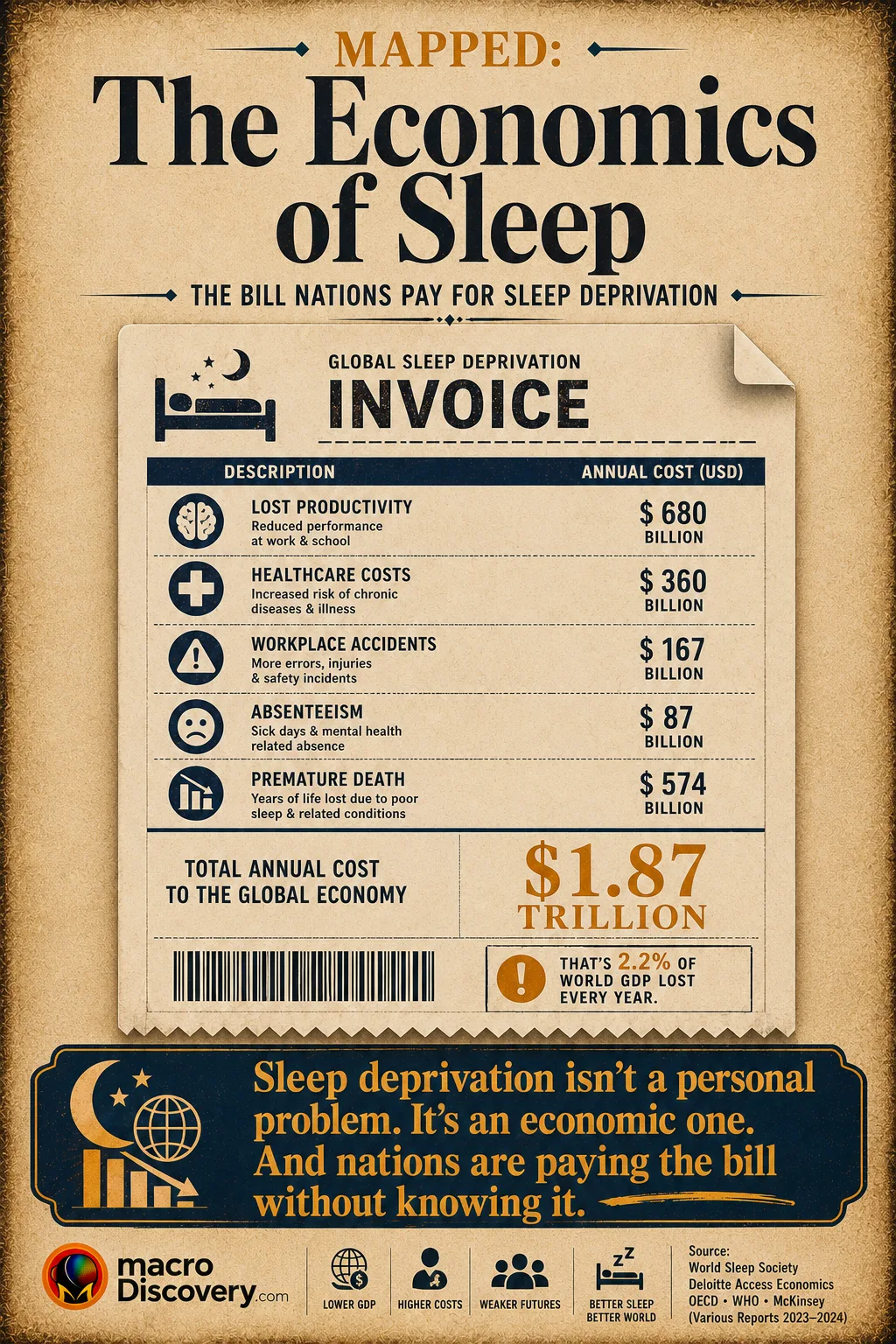
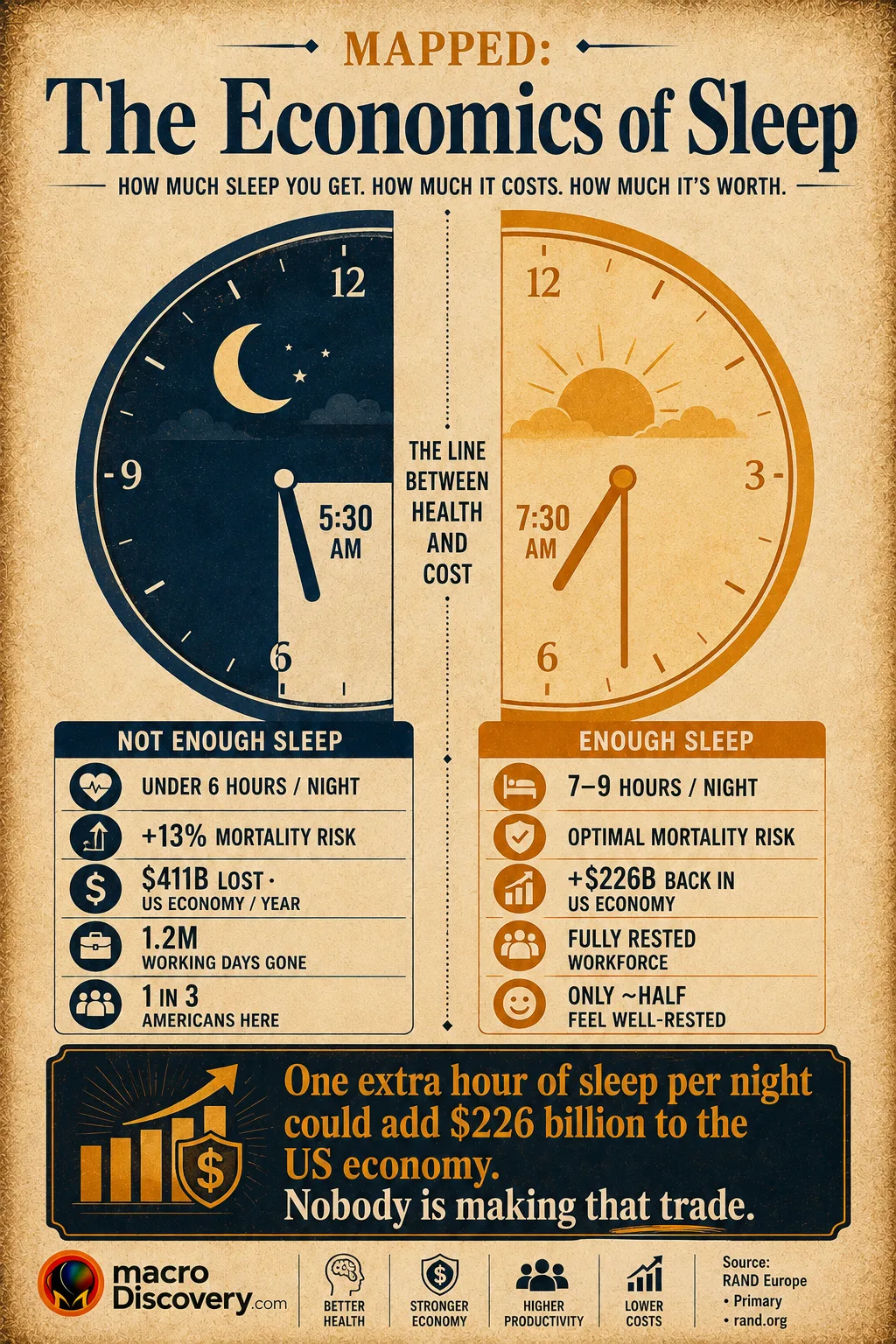
Sleep deprivation costs the US economy up to $411 billion every year — 2.28% of GDP. Across just five countries, $680 billion evaporates annually. A person sleeping under six hours a night has a 13% higher risk of dying earlier. And roughly one in three Americans doesn’t sleep enough. Here is what that actually costs.
Annual economic losses from insufficient sleep — GDP loss + productivity cost. Bars scaled to the US ($411B). Source: RAND Europe “Why Sleep Matters: Quantifying the Economic Costs of Insufficient Sleep” (primary · rand.org · directly fetched · published November 30, 2016 · 5-country OECD analysis). Note: 2016 study — the only comprehensive primary cross-country economic analysis of sleep deprivation.
Sleep deprivation is not a new problem. But it became an economic one slowly — and is only now being measured. Source: RAND Europe (primary) · CDC 2024 · NLM 2025.
Sleep is treated like a preference. The data says it is a necessity — and skipping it has a bill attached. RAND Europe’s landmark study, the only comprehensive cross-country economic analysis of sleep deprivation ever conducted, put that bill at $680 billion annually across five countries. The US alone loses $411 billion. And that is almost certainly an undercount: 80–90% of sleep disorders remain undiagnosed.
“Sleep deprivation is not a personal problem. It’s an economic one. The US loses up to $411 billion every year because people aren’t sleeping enough. That is a bill everyone pays.”
Japan Loses the Most as a Share of Its Economy — and Least Surprised
Japan loses up to 2.92% of its GDP to sleep deprivation — the highest proportion of any country in the RAND study. It also loses 600,000 working days per year. Japan has a word for working yourself to death: “karoshi.” It has another for sleeping in public as proof of dedication: “inemuri.” The country that built an entire culture around overwork is paying the highest proportional price for it. That is not a coincidence. It is cause and effect.
The Sleep Economy: People Are Finally Paying to Fix What Stress Broke
A century of overwork created the sleep deprivation crisis. Now a market is emerging to fix it. The broad “sleep economy” — mattresses, sleep apps, wearables, supplements, sleep coaching, and hotel sleep programs — surpassed $585 billion globally in 2025, with some estimates reaching $720 billion depending on scope. The treatment-focused market for sleep disorders (medical devices, diagnostics, prescription sleep aids) reached $30.46 billion in 2025 and is growing at 10% per year. People are spending more on sleep than on most leisure categories.