
AI vs Human Content in the Future
Is AI replacing human content?
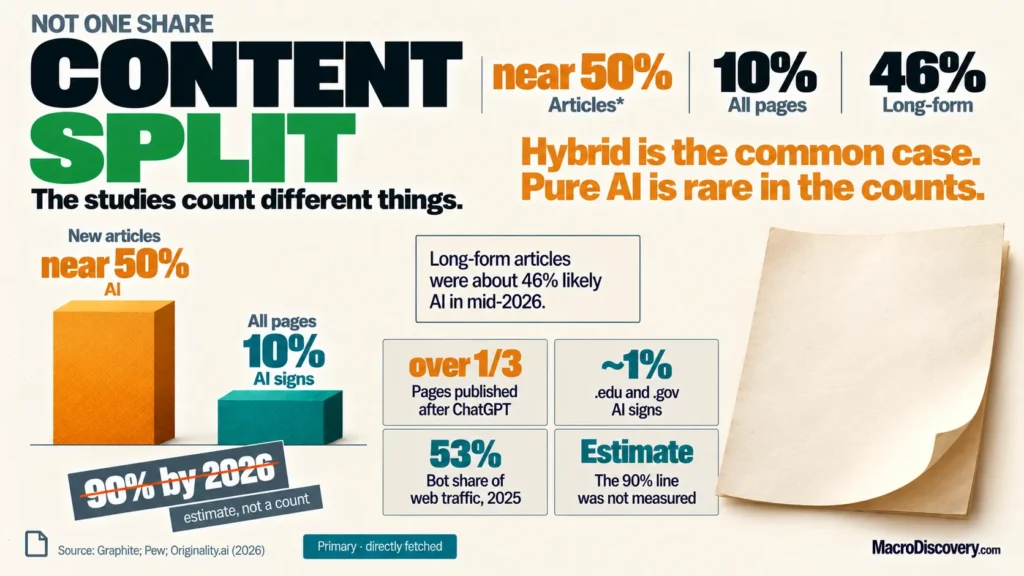
Ten percent of all webpages show significant signs of AI authorship. About half of newly published articles are primarily AI-generated. Most still get edited.
Three numbers
- 10% — share of all webpages in a recent sample that showed significant signs of AI authorship. Source: Pew Research.
- About 50% — share of newly published articles that are primarily AI-generated. Source: Graphite.
- 7% — share of AI-using marketers who publish content that is more than three-quarters pure unedited AI. Source: Ahrefs.
What the data shows
A common claim is that AI is replacing human content. The fact is that the share depends on what is counted. Pew Research examined a random sample of English-language webpages from Common Crawl and found that 10% showed significant signs of AI authorship. That is the whole web, including pages written years earlier. When the sample is limited to pages published after ChatGPT’s release in late 2022, the share rises to over one-third. The old web is still mostly human. The new web is mixed.
New articles are closer to even. Graphite’s analysis of article URLs found that the share of primarily AI-generated articles rose quickly after late 2022, reached about 48% within two years, and has plateaued near 50% since early 2025. In one quarter it briefly exceeded half, then settled back near half. Originality.AI’s sample of long-form articles put likely AI content at 45.6%. These are detector estimates on newly published articles. They are not a count of every page, and detectors have false positives and false negatives. A page that shows signs is not the same as a page that is entirely machine-written.
Most people who use AI still edit. An Ahrefs survey of AI-using marketers found that only 7% publish content that is more than three-quarters pure unedited AI material. Eighty-nine percent manually check what the tools produce. Fifty-seven percent still say human-written content is higher quality, down from 65% a year earlier. Twenty-four percent say AI content is better. The common path is a draft from a model and a human revision. Replacement would mean the human step disappears. The surveys show it has not.
The 10% is all pages of any age. The 50% is new articles. The 7% is marketers who publish mostly unedited AI.
| Count | Figure | What it is |
|---|---|---|
| All webpages | 10% | Significant AI signs. Pew |
| Post-ChatGPT pages | over one-third | Same study, newer pages only |
| New articles | about 50% | Primarily AI. Graphite |
| Long-form August | 45.6% | Likely AI. Originality.AI |
| Mostly unedited | 7% | AI-using marketers. Ahrefs |
How it was measured
Pew used a language model to look for patterns more common in AI text than in human text, on a random sample of pages. Graphite and Originality.AI used commercial detectors on article samples. A detector flags linguistic signals. It does not prove authorship, and it can miss edited text or flag human text. The Ahrefs figure is a survey of marketers who already use AI, not a count of all content.
A page of any age and a newly published article are different populations. The 10% and the 50% answer different questions. Neither is a traffic-weighted share of what people actually read.
What it means
It is settled that about 10% of all webpages show significant AI signs and that about half of new articles are primarily AI-generated by detector estimates. It is not settled that AI has replaced human content. Use 10% for the whole web. Use about 50% for new articles. Use 7% for mostly unedited output among AI-using marketers. Do not treat presence as replacement.
Common misreadings
- Ten percent of all pages is not half of all pages.
- About half of new articles is not replacement of the old web.
- Most marketers still edit. Pure unedited AI is a small share.
Where the numbers come from
How we built this
- Dataset: Pew webpage sample; Graphite article analysis; Ahrefs marketer survey.
- Scope: All pages kept apart from new articles. Detector estimates kept apart from pure unedited output.
- Figures: 10% is all pages. About 50% is new articles. 7% is mostly unedited. Replacement is treated as not shown.





I always find myself nodding along and agreeing with your wise words Your insights and advice are truly valuable
Your blog has helped me become a better version of myself Your words have inspired me to make positive changes in my life
What topics would you like to see covered in future posts? Let us know in the comments.
Your writing style is so engaging and easy to read It makes it a pleasure to read your blog and I always look forward to your new posts