Economics of Misinformation
False information spreads 6× faster than true information. Here is the business model behind it.
The 6× is a Twitter cascade to 1,500 people, from 2006 to 2017. It is not a law of every platform. The business is advertising.
Three numbers
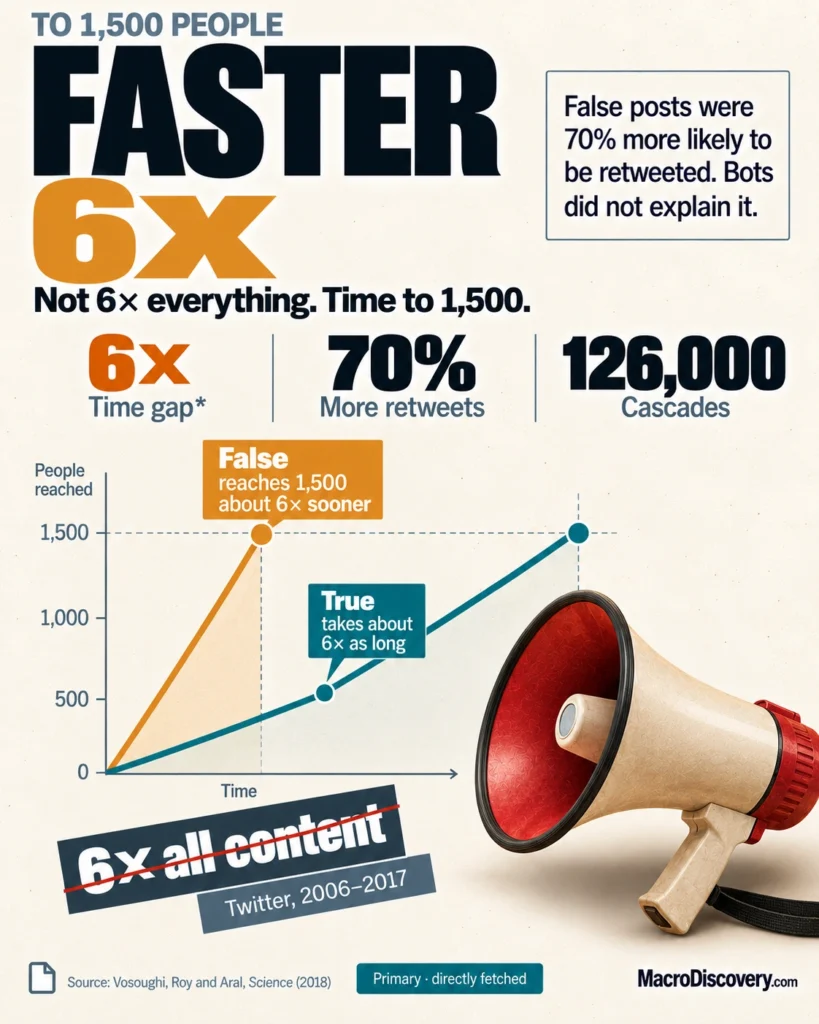
- About 6× — how much longer the truth took to reach 1,500 people, versus falsehood, on Twitter from 2006 to 2017. Source: Science.
- 70% — how much more likely a falsehood was to be retweeted than the truth, in the same study. Source: Science.
- 74% — share of misinformation websites in one sample supported by advertising, 2019 to 2021. Source: NBER.
What the data shows
A common claim is that false information spreads six times faster than true information, as a law of the internet. The fact is that the 6× is one measure, on one platform, from a closed decade. Vosoughi, Roy, and Aral, in Science in 2018, studied Twitter from 2006 to 2017. They found that falsehood took about a sixth as long as the truth to reach 1,500 people. Falsehoods were 70% more likely to be retweeted. The top 1% of false cascades reached between 1,000 and 100,000 people. The truth rarely passed 1,000. Novelty and emotion, especially surprise and disgust, drove the difference. Bots sped both sides about equally. Humans made the gap. The stories had been judged by fact-checkers. It was not every post, and it was not every app.
The business model is not the speed. It is the invoice. An NBER working paper found that 74% of misinformation websites in its sample were supported by advertising revenue between 2019 and 2021. A NewsGuard estimate cited there said that for every $2.16 of digital ad revenue sent to legitimate newspapers, advertisers sent $1 to misinformation sites. Platforms place those ads automatically across millions of sites. A brand does not have to choose the outlet. The exchange does it. The financial motive is widely conjectured. The paper’s point is that the supply is sustained by ads, and that cutting the ads is a supply-side lever, not only a user-side one.
The premium has not vanished. A European measurement by Science Feedback put the YouTube misinformation premium at about 11×: a low-credibility account received about eleven times more interactions per post than a high-credibility one of comparable size. About 81% of eligible low-credibility YouTube channels appeared monetized, against 90% of high-credibility ones. On Facebook the monetized share was 22% against 51%. The attention gap was wide. The monetization gap, on YouTube, was narrow. A 6× from a 2018 Twitter cascade and an 11× engagement premium on YouTube are different counts. Neither is a price. The price is the ad that rides the cascade.
This is time to 1,500 people on one platform. It is not a speed law for every app.
| Count | Figure | What it is |
|---|---|---|
| Time to 1,500 people | about 6× | Truth slower. Twitter, 2006–2017 |
| Retweet odds | 70% higher | Falsehood versus truth |
| Ad-supported sites | 74% | NBER sample, 2019–2021 |
| Ad flow | $1 per $2.16 | Misinfo sites vs newspapers. NewsGuard |
| YouTube premium | about 11× | Interactions per post. A different count |
How it was measured
The 2018 paper matched Twitter cascades to stories that fact-checkers had labeled true or false. Depth, size, and time-to-audience were the measures. The 6× is time for the truth to reach 1,500 people, relative to falsehood. A rumor that never reaches 1,500 is not in that ratio. Bots were separated and sped both sides.
The NBER sample is websites rated as misinformation, checked for ad support. The NewsGuard ratio is an industry estimate of ad dollars, not a census of every placement. The YouTube 11× is interactions per post for accounts of similar size, in a European measurement. Monetized means the public signals suggested ads were on. Platforms do not publish the invoice.
What it means
It is settled that, on Twitter from 2006 to 2017, falsehood reached 1,500 people about six times faster than the truth, and that ads sustain a large share of misinformation sites. It is not settled that 6× holds on every platform in 2026. Use 6× for that Twitter measure. Use 70% for the retweet gap. Use 74% for the ad-supported share in that sample. Do not treat the speed as the business model. The model is the ad.
Common misreadings
- 6× is time to 1,500 people on Twitter, 2006 to 2017. It is not every app.
- The business model is advertising. Speed is what the ad rides.
- An 11× engagement premium on YouTube is a different count from the 6×.
Where the numbers come from
How we built this
- Dataset: The 2018 Science Twitter study; an NBER sample of ad-supported misinformation sites; a European engagement measurement.
- Scope: The 6× kept as one platform and one audience size. Ads kept as the business model. The 11× kept as a different count.
- Figures: 6× is time to 1,500 people. 70% is the retweet gap. 74% is the ad-supported share. A universal speed law is treated as too wide.