The History of AI 1950 to 2026
The field is older than the product.
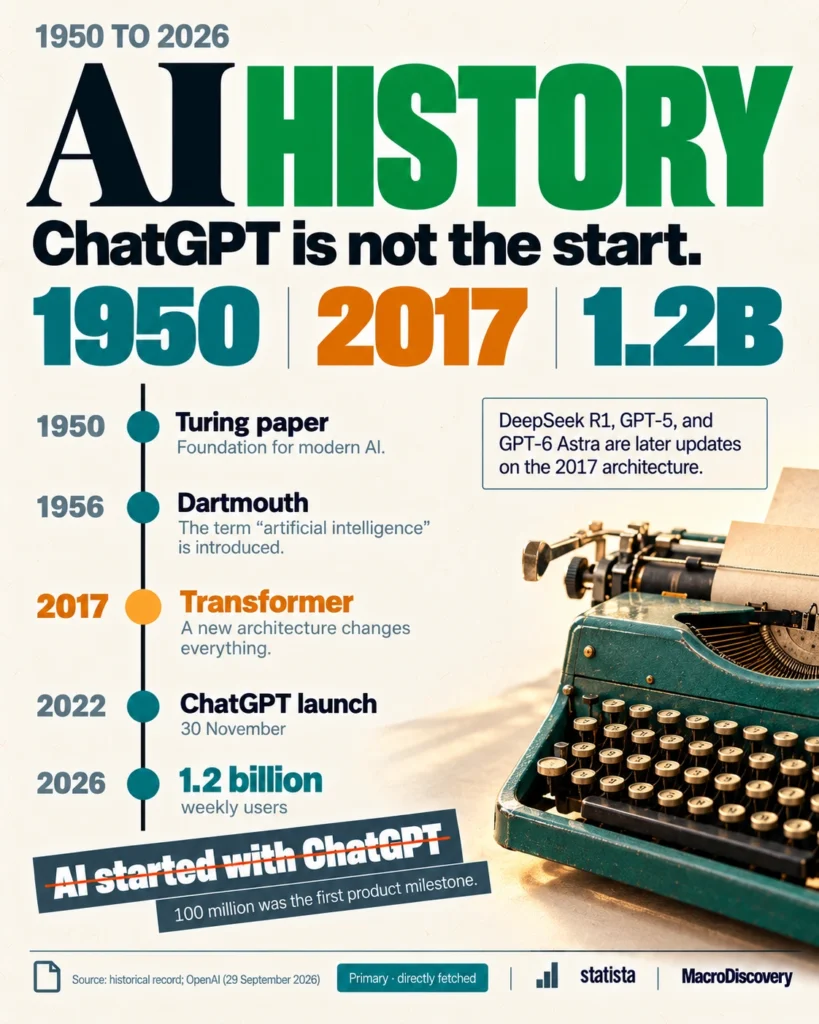
Turing’s paper is 1950. The term is 1956. The Transformer is 2017. ChatGPT is November 30, 2022. By September 2026 the same product had 1.2 billion weekly users.
Three dates
- 1950 — Alan Turing publishes Computing Machinery and Intelligence in Mind. Source: the paper.
- 2017 — Attention Is All You Need introduces the Transformer. Source: NeurIPS 2017.
- 1.2 billion — ChatGPT weekly users as of September 29, 2026. Source: OpenAI DevDay.
What the timeline shows
A common claim is that AI arrived with ChatGPT. The fact is that the field is older than the product. Alan Turing’s Computing Machinery and Intelligence appeared in Mind in 1950. The Dartmouth Summer Research Project in 1956, organized by John McCarthy, Marvin Minsky, Nathaniel Rochester, and Claude Shannon, is where the term artificial intelligence was coined. ChatGPT launched on November 30, 2022. By September 29, 2026, OpenAI said the same product reached 1.2 billion weekly users. The gap from the paper to the product is 72 years. The gap from the first 100 million users to 1.2 billion weekly users is under four years.
The path included two funding collapses. The Lighthill Report in 1973 and the subsequent cuts in the UK and the US mark the first AI winter. The collapse of the expert-systems market in the late 1980s marks the second. Researchers continued working through both. The 2012 ImageNet result, where Alex Krizhevsky, Ilya Sutskever, and Geoffrey Hinton’s AlexNet cut the top-5 error rate sharply, is the widely cited restart for deep learning. The 2017 paper Attention Is All You Need, by eight researchers then at Google, introduced the Transformer. Nearly every major language model since is built on that architecture.
Game milestones are verified but limited. IBM’s Deep Blue defeated Garry Kasparov in chess in 1997. DeepMind’s AlphaGo defeated Lee Sedol 4-1 in Go in March 2016. AlphaFold 2, in 2020, produced protein-structure predictions accurate enough that the CASP14 organizers and outside scientists treated it as a solution to a 50-year problem. Demis Hassabis and John Jumper shared the 2024 Nobel Prize in Chemistry for that work. Geoffrey Hinton and John Hopfield shared the 2024 Nobel Prize in Physics for foundational work on neural networks. These are verified events. They are not the same as a general intelligence that matches humans on every task. In January 2025 DeepSeek released R1, an open-weights reasoning model that matched frontier performance at a fraction of the reported training cost. In August 2025 OpenAI released GPT-5. In September 2026 it released GPT-6 Astra and reported 1.2 billion weekly ChatGPT users. Later model releases are product updates on the same architecture, not new fields.
Computing Machinery and Intelligence appears in Mind. The imitation game is proposed.
McCarthy, Minsky, Rochester, and Shannon convene the summer project. The term artificial intelligence is coined.
Joseph Weizenbaum’s program at MIT simulates a therapist by reflecting statements as questions.
The Lighthill Report and funding cuts in the UK and the US slow undirected AI research.
IBM’s system defeats Garry Kasparov in chess.
Krizhevsky, Sutskever, and Hinton win ImageNet with a deep convolutional network. Deep learning restarts.
DeepMind’s system defeats Lee Sedol 4-1 in Seoul.
Attention Is All You Need is published. The architecture behind later language models.
DeepMind’s system produces accurate protein-structure predictions at CASP14.
OpenAI launches the chat interface on November 30. About 100 million users in two months.
Hassabis and Jumper share the Chemistry prize for AlphaFold. Hinton and Hopfield share the Physics prize for neural-network foundations.
DeepSeek releases R1 in January, an open-weights reasoning model at a fraction of frontier cost. OpenAI releases GPT-5 in August.
OpenAI releases GPT-6 Astra in September. At DevDay on September 29 it reports 1.2 billion weekly ChatGPT users.
Dates are verified from primary papers, competition results, company announcements, and Nobel citations. Later model releases are product updates, not new fields.
How the dates were checked
Each milestone is tied to a primary source: a paper, a competition result, a company announcement, or a Nobel citation. The 100-million-user figure for ChatGPT is widely reported and accepted. The 1.2 billion weekly figure is OpenAI’s own statement at DevDay on September 29, 2026. Both measure product adoption, not research progress. The winters are dated from the funding cuts that followed the Lighthill Report and the expert-systems collapse, not from a single calendar day.
A timeline of products is not a timeline of the field. GPT-4, GPT-5, GPT-6, Claude, Gemini, and DeepSeek R1 are releases built on the Transformer architecture and on the data and compute available after 2017. They are real. They are not the start of the story.
What it means
It is settled that the field is dated to 1956, that the Transformer paper is 2017, and that ChatGPT launched on November 30, 2022. It is settled that OpenAI reported 1.2 billion weekly users on September 29, 2026. It is not settled that any single system is general intelligence. Use 1950 for Turing’s paper. Use 1956 for the name. Use 2017 for the architecture. Use November 30, 2022 for the product launch. Use 1.2 billion for the September 2026 weekly figure. Do not treat either user number as the start of the field.
Common misreadings
- ChatGPT is a product from 2022. The field is from 1956.
- The Transformer paper is 2017. Later models are built on it.
- Game wins and protein predictions are verified. They are not general intelligence.
Where the dates come from
How we built this
- Dataset: Primary papers, competition results, company announcements, and Nobel citations for the dates listed.
- Scope: Field milestones kept separate from product launches. Winters dated from funding cuts. Game and protein results treated as domain-specific. 2025–2026 model releases treated as product updates.
- Figures: 1950 is Turing. 1956 is the name. 2017 is the Transformer. November 30, 2022 is ChatGPT. 1.2 billion is the September 2026 weekly figure. Neither user number is the start of the field.