How Supermarkets Work
How supermarkets operate on thin margins and high turnover.
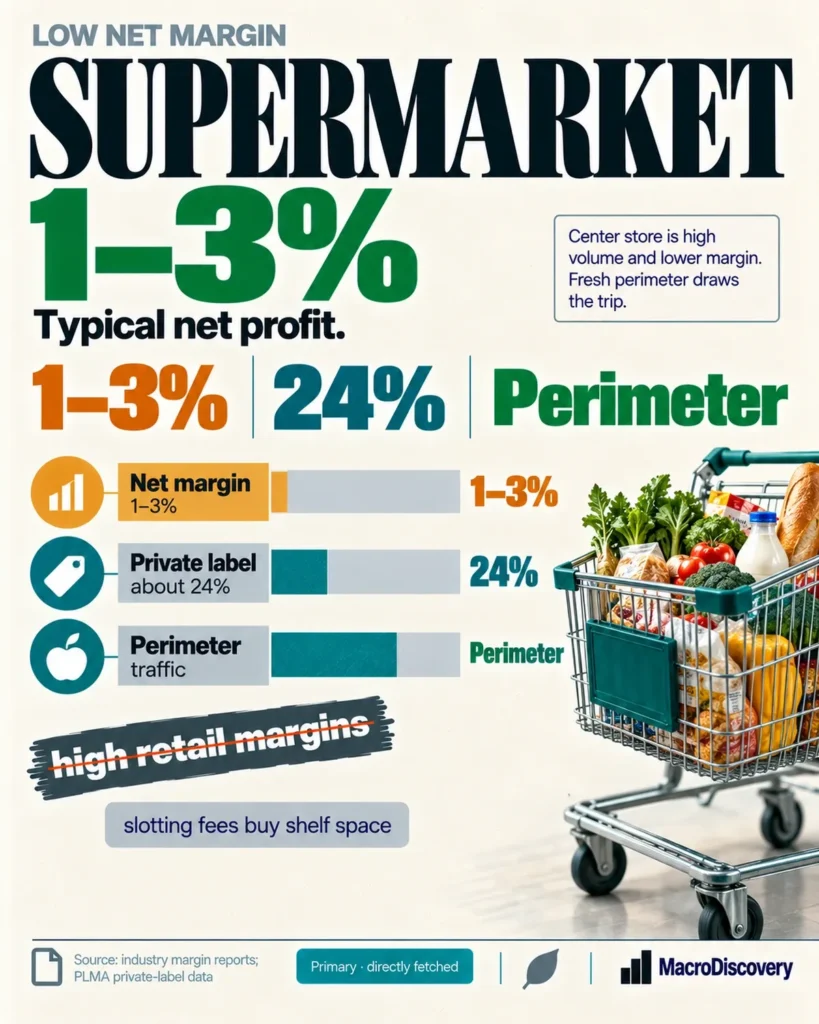
Supermarkets run on thin net margins of about 1–3%. They turn inventory roughly 12–16 times a year. Gross margins sit in the high 20s. Volume and speed, not high markups, make the business work.
Three numbers
- ~2% — typical net profit margin for grocery retailers. Source: FMI and industry surveys.
- 12–16x — typical annual inventory turnover. Roughly 23–30 days of stock on hand. Source: company filings and NGA studies.
- ~28% — typical gross margin. Source: Census and industry benchmarks.
What the data shows
A common claim is that supermarkets make large profits on every item. The fact is that net profit margins for grocery retailers typically run about 1–3% of sales. After the cost of goods, labor, rent, utilities, shrink and other operating costs, only a few cents remain from each dollar. Gross margins sit in the high 20s — roughly 25–29%. The difference between gross and net is consumed by operations. The business works because of volume and speed, not because of high markups on individual products.
Inventory turns roughly 12–16 times a year for a typical supermarket. That is about 23–30 days of stock on hand across the store. Fresh departments turn much faster: produce and meat can cycle in under a week. Centre-store dry goods sit longer, often 20–30 days. High turnover means the store converts its inventory investment into cash quickly. A low net margin multiplied by high volume and fast turns produces a workable return. Slow turns would tie up cash and increase spoilage risk.
Shelf space is scarce. Many retailers charge manufacturers slotting fees or free-fill requirements to place new products. These fees help allocate limited space and share the risk of new-item failure. Department margins vary widely — prepared foods and bakery often carry higher gross margins than centre-store grocery, but also higher labor and shrink. The supermarket is several businesses under one roof. The overall economics depend on the mix of high-turn fresh items and lower-turn packaged goods, plus the ability to keep operating costs tightly controlled. Thin net margins are the structural result of competition and perishability, not a sign of inefficiency alone.
| Metric | Typical range |
|---|---|
| Net profit margin | 1–3% |
| Gross margin | High 20s % |
| Inventory turns | 12–16x per year |
| Days of inventory | ~23–30 days |
Net and gross margin ranges from FMI, NGA and Census benchmarks. Inventory turns from public company filings and independent grocer studies. Slotting fees are a common industry practice for shelf allocation.
How it was measured
Net and gross margins come from industry surveys (FMI, NGA) and Census retail data. Inventory turnover is calculated from cost of goods sold divided by average inventory, reported in company filings and industry studies. The claim of large per-item profits is contradicted by the consistent finding of 1–3% net margins across the sector.
What it means
It is settled that grocery net margins typically run about 1–3%, that gross margins sit in the high 20s, and that inventory turns roughly 12–16 times a year. It is settled that the business depends on volume and speed. It is not settled that every store or department matches the average — fresh departments turn faster and carry different margins. Use ~2% for net margin. Use 12–16x for turns. Do not treat thin net margins as evidence of large hidden profits on individual items.
Common misreadings
- Supermarkets do not make large profits on every item. Net margins are typically 1–3%.
- High volume and fast inventory turns, not high markups, make the business work.
- Gross margin and net margin are different. Most of the gross is consumed by operating costs.
Where the numbers come from
How we built this
- Dataset: FMI and NGA industry surveys, public company filings, Census retail data.
- Scope: Typical supermarket economics. Net versus gross margin. Inventory turnover. Role of volume and slotting.
- Figures: ~2% net margin. 12–16x turns. ~28% gross margin. Thin margins are structural.