Science of Nutrition Labels
How nutrition labels work and what the numbers actually mean.
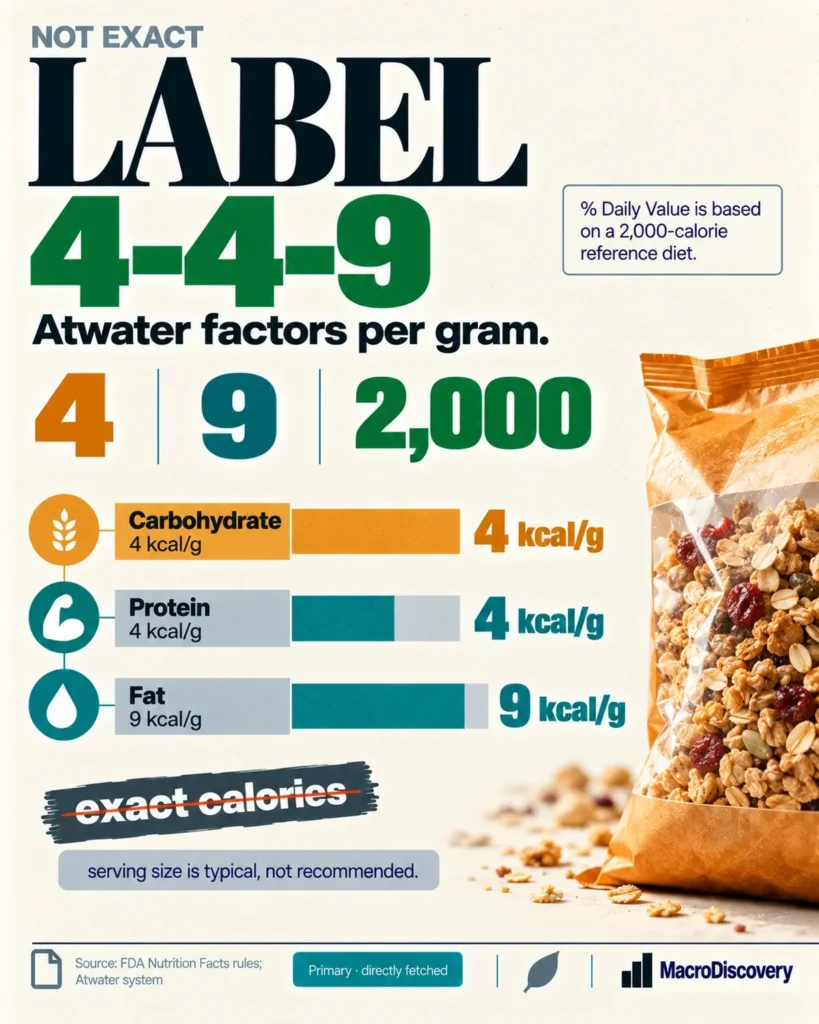
Nutrition labels show values per serving, not per package. Serving size is based on what people typically eat, not a recommendation. Percent Daily Value is calculated against a 2,000-calorie reference diet. 5% or less is low. 20% or more is high.
Three numbers
- 2,000 calories — the reference diet used to calculate Percent Daily Value. Not a personal target. Source: FDA.
- 5% or less / 20% or more — the rule for reading %DV. Low and high respectively. Source: FDA.
- Per serving — every calorie and nutrient number on the label is for one serving, not the whole package. Source: FDA.
What the data shows
A common claim is that the serving size on a nutrition label is a recommendation of how much you should eat. The fact is that serving size is set by law to the amount people typically consume in one sitting — the Reference Amount Customarily Consumed. It is a reference point for comparison, not dietary advice. Every number on the label — calories, fat, sodium, %DV — is listed for that single serving. If a package has four servings and you eat the whole package, you multiply every number by four.
Percent Daily Value shows how much one serving contributes to a total daily diet based on a 2,000-calorie reference. The 2,000-calorie figure is a general yardstick, not a personal calorie target. Individual needs vary by age, sex, size and activity. The practical reading rule is simple: 5% DV or less of a nutrient per serving is considered low. 20% DV or more is considered high. This lets you compare products without calculating from scratch. Added sugars, fiber, vitamin D, calcium, iron and potassium are among the nutrients now required in gram or microgram amounts as well as %DV.
Calories on the label come from the energy-yielding nutrients: roughly 4 calories per gram of carbohydrate or protein and 9 calories per gram of fat. The label lists the total for one serving after rounding according to FDA rules. Serving sizes themselves were updated to reflect what people actually eat — for example, ice cream moved from ½ cup to ⅔ cup and soda from 8 to 12 ounces. The science of the label is therefore about standardized reference amounts, per-serving arithmetic, and a fixed 2,000-calorie scale for %DV. It is not personal advice and it is not the whole package.
| Element | What it is |
|---|---|
| Serving size | Typical amount eaten, not a recommendation. All numbers are for this amount. |
| Calories | Energy in one serving. Multiply by servings eaten. |
| %DV | Share of a 2,000-calorie reference diet. 5% low, 20% high. |
| 2,000 calories | Reference scale for %DV. Not a personal target. |
Rules from FDA Nutrition Facts label guidance. Serving sizes based on Reference Amounts Customarily Consumed. %DV calculated against Daily Values for a 2,000-calorie diet.
How it was measured
Serving sizes are set from FDA Reference Amounts Customarily Consumed for each food category and expressed in household measures with metric equivalents. %DV is the nutrient amount in one serving divided by its Daily Value, rounded to the nearest percent. Daily Values are reference amounts to consume or not exceed, based on a 2,000-calorie diet. The claim that serving size is a recommendation is contradicted by the regulatory definition.
What it means
It is settled that every number on a nutrition label is for one serving, that serving size is based on typical consumption rather than a recommendation, and that %DV uses a 2,000-calorie reference. It is settled that 5% or less is low and 20% or more is high. It is not settled that the 2,000-calorie figure matches any individual. Use the serving size first. Multiply if you eat more than one. Use the 5/20 rule for %DV. Do not treat the serving size as advice on how much to eat.
Common misreadings
- Serving size is not a recommendation of how much you should eat.
- All numbers are per serving. Eating the whole package requires multiplication.
- The 2,000-calorie figure is a reference scale for %DV, not a personal calorie target.
Where the numbers come from
How we built this
- Dataset: FDA Nutrition Facts label rules and Daily Values.
- Scope: Per-serving basis. Serving size as RACC, not recommendation. %DV against 2,000-calorie reference. 5/20 rule.
- Figures: 2,000 calories is the reference. 5% or less is low. 20% or more is high. All values are per serving.