How Earthquakes Work
The ground moves several centimeters every year. Here is why the Earth shakes.
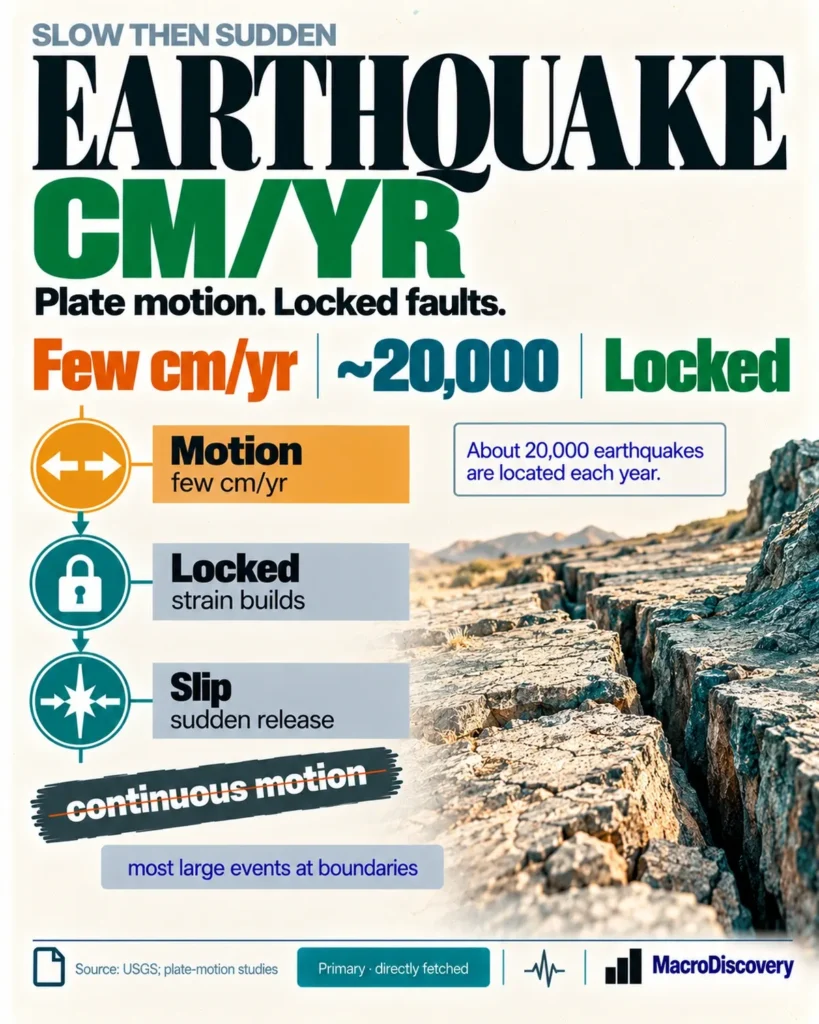
Tectonic plates move a few centimeters a year. Friction locks their edges so elastic strain builds for years or centuries, then releases suddenly as seismic waves. USGS data show roughly 500,000 detectable earthquakes worldwide each year.
Three numbers
- ~5 cm per year — typical relative motion of the Pacific and North American plates along the San Andreas Fault (about 2 inches/year). Source: USGS.
- ~500,000 — estimated detectable earthquakes worldwide each year. About 100,000 can be felt; roughly 100 cause damage. Source: USGS.
- Elastic rebound — the process by which stored strain is released when locked faults rupture. Source: Harry Fielding Reid after the 1906 San Francisco earthquake; still the standard model.
What the data shows
A common claim is that the ground is essentially static until an earthquake suddenly occurs. The fact is that Earth’s outer shell is broken into roughly a dozen major tectonic plates that move continuously at rates of a few centimeters per year. The USGS describes the Pacific Plate grinding northwestward past the North American Plate along the San Andreas Fault at about two inches (roughly 5 cm) per year. Other boundaries range from under 1 cm per year to more than 15 cm per year at the fastest spreading ridges. This slow motion is comparable to the growth of fingernails.
At plate boundaries the edges do not slide smoothly. Friction locks them while the rest of each plate keeps moving, so elastic strain accumulates in the rock for years, decades or centuries. When the stress exceeds the strength of the lock, the rocks rupture and snap back toward their unstressed shape. This sudden release — the elastic-rebound theory formulated by Harry Fielding Reid after the 1906 San Francisco earthquake — radiates seismic waves that shake the ground. Most of the world’s earthquakes occur at these boundaries: convergent (subduction) zones produce the largest events, transform faults such as the San Andreas produce shallow strike-slip quakes, and divergent ridges produce frequent but generally smaller events.
The measured pattern is continuous slow motion interrupted by abrupt releases. The USGS estimates roughly 500,000 detectable earthquakes worldwide each year. Of those, about 100,000 can be felt and roughly 100 cause damage. The National Earthquake Information Center locates about 20,000 annually. Long-term averages are approximately one magnitude 8 or larger and about 15 magnitude 7s per year. Each step up in magnitude corresponds to roughly ten times fewer events and about 30 times more energy. The ground moves several centimeters every year because the plates never stop; the Earth shakes when the accumulated strain is suddenly released.
| Element | What the data shows |
|---|---|
| Plate motion (San Andreas example) | ~5 cm/yr (~2 inches/yr) |
| Typical plate speeds worldwide | A few cm/yr (range ~1–15+ cm/yr) |
| Detectable earthquakes per year | ~500,000 (USGS estimate) |
| Mechanism of shaking | Elastic rebound after strain buildup |
Plate rates from USGS descriptions of the San Andreas and global plate-motion measurements. Earthquake frequency from USGS long-term statistics. Elastic rebound from Reid’s analysis of the 1906 San Francisco earthquake, still the accepted model.
How it was measured
Plate velocities are measured by GPS, satellite geodesy and geologic offsets. The USGS reports the San Andreas average rate of about 56 mm/yr over the past three million years, consistent with the roughly 2-inch-per-year figure commonly cited. Earthquake counts come from the USGS National Earthquake Information Center catalog and long-term frequency tables. The elastic-rebound mechanism was derived from geodetic observations of the 1906 San Francisco earthquake and remains the standard explanation for tectonic earthquakes.
How we built this
- Dataset: USGS plate-motion descriptions and earthquake frequency statistics. Elastic-rebound theory literature.
- Scope: Tectonic plate motion, strain accumulation at locked faults, and sudden release as seismic waves.
- Figures: ~5 cm/yr San Andreas motion. ~500,000 detectable quakes per year. Elastic rebound.