How Satellites Work
How satellites stay in orbit, generate power, and do their jobs.
About 17,000 active satellites orbit Earth. Most are in low Earth orbit and complete a lap in about 90 minutes. Geostationary satellites sit at 35,786 km and match Earth’s rotation. Power comes from solar panels and batteries.
Three numbers
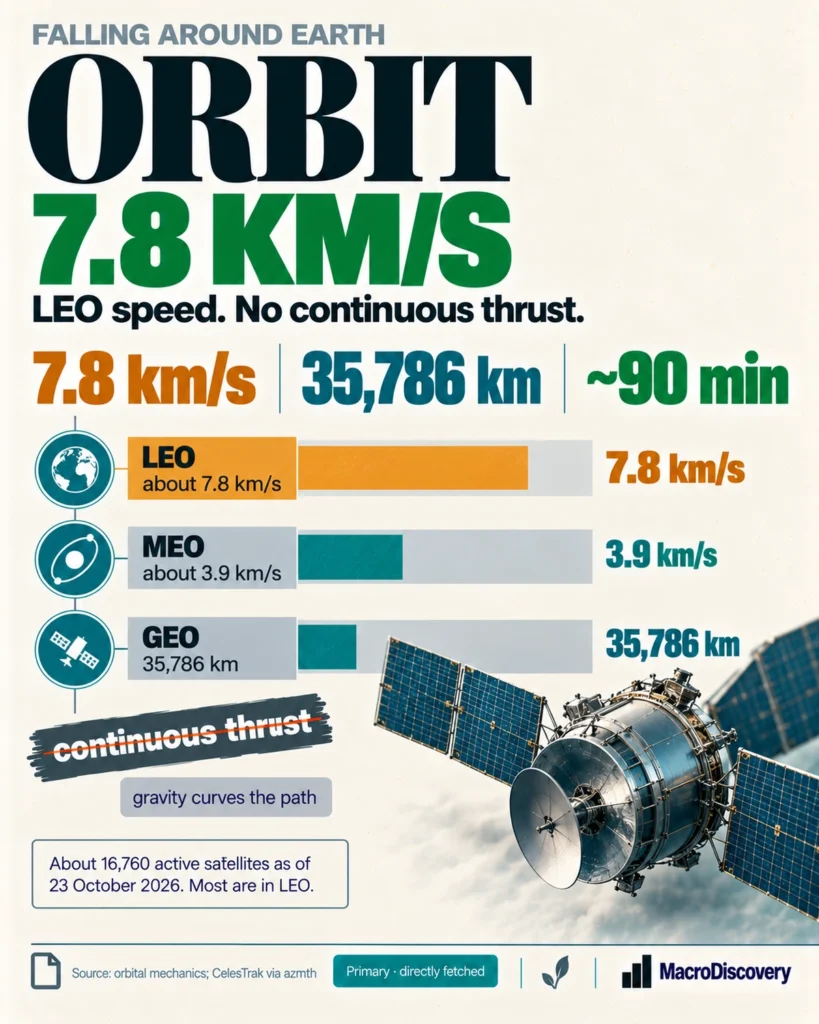
- ~17,000 — active satellites in Earth orbit as of late 2026. Source: CelesTrak-based catalogs.
- ~90 minutes — time for one low Earth orbit lap. Source: NASA / orbital mechanics.
- 35,786 km — altitude of geostationary orbit. Source: standard orbital parameters.
What the data shows
A common claim is that satellites float in space or that they need continuous thrust to stay aloft. The fact is that a satellite is in free fall around Earth. Its sideways speed matches the curve of the planet, so it falls around Earth instead of into it. No continuous thrust is required to stay in a stable orbit. Thrust is used only for station-keeping, attitude control and end-of-life disposal. About 17,000 active satellites are in orbit. The large majority are in low Earth orbit.
Low Earth orbit runs from roughly 200 km to 2,000 km. A typical lap takes about 90 minutes. The International Space Station orbits near 400 km and completes a circuit in roughly that time. Medium Earth orbit, around 20,000 km, is used mainly by navigation constellations such as GPS. Geostationary orbit is exactly 35,786 km above the equator. At that altitude the orbital period matches one sidereal day, so the satellite appears fixed over one point on Earth. Three GEO satellites can cover most of the planet for communications and weather.
Power comes from solar arrays and batteries. In sunlight the panels generate electricity and charge the batteries. In Earth’s shadow the batteries carry the load. A low Earth orbit satellite enters shadow on nearly every orbit — roughly 16 times a day — so its batteries cycle thousands of times. A GEO satellite sees continuous sunlight except during two short eclipse seasons near the equinoxes. The bus holds the structure, power system, attitude control, thermal control and communications. The payload does the mission — imaging, communications, navigation timing or science. The satellite works because orbital mechanics keep it falling around Earth and solar power keeps its electronics alive.
| Orbit | Altitude | Period | Typical use |
|---|---|---|---|
| LEO | 200–2,000 km | ~90 min | Imaging, broadband, ISS |
| MEO | ~20,000 km | ~12 hours | Navigation (GPS, Galileo) |
| GEO | 35,786 km | 24 hours | TV, weather, fixed links |
Active satellite count from CelesTrak-based catalogs as of late 2026. Orbital altitudes and periods are standard values. Solar power and battery cycling described from spacecraft power subsystem literature.
How it was measured
Active satellite counts come from public catalogs derived from CelesTrak orbital elements. Orbit altitudes and periods follow standard Keplerian mechanics. Power system behaviour is from spacecraft engineering literature on solar arrays and battery cycling in LEO versus GEO. The “satellites float” claim is contradicted by orbital mechanics: they are in continuous free fall around Earth.
What it means
It is settled that about 17,000 active satellites are in orbit, that most are in low Earth orbit, that a LEO lap takes about 90 minutes, and that GEO is at 35,786 km. It is settled that solar panels plus batteries power most Earth-orbiting satellites. It is not settled that every satellite uses the same power architecture or that the active count is static. Use ~17,000 for the active count. Use ~90 minutes for a LEO period. Use 35,786 km for GEO. Do not treat satellites as floating or as requiring continuous thrust to stay up.
Common misreadings
- Satellites do not float. They are in continuous free fall around Earth.
- Most satellites are in low Earth orbit, not geostationary orbit.
- Power comes from solar panels and batteries. Continuous sunlight is not available in LEO.
Where the numbers come from
How we built this
- Dataset: CelesTrak-derived catalogs for active counts. Standard orbital parameters for altitudes and periods. Spacecraft power literature for solar and battery operation.
- Scope: Earth-orbiting operational satellites. Free-fall orbital mechanics. Distinction between LEO, MEO and GEO. Power subsystem behaviour in sunlight and shadow.
- Figures: ~17,000 is the late-2026 active count. ~90 minutes is a typical LEO period. 35,786 km is the GEO altitude. Solar panels and batteries power the bus and payload.