How Book Publishing Works
Most books sell fewer than 1,000 copies. Here is how the publishing industry actually functions.
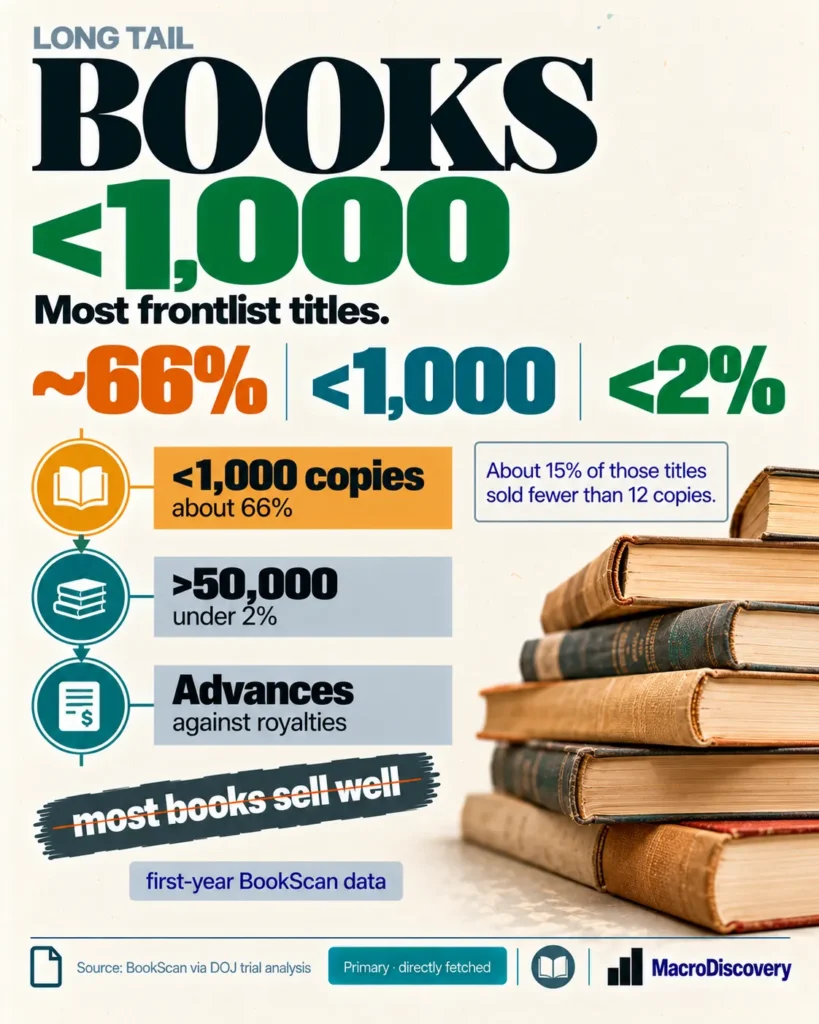
Most books sell modestly. NPD BookScan data on top-publisher frontlist titles showed roughly 66 percent sold fewer than 1,000 copies in 52 weeks. Publishing operates on a blockbuster model in which a few hits cover the costs of the many. Advances are against royalties and often are not earned out.
Three numbers
- ~66 percent — share of frontlist titles from the top ten U.S. trade publishers that sold fewer than 1,000 copies in a 52-week BookScan window. Source: NPD BookScan analysis by Kristen McLean.
- Blockbuster model — a small number of successful titles generate most profit and subsidize the many that sell modestly. Source: industry structure documented in BookScan and publisher reporting.
- Advances often not earned out — many books never generate enough royalties to exceed the advance. The author keeps the advance regardless. Source: industry estimates of earn-out rates.
What the data shows
A common claim is that a published book will sell tens of thousands of copies. The fact is that most titles sell far fewer. NPD BookScan (now Circana) tracks point-of-sale data from the majority of U.S. print retail. In an analysis of frontlist (new) titles from the top ten trade publishers over a 52-week period, roughly 66 percent sold fewer than 1,000 copies. About 15 percent sold fewer than 12 copies. Only a small fraction — under 2 percent — sold more than 50,000. These figures are for print retail sales in that window; lifetime totals across all formats can be higher, but the distribution remains highly skewed. Viral claims that half of all books sell fewer than a dozen copies overstated the data; the clearer measured result is that the large majority of even professionally published frontlist titles sell modestly.
The industry runs on a blockbuster model. Publishers acquire many titles, knowing that most will not sell large numbers. A small number of hits — the ones that reach bestseller lists or sustained demand — generate the bulk of revenue and profit. These successes cover the fixed costs of editing, design, printing, distribution and marketing for the wider list. Advances are payments against future royalties. Standard royalty rates for hardcover are often in the 10–15 percent range of list price, with lower rates for paperback and varying terms for ebooks. Many books never earn out their advance, meaning the author receives no additional royalty checks. The advance is not repaid if sales fall short; the risk sits with the publisher. Print books are sold on a returnable basis to bookstores, so publishers hold reserves against returns and net sales are lower than shipments.
The measured pattern is therefore one of extreme concentration. Total industry revenue is large — Association of American Publishers figures put U.S. publishing sales in the low-to-mid tens of billions of dollars — but it is concentrated in a minority of titles. The economics of any single book depend on its advance, print run, returns, marketing support and whether it becomes one of the few that sell well. Most published books sell fewer than 1,000 copies in their first year of retail tracking. The industry continues because the hits are large enough to subsidize the rest.
| Element | What the data shows |
|---|---|
| Frontlist sales (top 10 publishers, 52 weeks) | ~66% under 1,000 copies |
| Business model | Blockbuster — few hits subsidize many |
| Advances | Against royalties; many never earn out |
| Returns | Print books are returnable; net sales lower than shipments |
Sales distribution from NPD BookScan analysis of top-publisher frontlist (Kristen McLean). Blockbuster structure and advance/earn-out practice from industry reporting and publisher P&L norms. AAP data for overall industry scale.
How it was measured
BookScan collects point-of-sale data from retailers covering the large majority of U.S. print sales. The 66 percent figure is from an analysis of frontlist ISBNs from the top ten trade publishers over 52 weeks. Industry practice on advances and returns is documented in publisher contracts and reporting. The claim that most books sell large numbers is contradicted by the measured distribution.
What it means
It is settled that most frontlist titles from major publishers sell fewer than 1,000 copies in a given year of retail tracking. It is settled that publishing operates on a blockbuster model. It is settled that many advances are not earned out and that print books are returnable. It is not settled that every book’s lifetime total is under 1,000 — backlist and multi-format sales can add up, and self-published titles have different distributions. Use the BookScan frontlist distribution as the measured baseline for traditional trade publishing. Do not treat a published book as guaranteed large sales.
Common misreadings
- Most books do not sell tens of thousands of copies. The majority sell far fewer.
- An advance is not free money beyond royalties. It is an advance against them, and many books never earn out.
- The industry is not broken because most titles sell modestly. That is the measured structure of the business.
Where the numbers come from
How we built this
- Dataset: NPD BookScan frontlist analysis. Industry reporting on advances, earn-out rates and returns. AAP industry sales totals.
- Scope: Traditional trade publishing sales distribution. Blockbuster economics. Advance and royalty mechanics.
- Figures: ~66% under 1,000 copies. Blockbuster model. Advances often not earned out.