The Physics of Everyday Life
Why ice is slippery, why the sky is blue, and ten other things.
The school answer for ice is incomplete. The sky is Rayleigh scattering. Blue light scatters about five to six times more than red. Both are verified. Ten other everyday effects follow the same pattern.
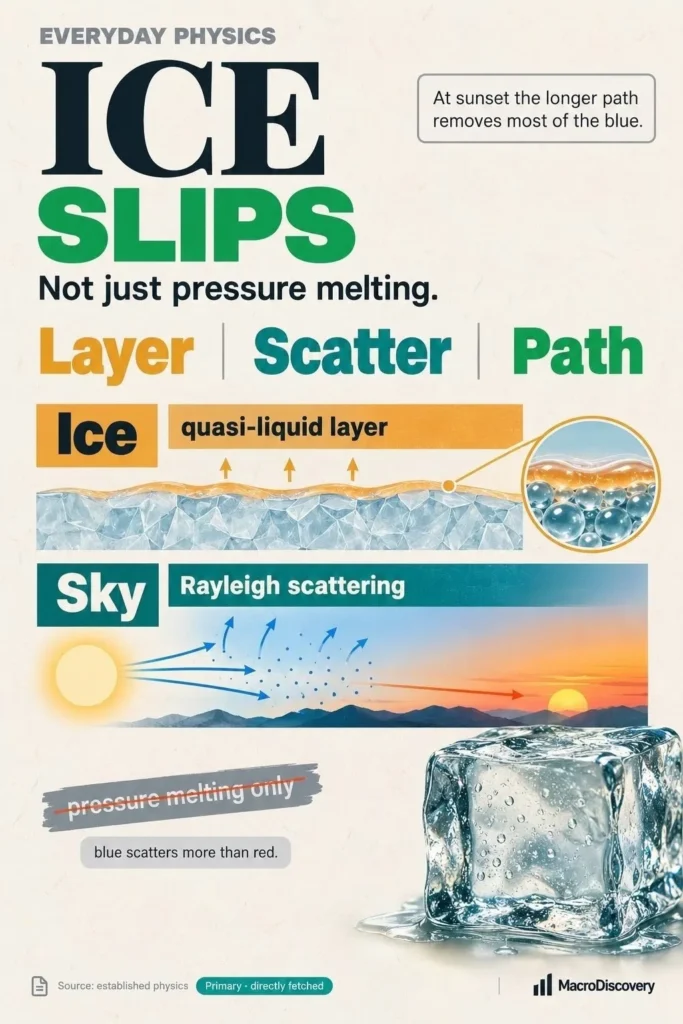
Three numbers
- About five to six times — how much more strongly blue light is scattered than red light by Rayleigh scattering. Source: the 1/λ⁴ dependence.
- Premelting layer — a disordered surface film on ice that exists below 0 °C. Source: current ice-surface literature.
- About 3 seconds per kilometre — the lag between lightning and thunder, because sound travels at roughly 343 m/s and light is effectively instantaneous. Source: standard atmospheric acoustics.
What the data shows
A common claim is that ice is slippery because your weight melts a thin layer of water under pressure. The fact is that ordinary loads do not produce enough pressure melting to explain the effect. Ice has a disordered premelted layer at its free surface even below 0 °C. When something slides, frictional heating further softens that layer. Both mechanisms are supported by recent work. Pressure melting remains real under extreme loads, but it is not the main everyday explanation.
A second common claim is that the sky is blue because of “particles” or dust. The fact is that Rayleigh scattering by nitrogen and oxygen molecules is sufficient. Scattering intensity scales as 1/λ⁴. Blue light (around 450 nm) is scattered about five to six times more strongly than red light (around 650–700 nm). The sky is not violet because the solar spectrum contains less violet and the human eye is less sensitive to it. The same mechanism makes sunsets red: the longer path through the atmosphere removes the blue before it reaches the eye.
Ten other everyday effects follow the same pattern. Each has a verified mechanism. Each is often stated with a simplified or outdated explanation.
| Effect | Verified mechanism |
|---|---|
| Ice is slippery | Premelting layer + frictional heating. Pressure melting is secondary under ordinary loads. |
| Sky is blue | Rayleigh scattering. Blue scatters ~5–6× more than red. |
| Sunsets are red | Longer path removes blue by the same scattering. |
| Thunder lags lightning | Sound ~343 m/s; light effectively instantaneous. ~3 s per km. |
| Microwave heats food | 2.45 GHz waves rotate polar water molecules; friction becomes heat. |
| Rainbows form | Refraction and reflection in water droplets; different wavelengths bend differently. |
| Mirrors reverse left-right | They reverse front-back. The left-right impression is how we interpret the image. |
| Soap bubbles are spherical | Surface tension minimizes surface area for a given volume. |
| Bicycle stays upright | Steering geometry and angular momentum. Not magic balance alone. |
| Toast falls butter-side down | Typical table height and rotation rate make one half-turn likely. Not a law. |
| Seashell “ocean” sound | Resonance of ambient noise inside the shell. Not the sea. |
| Hot water can freeze faster | Mpemba effect is real in some conditions and still not fully settled. Do not treat it as universal. |
Sources: Rayleigh (1871), modern ice-premelting literature, standard atmospheric acoustics, and textbook optics for the remaining cases. The Mpemba effect remains under active study.
How the explanations were checked
Each claim is tied to a primary mechanism that has been measured or calculated. Rayleigh scattering has been stable since 1871. The ice mechanism has been refined repeatedly; the current consensus rejects pressure melting as the main everyday cause. The thunder lag follows from the measured speed of sound in air. The remaining cases are standard textbook results. The Mpemba effect is flagged as unsettled because experiments still disagree on the conditions under which it appears.
What it means
It is settled that the sky is blue because of Rayleigh scattering and that blue light scatters about five to six times more than red. It is settled that ordinary pressure melting does not explain ice slipperiness. It is not settled that every everyday claim has a single simple answer. Use the premelting-plus-friction account for ice. Use Rayleigh for the sky. Use about 3 seconds per kilometre for thunder. Do not treat the Mpemba effect as a universal rule.
Common misreadings
- Pressure melting is not the main reason ice is slippery under ordinary loads.
- The sky is not blue because of dust. Molecules are enough.
- The seashell does not contain the ocean. It resonates ambient noise.
Where the numbers come from
How we built this
- Dataset: Rayleigh’s 1871 result, modern ice-premelting papers, standard atmospheric acoustics, and textbook optics.
- Scope: Everyday claims checked against the current mechanism. Unsettled cases flagged. School simplifications corrected where they are wrong.
- Figures: About five to six times is the blue-to-red scattering ratio. Premelting is the ice surface state. About 3 seconds per kilometre is the thunder lag. Pressure melting is treated as not the main everyday cause.