The Economics of Coffee
How a $4 cup travels across continents.
The farmer’s share of retail is a few percent. Beans are grown in the tropics, shipped green to Europe or North America for roasting, and sold on a third or fourth continent. The $4 price is mostly downstream.
Three numbers
- 3–10% — typical farmer share of the final retail price in commodity chains. Source: Coffee Barometer 2026 and industry estimates.
- Roughly half — the share of global production from Brazil and Vietnam together. Source: Trase / USDA.
- 3 or 4 continents — a common path from tropical farm to consuming-country roaster to cup. Source: trade flows.
What the data shows
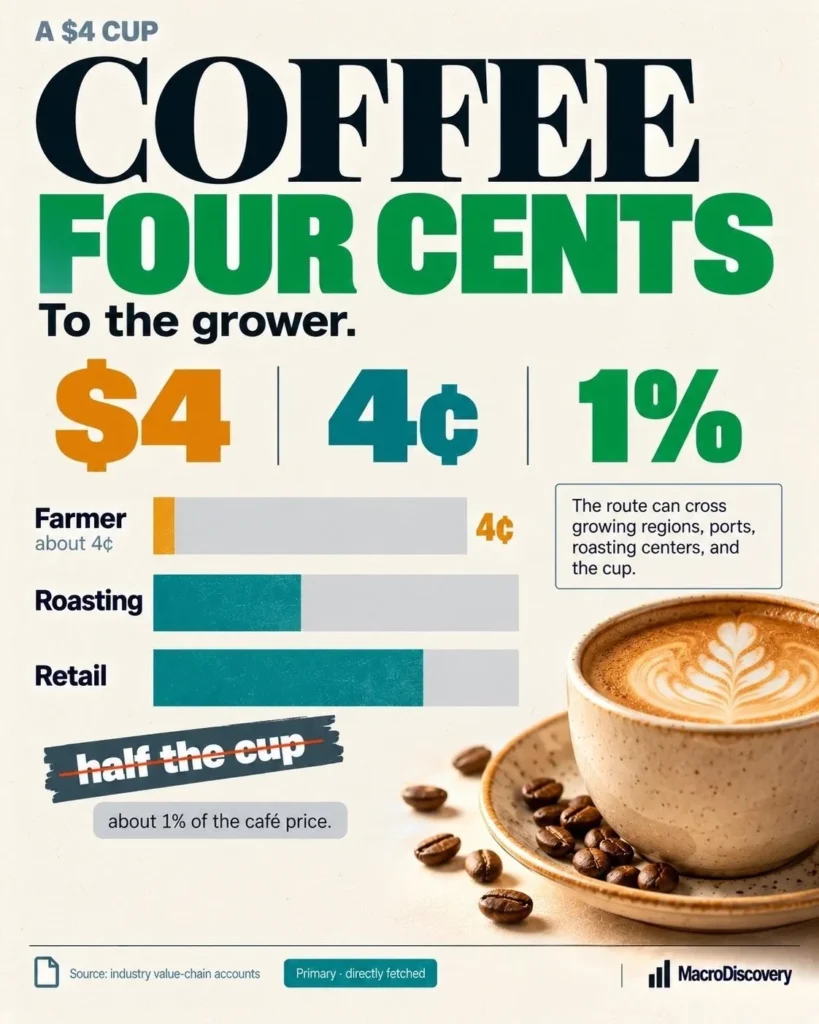
A common claim is that a $4 cup mostly pays the farmer. The fact is that the farmer’s share of retail is a few percent in most commodity chains. Estimates range from about 3–6% (Coffee Barometer 2026) to 7–15% depending on the source and whether the coffee is specialty. For a $4 cup that is roughly 12–60 cents before farm costs. One German retail example put the farmer’s net at about 4% of the shelf price. The rest of the $4 covers processing, export, shipping, roasting, packaging, rent, labour, milk and the café’s margin.
A second common claim is that coffee is grown and roasted in the same place. The fact is that more than 90% of coffee is exported green. Production is concentrated in the tropics of South America, Africa and Asia. Brazil alone supplies about 30–35%. Vietnam supplies about 18%, almost entirely robusta. Colombia, Indonesia and Ethiopia are the next major origins. The European Union takes about 40% of global imports. The United States takes about 18%. Beans are shipped green to a consuming country, roasted there, and sold. A cup in Europe or North America can easily involve three or four continents.
About 25 million smallholders produce the majority of the world’s coffee, mostly on plots under a few hectares. The top ten traders handle about 35% of exports from key producing countries. Value concentrates downstream. Specialty and direct-trade channels raise the farmer’s absolute price, but the share of the final retail price remains small in most cases. The $4 figure is a retail price, not a measure of farm income.
| Stage | What it typically captures |
|---|---|
| Farmer | 3–10% of retail in commodity chains |
| Processing, milling, export | Local costs and intermediary margins |
| Shipping and import | Freight, finance, quality differentials |
| Roasting and packaging | Weight loss (~15%), labour, packaging |
| Café / retail | Rent, labour, milk, equipment, margin |
Shares vary by origin, quality and contract. The range is from commodity to specialty. Sources: Coffee Barometer 2026, Solidaridad / BASIC studies, industry estimates.
How it was measured
Farmer share is measured against the final retail price, not against the green-coffee futures price. The C-price is the New York futures benchmark for green arabica. Farm-gate and FOB prices sit below it after local costs. Retail and café prices sit far above it after roasting, packaging and service costs. Comparing the two without labeling them is a common source of confusion.
Continent counts follow the physical path: tropical production (South America, Africa or Asia), green export, roasting in Europe or North America, and sale to a consumer who may be on yet another continent. Most coffee is roasted in the consuming country.
What it means
It is settled that the farmer’s share of a typical retail cup is a few percent and that most coffee is exported green. It is not settled that every $4 cup returns the same amount. Use 3–10% for the commodity range. Use roughly half for Brazil plus Vietnam. Use three or four continents for a typical path. Do not treat the $4 price as a direct measure of farm income.
Common misreadings
- A $4 cup does not mostly pay the farmer. The share is a few percent in commodity chains.
- Coffee is not usually roasted at origin. More than 90% is exported green.
- Specialty premiums raise the absolute farm price. They do not automatically raise the share of retail.
Where the numbers come from
How we built this
- Dataset: Coffee Barometer 2026, Trase/SEI trade mapping, Solidaridad/BASIC value-distribution study, industry estimates.
- Scope: Commodity chains as the baseline. Specialty and direct-trade noted as raising absolute prices but not automatically the retail share. Continent path follows green export and consuming-country roasting.
- Figures: 3–10% is the farmer share range. Roughly half is Brazil plus Vietnam. Three or four continents is a typical path. The $4 price is treated as retail, not farm income.