Countries That Pay You to Have Children
South Korea pays $75,000 per baby. Nobody is having more babies.
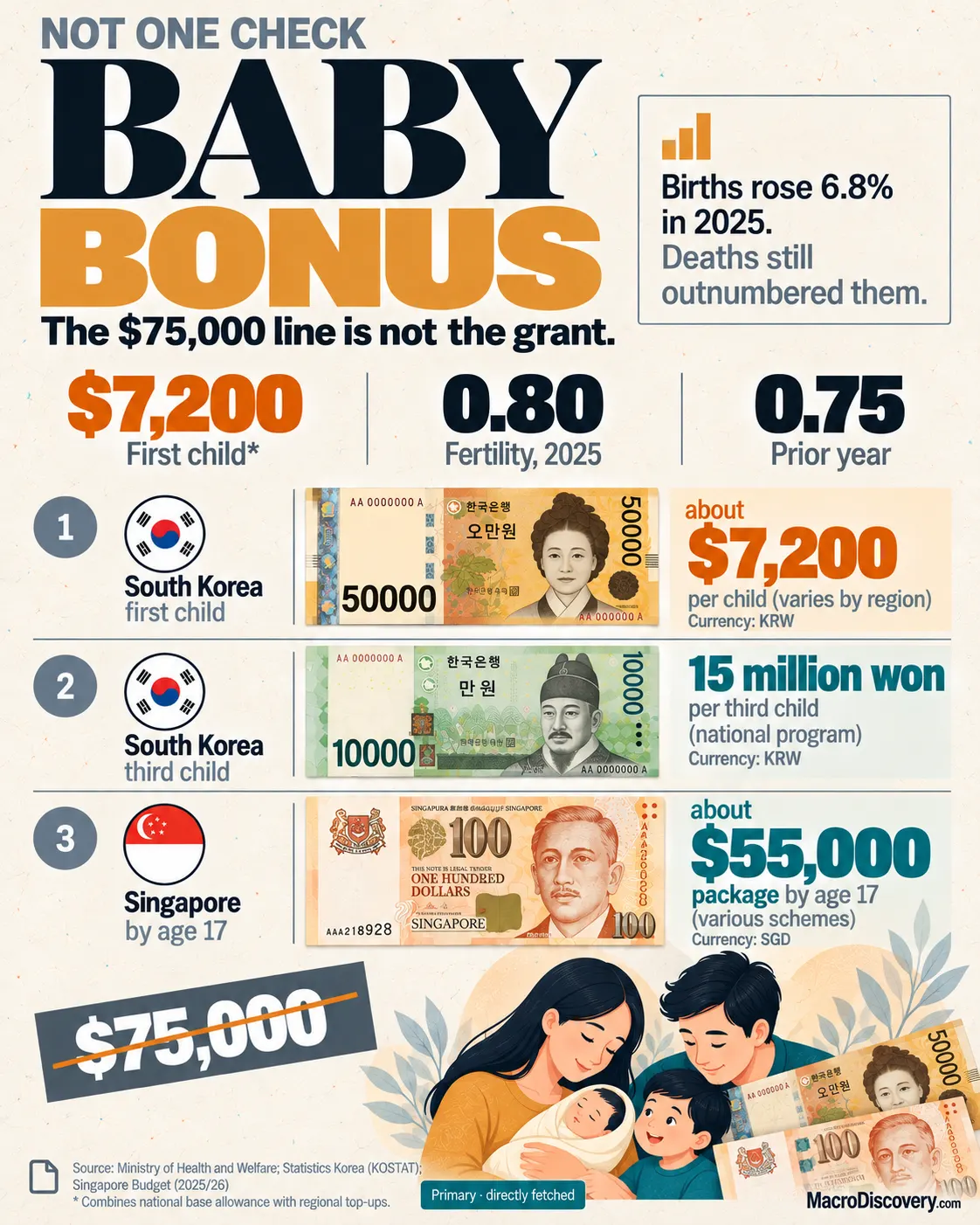
The new first-child grant is about $7,200, not $75,000. Births rose from 230,000 to 254,500. The rate is still 0.80.
Three numbers
- About $7,200 — 10 million won for a first child under the grant set on 7 October 2026. A second gets 12 million, a third 15 million. Source: health ministry.
- 0.80 — South Korea’s fertility rate in 2025, up from 0.72 in 2023. Births 254,500, up from 230,000. Source: Statistics Korea.
- About $55,000 — Singapore’s package by age 17, almost S$70,000. Cash since 2001 has not restored the rate. Source: government package.
What the data shows
A common claim is that South Korea pays $75,000 per baby, and that nobody is having more. The fact is that the payment at birth is a fraction of that stack, and births have risen. On 7 October 2026 the health ministry set a child welcome grant of 10 million won for a first child, about $7,200, 12 million won for a second, and 15 million for a third or later. Shrinking regions get another 5 million. The grant replaces a patchwork of a first-meeting voucher, a parental benefit, and a child allowance. The $75,000 line adds years of those allowances, leave, housing, and tax. It is a lifetime stack, not a check.
The direction of births is up, and the level is still low. Statistics Korea recorded 230,000 births and a fertility rate of 0.72 in 2023, the low. In 2024 births were 238,300 and the rate 0.75, the first rise in nine years. In 2025 the rate was 0.80 and births 254,500, up 6.8%. A 2026 second-quarter reading was about 0.88, with Seoul still near 0.6 to 0.7 and some regions above 1.1. Replacement is about 2.1. The country has been the only OECD member under 1 since 2018. More babies is not a recovery, and “nobody” is the wrong verb for a rise of 24,500 births.
A larger package has the same shape. Singapore’s new support is almost S$70,000 by age 17, about $55,000, replacing a baby bonus that began in 2001. The first and second child had been getting S$11,000 over six and a half years. The rate is still among the world’s lowest. A Hungarian model put family payments, leave, and tax allowances at about 19.5 million forint against an extra cost of about 100.7 million for a first child, roughly 19% of the bill. A rank of countries by the cheque does not rank them by births. The cheque is a share of the cost. The rate is still set by housing, work, and the age people marry.
The first-child grant is about $7,200. A stack of years of support is a different object.
| Count | Figure | What it is |
|---|---|---|
| First-child grant | 10 million won | About $7,200. Not $75,000 |
| Third child | 15 million won | Plus 5 million in shrinking regions |
| Fertility, 2023 to 2025 | 0.72 to 0.80 | Births 230,000 to 254,500 |
| Replacement | about 2.1 | Still more than double the rate |
| Singapore by age 17 | about $55,000 | Cash since 2001. Rate still low |
How it was measured
The grant is a payment at birth, in won, converted at about 1,400 won to the dollar. A lifetime stack adds monthly parental benefits, a child allowance to a set age, leave, and housing. Those are not paid on the day of birth, and a family that does not use all of them does not receive the headline.
The fertility rate is the average number of children a woman would have at current age-specific rates. A one-year rise can be postponed weddings arriving together. Singapore’s $55,000 is support to age 17, not a birth cheque. Hungary’s 19% is a model of cost, not a ranked bonus.
What it means
It is settled that the new first-child grant is 10 million won, that the 2025 rate was 0.80, and that Singapore’s larger lifetime package has not restored replacement. It is not settled that a stacked $75,000 is a payment, or that the rise is a turn. Use $7,200 for the grant. Use 0.80 for the rate. Use $55,000 for Singapore’s package to age 17. Do not use $75,000 as a cheque.
Common misreadings
- $75,000 is a stack of years. The birth grant is about $7,200.
- Births rose. The rate is still 0.80, under half of replacement.
- A larger package in Singapore has not produced a larger rate.
Where the numbers come from
How we built this
- Dataset: The October 2026 grant; Statistics Korea fertility; Singapore’s package to age 17.
- Scope: A birth cheque kept apart from a lifetime stack. A rise in births kept apart from replacement.
- Figures: $7,200 is the first-child grant. 0.80 is the 2025 rate. $55,000 is Singapore by age 17. $75,000 is treated as a stack, not a cheque.