The Global Battery Race
The country that controls battery technology controls the future of energy.
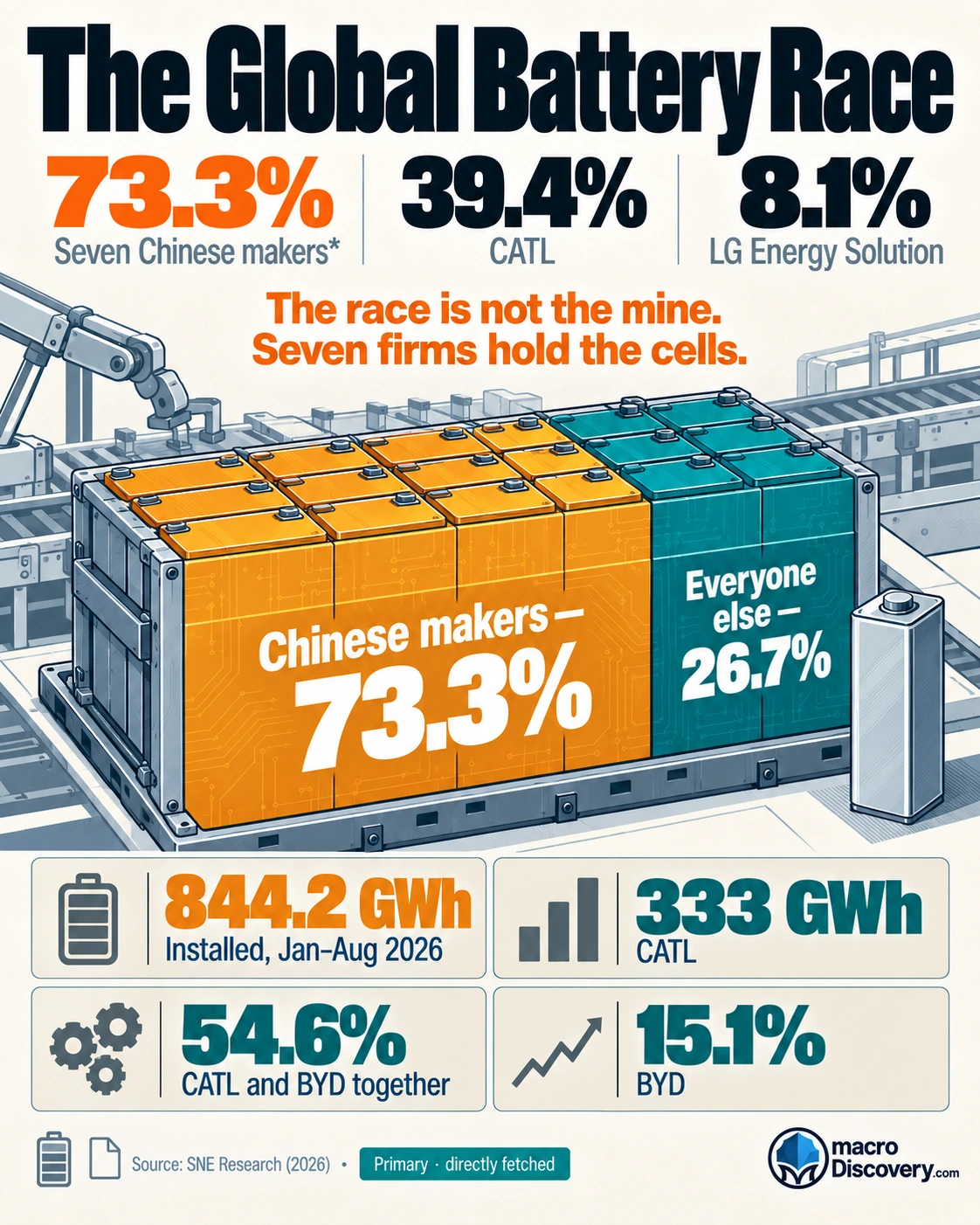
China made well over 80% of lithium-ion batteries in 2025. That is a factory share. Batteries store power. They do not generate it.
Three numbers
- Well over 80% — China’s share of lithium-ion battery manufacturing in 2025. LFP cells were over 98%. Source: IEA.
- 108 GW — new battery storage deployed in 2025, up 40% on 2024. China took about 60% of the additions. Source: IEA.
- 40.9% — low-carbon share of global electricity in 2024. Batteries are not in that generation mix. Source: Ember.
What the data shows
A common claim is that the country which controls battery technology controls the future of energy. The fact is that one country dominates the factories, and the factories do not generate the power. The International Energy Agency says China manufactured well over 80% of lithium-ion batteries in 2025. Chinese, Korean, and Japanese firms account for nearly all cell output. The European Union and the United States make most of the rest, in similar shares. LFP cathode material and LFP cells were over 98% Chinese. Nickel-based cells were about 60%. The concentration is real. It is a manufacturing share.
Mines are a different map. Lithium, nickel, and cobalt are dug in more countries than the cells are built in. The IEA’s own chain chart separates mining, refining, components, and cells. Refining and cathodes sit much closer to China than the ore does. Europe and the United States still import most components. Nearly all grid batteries rely on China for at least one step. Over 70% of electric vehicles made outside China rely on Chinese batteries or parts. A cell lead is not a mine lead, and a mine lead is not a grid.
Storage is not the energy system. The world added 108 GW of battery storage in 2025, 40% more than in 2024, and eleven times the additions of 2021. About 80% was utility-scale. Most projects still last about two hours. LFP was about 90% of storage deployments. China took about 60% of the new capacity. A battery moves electricity from noon to evening. It does not make the noon. Low-carbon sources were 40.9% of global electricity in 2024. Fossil generation still rose. Controlling the cell does not control the coal plant, the gas plant, or the solar farm that fills the cell.
LFP cells are more concentrated than this average, over 98%. Nickel-based cells are about 60%.
| Count | Figure | What it is |
|---|---|---|
| China cell output, 2025 | well over 80% | Lithium-ion batteries |
| LFP cells and cathodes | over 98% | More concentrated than nickel-based |
| Storage added, 2025 | 108 GW | China about 60% of additions |
| Typical duration | about 2 hours | A shift, not a power plant |
| Low-carbon electricity, 2024 | 40.9% | Generation. Not batteries |
How it was measured
The IEA cell share is where the battery is manufactured. A Korean firm building in China counts as China. Mining shares are where the ore is dug. Refining is a third map. Mixing the three is how a factory share becomes “control of energy.”
Storage additions are power capacity, in gigawatts, not energy generated, in terawatt-hours. A 108 GW battery that runs two hours is a different object from a 108 GW coal plant that runs all year. The 40.9% is a generation share. Batteries are absent from it on purpose.
What it means
It is settled that China made well over 80% of lithium-ion batteries in 2025, and that storage additions were 108 GW. It is not settled that this is control of the future of energy. Use 80% for cells. Use 108 GW for storage added. Use 40.9% for low-carbon electricity. Do not use the cell share as a share of the power system.
Common misreadings
- A cell factory is not a mine. Ore is more spread out than the batteries.
- 108 GW of storage is not 108 GW of generation. Most projects last about two hours.
- Low-carbon power was 40.9% of electricity. Batteries did not produce that share.
Where the numbers come from
How we built this
- Dataset: IEA battery manufacturing and storage figures; Ember electricity mix for 2024.
- Scope: Cells, storage additions, and generation kept separate. Mining noted as more spread out, without a fake single-country ore share.
- Figures: Over 80% is cells. 108 GW is storage added. 40.9% is low-carbon electricity. The energy-control line is treated as a category error.