Economics of Remote Islands
There are places so remote that supply ships come once a year. People still choose to live there.
Once a year is the weather-station run. Tristan da Cunha gets about nine or ten scheduled ships a year. The cash crop is lobster.
Three numbers
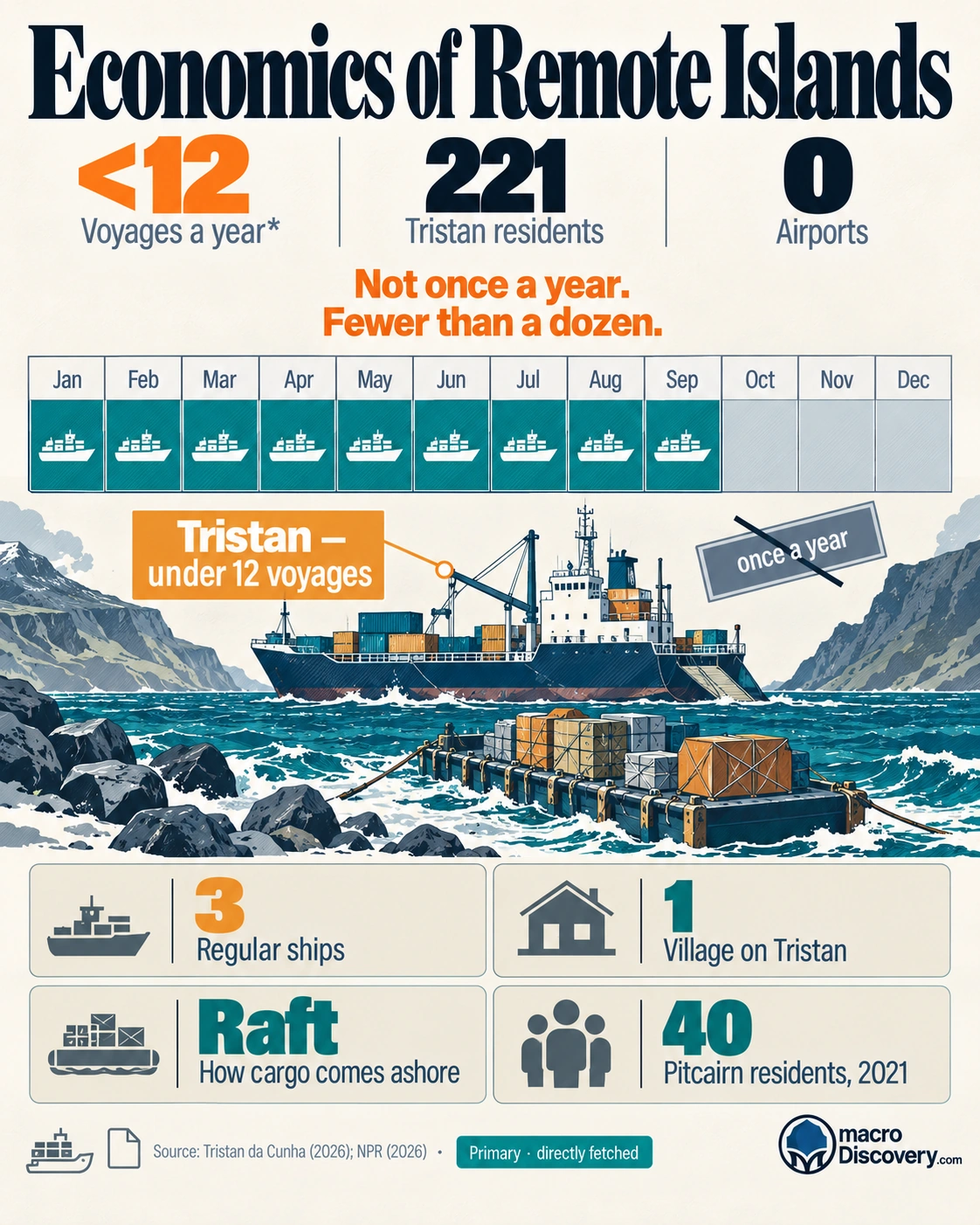
- About 9 to 10 — scheduled ship calls a year at Tristan da Cunha. The island’s own page says fewer than a dozen. Source: Tristan da Cunha shipping page.
- About 240 — people in Edinburgh of the Seven Seas, the only settlement. No airport. Source: island counts.
- 2,414 km — distance to St Helena, the nearest inhabited neighbor. Cape Town is the regular port. Source: BBC.
What the data shows
A common claim is that some places are so remote that a supply ship comes once a year, and people still choose to live there. The living is real. The once-a-year ship is the wrong schedule. Tristan da Cunha, in the South Atlantic, is the usual example: no airport, a six-day sail from Cape Town in fair weather, and a harbor that can stay closed in a swell. The island’s shipping page says only three ships travel there regularly, and there are fewer than a dozen voyages a year. A BBC count put the regular list at nine ships and 136 passenger berths. That is a thin calendar. It is not one ship.
The once-a-year sailing is a different stop. The SA Agulhas II makes a spring voyage from Cape Town, calls at Tristan, and continues to Gough Island to resupply a weather station and swap its staff. Gough is uninhabited apart from that station. Folding that annual run into the town’s supply is how the claim gets to one ship. The town’s cargo is the fishing boats as well. The MV Lance, under the fishery contract, has made about six voyages a year. Mail, fuel, and passengers move on those hulls.
People stay because the island has an income, not because a ship is a curiosity. Edinburgh of the Seven Seas has about 240 people. The nearest inhabited land, St Helena, is 2,414 km north. The cash crop is lobster. From August 2023 to April 2024 one vessel landed about 316 tonnes of an estimated 441-tonne annual catch. The fishing company also provides jobs, electricity, and the cargo run, including medical trips to Cape Town. Orders for Christmas go out months ahead because the schedule is short. A short schedule is not a single annual visit.
Cruise calls and yachts are extra. They are not the supply.
| Count | Figure | What it is |
|---|---|---|
| Scheduled voyages | about 9–10 | Three regular ships. Under a dozen |
| Annual station run | 1 | SA Agulhas II, then on to Gough |
| Settlement | about 240 | Edinburgh of the Seven Seas. No airport |
| Nearest inhabited land | 2,414 km | St Helena |
| Lobster catch | about 441 tonnes | One year. One vessel landed 316 |
How it was measured
A voyage is a scheduled return from Cape Town, not a day in port. Weather can cancel a landing after the ship has arrived. The island’s page counts regular ships. A cruise call is a visit, not fuel and mail. The Gough run is one of the scheduled hulls, and it is the piece that matches “once a year.”
The catch figure is one season, landed weight, not export revenue. Population counts for the island sit between about 200 and 250. The distance to St Helena is the nearest inhabited land, not the port the ships use. Cape Town is the working link.
What it means
It is settled that Tristan has no airport, that scheduled ships number about nine or ten a year, and that lobster is the cash crop. It is not settled that supply ships come once a year. Use 9 to 10 for the island schedule. Use 1 only for the Gough station run. Use about 240 for the settlement. Do not use one ship as the town’s supply.
Common misreadings
- Once a year is the weather-station voyage. The town gets about nine or ten scheduled ships.
- No airport is not no supply. The fishery boats carry cargo.
- A six-month Christmas order is a short calendar, not a single annual ship.
Where the numbers come from
How we built this
- Dataset: Tristan da Cunha shipping pages; BBC 2025 fishery and berth counts.
- Scope: The remotest inhabited island, not every remote territory. Gough is separated as a station. Cruise calls excluded from the supply count.
- Figures: 9 to 10 is the scheduled list. 1 is the station run. About 240 is the settlement. 441 tonnes is one season’s catch.