The Homelessness Crisis
150 million people have no home. The wealthiest cities have the fastest-growing numbers.
150 million is an older floor. UN-Habitat’s estimate is 318 million, and it is still not a census. The richest-city growth line is not a measured global fact.
Three numbers
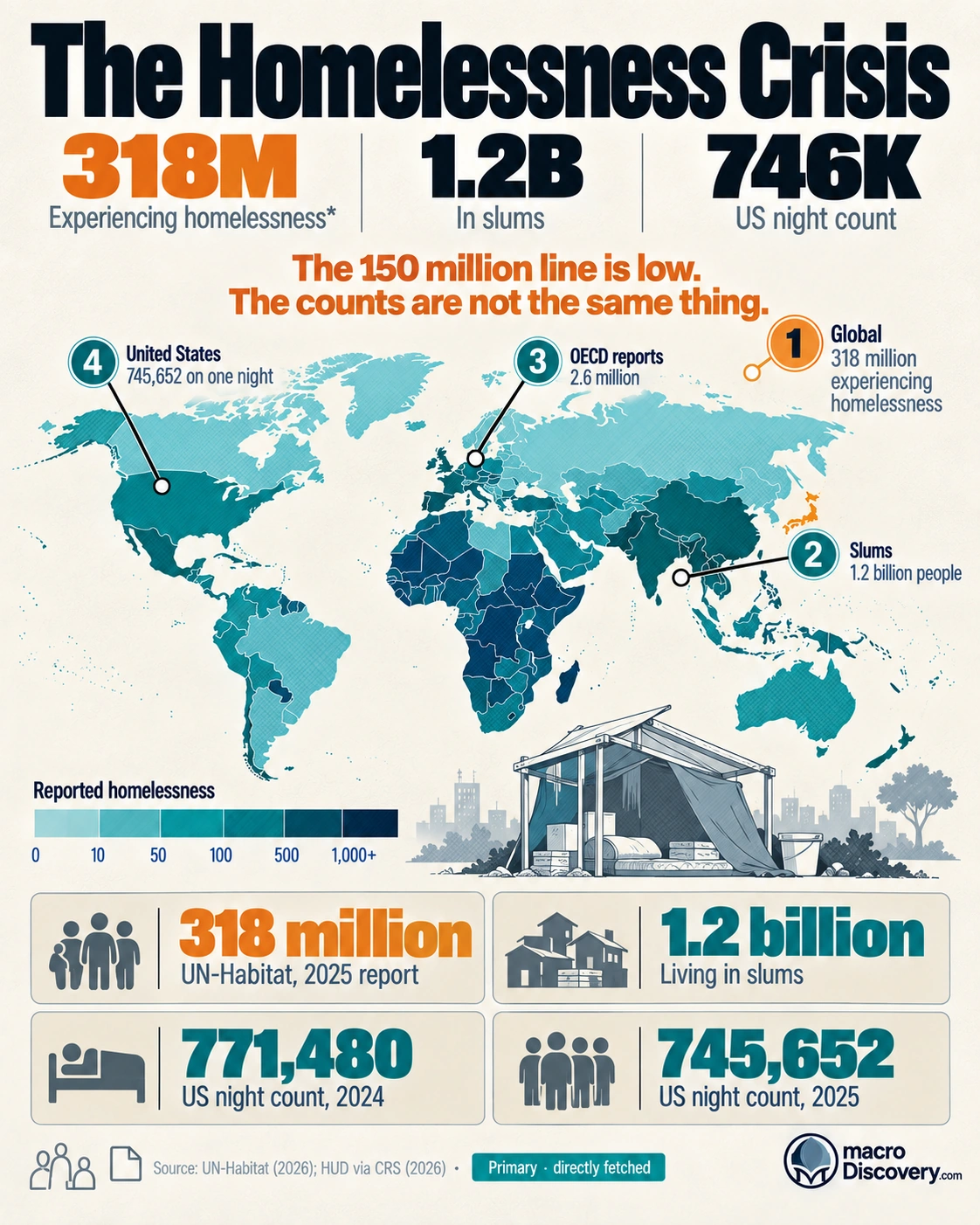
- 318 million — UN-Habitat’s estimate of people experiencing homelessness. The 150 million line is older. Source: UN-Habitat.
- 2.8 billion — people without adequate housing. Not the same as having no home. Source: UN-Habitat.
- About 746,000 — people counted homeless in the United States on one night in January 2025, down 3.3% from 2024. Source: HUD.
What the data shows
A common claim is that 150 million people have no home, and that the wealthiest cities have the fastest-growing numbers. The fact is that 150 million is an older floor, and the city line is not a measured global ranking. UN-Habitat’s current estimate is 318 million people experiencing homelessness. The agency says official counts mostly catch people on the street or in shelters, and miss people couch-surfing or in unregistered rooms. There is still no agreed international definition. The 318 million figure is an estimate with a hole in it, not a census of people with no shelter.
A larger number is a different problem. UN figures put 2.8 billion people without adequate housing, more than a third of the world, and about 1.1 to 1.2 billion in informal settlements, mostly in Africa and Asia. UN-Habitat warns not to fold that slum count into homelessness. Many people in those settlements have a home they would not call homelessness. The World Cities Report 2026 uses a still wider inadequate-housing figure, up to 3.4 billion, including the slum count. Housing deficits rose from 251 million units in 2010 to 288 million in 2023. Those are unit gaps, not people on a street.
The richest-city claim does not survive the one place with a comparable night count. The US point-in-time count in January 2025 found about 746,000 people, down 3.3% from 2024. California had the largest number, about 182,000. New York had the highest rate, about 73 per 10,000. New York and Los Angeles together held more than a quarter of the national count. That is concentration, not proof of the fastest growth. From 2020 to 2025 the biggest state rate rise was Vermont. A rich city can have a large count because rents are high and the count is public. It is not a global growth table.
Both bars are estimates. Hidden homelessness is missing from both. Do not add the slum count.
| Count | Figure | What it is |
|---|---|---|
| Homelessness, UN-Habitat | 318 million | Estimate. Not a street census |
| Older viral line | 150 million | Stale floor |
| Inadequate housing | 2.8 billion | A different definition |
| Informal settlements | 1.1–1.2 billion | Not the same as homelessness |
| US one-night count, 2025 | about 746,000 | Down 3.3% from 2024 |
How it was measured
UN-Habitat builds the 318 million from national reports that do not share a definition. A shelter bed, a pavement, and a temporary room can all be in or out. The agency’s own note says visible homelessness is what most systems count. The US figure is a point-in-time count on one night in January. It misses people who are homeless on other nights, and it counts a sheltered person and an unsheltered person together.
Adequate housing adds crowding, tenure, water, and safety. A household can fail that test and still have a roof. Unit deficits count missing dwellings, not people. These series should not be added.
What it means
It is settled that the current UN-Habitat homelessness estimate is 318 million, that 2.8 billion lack adequate housing, and that the US one-night count was about 746,000 in January 2025. It is not settled that 150 million people have no home, or that the wealthiest cities are growing fastest. Use 318 million for the estimate. Use 2.8 billion only for adequate housing. Use 746,000 for the US night count. Do not use 150 million as the current total.
Common misreadings
- 150 million is an older floor. The current estimate is 318 million, and it is incomplete.
- Slums and inadequate housing are not homelessness. Do not add 1.2 billion to 318 million.
- A large count in New York or Los Angeles is not proof those cities are growing fastest.
Where the numbers come from
How we built this
- Dataset: UN-Habitat homelessness and housing estimates; HUD point-in-time count for January 2025.
- Scope: Homelessness kept separate from slums and inadequate housing. City growth is not ranked where no comparable series exists.
- Figures: 318 million is the current estimate. 150 million is treated as a stale floor. 746,000 is the US one-night count.