The Microbiome Economy
39 trillion bacteria live inside you. Science is just beginning to understand what they do.
39 trillion is a 2016 estimate for a 70 kg man, with a wide error bar. Human cells are about 30 trillion. The approved use is one infection.
Three numbers
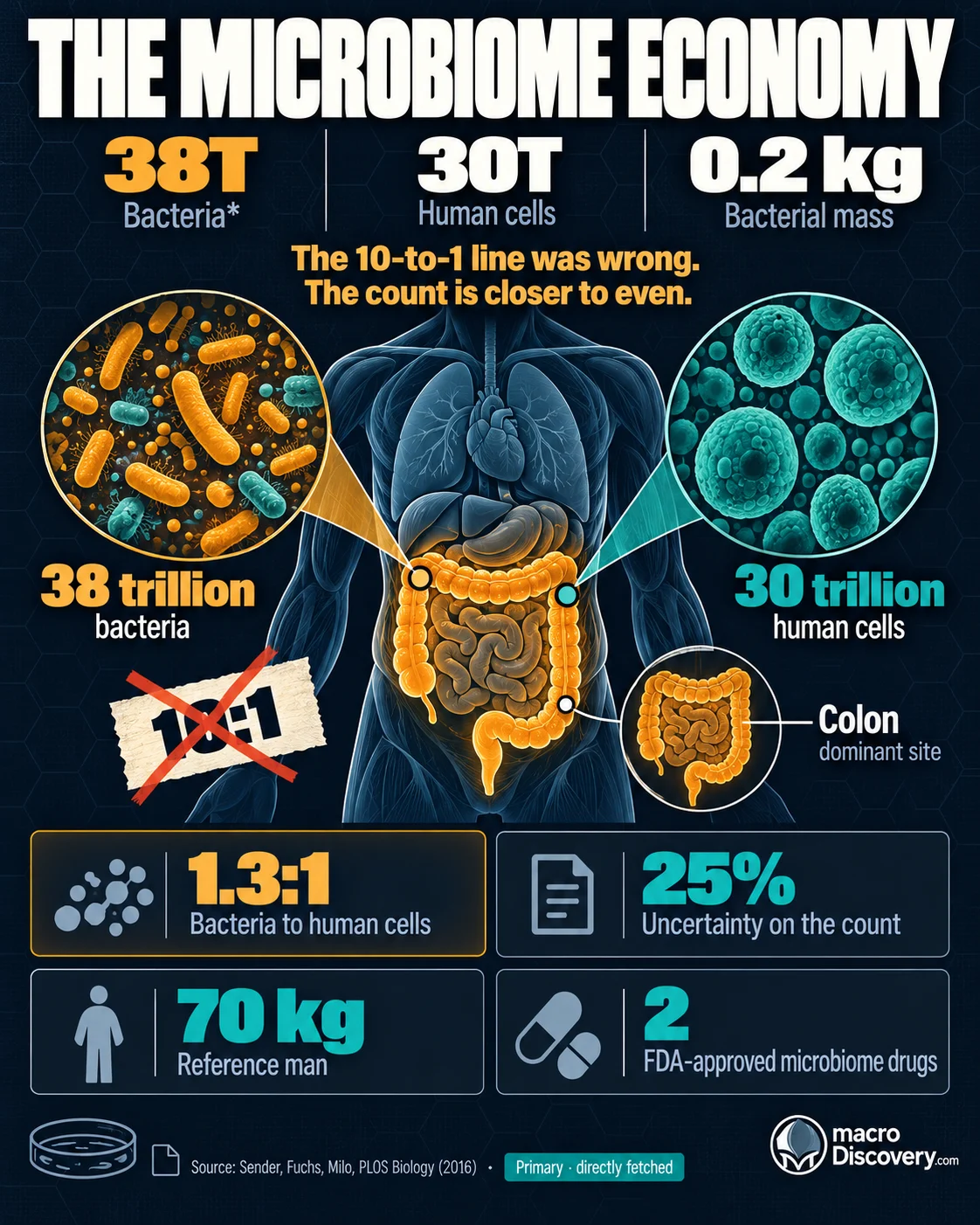
- 39 trillion — bacterial cells in a 70 kg reference man. Standard error 25%. Spread across people 52%. Source: Sender, Fuchs, and Milo, 2016.
- 30 trillion — human cells in that same body, mostly red blood cells. Source: Sender, Fuchs, and Milo.
- 1.3 to 1 — bacteria per human cell. The old line was 10 to 1. Source: Sender, Fuchs, and Milo.
What the data shows
A common claim is that 39 trillion bacteria live inside you, and that science is just beginning to understand what they do. The count is an estimate for one kind of body, not a census of yours, and the approved use is one infection. Sender, Fuchs, and Milo, in a 2016 paper, put bacterial cells in a 70 kg reference man at 3.9 × 10¹³, about 39 trillion. The standard error is 25%. The spread across people is 52%. Most of those bacteria are in the colon. A bowel movement can flip the ratio toward human cells.
The same paper retired the 10-to-1 line. Human cells in that reference man are about 30 trillion, and about 90% of them are blood cells. The ratio is about 1.3 bacteria per human cell. The 10-to-1 figure was a back-of-the-envelope number that stuck because it was round. Bacteria still dominate by mass in the gut. They do not outnumber your cells ten to one. The estimate is for a young man of 70 kg and 1.7 metres. A smaller body, or a body after a bowel movement, is a different count.
The economy is narrower than the cell count. In November 2022 the FDA approved Rebyota, the first fecal microbiota product, to prevent recurrence of Clostridioides difficile in adults after antibiotic treatment. In the combined analysis, success through 8 weeks was 70.6% for Rebyota and 57.5% for placebo. C. difficile is linked to 15,000 to 30,000 deaths a year in the United States. That is one approved use. It is not a map of what the other bacteria do, and it is not a market built on 39 trillion cells.
The bacterial bar has a 25% standard error. Most of those cells are in the colon, not spread through the body.
| Count | Figure | What it is |
|---|---|---|
| Bacteria, reference man | 39 trillion | 2016 estimate. Error 25% |
| Human cells | 30 trillion | Mostly red blood cells |
| Ratio | 1.3 to 1 | Not the old 10 to 1 |
| Rebyota success | 70.6% | Through 8 weeks. Placebo 57.5% |
| C. difficile deaths, US | 15,000–30,000 | A year. The approved use |
How it was measured
Sender, Fuchs, and Milo reviewed measured cell counts, not a new full-body scan. Bacterial numbers come mostly from stool density times colon volume. Human cells are dominated by the blood line, from counts and organ volumes. The reference man is a standard body, 70 kg, 20 to 30 years old, 1.7 metres. The 52% population spread means two people can differ by a lot.
Rebyota is a licensed product made from screened donor stool, for one indication. The 70.6% figure is a combined analysis through 8 weeks, not a cure rate for the microbiome. A probiotic sold as a food is not this approval.
What it means
It is settled that the best-known revision puts bacteria and human cells in the same order of magnitude, about 39 trillion and 30 trillion in a reference man. It is not settled that 39 trillion live in you, or that science has mapped what they do. Use 39 trillion as the reference-man estimate. Use 1.3 to 1 for the ratio. Use Rebyota for the approved product. Do not use 10 to 1.
Common misreadings
- 39 trillion is a reference man, with a 25% error. It is not your census.
- The ratio is about 1.3 to 1, not 10 to 1. A bowel movement can flip it.
- The approved product prevents one recurrent infection. It is not a map of the microbiome.
Where the numbers come from
How we built this
- Dataset: Sender, Fuchs, and Milo 2016 cell estimates; FDA Rebyota approval and trial summary.
- Scope: Cell counts for a reference man, and the first approved fecal microbiota product. Food probiotics and unapproved claims excluded.
- Figures: 39 trillion and 30 trillion are the reference-man estimates. 1.3 to 1 replaces 10 to 1. 70.6% is the 8-week success figure.