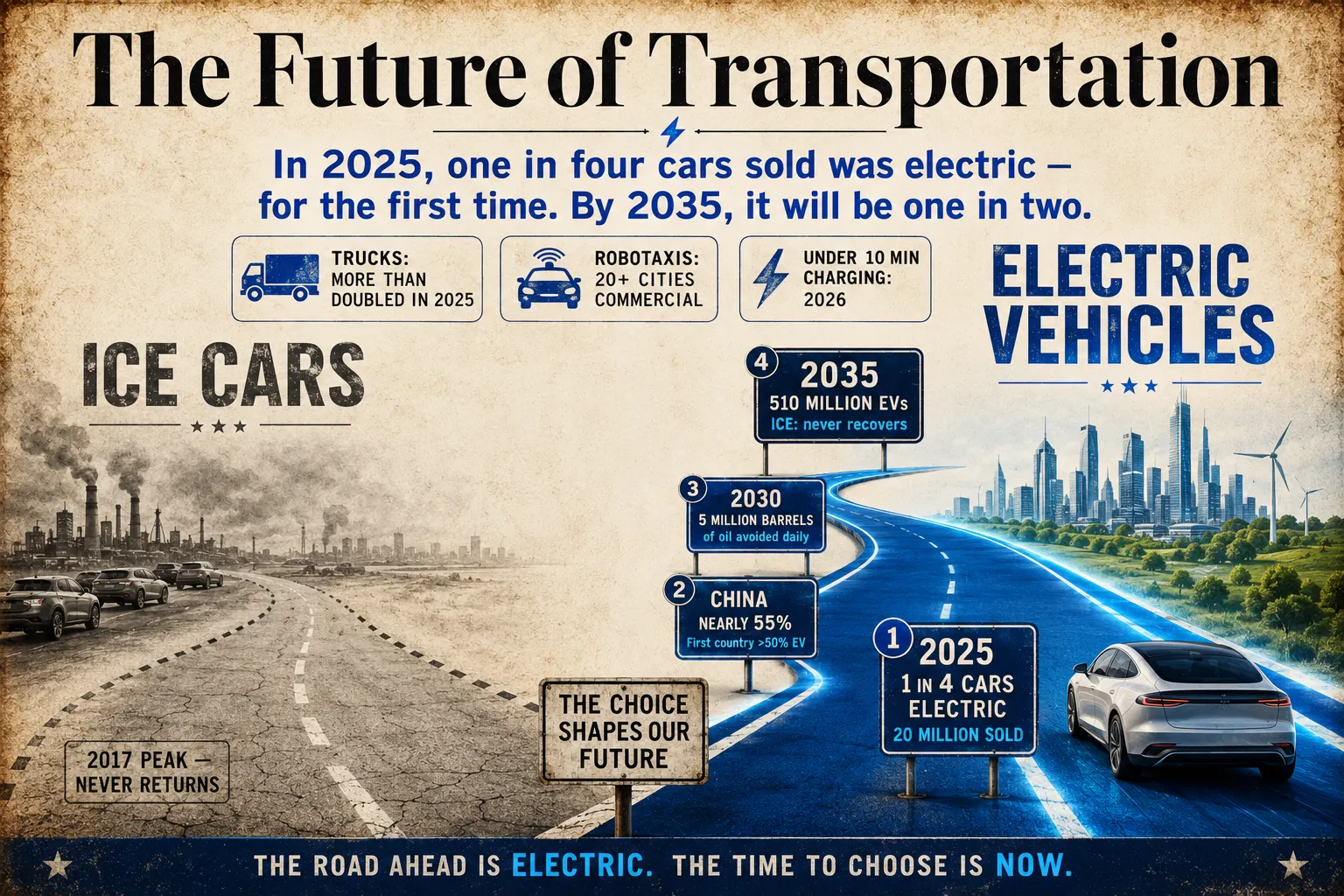
The internal combustion engine dominated transport for more than a century. It shaped cities, geopolitics, and global oil demand. Now the transition away from it is accelerating faster than most forecasters expected. The data confirms what was once theory: the tipping point has passed. The question is no longer whether EVs will dominate. It is how fast.
IEA — Global EV Outlook 2026 · PRIMARY · iea.org · directly fetched · © 2026 IEA · CC BY 4.0 · May 2026
1-in-4
“Electric car sales grew by 20% globally to exceed 20 million in 2025, meaning one-quarter of all new cars sold were electric.” — IEA Global EV Outlook 2026, directly fetched
This is the first year in history that EVs reached a global market share of 25%. More than 100 countries recorded electric car sales growth in 2025. In one-third of those countries, EVs already represented at least 10% of new car sales. Chinese automakers supplied approximately 60% of global electric car sales in 2025 — meaning that China’s automotive industry now shapes what the world drives. Nearly 22 million electric cars were produced globally in 2025, up more than 25% from the previous year, with China accounting for nearly 75% of production. China also accounted for over 80% of battery cell production globally. The IEA projects 23 million EVs in 2026, representing 28% of all car sales.
Source: IEA — Global EV Outlook 2026 (PRIMARY · directly fetched · iea.org/reports/global-ev-outlook-2026/executive-summary · © 2026 IEA · CC BY 4.0 · May 2026 · verbatim: “Electric car sales grew by 20% globally to exceed 20 million in 2025, meaning one-quarter of all new cars sold were electric” · “Chinese automakers supplied 60% of global electric car sales in 2025” · “Almost 22 million electric cars were produced globally in 2025 – a more than 25% increase on the previous year” · “China remains the world’s largest EV manufacturing hub, accounting for nearly 75% of electric cars produced in 2025” · “China accounted for over 80% of battery cell production in 2025” · “Global electric car sales are expected to grow to 23 million in 2026, representing 28% of total car sales”)
“The road transport sector represents close to half of oil demand today.”
— IEA Global EV Outlook 2026 (PRIMARY · directly fetched · iea.org · © 2026 IEA · May 2026)
The Truck Revolution — The Quietest and Most Important EV Story of 2025
Cars get the headlines. Trucks move the world. Electric cars replacing petrol cars is significant. But electric trucks replacing diesel freight is potentially more transformative — because diesel trucks are disproportionately large emitters relative to their numbers. The IEA confirmed that electric truck sales more than doubled in 2025, reaching 9% of global truck sales. In China, one in four trucks sold was electric. The TCO is already competitive in China. Europe reaches TCO parity by 2030. By 2035, electric trucks represent at least 20% of global truck sales — and 60% in China. The EU has already built over 1,000 charging points exclusively for electric trucks along major routes. Truck electrification is the front that most people are not watching — and the one that will move the fastest once economics reach parity across markets.
Why it matters: road freight contributes disproportionately to transport emissions. When electric trucks reach cost parity with diesel in Europe by 2030 — as the IEA projects — the commercial logic becomes irreversible. Fleet operators optimise for total cost of ownership, not list price.
IEA — Global EV Outlook 2026 · PRIMARY · directly fetched · Oil Displacement · 2025–2030
1.7Mb/d
“In 2025, the global fleet of EVs avoided the consumption of around 1.7 million barrels of oil per day.” Globally, that displacement is “on track to triple to around 5 mb/d per day in 2030.” — IEA primary verbatim
The road transport sector “represents close to half of oil demand today.” The 1.7 million barrels per day avoided in 2025 represents the largest displacement of oil demand from any single technology in the energy transition so far. China — “the world’s largest oil importer” — accounted for roughly 1 million barrels of that 1.7 million, and is “set to displace 2.7 mb/d annually by 2030.” The energy security dimension of EV adoption has sharpened dramatically in 2026 due to the ongoing Middle East energy crisis: countries dependent on oil imports are increasingly viewing EV adoption as an energy security measure, not just a climate policy. Some Southeast Asian countries have already announced expanded EV incentives as part of their crisis response.
Source: IEA — Global EV Outlook 2026 (PRIMARY · directly fetched · iea.org · © 2026 IEA · May 2026 · verbatim: “In 2025, the global fleet of EVs avoided the consumption of around 1.7 million barrels of oil per day (mb/d)” · “The road transport sector represents close to half of oil demand today” · “Globally, the annual displacement of oil by EVs is on track to triple to around 5 mb/d per day in 2030” · “China – the world’s largest oil importer – is also home to the largest stock of EVs, which displaced around 1 mb/d of oil demand in 2025 and is set to displace 2.7 mb/d annually by 2030”)
The 2035 Horizon — 510 Million EVs, ICE at Its Ceiling, and the End of the Oil Car
The IEA projects the global EV fleet will grow more than sixfold by 2035 — reaching 510 million vehicles, not counting electric two- and three-wheelers. That represents one of the fastest large-scale capital stock transitions in industrial history. EVs reach 50% of global car sales by 2035. China reaches 90%. ICE car sales never return to their 2017 peak. The technology and cost logic is now self-reinforcing: in China, 70% of battery EVs sold in 2025 were already cheaper than the average conventional car. Under-10-minute charging has been announced for 2026 models. The first 1,000-volt vehicle platforms arrived in 2025. V2G — vehicle-to-grid — made its first commercial appearance for private EV owners in 2025. The transport system of 2035 will be unrecognisable compared to 2015. The transition is not a future scenario. It is underway, measurable, and accelerating.
Why it matters: the 510 million EV projection is a Current Policies Scenario — it requires no new policy announcements to reach. It reflects only what is already in law and already in the pipeline. The real question is whether the electricity grid, the charging infrastructure, and the battery supply chain can scale fast enough to meet demand that is already locked in.
IEA — Global EV Outlook 2026 · PRIMARY · directly fetched · 2035 Projections
510M
“The global fleet of EVs is projected to grow more than sixfold by 2035 from 2025 levels, to reach as many as 510 million, without counting electric two- or three-wheelers.” ICE car sales “never return to their 2017 peak.” — IEA primary verbatim
The IEA’s exploratory scenarios project that the share of EVs in global car sales reaches “around 50% in 2035.” In China, “electric cars could exceed 90% of total car sales by 2035.” Electric trucks reach “at least 20% of global truck sales in 2035,” with China at 60% truck electrification. The oil displacement from EVs triples from today’s 1.7 million barrels per day to 5 million by 2030, and continues growing through 2035 as electric trucks add significant additional displacement. Electricity demand from EVs could exceed 1,500 TWh by 2035 — roughly sixfold from 2025 levels — but this would increase total global electricity demand by only about 4%. The EV transition is large in absolute terms and manageable in grid terms, provided smart charging and V2G infrastructure scale alongside vehicle adoption.
Source: IEA — Global EV Outlook 2026 (PRIMARY · directly fetched · iea.org/reports/global-ev-outlook-2026/executive-summary · © 2026 IEA · CC BY 4.0 · May 2026 · verbatim: “the global fleet of EVs is projected to grow more than sixfold by 2035 from 2025 levels, to reach as many as 510 million, without counting electric two- or three-wheelers” · “pushing up the share of EVs in global car sales to around 50% in 2035” · “the share of ICE cars continues to shrink in all scenarios, and sales never return to their 2017 peak” · “electric cars to exceed 90% of total car sales in China in 2035” · “electric trucks are set to constitute at least 20% of global truck sales in 2035” · “electricity demand from EVs could exceed 1 500 TWh by 2035”)