Mapped: The Global
Semiconductor Race
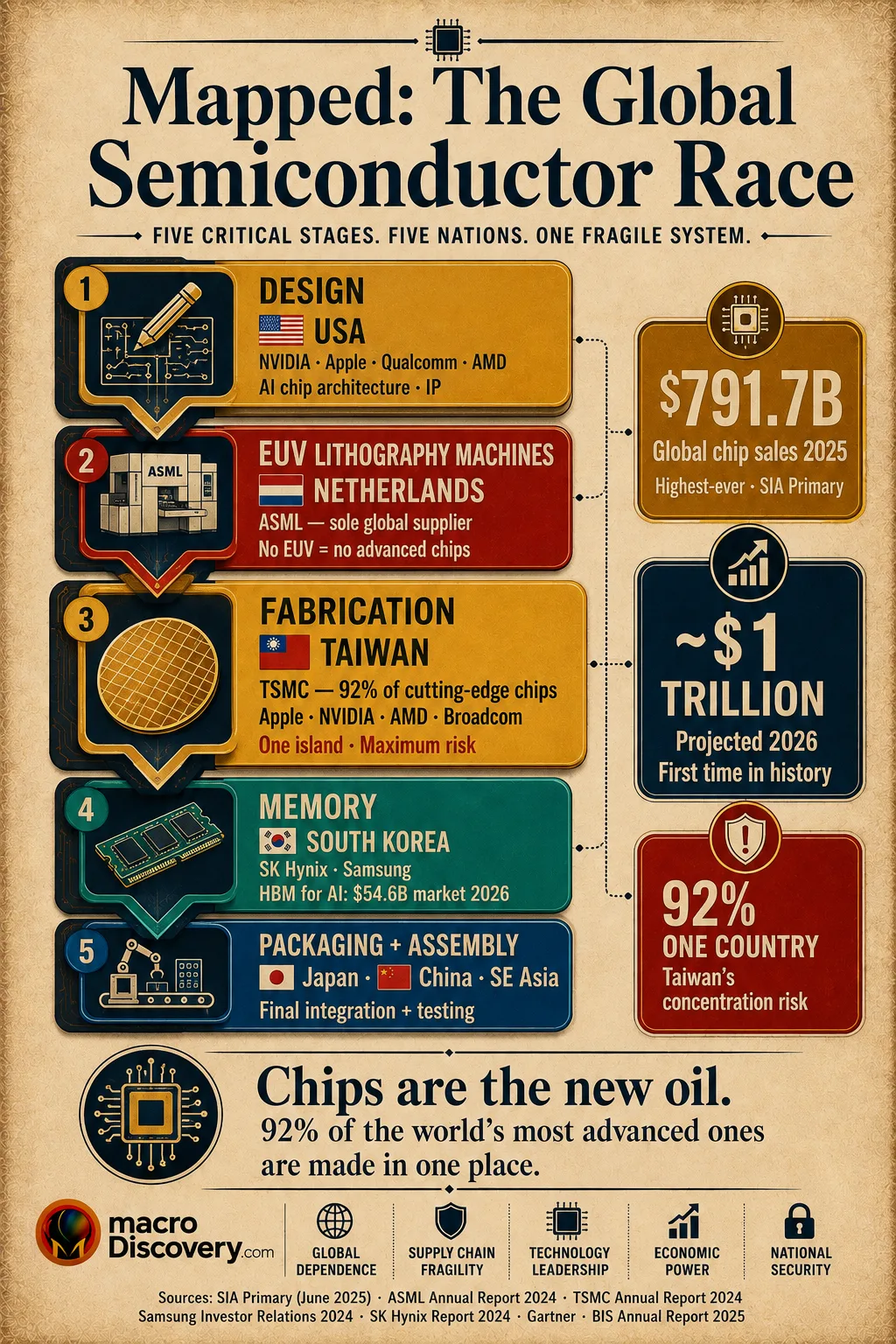
Chips are the oil of the 21st century. Global semiconductor sales hit a record $791.7 billion in 2025 — and are on track to cross $1 trillion in 2026 for the first time in history. One island manufactures 92% of the world’s most advanced chips. One company’s data center revenue surpassed the entire semiconductor market’s size just a decade ago. Here is where the race stands.
The semiconductor supply chain spans every continent — but critical chokepoints are concentrated in just a few countries. No single nation controls everything. The US dominates design and AI. Taiwan fabricates the most advanced chips. South Korea leads memory. The Netherlands makes the only machines that can make sub-7nm chips. Tap each country for detail. Sources: SIA (primary · semiconductors.org) · TSMC SEC 6-K (primary · March 4, 2025) · CHIPS Program Office · Axis Intelligence (June 2026) · Stimson Center (December 2025).
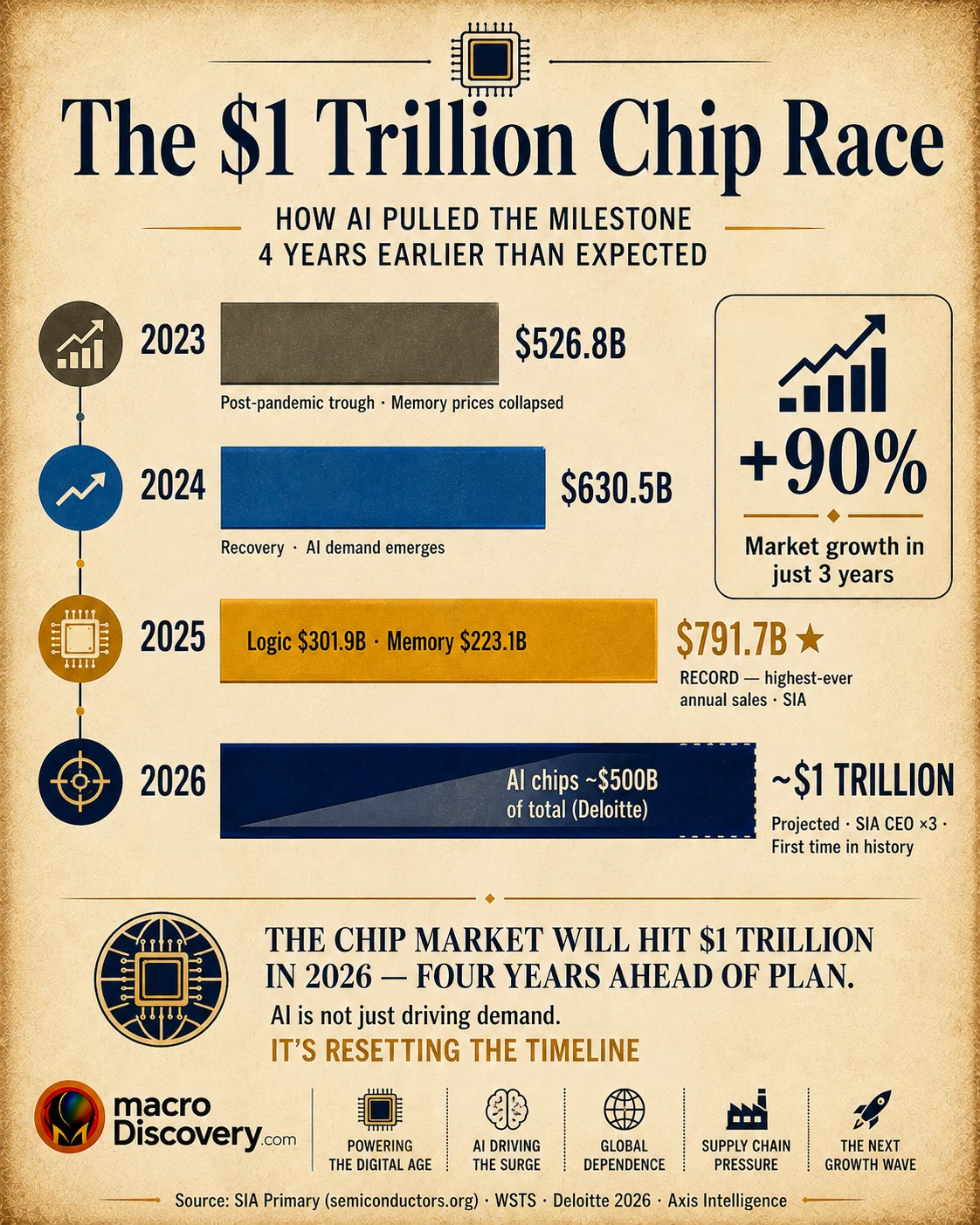
The semiconductor market’s path to its first $1 trillion year — and what is driving it. Source: SIA (Semiconductor Industry Association, PRIMARY · semiconductors.org) · WSTS (World Semiconductor Trade Statistics) · Deloitte 2026 Outlook · Axis Intelligence (June 2026, citing SIA/WSTS/SEC filings).
Semiconductors are not a technology industry. They are the foundation of every technology industry. Every smartphone, every data centre server, every car with driver-assist features, every weapon system, every medical scanner runs on chips. The country that controls chip production controls the 21st century’s most important resource. That is why governments are spending tens of billions to reshape a supply chain that took 50 years to build in Asia.
“Global chip sales remain on track to reach $1 trillion in 2026, with Q1 sales significantly exceeding sales in Q4 2025.”
— John Neuffer, SIA President & CEO · May 4, 2026 · semiconductors.org (primary)The Taiwan Problem — One Island, 92% of the World’s Most Advanced Chips
There is no polite way to say this. The entire global supply of advanced chips — the ones inside every flagship smartphone, AI server, and high-performance computer — flows through a single company on a single island in the Taiwan Strait. TSMC does not just lead in advanced chip manufacturing. It has an effective monopoly at the cutting edge. Its customers include Apple, NVIDIA, AMD, Broadcom, Google, and Qualcomm — every company that defines the AI era. If something disrupted TSMC’s fabs, there is no backup. That is what the CHIPS Act is trying to change — with partial success and significant delays.
The CHIPS Act — $52.7 Billion Committed, 40% of Projects Delayed, 70,000 Workers Still Needed
The US CHIPS and Science Act authorised $52.7 billion to rebuild American semiconductor manufacturing. It is the most significant industrial policy the US government has passed in decades. The Commerce Department has finalized more than $33 billion in direct funding across 20 awards. But the execution reality is sobering. As of mid-2024, 40% of the largest manufacturing projects funded under the Act were reported as delayed. Intel’s Ohio “Silicon Heartland” — once the flagship of American chip resurgence — has been pushed to 2030. Building fabs outside Asia’s optimised ecosystem costs more and takes longer than the announcements suggested. The chip industry also faces a projected shortage of roughly 70,000 engineers and technicians by 2030 — workers that no amount of government money can instantly create.